

Only 5.4% of India's schools teach Grades 1-12 in one place. UDISE+ 2024-25 and NITI Aayog data show why children change schools and what it costs.
Key Takeaways
- Only 5.4% of India's 14.71 lakh schools teach the full Grades 1 to 12 in one place, as per UDISE+ 2024-25 data. Nearly half (49.6%) stop at Grade 5.
- Most children change schools at least once to complete their education, since 94.6% of schools offer only part of the Grade 1 to 12 range.
- Rajasthan is the country's outlier: 26.2% of its schools span Grades 1 to 12, and it alone accounts for 35% of every such school in India.
- Progression weakens at each point where schools change: 92.2% of students move from Primary to Upper Primary, but only 75.1% move from Secondary to Higher Secondary.
- NITI Aayog's May 2026 report calls this a "pyramidal" structure and recommends shifting toward composite, "cylindrical" schools covering all twelve grades.
India has 14.71 lakh schools, but only 5.4% of them teach Grades 1 to 12 in one place.[1] Because 94.6% of schools do not offer the full span, many children will need to move at least once to complete schooling, though the exact share of students affected may differ from the share of schools. For many, that means changing schools more than once, at whichever grade a school stops.
This isn't a story about whether schools exist. It's a story about how those schools are shaped, and how few of them cover the full span a child needs.
What "Grade Coverage" Means in the Data
UDISE+ classifies schools by the grade span they actually teach, which makes it possible to see how many institutions stop at each stage and how many cover the full path to Grade 12. A school can be Primary only (Grades 1-5), Upper Primary only (6-8), Secondary only (9-10), Higher Secondary only (11-12). Beyond these four single-level categories, UDISE+ also tracks five combinations that span two or more levels, plus the full Grade 1 to 12 range. [1]
This classification is what makes it possible to answer a specific question: not "how many schools teach Grade 10", but "how many schools take children from Grade 1 all the way to Grade 12 without them having to leave."
Half the Country's Schools Stop at Grade 5
The table below shows national breakdown:
Grade Span | Number of Schools | Share of Total |
Primary only (1-5) | 730,518 | 49.6% |
Primary to Upper Primary (1-8) | 345,749 | 23.5% |
Upper Primary only (6-8) | 88,264 | 6.0% |
Primary to Secondary (1-10) | 73,379 | 5.0% |
Upper Primary to Secondary (6-10) | 42,541 | 2.9% |
Secondary only (9-10) | 26,829 | 1.8% |
Full span (1-12) | 79,980 | 5.4% |
Upper Primary to Higher Secondary (6-12) | 41,784 | 2.8% |
Secondary to Higher Secondary (9-12) | 26,437 | 1.8% |
Higher Secondary only (11-12) | 15,992 | 1.1% |
Number of schools by grade span, All India, 2024-25. Source: UDISE+ 2024-25, Table 3.2[1]
NITI Aayog's (National Institution for Transforming India) May 2026 report describes this pattern as a ‘pyramidal’ structure: wide at the primary base and narrow at the top.[2] The numbers back that up directly. There are roughly 7.3 lakh primary-only schools in India, but only 1.64 lakh schools teach Grade 11 or Grade 12 in some form, across every combination in the table above. [1] [2]
Why the System Grew This Way
This pattern is not accidental. It reflects how school expansion was shaped by law and policy.
The Right to Education (RTE) Act, 2009, makes schooling a legal right, but only for ages 6 to 14, Grades 1 to 8.[2] States had a legal obligation to build enough primary and upper primary schools to meet that mandate, which is exactly where school-building was concentrated. Secondary and higher secondary education were never brought under that same legal requirement, which explains why fewer schools exist at those levels.
That legal gap has a second consequence, separate from where schools got built. NITI Aayog's report points out that because RTE stops at Grade 8, the cost of continuing (tuition, uniforms, books, transport) falls on families from Grade 9 onward, and that cost pushes some children out of the system entirely.[2]
What Happens at Each Transition Point
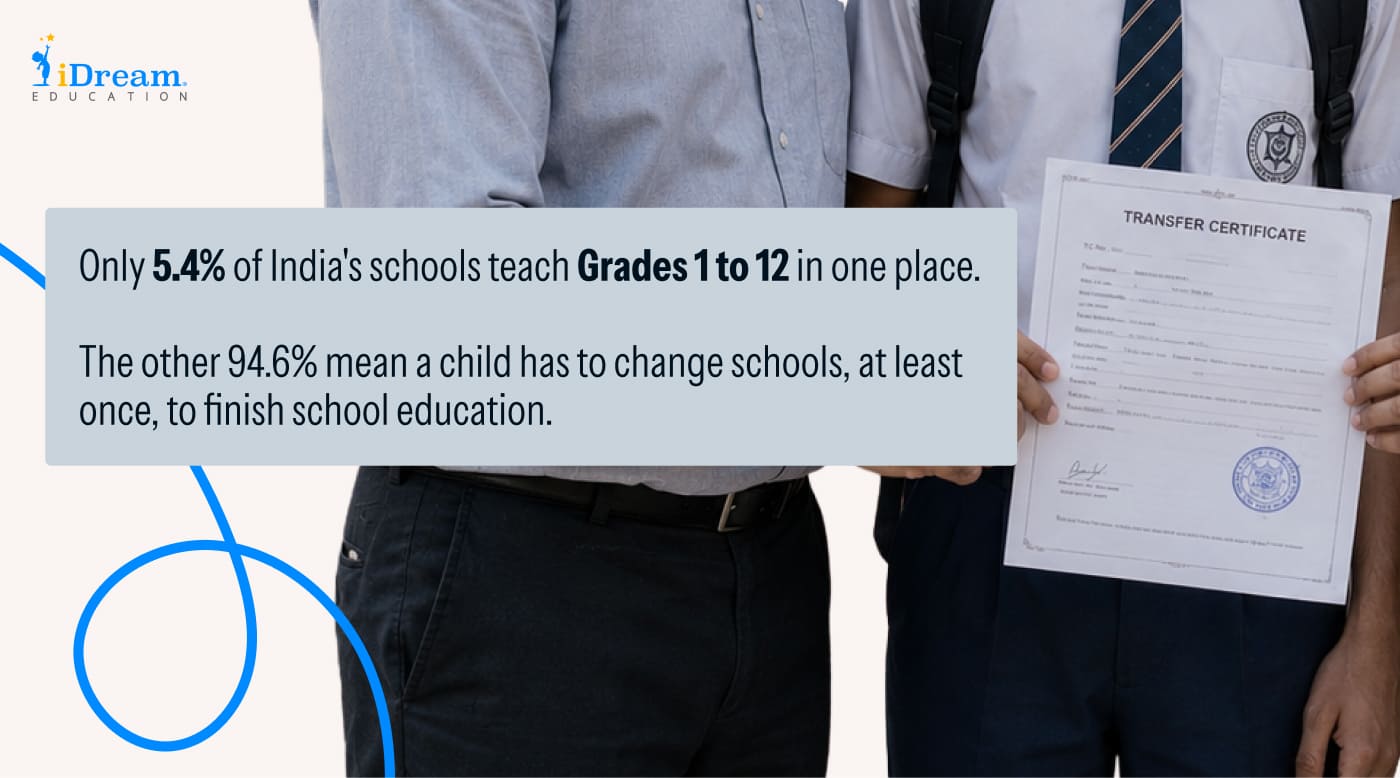
Every time a school stops short of Grade 12, a child has to physically move to a new institution to continue. UDISE+ tracks what happens to students at exactly these points, and the pattern lines up with where the school system itself breaks.
Transition | Rate |
Primary → Upper Primary (Grade 5→6) | 92.2% |
Upper Primary → Secondary (Grade 8→9) | 86.6% |
Secondary → Higher Secondary (Grade 10→11) | 75.1% |
Share of students who progress to the next stage, All India, 2024-25. Source: UDISE+ 2024-25[1][2]
Dropout follows the same shape: 0.3% at Primary, 3.5% at Upper Primary, and 11.5% at Secondary.[1][2] None of this proves that changing schools causes a child to drop out; economic pressure, distance, and a dozen other factors play a role too. But NITI Aayog draws the connection directly: a fragmented school structure forces repeated transitions, and that adds to dropout risk at higher grades.[2] The points at which the school system becomes fragmented are also the points where student progression becomes less smooth.
The state-level picture plays out unevenly, too. Some states have built far more full-span schools than others, which changes how often a child in that state needs to transition at all:
State | Full-Span (1-12) Schools | Share of State's Own Schools |
Rajasthan | 27,889 | 26.2% |
Haryana | 3,782 | 16.1% |
Punjab | 3,040 | 11.1% |
Kerala | 1,520 | 9.7% |
Tamil Nadu | 4,447 | 7.7% |
Maharashtra | 7,751 | 7.2% |
Uttar Pradesh | 7,610 | 2.9% |
West Bengal | 857 | 0.9% |
Andhra Pradesh | 557 | 0.9% |
Odisha | 432 | 0.7% |
Mizoram | 6 | 0.15% |
Schools spanning Grades 1 to 12, selected states, 2024-25. Source: UDISE+ 2024-25, Table 3.2, via NITI Aayog (2026)[1][2]
Rajasthan is the clear outlier, with 27,889 full-span schools, about 35% of all such schools in India, and 26.2% of its own school network covering Grades 1 to 12. At the other end, Odisha offers the full span in just 0.7% of its schools, the lowest share among the larger states. And Mizoram lower still at 0.15%, though its small total school count (3,974) makes that figure less comparable to a large state like Odisha. Most large states, including Uttar Pradesh, West Bengal, and Andhra Pradesh, offer the full span in under 3% of their schools.[2]
What NITI Aayog Is Recommending
The May 2026 report doesn't stop at describing the problem. It proposes:
- "Cylindrical" model
Composite schools that carry a child from Grade 1 to Grade 12 under one roof, cutting out the extra transitions.[2] - "School complexes"
Clustering a secondary or higher secondary school with nearby primary schools and Anganwadis within 5 to 10 km. This way, they can pool teachers and share labs, libraries, and other resources across the cluster instead of each school needing its own.[2]
This is a policy direction, not yet a settled reform. The report is explicitly framed as independent research for NITI Aayog rather than adopted government policy.[2] But it signals where the conversation on school structure in India is heading.
What This Means for Programme Design
For organisations funding or implementing education programmes in government schools, this data raises one question worth asking directly: does the programme assume a child stays at one school for all twelve grades? Most children won't.
That has practical consequences for how a programme is scoped:
- Site planning.
A single-campus programme in a district dominated by primary-only schools reaches children for at most five years before they move on. The programme either needs to follow them to the next school or accept that continuity ends at Grade 5. Whichever it is, that choice should be made deliberately, not by default. - Continuity of learning records.
Based on the transition data above, a child moving schools is a structural certainty for most students, not an edge case. Programmes that track a child's progress over multiple years, whether through assessments, reading levels, learning-platform data, or something else entirely, need to plan for that child leaving the school where the tracking started. Where a programme doesn't have a way to follow the student, or reconstruct their record at the new school, continuity breaks along with the transition. - Clustering as the natural planning unit.
NITI Aayog's own recommendation, grouping a secondary school with its feeder primary schools within 5 to 10 km, points to a useful design principle beyond policy. A cluster of schools that a child moves through is often a more realistic unit for a programme than a single building. - State-specific rollout logistics.
A programme built around Rajasthan's structure, fewer, larger, full-span schools, needs a different site count and staffing plan than one built for a state like Odisha, where almost every school is single-level, and a child is likely to pass through several separate institutions before Grade 12.
None of this argues for a single correct programme model. It argues that the model should match the structure of the schools it's working with, rather than assuming every school looks like the one it started in.
Conclusion
India's school system was built with primary school first, because that's what the law required, and everything above that has had to catch up. Only 5.4% of schools now offer a child the full Grade 1 to 12 span in one place, and where the system breaks lines up closely with where children leave it. Rajasthan shows a full-span model works at scale; NITI Aayog's May 2026 report now recommends moving the rest of the country in that direction. Though how, and how fast, remains an open policy question.
For now, most children will cross at least one of these transition points before finishing Grade 12. iDream Education partners with state education departments and CSR programmes on technology infrastructure for government schools, with an eye toward the continuity gaps this data points to.
Sources
- UDISE+ 2024-25 Report, Department of School Education & Literacy, Ministry of Education, Government of India (Table 1: National Highlights; Table 3.2: Number of Schools by Management and School Category):
https://dashboard.udiseplus.gov.in/report-new-v.6-demo2025/static/media/UDISE+2024_25_Booklet_existing.118ba29d4773e6372f72.pdf - NITI Aayog, "School Education System in India: Temporal Analysis and Policy Roadmap for Quality Enhancement" (May 2026):
https://niti.gov.in/sites/default/files/2026-05/School-Education-System-in-India.pdf
Frequently Asked Questions
What percentage of Indian schools teach Grades 1 to 12?

Only 5.4% of India's 14.71 lakh schools offer continuous education from Grade 1 to Grade 12 in a single institution, according to UDISE+ 2024-25 data. Nearly half of all schools (49.6%) teach only Grades 1 to 5.
Why don't more schools cover the full Grade 1 to 12 range?
The Right to Education Act makes schooling a legal right only for ages 6 to 14, Grades 1 to 8, so states were required to expand primary and upper primary schools but not secondary or higher secondary ones. This is why NITI Aayog's May 2026 report describes the system as "pyramidal", wide at the base and narrow at the top.
Which Indian state has the most schools covering Grades 1 to 12?
Rajasthan, by a wide margin. It has 27,889 schools spanning Grades 1 to 12, more than a third of every such schools in India, and 26.2% of its own total school network, far above any other large state.
Which state has the fewest schools covering Grades 1 to 12?
Mizoram has the lowest share nationally, just 0.15% of its schools (6 out of 3,974) span Grades 1 to 12, though it's a small state and the low count reflects that scale. Among larger states, Odisha has the lowest share at 0.70%, followed closely by West Bengal and Andhra Pradesh, both under 1%.
Does changing schools increase the risk of a child dropping out?
UDISE+ data shows transition rates fall at each point where school levels typically change: 92.2% of students move from Primary to Upper Primary, but only 75.1% move from Secondary to Higher Secondary. NITI Aayog's analysis links fragmented school structures to this pattern, though it does not claim the relationship is the sole cause of dropout.
What is NITI Aayog's "cylindrical" schooling model?
It's a proposal to replace India's current pyramidal school structure with composite schools covering Grades 1 to 12 in one location, alongside "school complexes" that cluster nearby schools to share teachers and resources. It was proposed in NITI Aayog's May 2026 report and is not yet adopted government policy.


