

India crossed 1 crore teachers in 2024-25. UDISE+ data shows Pre-Primary teacher training is near 50%, while some states lag at Higher Secondary.
Key Takeaways
- India crossed 1 crore teachers for the first time in 2024-25, but how well-trained they are varies by school stage level and the state.
- "Trained" and "professionally qualified" are two different measures in UDISE+ (Unified District Information System for Education Plus) data. A teacher can hold one ‘status’ without the other, and that gap widens in a few specific states.
- Pre-Primary teachers rank lowest on both measures in the system: only ~53% are trained, and ~48% are professionally qualified.
- From Primary through Higher Secondary, the share of trained teachers stays above 91% nationally, and professionally qualified teachers stay close behind.
- Higher Secondary shows a wide state-level gap, and not all of it is the same problem. Meghalaya, Assam, and Telangana have low training levels to begin with, while Andhra Pradesh and Odisha have trained teachers who mostly lack the formal qualification.
What "Trained" and "Professionally Qualified" Teachers Mean
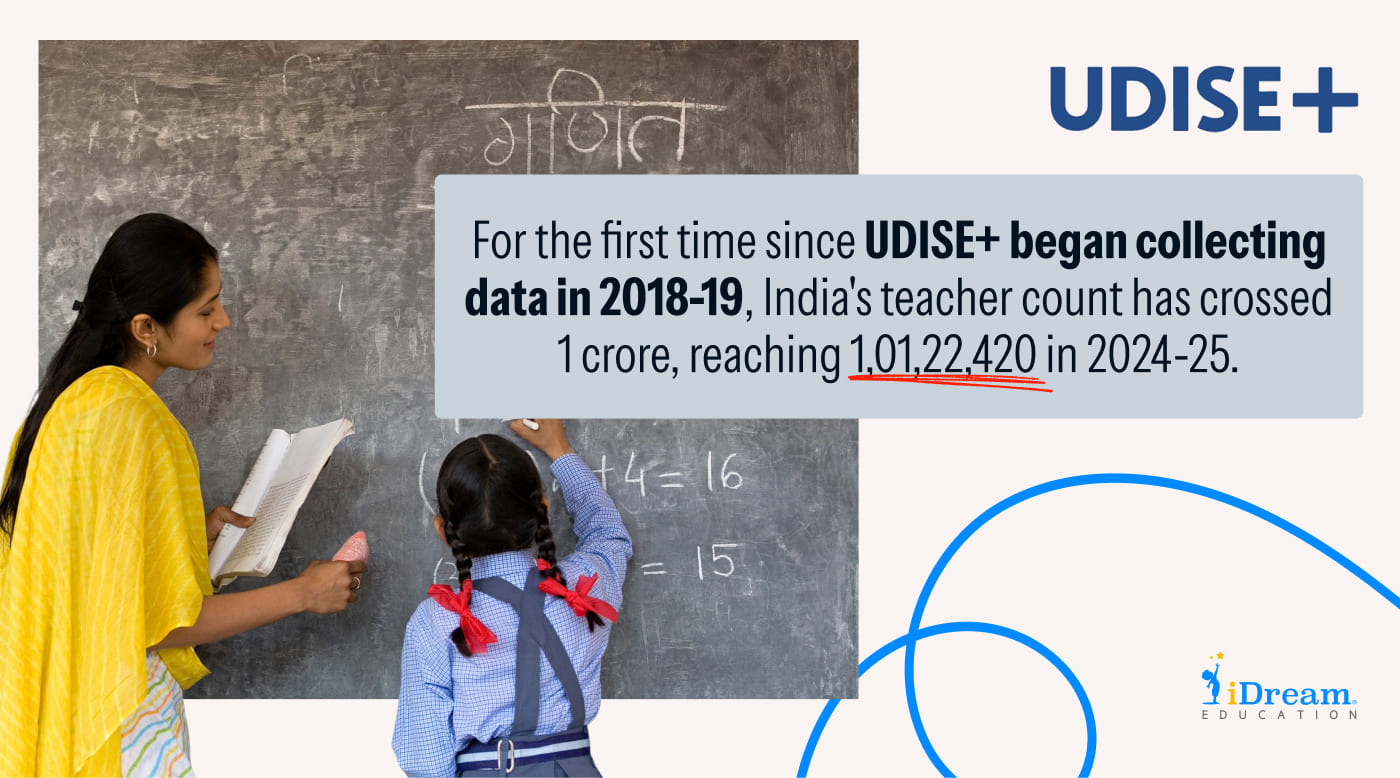
As of 2024-25, India had 1,01,22,420 teachers, crossing 1 crore for the first time since UDISE+ (Unified District Information System for Education Plus) began collecting data in 2018-19. The total count reached 1,01,22,420 in 2024-25, a 6.7% increase from two years earlier. [1]
But ‘more teachers’ is only part of the story. How ‘prepared’ they are is the other part, and that picture is far less even.
What does "prepared" mean here?
UDISE+ tracks two separate things about a teacher: trained and qualified, and it's worth being clear about the difference before looking at the numbers:
- A trained teacher is one who has completed basic teacher training, the pedagogical preparation for classroom teaching.
- A professionally qualified teacher, on the other hand, is one who holds the specific qualification prescribed for their role, such as a Diploma in Elementary Education (D.El.Ed) for primary teaching or a Bachelor of Education (B.Ed) for secondary and higher secondary teaching. [2]
A teacher can be trained without holding the full required qualification, or the reverse. The two numbers usually move together, but where they don't, that gap itself is worth noticing.
The National Picture of Teacher Training and Qualification Levels
With that distinction in mind, here's how both measures look across every level of schooling:
Level | Trained Teachers | Professionally Qualified Teachers |
Pre-Primary | 53.3% | 48.2% |
Primary (Grades 1-5) | 91.4% | 87.7% |
Upper Primary (Grades 6-8) | 91.7% | 88.5% |
Secondary (Grades 9-10) | 92.7% | 90.4% |
Higher Secondary (Grades 11-12) | 92.6% | 89.4% |
Percentage of teachers trained and professionally qualified, by level, All India, 2024-25. Source: UDISE+ 2024-25, Tables 4.18 and 4.19, via Education For All in India[2]
From Primary through Higher Secondary, both measures are consistently above 87%, which is a good sign. It points to a mature training pipeline once formal schooling begins from Grade 1 onward. Pre-Primary, though, breaks that pattern entirely, with teacher training and qualification levels nearly 40% below every other stage of schooling.
The national average for most stages looks healthy.
But underneath it sit different gaps: a broad Pre-Primary training gap, a training-access gap in a small group of Higher Secondary states, and a narrower certification-only gap in a separate, smaller set of Higher Secondary states.
Why Pre-Primary Teachers Are the Least-Trained Group
Part of the Pre-Primary gap comes down to how the system is structured, not just how well it's staffed.
Formal teacher qualifications such as B.Ed and D.El.Ed are designed around Grade 1 onward, the stage covered by the Right to Education Act. Pre-Primary is outside that mandate altogether. Many Pre-Primary educators come through the Anganwadi and early childhood care system instead, rather than the formal teacher-training pipeline that produces trained and qualified teachers everywhere else.
In effect, the group teaching India's youngest children ends up measured against a certification system that was never built with them in mind.
To be fair, UDISE+ data doesn't say this outright; it's simply a direct explanation of the structure the system supports.[2] But what the data does show clearly is the gap itself.
Pre-Primary teacher training is 38 percentage points lower than Primary, and the qualification gap is even wider, at 39.5%. That gap likely matters most at exactly the stage where foundational learning habits start to form, something the data itself doesn't measure directly.
Where Teacher Training and Qualification Break Down by State
Nationally, Higher Secondary teacher training looks strong at 92.6% trained and 89.4% professionally qualified. That average, however, hides a wide range across individual states:
State | Trained (Higher Secondary) | Professionally Qualified (Higher Secondary) |
Meghalaya | 66.5% | 56.9% |
Assam | 66.8% | 54.9% |
Telangana | 73.0% | 66.6% |
Odisha | 80.6% | 73.0% |
Andhra Pradesh | 83.9% | 72.6% |
Nagaland | 81.6% | 76.1% |
Manipur | 83.9% | 76.5% |
Karnataka | 91.9% | 82.4% |
Uttar Pradesh | 88.5% | 84.1% |
Bihar | 94.1% | 91.2% |
Jharkhand | 94.6% | 92.0% |
Rajasthan | 97.3% | 96.0% |
Maharashtra | 97.7% | 95.9% |
Tamil Nadu | 99.0% | 98.1% |
Delhi | 99.5% | 99.4% |
Percentage of Higher Secondary teachers trained and professionally qualified, selected states, 2024-25. Source: UDISE+ 2024-25, Tables 4.18 and 4.19, via Education For All in India[2]
The gap between "trained" and "professionally qualified" also varies by state, and it points to a different kind of shortfall depending on where you look.
- In some states, like Delhi and Tamil Nadu, the two numbers move almost together.
- In Andhra Pradesh, the gap widens to around 11%, meaning a significant share of Higher Secondary teachers have completed basic training but still don't hold the formal qualification the role requires.
The size of that gap matters for what happens next. When training levels are already high but qualification gaps stay wide, that points to a certification problem: teachers are trained but not formally qualified. Low numbers on both sides, as seen in Meghalaya, Assam, and Telangana, point to a training-access problem instead. Each state needs a different fix depending on which of the two gaps they're facing.
What This Means for Programme Design
For organisations planning teacher-support work in government schools, this data points to a few distinct kinds of intervention.
- Pre-Primary needs training access extended to a group that the formal pipeline doesn't fully reach in the first place, likely through partnerships with the Anganwadi and early childhood system rather than the standard D.El.Ed/B.Ed route.
- States that lag on both measures, meaning low training and low qualification, need the same kind of groundwork: teacher-training infrastructure and enrolment drives aimed at Higher Secondary staff who haven't completed basic training yet.
- A separate group of states shows a wide certification gap despite decent training levels already in place. These need a narrower fix: bridge courses or fast-track qualification pathways for teachers who are already in the classroom and already trained, just missing the formal credential.
Treating all of these the same way, as "more teacher training," risks solving the wrong problem in each place.
State targeting matters here too. Meghalaya, Assam, and Telangana need the training-access fix. Andhra Pradesh and Odisha are closer to the certification-gap end: teachers there are already trained in far greater numbers, and the remaining shortfall is in formal qualification, not basic training. Between them, these five states carry most of the Higher Secondary shortfall, so a programme built around the national average would end up missing exactly where the real gap is found.
Conclusion
Put together, India now has more teachers than at any point since UDISE+ began recording the number, and for most of the school system, the share of trained teachers is high. But two clear gaps sit underneath that headline: Pre-Primary teachers remain well outside the formal training system that covers every other level. And a small group of states, led by Meghalaya, Assam, and Telangana, and joined by Andhra Pradesh and Odisha, lag far behind the rest of the country at Higher Secondary. Neither gap shows up in the national average, and neither will close by treating the system as evenly staffed when the data says it isn't.
iDream Education partners with state education departments and CSR programmes to build teacher capacity exactly where UDISE+ data shows the gaps sit. That includes the Pre-Primary stage and the specific states where Higher Secondary qualification rates remain low.
Sources
- Ministry of Education, PIB, press release on the UDISE+ 2024-25 report: https://www.pib.gov.in/PressReleasePage.aspx?PRID=2161543
- Prof. Arun C. Mehta, "Analysis of Trained and Professionally Qualified Teachers in India: UDISEPlus 2024-25 Data", Education For All in India, citing UDISE+ 2024-25 Tables 4.18 and 4.19: https://educationforallinindia.com/wp-content/uploads/2025/09/trained-and-professionally-qualified-teachers-UDISEPlus-2024-25.pdf
Frequently Asked Questions
How many teachers does India have?

As of 2024-25, India had 1,01,22,420 teachers, crossing 1 crore for the first time since UDISE+ began collecting data, a 6.7% rise over two years.
What percentage of teachers in India are trained?
Nationally, 53.3% of teachers are trained at Pre-Primary, and more than 91% are trained at every level from Primary through Higher Secondary. The share of trained teachers varies significantly depending on which level of schooling is being measured.
What is the difference between a "trained" and a "professionally qualified" teacher?
A trained teacher has completed basic pedagogical training. A professionally qualified teacher holds the qualification required for their role, such as a Diploma in Elementary Education (D.El.Ed) for primary teaching or a Bachelor of Education (B.Ed) for secondary and higher secondary. A teacher can hold one status without the other.
Which level of schooling has the least-trained teachers in India?
Pre-Primary, by a wide margin. According to UDISE+ 2024-25 data, only 53.3% of Pre-Primary teachers are trained, and 48.2% are professionally qualified, compared with 87% or higher at every level from Primary upward.
Which level of schooling has the most trained teachers in India?
Secondary (Grades 9-10) has the most trained teachers, at 92.7% trained and 90.4% professionally qualified, narrowly ahead of Upper Primary and Higher Secondary.
Which states have the lowest share of qualified Higher Secondary teachers?
According to UDISE+ 2024-25 data, Assam (54.9%), Meghalaya (56.9%), and Telangana (66.6%) have the lowest shares of professionally qualified Higher Secondary teachers, well below the national average of 89.4%.
Which states have the highest share of qualified Higher Secondary teachers?
According to UDISE+ 2024-25 data, Delhi has the highest share of qualified Higher Secondary teachers at 99.4%, followed by Tamil Nadu (98.1%) and Rajasthan (96.0%).


