

Hi,
As the heatwave intensifies across India, we are all feeling the pressure to find sustainable solutions, not just for the weather, but for the systems we build. In our schools, much like this summer heat, a “quick fix” isn’t enough. We need deep-rooted interventions that can weather the reality of a rural classroom.
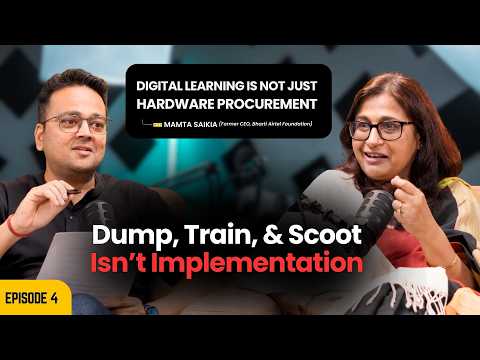
In my recent podcast conversation with Ms. Mamta Saikia (former CEO, Bharti Airtel Foundation), we discussed why many EdTech projects fail once the initial “cool breeze” of a new gadget wears off. She shared sharp insights on how we can move from mere hardware deployment to genuine impact.
Here are a few critical takeaways for every CSR leader, NGO professional, and EdTech provider:
- “Avoid the “Dump, Train, and Scoot” Trap:” Mamta ji highlighted a recurring tragedy where hardware is installed, teachers get two days of training, and then the vendor disappears. She calls one-time training a “luxury” that simply doesn’t work. To be sustainable, technology must be embedded into the school calendar and governance, supported by continuous handholding and feedback loops.
- “AI is an “Intern,” Not the Teacher:” While “AI-powered” hardware is the latest trend, Mamta ji cautions against “Vanilla AI”, efficient but soul-less content that lacks the human grit and passion of a real educator. She views AI as an “Intern” to help with efficiency, not a replacement for high-quality, scientifically built pedagogy. In schools with infrastructure issues, teachers can’t wait for internet-dependent models that might hallucinate. They need curriculum-aligned, offline-ready content available then and there.
- “The Three Buckets of Impact:” For any project to succeed, we must evaluate partners across three pillars: Content Quality, Technology Platform, and Feet on the Ground. Without a partner or a dedicated team to manage the human element and school-level accountability, even the best technology will likely fail.
- “Metrics Over Intentions:” As Mamta ji rightly said, “what gets measured gets documented”. We must move beyond the “cost lens” and start using auditable data and benchmarks, like those from EdTech Tulna, to ensure our investments actually move the needle on learning outcomes.
I invite you to listen to the full episode to hear Mamta ji’s thoughts on how we can collectively raise the bar for EdTech in India.
Let’s build for depth and sustainability, even when the heat is on.