

Hi,
Over the last 5 months, we have received more than 100 phone calls from government school teachers across Haryana, Uttar Pradesh, Odisha, Karnataka and several other states.
Initially, I did not think much of it. I assumed these were regular enquiries, perhaps schools looking to explore digital learning or teachers wanting additional support.
But as more calls started coming in, I became curious. One day, I spoke to one of our team members who handles many of these conversations. I asked him, “What exactly are teachers asking for?” Her answer surprised me. “They are asking for videos, question banks, books, and digital learning material that they can download and use in their smart classrooms.“
That stayed with me. Because these were not schools without infrastructure.
- Many of them already had smart TVs installed.
- Some had interactive panels.
- Some had tablets or computer labs.
Several had received digital infrastructure through different government or CSR initiatives.
So naturally, a question came to my mind: If the devices are already there, why are teachers still calling us asking for basic digital learning resources? As I started listening more carefully to these conversations, a pattern emerged. Teachers repeatedly asked us:
- Do you provide curriculum-aligned digital content?
- Is there an LMS through which we can manage learning?
- Can students practice and learn through the platform?
- How can we make classroom teaching more engaging using the devices already installed?
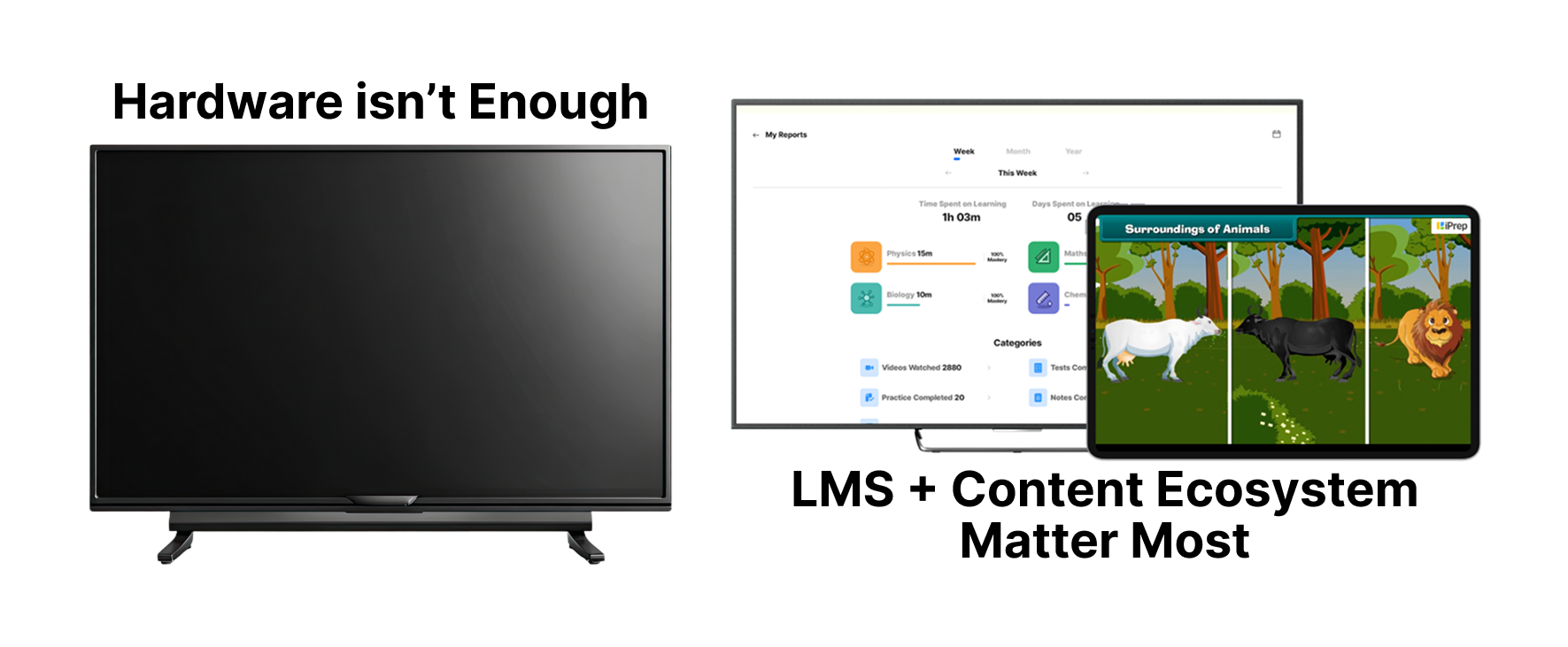
And slowly, the real issue became visible. The challenge was not the absence of hardware. The challenge was what came after the hardware.
In many schools, teachers had received the devices, but not the ecosystem needed to meaningfully use them in classrooms. The issue is that despite having the hardware, many teachers are unable to effectively use these devices for classroom teaching because there is no offline LMS nor any digital content provided in local languages.
One teacher explained their reality to us very honestly. He said the installation team had suggested, “You can use YouTube or AI tools to create content.” But their school hardly gets good internet access. And then they do not find enough time to go back home, search for the right content, download it on their pen drives and then bring those to the classroom. His sentence captured the gap perfectly. Somewhere between installation and actual classroom usage, we are assuming conditions that often do not exist in real schools.
This reality raises an important point for everyone working in education digitization today. Across India, a significant amount of money is being invested into digital infrastructure for schools. Large-scale programs are enabling access to smart classrooms and devices faster than ever before.
But one important question remains: Are we investing equally in helping teachers actually use these systems effectively for teaching and learning? Because infrastructure alone does not automatically lead to classroom integration.
Hence, before your next smart classroom or NGO/CSR-led education program is launched, it may be worth asking:
- Are teachers getting the right support to actually use these devices in classrooms?
- Is relevant digital content available for everyday teaching and learning?
- Is there a plan for continuous usage and support beyond installation?
- Are these interventions helping improve classroom learning experiences for students?
Because the success of digital learning is not decided on installation day. It is decided by what continues to happen inside the classroom after that.
I would love to hear your thoughts, experiences, and reflections on this. Looking forward to your responses and hopefully, to working together toward digital learning that truly improves outcomes for children.