
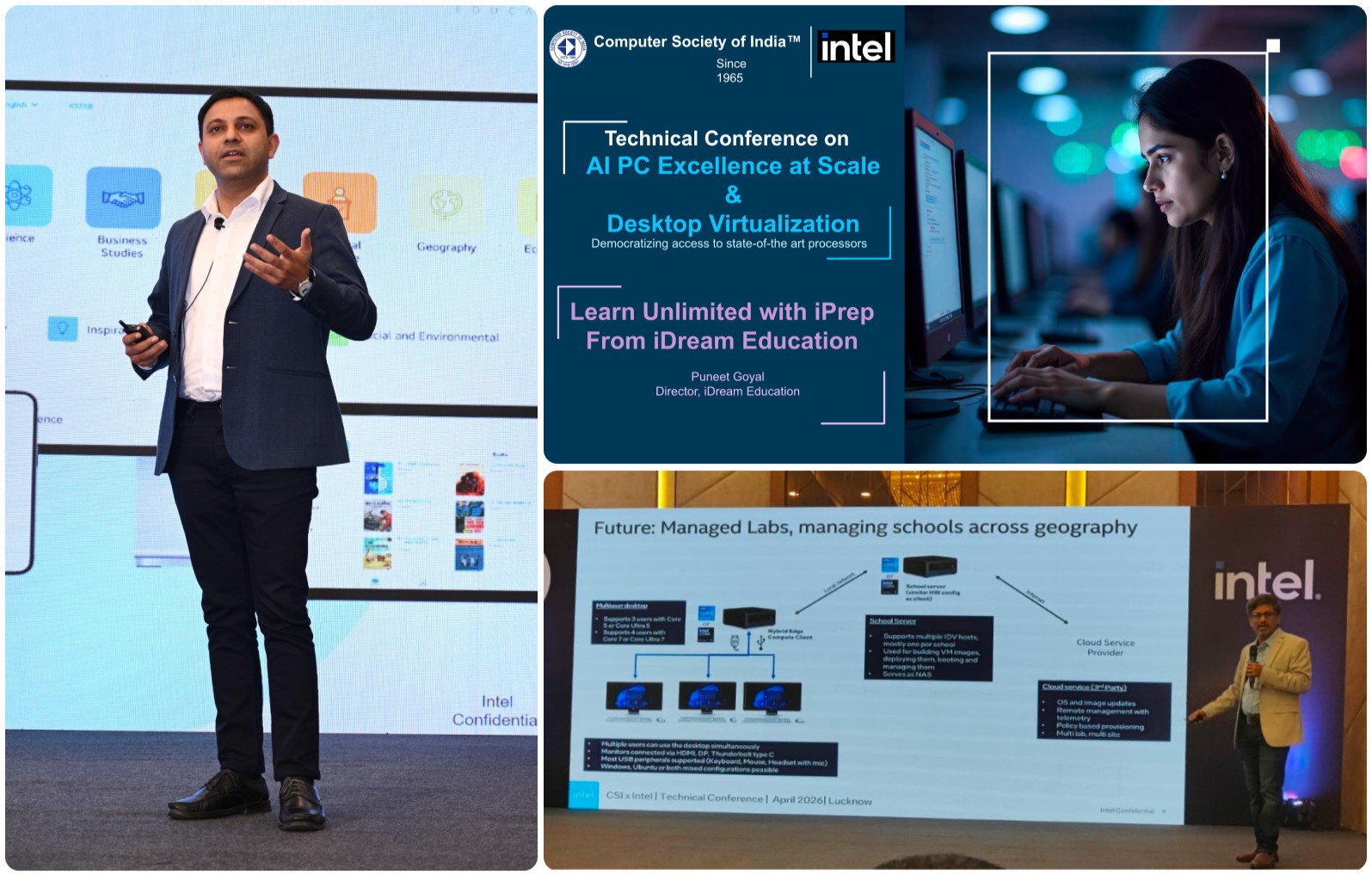

Hi,
I am happy to share about our recent participation with Intel Corporation and Computer Society of India at the conference in Lucknow on April 29, where discussions focused on enabling AI-powered learning solutions that can work effectively even in low-bandwidth and infrastructure-constrained school environments. The coming together of iPrep’s adaptive learning ecosystem and Intel-powered Next Gen Virtual Machines represents an important step towards enabling more advanced AI-driven personalised learning at scale across India.
The Challenge: AI and PAL Are Promising, But Hard to Deliver at Scale
AI is rapidly entering mainstream conversations in education. Yet a critical question remains: how do we make AI actually usable for teachers and students in low-resource environments? As the BaSE Survey by Central Square Foundation highlights, 90% of households own a smartphone, and 99% of children report having internet access. Additionally, 98% of teachers have access to a smartphone at home, with 94% using it for teaching and school-related activities. Yet, meaningful AI adoption in schools remains limited, held back by inconsistent bandwidth, time-constrained classrooms, and the practical reality that teachers cannot wait for heavy AI systems to load.
At the same time, Personalised Adaptive Learning (PAL) is increasingly recognised as among the most effective approaches to addressing learning gaps in India. But PAL at scale requires devices for every student, and deploying large-scale device infrastructure in government schools remains financially out of reach for most programs.
Why This Collaboration Matters
This is precisely where the Intel x iPrep collaboration becomes meaningful. Intel-powered Next Gen Virtual Machines with hardware virtualisation allow multiple students to share a single compute unit, significantly reducing device deployment costs while still enabling a full AI-powered learning environment. Critically, this infrastructure supports adaptive learning, multilingual content, and real-time classroom tools without dependence on internet connectivity, making advanced PAL genuinely viable for the last mile.
Take a look at this short video to get a glimpse of the session:
If this aligns with your organisation’s vision for education programs, we would be happy to organise a joint demonstration with the Intel team to show how this model can work for your initiatives. Do write back and we can set something up.