

Hi,
Let’s imagine a scene you’ve probably seen many times. A beautiful new smart classroom has just been inaugurated in a government school. There are photos, a ribbon-cutting, maybe even a press note. The CSR report will proudly carry the numbers: X classrooms set up, Y devices deployed, Z students “benefited”.
And then, a few months later, the smart classroom door is mostly… closed.
The silent smart classroom is what I’d like to talk about
As someone who has spent years in this ecosystem, I see a pattern that you’ve probably sensed too. We are investing crores in smart classrooms in government schools. But the regular, meaningful utilisation of these classrooms by teachers – the kind that actually moves learning outcomes — is still the exception, not the norm.
What’s interesting is this:
There is a lot of ongoing research and conversation around Personalised Adaptive Learning (PAL) and how it can drive student learning. But there is hardly any serious research or discourse on how smart classrooms themselves can deliver impact in government schools — and do so at a cost that is often far lower than setting up full-fledged PAL labs.
In our work, we’ve realised one big reason: Teacher training is treated as an operational checkbox, not as a core pedagogy intervention.
Where we usually go wrong with training
Typical smart classroom training in large-scale projects looks like this:
- An on-ground coordinator or operations person is told to “train the teachers”.
- They walk teachers through the LMS in a very transactional way: which button does what, where to click, how to log in.
- At best, someone shows a polished PowerPoint with screenshots of the LMS.
What usually doesn’t happen:
- Nobody sits with teachers to discuss their actual lesson plans.
- Nobody helps them see how digital content connects to the pedagogy they already use.
- Nobody shows them how different content types – videos, animations, quizzes, simulations, activities can be combined to:
- Make lessons more engaging,
- Check for understanding in real time, and
- Improve student participation and interaction.
We even made the same mistake initially.
Our own hard-earned lesson
When we started setting up smart classrooms in government schools, we also fell for the “fancy PowerPoint” approach.
We built nice decks. We walked teachers through features. We explained how the LMS works and sincerely hoped that once they had seen the PowerPoint, they would go back and start using the smart classroom as part of their daily teaching.
It didn’t happen. Not at scale. Not consistently. No matter how many times we repeated the same kind of training. It took us a few years – and some honest conversations with teachers to accept that our approach was flawed.
What changed things for us was a simple … to “letting teachers experience it themselves, live, with us by their side”.
What experiential teacher training actually looks like
In our current model, an experienced teacher (not just an ops person) goes to the school and runs a truly experiential session. A typical session looks like this:
- Teachers, not trainers, use the device, where they login and navigate. We don’t show, they do. We create a lesson plan together and actually teach a mini lesson
- We debrief like coaches, not inspectors.
- What worked? Where did students (or peer teachers) engage more? At what point could you pause and ask questions? How did the quiz help you understand learning levels?
- We show how simple it actually is.
When teachers experience that using the smart classroom is not “extra work” but a natural extension of their teaching, the fear and hesitation drop dramatically.
The goal of such training is very simple: When the trainer leaves the school, at least a few teachers should feel, “I can do this on my own tomorrow. This is not difficult.” Once that confidence is built, adoption starts to rise on its own.
What happened when we switched to experiential training
Let me share one recent project from a government school program we’re running.
- We conducted experiential teacher training in August.
- We then tracked smart classroom usage over the next three months.
Here’s what we saw across the project schools:
- Overall smart classroom usage went up by 18% in just three months.
- On average: The smart classroom is now used for around 16 days in a month. Each usage session runs for about 10-12 minutes, which is ideal for a class of 30-40 min duration
When we went deeper into subject-wise data, the pattern was even more encouraging:
- In Science, smart classroom usage increased by about 27%.
- In Mathematics, usage went up by nearly 50% over the same period.
This is not a one-off spike after training day. This is sustained usage over three months, and we’re continuing to track it.
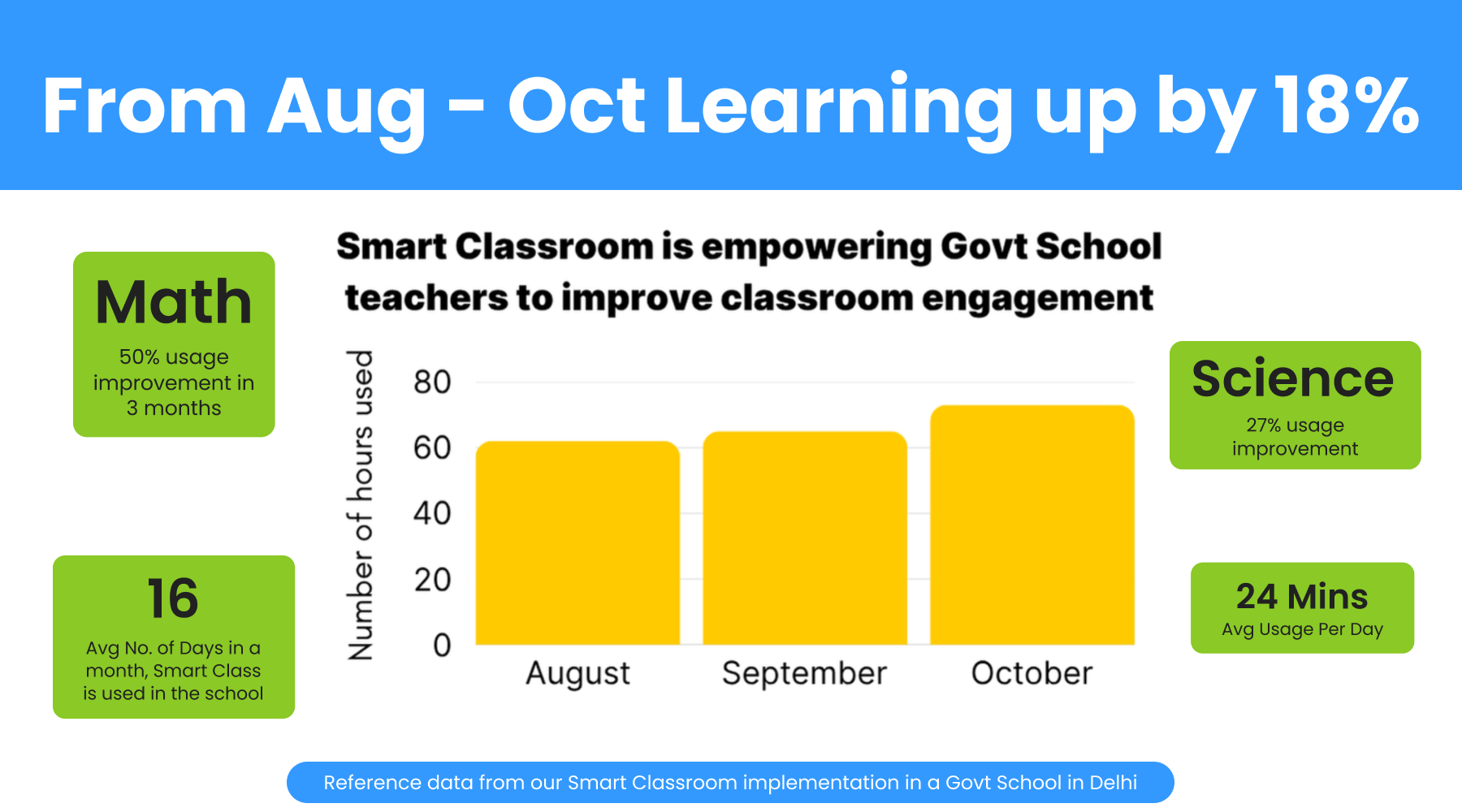
For us, this data strongly validates our working hypothesis:
If you let teachers experience the LMS live, help them integrate it with their lesson plans, and coach them like peers, then consistent smart classroom usage becomes a natural outcome – not a forced mandate.
Why this matters so much for CSR and NGO leaders
Here’s the uncomfortable question I’ve started asking myself – and I invite you to ask it too: In our last ICT / smart classroom project budget, what percentage did we allocate to high-quality, experiential teacher capacity building?
While most CSR budgets focus on hardware and software, training often gets neglected.
Yet, from an impact lens, that small line item might be the single largest lever that decides whether:
- Your investment creates living, breathing smart classrooms that students love, or
- You end up with expensive showpieces that are switched on only for visits and photos.
The incremental budget for deep, experiential teacher training is relatively small. But its influence on actual classroom usage over the next 1–2 years is massive.
What this means for your next program or RFP
If you’re planning a new ICT / smart classroom initiative, or expanding an existing one, here are a few practical shifts to consider:
- Design training as a pedagogy intervention, not a handover ritual
- Insist on experiential, hands-on formats
- Bring in real teachers as trainers
- Plan for follow-up, not one-time workshops
- Track usage and learning data from day one
I’m sharing this not just as a solution provider, but as someone who has made the mistakes, learned from them, and now sees the difference that experiential training can make in real government school classrooms.
If there’s one message I’d love you to take back to your team, it is this:
Don’t under-budget teacher training. Under-budgeted training silently undercuts everything else you’re funding.
If you’d like to see more detailed data, sample training designs, or case studies from our work, I’d be very happy to share and brainstorm how this approach could fit into your programs.
After all, our shared goal is the same: to ensure that every smart classroom we fund actually becomes a smart learning space – alive, engaging and regularly used for the children who need it the most.