
Hi Reader,
Hope you are doing well. It is a happy feeling to see rains beginning to come in different parts of India. People like me in Gurgaon are eagerly waiting for the rain, and if it hasn’t reached you yet, I hope it will arrive soon.
In the meantime, I am happy to share with you our second newsletter. If you’re reading this for the first time, you can find the previous version at this link.
I want to take you back to 2016 when we had started iDream Education. Because most of the technology in schools back then was teacher-centric, we wanted to work on student-centric technology. This was based on the insight that young children have no preconceived fear of using technology. Plus, the familiarity with touch phones was increasingly high. We were one of the first ones to start talking about enabling tablets in government schools for learning and the most often asked question to us was – WHY TABLETS?
Challenges aside, we did succeed in convincing one corporate to set up a Tablet-based Lab in schools as a part of their CSR. This was a Wind Energy company based in Mumbai and program locations in Gujarat and Andhra Pradesh. I remember being happy that we got our first project, only to be taken completely by surprise when we were asked, “But, how will the teachers charge these tablets?”. And I was like, “Oh! We didn’t think about this at all”.
One lesson we had learned in our MBA school proved relevant here.
Always listen to your users and solve for them. We checked with government schools, we came to understand that relying on teachers to store the devices in their almirahs and then expecting them to individually charge each device using the limited sockets in their schools, was not feasible. And if we continue, we will bounce back to the same problem we began with.
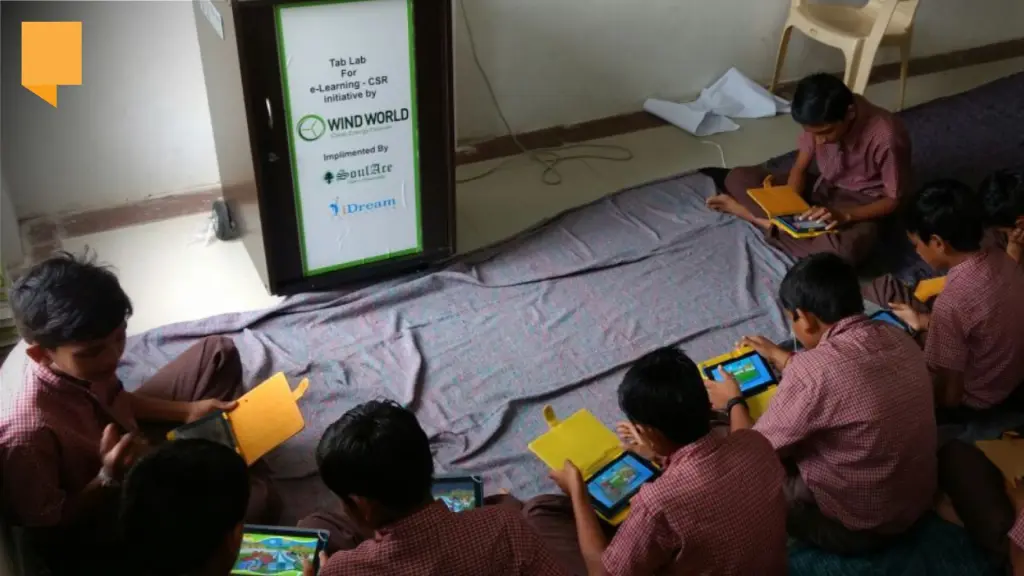
This was the first model of a Storage and Charging Rack that we had introduced. It was very basic and yet it served two key purposes:
- Teachers no longer had to worry about the storage of the devices
- Tablets can now be charged with a single switch within 2-3 hours, allowing them to be used throughout school hours. This ensures uninterrupted learning, regardless of the availability of continuous electricity in schools.
The result was a smile on the faces of the teachers because effective hardware management is one of the main challenges for government school teachers, and is a big reason for the non-usage of digital infrastructure. But, a Tablet-based digital library, on the ground led to regular usage. Teachers did not even have to worry about handling the devices to the students. Students could take out the devices, use them, and put them back on their own. This led to regular usage of tablets in the school, a problem we wanted to solve.
In fact over the years, we found so much value that we persisted with this even in those situations where the CSR or the NGOs told us that we wouldn’t need the rack. We knew very well that with no rack, it would be difficult to expect results.
What you saw above was the first model of the Rack.
It’s been 8 years since then and we have refined and improved it so much today with absolutely no increment on the cost. We have done this through the finer innovation and persistence of our team. The rack today also has wheels and teachers can comfortably move it to any classroom/lab/hall. As a result, we have set up tablet-based labs even in such schools that do not have a dedicated lab room.
We have previously written some blogs where you can get to know more about these Charging Racks and the interesting journey we have had with them.
See you next time with another story.
PS: If you have any feedback on our work or our newsletter, please feel free to write to me directly at [email protected]