

Hi,
As we begin FY 2025-26, I wanted to take a moment to highlight a concerning issue that’s unfolding in one of India’s most underdeveloped districts – Nuh.
A recent study on government schools of Nuh reveals an alarming education crisis.
In the 2024-25 academic year, 1.45 lakh students were enrolled in Class 5. By Class 8, this dropped to 82,950. By Class 10, only 22,402 remained, and by Class 12, the number was a mere 12,981—just 9% of the original Class 5 strength.
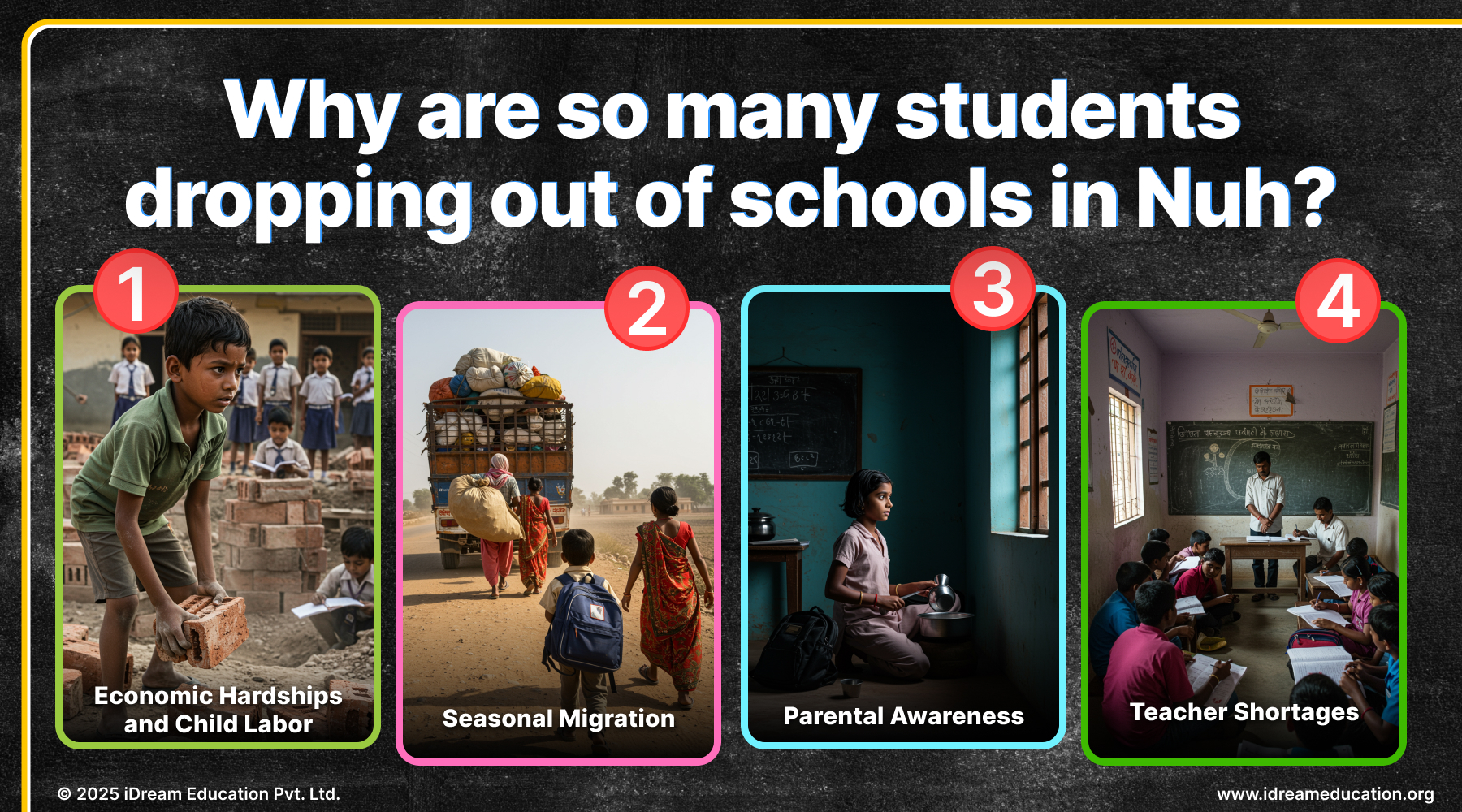
From what is shown above, to my understanding, one major – yet overlooked factor contributing to the current challenge is the widening learning gap among students.
There’s little to no support for teachers to help students who fall behind. As a result, students struggle to cope with the increasing academic demands and gradually disengage from school altogether. This issue is further compounded by frequent family migration, which disrupts continuity in learning.
Based on our experience working with government schools, including the ones in Nuh, I’ve also observed something equally critical—a lack of engaging classrooms.
To tackle this multi-layered issue across the country, we need to start with actionable, scalable solutions. While I may not be an expert in every domain, I strongly believe that digital learning can play a crucial role in reversing the dropout trend.
Let’s see how:
- First is by Making Learning Fun and Interactive: From our experience of setting up Smart Classrooms in East Jaintia Hills, Meghalaya, we’ve seen how the right resources can make a big difference. With animated videos, practice questions, and simulations, teachers are able to explain concepts better, and make classrooms interactive. Before this, the Class X pass rate in the district was just 28%. After introducing Smart Classrooms in Grades 8 to 10, the passing % improved to 60%. Watch this video to see how an affordable and well-designed intervention can help reduce dropouts and improve learning outcomes.
- Second is by Bridging Learning Gaps with PAL Solution: This could be achieved by setting up PAL labs. These labs enable students to cover up historical learning gaps while they also empower teachers with valuable data on students’ learning gaps, enabling them to personalize instruction effectively. Measuring learning gaps is essential, as it will allow teachers to address and bridge the gaps systematically. I am confident of this because, with just one year of usage of our iPrep PAL Application on mobile devices, over 10500 students in schools of Haryana were able to achieve 38% improvement in their performance. Watch this video to understand what Personalised Adaptive Learning or PAL is and why it is so critical for government schools to adopt it now.
The student dropout crisis in Nuh is a reflection of deep-rooted challenges that many underserved districts across India face.
By combining thoughtful policy, digital innovation, and ground-level implementation, we can start changing this narrative. I would be happy to collaborate with you on implementing solutions to reverse the student dropout trend—not just in Nuh, but across India. Let’s identify the gap and address the issue to ensure every learner gets an equal opportunity to learn and grow.
Top Post on LinkedIn: Watch as I break down the issue of alarming student dropouts in Nuh.
Blog of the Week: To explore the issue of alarming student dropouts in Nuh—its causes and possible solutions—read the full article.
PS: You can check all the previous newsletters on this link.