
Hi,
As we look toward the future of education in India, I recently sat down with Shri Anil Swarup ji, the former Education Secretary and chief architect of Samagra Shiksha 1.0, to discuss the roadmap for Samagra 2.0 in Episode 3 of our Podcast series.
But before that, you must also know that Samagra 1.0, which merged three schemes to cover government schools from pre-primary to Class 12, was also a monumental success in enrolling children in school. It successfully enrolled nearly 25 crore children and set up over 15 Lakh smart classrooms. While the hardware is reaching the schools, the “unfinished business” is ensuring that it actually facilitates learning.
The core problem has been the program design itself. As Shri Anil Swarup ji says, “In my experience with the government in education, procurement was always the easier part. So that’s where the energy went. First, the hardware, then maybe the software, but the purpose of all of it was never clearly defined. However, it should have been the other way around. What is the purpose? Then what software is required for that purpose? And then what hardware?“
We also addressed why massive platforms like DIKSHA, despite being vast repositories of information, haven’t fully served their purpose. Shri Swarup highlighted a critical “disconnect”: expecting a teacher to browse through thousands of videos to find what is relevant for their specific class is simply “asking too much”. Without better discoverability and curated, context-specific offline content, even the best digital resources remain underutilized.
For Samagra 2.0 to succeed, the government and the ecosystem must pivot from infrastructure to student learning outcomes. In our discussion, we identified two critical areas:
- “Empowering the Teacher as the Pivot:” We must stop asking teachers to “reinvent the wheel” or browse endlessly for content. Instead, they need curated, structured offline content and meaningful, continuous training that helps them understand the utility of technology in the classroom.
- “Data and Evaluation:” We can no longer be “shy of evaluating ourselves”. Technology must be used to track usage and measure whether learning outcomes are actually improving on the ground. Continuous availability of data can enable stakeholders to take better decisions and fine-tune program design to achieve the desired outcomes.
This is not a conversation about technology. It’s a conversation about intent, design, and accountability, and what it takes to build something that actually works for the child sitting in a government school classroom.
Take a few minutes to hear this conversation:
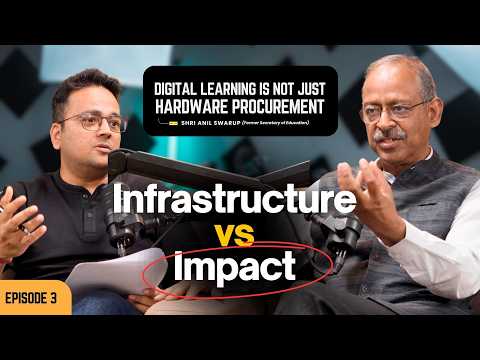
I invite you to watch this episode to understand how we, as ecosystem enablers, and you, as CSR and NGO leaders, can align our strategies with this upcoming shift toward a more outcome-oriented digital ecosystem.