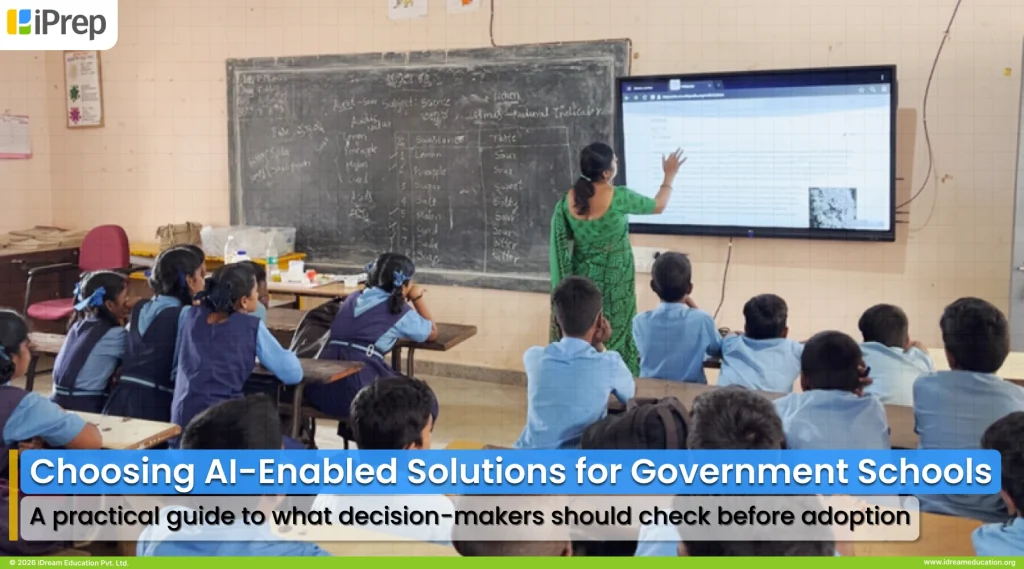
In India’s rapidly evolving edtech ecosystem, hardware brands are aggressively marketing devices as AI-enabled solutions for government school education.
The pitch is compelling: teachers can instantly create content, generate lesson plans, produce images, design 3D visuals, and craft custom assessments, all through AI integration. More concerning is that these vendors actively promote the notion that traditional offline LMS for government schools and pre-loaded digital content are obsolete. The real question is not whether AI can create content, but whether such tools can realistically function inside the daily constraints of a government classroom.
While this AI trend is technologically exciting, it ignores critical ground realities in government schools and risks creating serious long-term challenges for education authorities, CSR programs, and school administrators.
The Disconnect Between Vendor Promises and Classroom Realities
Consider a typical government school teacher managing Classes 6-8. Their day includes:
- 5 teaching periods (40 minutes each) across subjects
- Assembly duties, attendance marking
- Mid-day meal supervision
- Paperwork and parent meetings after school
In this context, when does content creation actually happen? During a Hindi period, when 60 students are looking for guidance? Between Science activities, when is the teacher already stretched? A 40-minute period leaves no realistic window for generating fresh AI-based 3D diagrams or custom quizzes in the middle of a lesson.
On top of this, internet availability remains a major constraint. A large proportion of rural government schools still lack reliable connectivity, which means even “AI-integrated” hardware becomes ineffective the moment the internet fails, turning devices into expensive, idle assets rather than active learning tools.
Recent government RFPs increasingly reflect this same mismatch. Many tenders highlight AI features but underplay or even ignore the need for offline LMS and curriculum-mapped digital content. This creates procurement traps where schools receive hardware and AI claims, but not the foundational content and systems needed for daily teaching. This is how well-intended technology investments quietly fail – not because the tools are weak, but because they are misaligned with how classrooms actually work.
Why AI-Enabled Solutions Fall Short in Indian Classrooms
While AI-enabled solutions for govt schools are often seen as transformative for education, their impact in Indian classrooms remains uneven. This is because:
There are certainly areas where AI can add value. AI works better with Subjects such as Mathematics and Science because many concepts are globally standard. Equation solvers, diagram generators, and basic explanations tend to be more consistent.
On the other hand, AI solutions struggle to deliver curriculum-aligned content that depends heavily on local context and specific syllabus. This includes:
- Hindi Vyakaran topics such as sandhi-vichhed, samas, and alankar
- State-specific Social Sciences, including local governance and regional history
- English grammar aligned to CBSE or State Board patterns
Most AI-Enabled Solutions for government schools rely on repurposed global models, such as commonly used large language models. These are not primarily trained on NCERT textbooks, State Board syllabi, or India’s multiple regional languages. This limitation leads to content that sounds fluent but is factually inaccurate, pedagogically misaligned, or culturally disconnected.
- At the classroom level, even highly motivated teachers rarely have the time or capacity to learn advanced prompting or constantly fix issues in AI-generated content while managing packed teaching schedules.
- At the system level, there is still no India-focused education language model built from the ground up for our curriculum and multilingual realities. Instead, many solutions simply wrap generic AI with a thin curriculum layer – often insufficient to ensure accuracy and alignment.
When AI is introduced without strong curriculum grounding, teacher readiness, and system-level oversight, the risk shifts from innovation failure to learning distortion.
Another Critical Missing Piece: Data-Driven Monitoring and Evaluation
Given these gaps in curriculum alignment, teacher readiness, and system support, one more requirement becomes unavoidable: if AI-Enabled solutions are introduced into government classrooms, their impact cannot be assumed – it must be measured. And it cannot be measured only through activity metrics. Most AI-based solutions are very good at tracking usage – logins, number of queries, or minutes spent on a tool. But education leaders need deeper, outcome-based answers, such as:
- Are learning outcomes improving in a measurable way (for example, Math proficiency improving over a term)?
- Are students engaging more with concepts where they were previously weak?
- Are teachers actually saving planning time and feeling more supported?
- Are potential dropout risks being identified early through usage and performance patterns?
A structured system answers these questions reliably. An offline LMS with robust analytics captures student performance, content usage, and teacher interactions. It syncs data when connectivity becomes available. Pure AI hardware or stand-alone tools generally do not provide this depth of monitoring.
What Procurement Must Consider When Choosing an AI-Enabled Solution for Govt School Education?
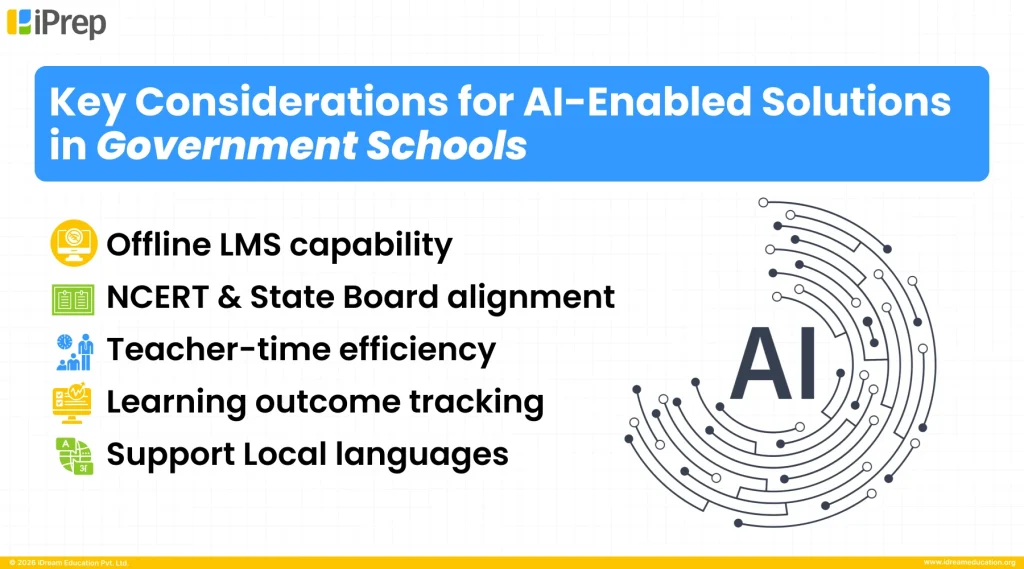
Decision-makers evaluating any AI-enabled solutions for government school education in India need to prioritise what works inside a real government classroom, not just what looks impressive in a demo. Once the risks are understood, procurement decisions must shift from feature-led evaluation to classroom-led evaluation. Some non‑negotiable foundations include:
- Complete offline LMS with pre-loaded content: The AI-enabled solution you are choosing should offer curriculum-aligned, ready-to-use digital resources mapped to NCERT and State Boards so that learning can continue even without internet access.
- Time-efficient teacher tools: AI or otherwise, the classroom tools must help teachers quickly generate or select lesson plans and assessments that fit within a 40-minute period, rather than requiring long content creation workflows.
- Outcome-focused monitoring: Systems must track learning progress, not just usage. Dashboards that show growth, improvement areas, and class-level adoption and learning patterns. These are far more valuable than login charts.
- Coverage of local context subjects: Solutions you choose must support not just Maths and Science, but also languages, grammar, and Social Sciences subjects, in ways that respect regional content and language realities.
So, Where Does AI Really Fit in Government Schools?
Building on the gaps we’ve seen in curriculum alignment, teacher readiness, and system oversight, the answer is not to replace existing systems with AI – but to strengthen them and then layer AI thoughtfully on top.
AI-enabled solutions for government schools do hold genuine potential, but they must be built as an additional layer on top of reliable, proven foundations, not as a replacement. A balanced architecture looks something like this:
- Layer 1: Foundational Content – An offline LMS with 100% curriculum coverage that students and teachers can depend on every day.
- Layer 2: Teacher Efficiency Tools – Features that help teachers save time on planning and assessment, instead of adding new burdens.
- Layer 3: Progress Monitoring – Clear data on learning outcomes, engagement, and gaps, accessible at school, block, and district levels.
- Layer 4: AI Enhancement – Carefully integrated AI supported by proper infrastructure and training, added once the first three layers are strong.
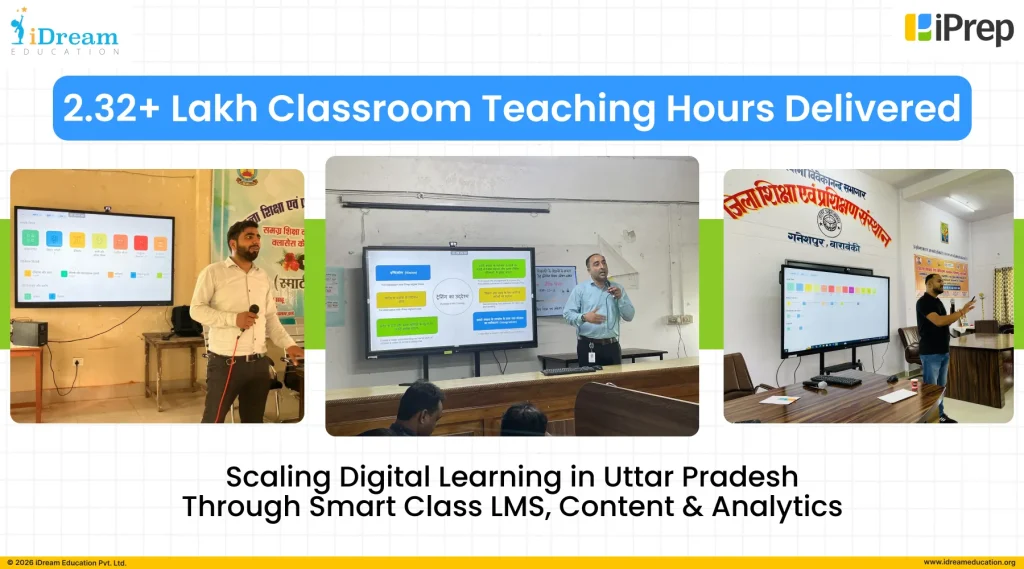
This layered approach reflects how many large-scale deployments, covering lakhs of students across thousands of schools, have been implemented, especially in contexts where offline-first LMS systems and structured digital content delivered through K–12 learning platforms form the backbone of implementation.
Why Does This Matter for India’s Education Future?
Government schools educate around 24 Cr. of India’s children. Decisions about digital procurement are not just technology choices, they directly affect learning equity and opportunity for an entire generation. Poorly chosen AI-enabled solutions for government school education can waste public resources, increase teacher frustration, and leave students no better off than before.
On the other hand, the right solutions can:
- Improve foundational skills significantly when integrated with good content and pedagogy
- Save substantial planning and assessment time for teachers
- Give administrators district-wide visibility into learning patterns and problem areas within weeks instead of years
Schools, education departments, and CSR programs must shift procurement focus from technological sophistication to classroom utility. Does the solution work without the internet? Save teachers’ time during 40-minute classes? Measure actual learning progress? Align with local curriculum realities?
These questions guide procurement to strengthen teaching and learning. When it is not, even the most advanced hardware risks becoming just another set of devices locked away in a storeroom.
If you wish to explore an AI-enabled solution for govt school education, you may contact us at +917678265039 or write to us at share@idreameducation.org.
Categories You may Explore
Related Articles