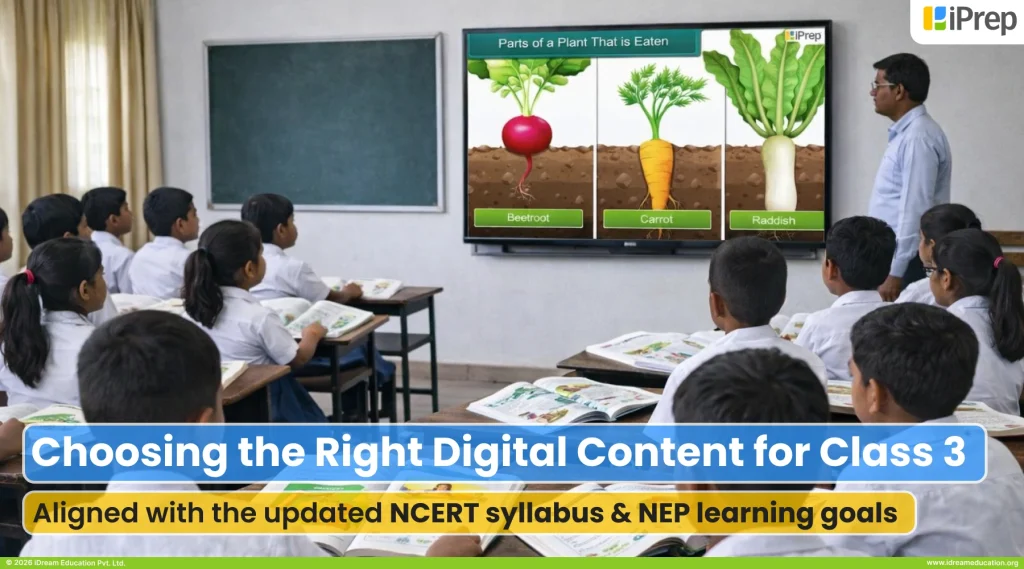
Class 3 is not just another grade – it is the turning point in a child’s learning journey. Under NEP 2020’s 5+3+3+4 structure, Grade 3 marks the formal entry into the Preparatory Stage, where children move from activity-led foundational learning in Classes 1–2 to more structured academic engagement. This is also the stage where “learning to read” must successfully transform into “reading to learn” – a shift that determines how confidently a child will engage with every subject that follows.
Yet, national learning assessments show how fragile this transition still is.
PARAKH findings reveal that more than half of Class 3 students struggle with basic number sense, and nearly half of older students face difficulties with simple operations—proof that gaps formed early don’t disappear, they multiply. As educationist Dr. Rukmini Banerji rightly notes, Class 3 is the inflection point where foundational skills either strengthen or silently weaken a child’s future learning path.
For educators, policymakers, CSR leaders, and NGOs, this makes Class 3 the most strategic stage for intervention. Supporting learners here directly contributes to NIPUN Bharat goals, strengthens NEP implementation, and promotes equitable learning outcomes across regions. And in this high-stakes year, the kind of content, whether it is only textbooks or rich digital content for Class 3, it is important to ensure how it is designed in terms of format, language, interactivity, and curriculum alignment. This makes the difference between surface-level exposure and deep, lasting understanding.
Key Updates in CBSE Class 3 Syllabus 2025–26 – What’s New and What It Means
Languages (Hindi: Veena | English: Santoor) – shift towards joyful reading + richer language use
The 2025–26 update brings in new language textbooks – Veena (Hindi) and Santoor (English), signalling a stronger push towards engaging, age-appropriate reading rather than only drill-based language practice. In practical terms, this typically means more room for read-alouds, storytelling, speaking–listening activities, and vocabulary-in-context, exactly what Class 3 needs as children move from learning to read to reading to learn. For multi-format digital content, this is where audio narration, read-along highlighting, local-language support, and interactive comprehension checks can amplify the textbook experience instead of replacing it.
The World Around Us (Our Wondrous World) – a new, integrated “environment & society” lens (experiential + interdisciplinary)
A major NCERT change is the introduction of The World Around Us as a subject area at the Preparatory Stage (Grades 3–5). NCERT positions it as environmental education through experiential learning, connecting children’s day-to-day experiences with foundational ideas that later branch into science and social science. For Class 3 content design, this makes videos, simulations, local-context visuals, simple field tasks, picture-based prompts, and project templates especially valuable (because the subject is meant to be “lived”, not memorised).
Mathematics (Math-Mela) – more activity-led, concept-first math (less “just sums”, more thinking)
With Math-Mela, the intent is clearly to make math more interactive and conceptually grounded for young learners. The opportunity here is to reduce early learning gaps by helping children build number sense, reasoning, and strategy, not just arrive at answers. In a multi-format setup, tools like virtual manipulatives, step-by-step animations, short practice sets with instant feedback, and teacher-friendly printables support this shift. Together, they help Class 3 classrooms move from rote completion to real understanding, especially in mixed-ability settings.
Activity-Based Learning & Assessment
The updated curriculum moves away from rote learning toward hands-on activities, cross-disciplinary projects, and formative assessments that value thinking and understanding. Tasks like journaling, role-play, experiments, nature walks, and classroom discussions are now part of everyday learning.
Language Across Curriculum
Language learning isn’t confined to language periods only. Skills such as reading, listening, speaking, and writing are expected to be reinforced across subjects.
Benefits of Class 3 Curriculum Updates

The Class 3 syllabus update for 2025 – 26 goes beyond simple textbook revisions. It represents a pedagogical shift towards learner-centered, activity-driven, and concept-based education. This is fully in line with NEP 2020 principles. Here are the associated benefits for learners:
- Stronger Foundational Skills: New materials emphasize comprehension, reasoning, and real-world connections that build solid foundations in reading, numeracy, and observation.
- Enhanced Engagement & Curiosity: Creative texts, exploration-based themes, and opportunities to investigate real-life situations make learning more meaningful and enjoyable.
- Improved Critical Thinking: Activities like simple research, arts integration, and math games help build early higher-order thinking skills.
- Better Prepared for Higher Grades: By mastering foundational concepts early, students enter Grades 4–5 with confidence, reducing repetitive remediation later.
Multi-Format Digital Content for Class 3: The Right Mix for Growth in the New Syllabus Era
With the Class 3 syllabus becoming more activity-driven and concept-focused, stakeholders – schools, governments, CSR partners, and NGOs must prioritise digital content that is strictly aligned with NCERT and State Boards, while also being rich in format and experience. At this age, learning is not linear; children think in stories, images, sounds, movement, and play. The more formats a lesson speaks in, the more minds it reaches.
- Animated videos play a powerful role in introducing concepts through narrative. A story about shapes becoming characters, or numbers going on adventures, builds emotional connection and curiosity, helping children visualise ideas before they are asked to practise them. This mental imagery is critical for long-term understanding, especially in early grades.
- Interactive simulations then turn that understanding into action. Drag-and-drop number ordering, matching shapes to real-world objects, or puzzle-based addition lets children “learn by doing.” These activities strengthen fine motor skills, hand–eye coordination, and logical thinking—skills that textbooks alone cannot build.
- Audio narration supports language learning in a gentle, inclusive way. Rhymes, read-aloud stories, and nature soundscapes help children with low reading fluency, multilingual backgrounds, or learning difficulties stay engaged. Listening regularly also improves pronunciation, attention span, and emotional calm, often overlooked but essential classroom skills.
- Picture-based questions sharpen observation and real-world connection. Tasks like “Spot the pattern,” “Match shapes to objects around you,” or “What do you see in this picture?” mirror classroom visuals and blackboard teaching, making digital learning feel familiar rather than foreign.
- Short quizzes, comic-strip word problems, and printable worksheets add a light-touch assessment. These do not interrupt learning – they extend it. Children get feedback, teachers get insight, and progress is tracked without stress or fear.
Let’s Look at Digital Content for Class 3: What You Should Look at When Enabling It in Schools

Once the importance of Class 3 and the role of digital content are established, the focus shifts to practical decision-making. When enabling digital content for this grade, a few foundational considerations help ensure that adoption remains aligned with curriculum intent and classroom realities.
Curriculum Alignment
Digital content for Class 3 must align with the updated NCERT syllabus (2025–26). It should also map smoothly to relevant State Board frameworks. This alignment ensures continuity between textbooks and digital resources. It also makes it easier for teachers to use both together in everyday classroom practice.
When digital content follows the same structure, chapter flow, and learning outcomes as the curriculum, it doesn’t feel like an “extra,” it becomes part of the lesson itself. This alignment helps teachers plan better, reduces confusion for students, and ensures that what is taught digitally directly supports what is assessed in school
Multi-Category Content
Since textbooks already form the core instructional resource, digital content should add value – not duplicate what is already there. Multi-category content does this by offering different ways for students to engage with the same concept.
A strong Class 3 digital content solution should include video lessons, practice activities, assessments, and interactive or experiential elements. Together, these help students observe, practise, and visualise what they learn in class. This supports experiential and activity-based learning, while keeping the teacher’s workload manageable – because the content complements classroom teaching rather than complicating it.
Language Availability
Digital content for Class 3 you choose should be available in English, Hindi, and relevant local languages. This reflects the real language environment of classrooms, where teachers and students learn in their preferred medium.
When content is language-accessible, it becomes easier for teachers to adopt and adapt in daily teaching. Instead of being used occasionally, it becomes a regular classroom resource – supporting better comprehension, inclusion, and confidence among young learners.
Online and Offline Accessibility
Connectivity constraints are still a reality in many regions. That’s why digital content for Class 3 must work in both online and offline modes. Learning should not stop just because the internet is slow or unavailable.
Bringing It All Together
Now, the real question is – how do schools and education programmes bring all these elements together to enable Class 3 learning effectively? Curriculum alignment, multi-format content, language accessibility, and online–offline flexibility are not standalone features. Their real impact is seen when they work together as a single, well-integrated learning ecosystem.
At iDream Education, we create and curate multi-format digital content for Class 3 aligned with the latest NCERT syllabus updates. At the same time, we continue to support schools that still follow the older NCERT framework. Schools can access content aligned to the new syllabus, the old syllabus, or a combination of both, based on academic needs.
This approach ensures that schools, teachers, and education programmes don’t have to choose between continuity and change. They can transition smoothly, adopt digital learning confidently, and ensure that every Class 3 student gets content that is relevant, engaging, and aligned with what they are learning in their textbooks. If you are looking for digital content for Class 3 aligned with CBSE or State Board, you may contact us at +917678265039. You can also write to us at share@idreameducation.org or share your details here.
Categories You may Explore
Related Articles