
Digital Library Service in India for CBSE & State Board schools. Get library software, content, offline access, tracking, & scalable models.
In most Indian schools, the library is still a room. A room with shelves. A room with registers. A room students visit once a week - if at all. For years, this model worked. For decades, it symbolized academic seriousness. Whether in schools affiliated with the Central Board of Secondary Education or State Boards, the library was a physical space of knowledge.
But let’s pause and ask ourselves - does that model still reflect how children actually learn today?
Learning has changed. Access has changed. Students have changed. Yet in many schools, the library hasn’t evolved. We still see outdated books, limited copies, shelves that look full but feel irrelevant, and collections that are not aligned with the current curriculum. In several remote or resource-constrained schools, a functional library doesn’t even exist as part of the infrastructure. If we are honest, many “library periods” are more about attendance than engagement.
As education leaders and implementers working on school enhancement, we must ask: are we truly enabling access to knowledge, or are we preserving a legacy structure?
With the vision of the National Education Policy (NEP) 2020 pushing for equity, accessibility, multilingual resources, and meaningful technology integration, the conversation around libraries must shift. Access to quality reading material cannot depend on geography, budget cycles, or physical storage space. It must be continuous, curriculum-aligned, diverse, measurable, and inclusive. This is where the idea of a Digital Library Service becomes not just relevant, but essential.
So what exactly is a Digital Library?
A Digital Library is not simply a collection of eBooks stored on a device. It is a structured, curriculum-aligned, searchable, and accessible repository of learning and reading resources that students and teachers can use anytime - inside or outside the classroom. It moves the library from being a room students visit to a resource students access daily.
For CBSE and State Board schools, a meaningful digital library service must go beyond generic content. It should include bilingual (or multilingual) resources aligned to NCERT and respective State Board curricula, covering textbooks, reference materials, practice content, concept explainers, storybooks, general reading, sample papers and enrichment resources. In other words, it should combine academic curriculum support with a library-style reading repository, so students can prepare for exams and build reading habits in parallel.
And more importantly, What Does a Digital Library Service Provider Should Actually Offer?
A Digital Library Service Provider should offer an easy-to-setup, easy-to-manage, and easy-to-use solution that works within the realities of Indian schools, especially those with limited infrastructure. Digital library service providers should offer:
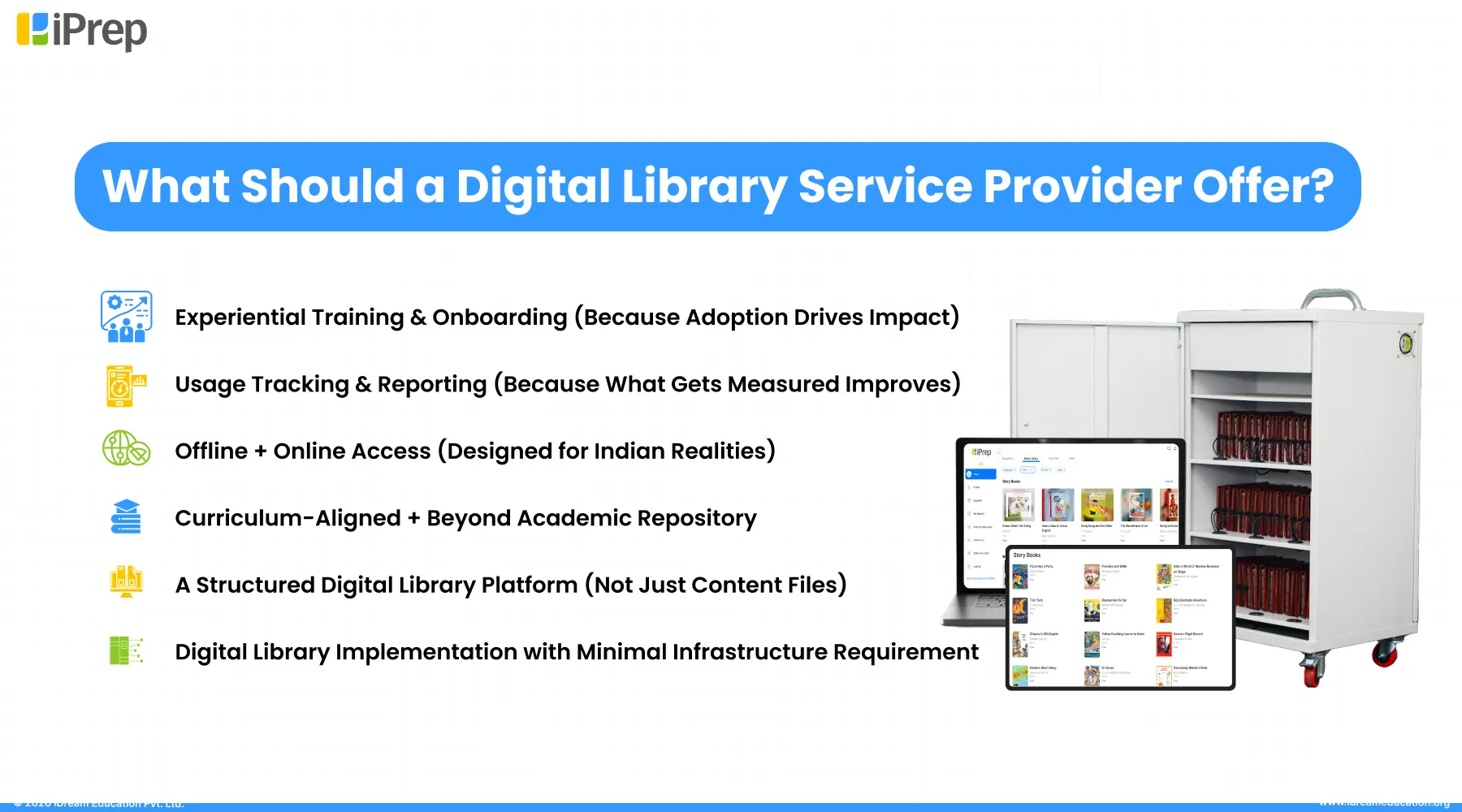
Digital Library Implementation with Minimal Infrastructure Requirement
A digital library should not demand heavy new investments. Instead, it should be flexible enough to adapt to your existing setup. A strong digital library service offer multiple implementation models such as:
- Smart Class (TV/Panel-based) Digital Library
- Tablet-Based Digital Library
- Laptop/Chromebook-Based Digital Library
- Local Server-Based Digital Library (for offline-heavy environments)
- Custom deployment options based on project scale and funding structure
This flexibility ensures that whether you're implementing at a single school level or across a district/state project, the solution fits your infrastructure.
A Structured Digital Library Platform (Not Just Content Files)
A digital library service is incomplete without a robust, intuitive software platform. It’s not enough to provide downloadable PDFs or scattered resources. The provider must offer a dedicated digital library platform where:
- All resources are organized grade-wise, subject-wise, and age-wise
- Students can easily switch between language options (English + regional language)
- Academic and non-academic reading materials are clearly categorized
- Search, filtering, and navigation are simple, even for first-generation learners
The digital library platform should feel like a guided reading ecosystem, not a storage drive. This ensures students are able to navigate to e-library resources seamlessly, without much training.
Curriculum-Aligned + Beyond Academic Repository
Digital library service for CBSE and State Board schools must include:
- NCERT and State Board aligned multi-category academic resources
- Syllabus-based reading materials
- Reference books and supplementary learning content
- Bilingual support for improved comprehension
- Reading resources such as inspirational biographies, life skills and value education, sample papers, stories, poems, journals, and lot more across multiple genres
This wholesome digital library empowers you to enable a comprehensive and diverse range of resources, thoughtfully designed for State Board and CBSE schools.
Offline + Online Access (Designed for Indian Realities)
In many Indian schools, especially in semi-urban and rural regions continuous internet connectivity cannot be assumed. A Digital Library Service Provider must design for this reality, not ignore it. The e-library solution should offer:
- Offline access to curated digital library resources
- Sync capability when internet becomes available
- Local server-based or device-level content access models
- Seamless transition between offline and online modes
This ensures that reading does not stop because the internet does. Whether a school operates fully online, fully offline, or in a hybrid environment, the digital library must remain consistently accessible.
Usage Tracking & Reporting (Because What Gets Measured Improves)
A strong Digital Library Service Provider should offer structured dashboards and usage reporting features that help schools and project administrators understand:
- How often students are using the digital library
- Which grades are most engaged
- What categories (academic vs. general reading) are most accessed
- Trends in reading frequency over weeks and months
This transforms the digital library from a passive resource into a measurable school improvement tool. For project leaders, this means data-backed decision-making. For teachers, it means identifying students who need encouragement. For large-scale projects, it means demonstrating real impact & outcomes. Ultimately, a digital library should not just exist in a school, it should be actively used, tracked, and continuously strengthened.
Experiential Training & Onboarding (Because Adoption Drives Impact)
Even the most thoughtfully designed digital library will remain underutilized if stakeholders are not confident using it. A responsible Digital Library Service Provider should not stop at installation. They must ensure experiential, hands-on training for teachers, librarians, students, project coordinators. This training should go beyond platform navigation. It should demonstrate:
- How to integrate digital reading into classroom teaching
- How to use the platform during library periods
- How to create digital library period for rotational use
- How to encourage self-reading habits among students
- How to interpret usage reports for improvement planning
Experiential onboarding ensures that the digital library becomes part of the school culture, not just another digital setup in schools.
Before finalizing a Digital Library Service, ask these essential questions:
- If your school is State Board aligned, does the platform provide content mapped specifically to your state syllabus along with beyond-academic reading resources to ensure both syllabus coverage and reading habit development?
- If your school follows CBSE, is the digital library structured grade-wise and subject-wise as per NCERT, while also offering enrichment reading content?
- Does the solution work in offline environments, or is it completely dependent on internet connectivity?
- Can the digital library be implemented using your existing infrastructure (smart class, tablets, laptops, local server), or does it require additional heavy investment?
- Is there a structured digital platform interface, or are you simply getting access to scattered PDFs?
- Does the provider offer usage tracking and reporting, so you can measure student engagement with e-library content?
- Is experiential teacher training included, ensuring the library is actually used and not just installed?
- Does the provider have proven experience implementing digital libraries in Indian schools?
If the Answers Are Yes, Then You’re Ready for the Right Digital Library Partner
We are one of the leading Digital Library Service Providers in India for school education and have been enabling exactly this transformation across thousands of schools. With extensive experience in implementing digital libraries in partnership with CSR initiatives, NGOs, and government departments, the focus has always remained clear: make digital reading accessible, structured, measurable, and sustainable. Our implementations are not limited to installation, they are built for regular usage.
Let’s look at a recent example from government schools in Kansar, Jodhpur (Rajasthan)
In this digital library project, tablet-based Digital Library setup has been implemented. The digital library platform includes Rajasthan Board-aligned academic content along with a structured digital book library featuring beyond-academic reading resources in Hindi & English Medium.
What makes this implementation meaningful is its usage trend.
- The monthly usage of the digital library increased steadily from 29% in August to 35% in September, and further to 36% in October. Within just three months, this consistent upward growth reflects increasing student familiarity with the platform, stronger adoption, and gradual development of a digital reading culture. It demonstrates that when access, alignment, and ease of use come together, digital libraries do not remain passive infrastructure, they become actively used learning ecosystems.
- The category-wise usage data from these schools offers deeper insight into how students are engaging with the digital library. A significant share of usage comes from Life Skills content (32%) and Video Lessons (32%), showing that students are revisiting academic concepts through video content and reading through developmental learning resources. Simulation content (18%) and Practice modules (10%) further highlight that the digital library is actively being used for academic reinforcement, concept clarity, and post-classroom revision.
The usage data pattern clearly shows that:
In schools, digital libraries are not merely acting as digital book repositories, they are functioning as structured academic support systems alongside enrichment platforms. It also reinforces an important point: for a digital library to be truly effective, it must be closely aligned with the State Board or CBSE curriculum. When content is syllabus-mapped and contextually relevant, students naturally use it to strengthen classroom learning.
Plus, you would be pleased to know that:
These schools also follow a structured digital library timetable, ensuring that tablets are used on a rotational basis by all students. This planned scheduling makes the tablet-based digital library model highly cost-effective while maximizing device utilization. As a result, the digital library becomes a shared academic resource, benefiting the entire school rather than functioning as a limited-access intervention.


