

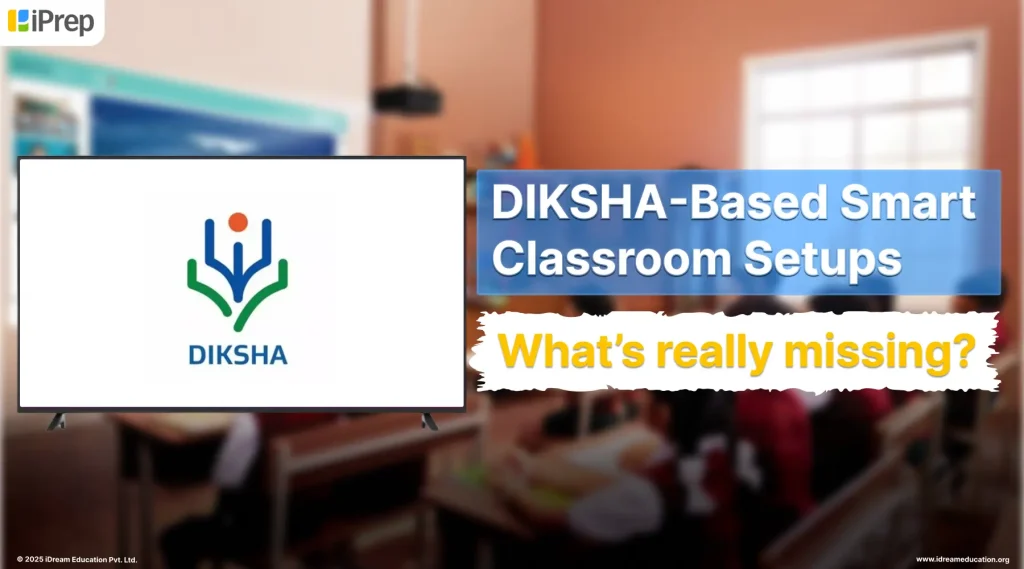
In our conversations with educators, school leaders, and implementation teams across the ecosystem, one belief often comes up – “We’ve installed smart classroom hardware and integrated the DIKSHA platform, so students can now learn effectively through digital content.” At first, it sounds like the perfect solution. After all, DIKSHA holds a massive repository of curriculum-aligned resources, and smart classrooms are supposed to make teaching more interactive.
But when we look closely at classroom usage and student engagement, the picture is quite different.
The challenge lies in the assumption itself.
DIKSHA was never designed to function as a smart classroom teaching tool. It is a self-access digital repository, not an instructional facilitator. Using it in a live teaching environment often leads to interruptions, limited engagement, and minimal alignment with the way teachers actually conduct lessons.
Yet, across India, we continue to invest time, attention, and significant funds in setting up DIKSHA-based smart classrooms, hoping it will improve learning outcomes.
This gap – between infrastructure and actual smart classroom impact – is exactly what we need to address
Let Us First Understand the Gaps of DIKSHA-Based Smart Classroom
Internet Dependency Limits Real Classroom Use
DIKSHA functions entirely online. This means every time a teacher wants to access a lesson, video, or resource, the platform requires uninterrupted internet connectivity. While this may seem manageable on paper, the ground reality in most government schools is very different. As, consistent and high-speed internet access is still a major challenge. Many schools either have unstable connectivity or rely on limited mobile hotspots. As a result, teachers struggle to use DIKSHA based smart classrooms during live classroom sessions. Even when smart classroom hardware is fully installed and ready, the learning process is paused the moment the internet buffers or drops. This results in teachers shifting back to blackboard teaching because it’s more reliable.
Until digital content is accessible offline or without relying on internet speed, DIKSHA will continue to be difficult to use effectively in classroom teaching.
Content on DIKSHA is Designed for Self-Learning, Not Classroom Teaching
Another key challenge lies in the nature of DIKSHA’s content. Most resources available on the platform are videos or digital books. While these can support self-paced learning, they are not designed to actively involve students during a live classroom session. In real classroom settings, teachers need content that promotes participation and checks understanding in the moment. This includes practice questions, quizzes, interactive assessments, simulations, tests, and other activity-based learning tools. These elements not only help students engage better but also enable teachers to adapt their teaching based on how well students have grasped each concept. Without interactive elements, teaching through DIKSHA in a classroom becomes one-way communication, limiting the potential of smart class technology.
To genuinely drive learning outcomes, smart class content should be easy to access, understand, use and must support real-time teacher-student interaction and continuous feedback.
Low Relevance for Live Teaching
It’s also important to understand that most video lessons on DIKSHA are teacher-recorded classes. These are originally designed to support students learning independently at home. They work well when a student is revising or stuck on a concept while studying from a textbook. But inside a classroom, it makes little sense for one teacher to pause a lesson & play another teacher’s recorded session. This approach disrupts the flow of teaching and reduces the teacher’s role to that of a content operator instead of a facilitator.
To make technology-driven classroom learning truly meaningful, smart classrooms must enhance a teacher’s ability to teach by empowering them to plan lessons better and deliver instruction more effectively.
No Monitoring Mechanism
Additionally, DIKSHA lacks a reporting and monitoring system. There is no way to track how teachers are using the content, how many times, for what classes, or whether the DIKSHA-based smart classroom setups are making any measurable impact on student learning. This absence of data visibility becomes a major limitation for CSR partners, NGOs, district teams, and state officials who invest significantly in smart classroom initiatives. Without usage analytics or learning outcome insights, it is also challenging to measure effectiveness or improve implementation strategies.
Hence, to make technology-driven classroom learning outcome driven, monitoring of progress in the form of data is crucial. But, currently, both are missing in DIKSHA-based smart classroom setups.
To Truly Drive the Potential of Smart Classrooms, We Need Them Equipped With the Right Capabilities
To ensure smart classrooms genuinely support teaching and improve learning outcomes, they must go beyond hardware and online access. They should be built around the realities of classroom teaching and the needs of teachers. Key capabilities include:
Offline-First LMS
Smart classroom LMS must work fully offline, without depending on uninterrupted internet. A well-structured, easy-to-navigate LMS that organizes content clearly without the need to switch tabs or stream online allows teachers to confidently use digital resources in every class.
Curriculum-Aligned Digital Content
Digital content should be designed specifically for teaching, not just viewing. It must be aligned with the curriculum and structured subject-wise, and chapter-wise, exactly matching textbook flow. This ensures the transition from traditional to digital instruction is smooth and supports teachers in enhancing classroom delivery.
Content in Hindi, English & Local Languages
For technology to be truly adopted, it must speak the language of the classroom. Content and the LMS itself should be available in Hindi, English, or the local language used by teachers and students. This not only helps with easier adoption but also makes smart classrooms a regular part of teaching, rather than an occasional add-on.
You can also watch video to uncover the real challenges behind DIKSHA-based smart classroom setups and understand what’s truly missing
A truly effective smart classroom is one that not only supports teachers in planning and delivering better lessons but also gives CSR partners, NGOs, and state officials the ability to monitor usage and make data-driven decisions for continuous improvement. Only when smart classroom setups enable meaningful teaching and provide measurable insights can we ensure that the thousands of classrooms being deployed across India actually lead to stronger conceptual understanding and improved learning outcomes.
If you are planning or implementing a smart classroom initiative based solely on DIKSHA, you may contact us at +91 7678265039. You can also write to us share@idreameducation.org or share your details here
Categories You may Explore
Related Articles