

The National Education Policy 2020 has laid out a clear and compelling vision of a future where students progress based not on memory but on proven competencies. This shift to competency-based progression is crucial for equipping our youth with twenty-first-century skills. However, the journey from policy document to nationwide success introduces a critical systemic dependency.
As policymakers and funders, implementers, we must address a vital question. How do we guarantee that this ambitious framework of mastery and personalization is accessible and accountable for every single student, regardless of their background?
At its core, competency-based progression is an educational model where a student advances only after demonstrating mastery of a specific skill or learning outcome. But before we move forward, we must look closely at the mechanics of this shift. What does this progression actually look like, and why is it the only way forward for our schools?
What is Competency-Based Progression (CBP)?
Competency progression is an educational model where a student advances only after demonstrating mastery of a specific skill or learning outcome. In this framework, success is measured not by a raw test score but by the demonstrated ability to apply knowledge and skills in various contexts. It shifts the focus from time spent in class to proven ability. This model requires education to be individualized and flexible, and targeted, which is a direct rejection of the rigid one-size-fits-all model of the past.
But here lies the hard truth that we can no longer ignore. Our past system, built on rote learning, created a silent epidemic of foundational learning gaps. These gaps are the unseen obstructions that stall all current progress and prevent us from realizing the promise of the NEP 2020. For decades, our assessment methods only measured recall. A student could pass an exam while masking a critical deficiency in a concept like proportional reasoning or reading comprehension.
For decades, our assessment methods only measured recall. A student could pass an exam, masking a critical deficiency, a learning gap in a concept like proportional reasoning or reading comprehension.
This is not just an academic failure, it is an issue of strategic inefficiency and equity. The solution lies in the Learning Gap Identification System, a clinical and diagnostic engine that makes Competency-Based Progression viable. This is not just another test, it is a strategic instrument for educational health and governance.
The Learning Gap Identification System: The Diagnostic Engine of NEP 2020
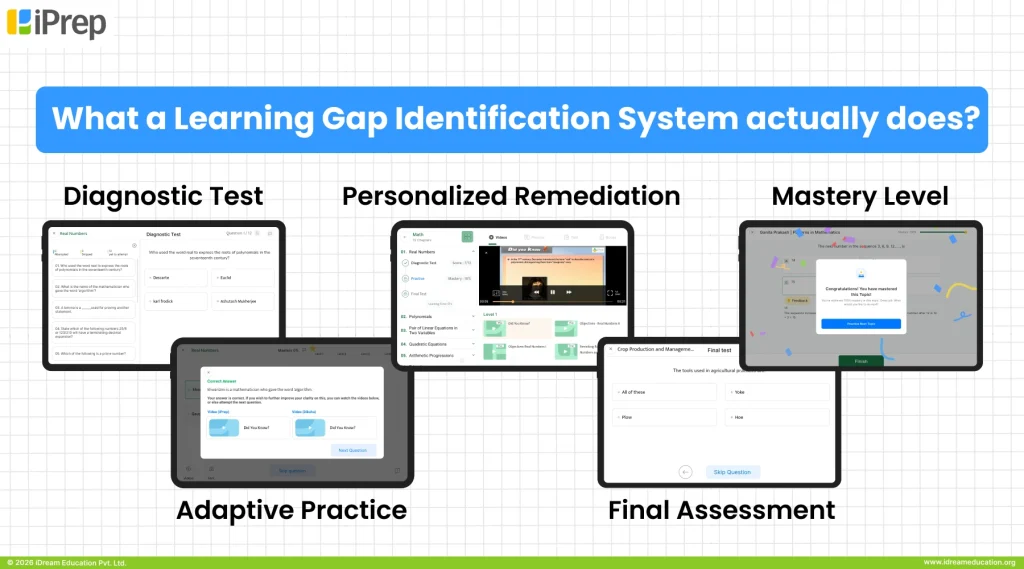
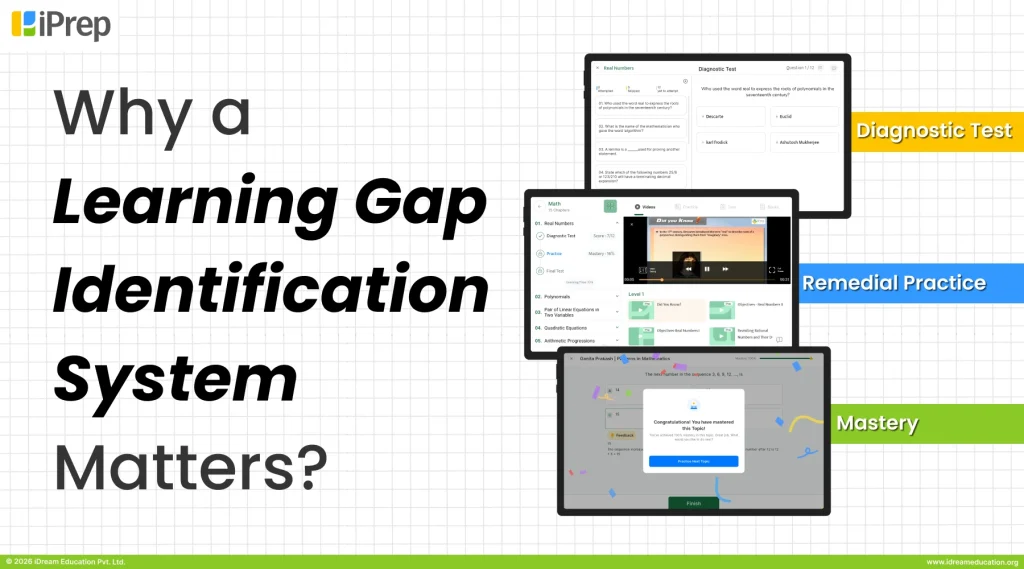
If Competency-Based Progression is the goal, the Learning Gap Identification System (LGIS) is the engine that makes it run. Unlike traditional testing, which simply measures what a student doesn’t know, an LGIS is designed to uncover why they don’t know it.
1. Precision in Diagnosis: Moving from “Scores” to “Root Causes.”
The system reframes the output of every assessment. Traditional models provide a grade, the LGIS provides a clinical diagnosis.
- The Granular Insight: Instead of a generic report stating “Student B is weak in Math,” the system provides actionable intelligence. “Student B has a gap in understanding the relationship between fractions and decimals, which is the prerequisite for the current unit on percentages.”
- Prerequisite Mapping: The system analyzes responses against a hierarchical map of skills, identifying which “missing brick” in the foundation is causing the current collapse in understanding.
2. The Competency Map: A Real-Time GPS for Mastery
Under the NEP framework, learning is no longer a linear race against time, it is a journey toward mastery.
- Strategic Alignment: Every assessment question is tagged to a specific learning competency defined by the NEP.
- Live Accountability: As students answer, the system populates a real-time map. This allows teachers and leaders to see exactly where the class stands against national standards, turning invisible learning into a visible, trackable asset.
3. Targeted Remediation: The Bridge from Data to Recovery
The true power of the LGIS lies in its ability to trigger Surgical Intervention. Identifying the gap is only half the battle; the system must close the loop by linking directly to the “medicine.”
- Instant Content Linking: The precision in diagnosis allows the system to instantly suggest the exact video, interactive quiz, or reading material required to fill that specific missing block.
- The Digital Learning Model: The K12 digital learning Platform demonstrates this efficacy by tagging rich digital content to these specific learning milestones. This transforms raw assessment data into a personalized learning path, ensuring that remediation is not a generic “re-teaching” but a targeted fix for a specific deficiency.
If we agree that this precision is necessary, we must then ask: what does this mean for the leaders managing these programs?
The dependency between competency-based progression and the gap system is a strategic one, offering an unprecedented level of accountability.
You cannot have competency-based progression without accurate gap identification. The system is the engine that drives the vision.
- Impact Verification for Funders: The Gap System offers a far superior metric: Competency Delta. It allows you to measure the precise, demonstrable closure of foundational gaps in your target population over a funding cycle, validating impact with strategic, objective data.
- Strategic Governance for Administrators: The system provides a real-time, aggregated dashboard of student weaknesses across districts. It identifies specific issues like: “Are District X Grade 4 students consistently failing science concepts?” This insight triggers proactive steps. Deploy resources, retrain teachers, revise curriculum pacing, or introduce K12 digital content. Take action before the problem becomes systemic across the district.
But what next? Data alone isn’t the solution, the real work starts when we turn these insights into action.
The biggest challenge is not technological, it is cultural and financial commitment to infrastructure. To fully realize this engine of reform, leaders must champion three critical shifts
1. The Mindset Shift: From Evaluation to Diagnosis
The most difficult challenge is cultural. Educators and administrators must move away from the mindset of assessment as a final evaluation tool (high-stakes exams) to assessment as a diagnostic tool that perpetually informs instruction. Diagnostic data is not for grading; it is for guidance.
2. Investing in Integrated, Adaptive Technology
To achieve true scale, the Gap System must be digital, adaptive, and seamlessly integrated with learning resources.
- Proof of Concept: iPrep PAL, iDream’s personalized adaptive learning solution, demonstrates the technical viability of this integration, showing how a system can not only diagnose a gap but also automatically deploy the exact NEP-aligned, multi-format digital content needed to fill it, operating effectively even in low-connectivity environments.
- Strategic Requirement: Your funding should be directed toward solutions that connect assessment directly to remedial solutions, systems that close the loop between what is missing and how to fix it.
3. Funding the Foundational Layer
Investment must be directed toward the core infrastructure:
- Developing high-quality, culturally relevant diagnostic tools tied to the local curriculum.
- Building teacher capacity to interpret the data and confidently use the suggested remedial digital content.
- Integrating the system into existing digital platforms (like DIKSHA or state LMS initiatives) to leverage existing investments.
But why is this foundational investment so urgent for the future of our students?
The answer is simple: Without knowing why a student is struggling, the journey of progression stops, and the promise of personalized learning fails. The promise of NEP 2020 is not that every student will receive the same education, but that every student will receive the education they specifically need to succeed.
Without a robust Learning Gap Identification System, one that is technically enabled by the very integrated platforms we must fund. This promise remains an aspiration, blocked by the unseen foundational gaps of the past. For senior leaders focused on sustainable impact, the mandate is clear: Invest in the diagnostic engine and the content infrastructure that fuels it. This data-driven approach is the only way to make competency-based learning a successful, equitable reality for every child in India.
If you are looking to align your educational initiatives with the NEP 2020 vision of competency progression, start with a system that identifies exactly where every student stands. Can contact us at +917678265039 or write to us at share@idreameducation.org.
Categories You may Explore
Related Articles