
Discover why the Interactive Digital Library can be the most scalable way to give every student access to NEP-aligned learning content.
Walk into any classroom today, and you’ll see the tension clearly. The current educational landscape presents a profound challenge: how do we prepare millions of students for a future defined by radical speed? We observe a stark contrast: the static, rigid structures of legacy schooling against the dynamic, disruptive nature of the world our children will inherit, a world of ubiquitous AI, rapid automation, and jobs that do not yet exist.
This global reality means that the purpose of education has shifted. It is no longer sufficient for students to merely recall facts. To thrive in the 21st century, every child requires skills that the traditional system struggles to quantify, let alone teach:
- Creativity – to solve new problems in new ways.
- Collaboration – to work across geographies and disciplines.
- Communication – to express ideas clearly, across multiple formats.
- Adaptability & Resilience – to keep learning, unlearning, and relearning throughout their careers.
The National Education Policy (NEP) 2020 recognizes that it is no longer enough to recall facts. To thrive, every child needs creativity, collaboration, and adaptability. But if the future is dynamic, our learning models cannot remain confined to a fixed textbook or a limited physical shelf. We need a solution that meets children where they are.
However, the first hurdle we must clear is the infrastructure that currently holds our schools back.
Why Physical Infrastructure Can No Longer Carry the Weight of the NEP?
For decades, we relied on the physical library. But in the context of NEP's ambitious scale and skills agenda, the physical model becomes a bottleneck, limiting both reach and relevance.
- The Crisis of Relevance: Facts change faster than print. Updating a physical library, buying, shipping, and warehousing books, is too slow for a 21st-century curriculum.
- The Crisis of Scale: Setting up a proper physical library requires dedicated space and staff that thousands of government schools simply do not have.
To bridge this gap, we must move from a "building" to an "ecosystem", shifting from physical wood to the Interactive Digital Library (IDL).
Interactive Digital Library: Transforming the Library into a Living Ecosystem for 21st-Century Skills
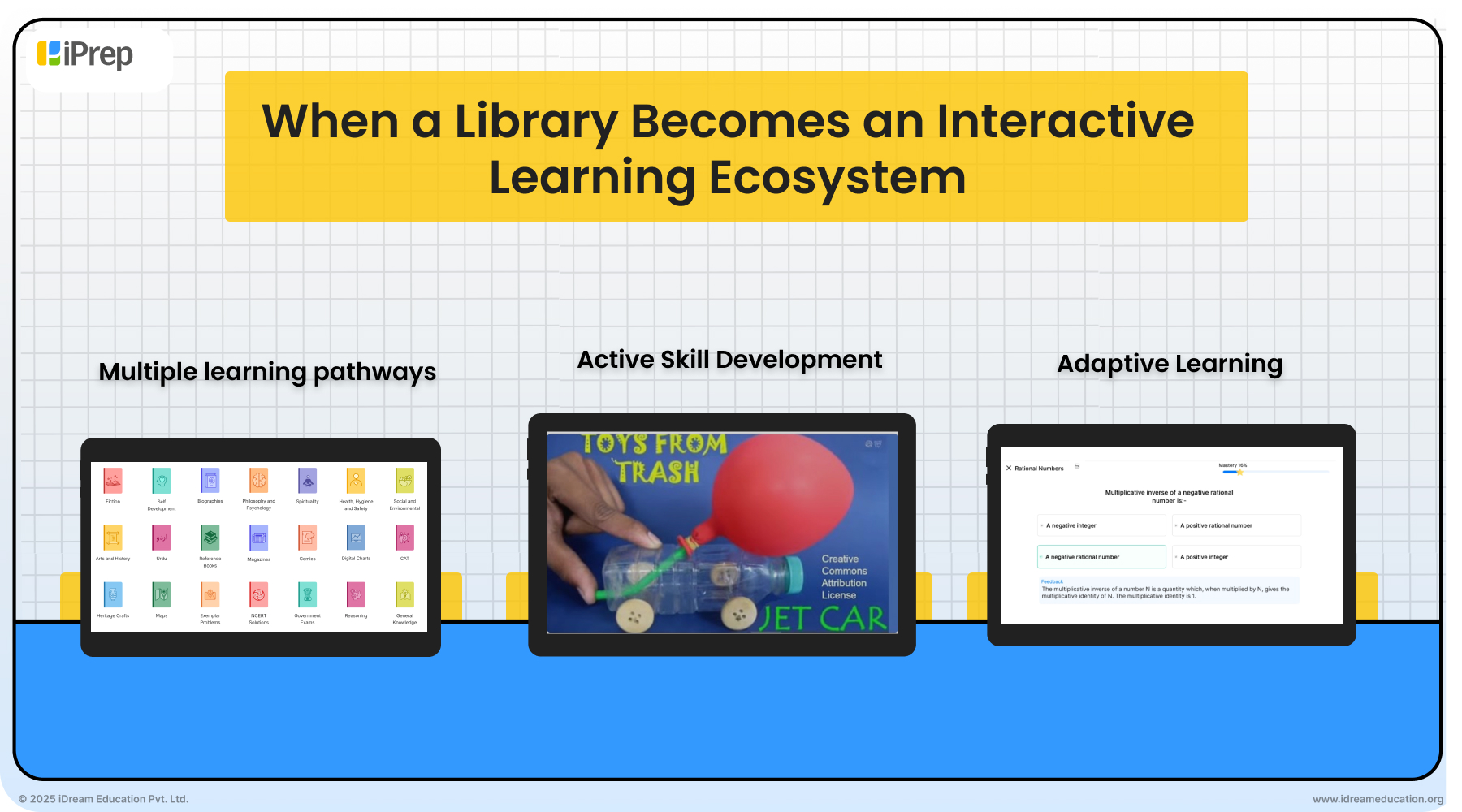
If replicating physical libraries proves slow and expensive, deploy the Interactive Digital Library (IDL) as the strategic tool for speed and infinite capacity. The Interactive Digital Library goes beyond a mere PDF collection; it delivers a curated digital ecosystem mapped directly to the student's curriculum and competency level.
The true power lies in being "Interactive." This shift transforms the library from a quiet room into a "Skill Lab" where students find:
The true power lies in being "Interactive." This means students have
- Multiple learning pathways: Easily offering animated videos, simulations, audio stories, and interactive quizzes, catering to the diverse learning styles emphasized by the NEP (reading, watching, doing).
- Active Skill Development: Including content that actively builds creativity (design challenges), collaboration (group projects), and critical thinking (real-life case studies and puzzles). The library becomes a lab where children explore skills beyond the textbook.
- Adaptive Learning: The platform can intelligently track usage, interest, and performance, adapting to recommend content that matches the student's pace and identified needs, a level of personalization impossible in print.
While these features redefine learning, the real breakthrough is how this model adapts to the difficult environments of rural India.
The Scalability Mechanism Built for the Reality of Indian Schools
Now, for the key question driving all strategic deployment: Why is the Interactive Digital Library one of the most scalable solutions right now? The answer lies in the digital turning point India has already experienced.
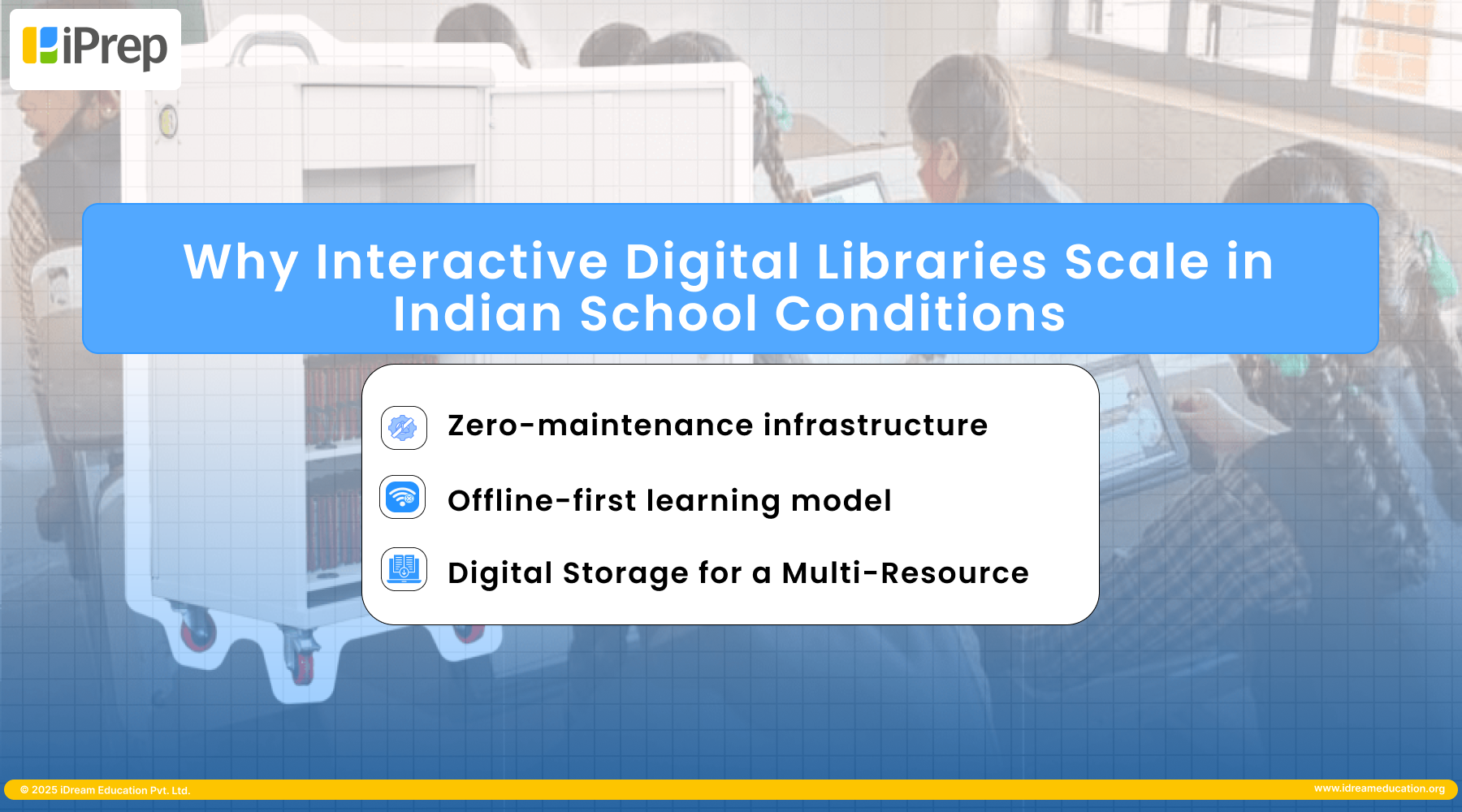
Zero-Maintenance Infrastructure
We do not need to build expensive computer labs. The Interactive Digital Library rides on the wave of low-cost Android-based devices (tablets, smart TVs, or low-cost laptops). Android has quietly become the "language" of digital access across India.
- Low Maintenance: These digital learning devices support everyday use and demand minimal maintenance compared to legacy computer systems.
- Familiarity: Teachers and students are already comfortable with basic Android navigation. This approach drastically reduces training efforts and enables rapid deployment across thousands of schools without requiring a massive change management program.
The Offline-First Model
For equity and resilience, the Interactive Digital Library cannot depend on continuous high-speed internet. Well-designed digital library content uses an offline-first, online-updated model.
- Content can be preloaded onto school devices or local servers.
- Students can use the content (watch videos, read e-books, attempt quizzes) completely offline during school hours.
- Usage data and updates sync only periodically when the internet is available.
This e-library model is perfect for remote government schools, ensuring that the students in the remotest villages. It has the same access to quality NEP-aligned content as a student in a major city.
Digital Storage for a Multi-Resource
This is the ultimate efficiency gain. A digital library’s shelf is virtually infinite.
- Cost Efficiency: The marginal cost of adding thousands of new books or videos is tiny compared to printing and shipping physical books across the country.
- Immediate Policy Compliance: When new policies or content revisions occur, the update is performed once at the source and instantly pushed to all connected devices. This ensures every student is learning from the most up-to-date material required by the NEP.
The strategic imperative for every senior leader, in government, in CSR, and in the NGO sector, is to invest in and champion the rapid deployment of the Interactive Digital Library model.
It is the critical structural component that allows us to deliver the core tenets of the NEP at scale:
- The best digital library software ensures Equity by delivering multi-format content to the last mile, regardless of connectivity.
- It ensures Relevance by allowing for continuous, immediate content updates aligned with the fast-changing 21st-century world.
- It ensures Efficiency by drastically reducing maintenance and material costs compared to physical models.
The time for pilot projects is over. Invest in the scalable future. The Interactive Digital Library is one of the most accountable ways to put a living, breathing, future-ready library into every child’s hands.
Don't let slow infrastructure limit your educational goals. Contact us today to deploy an offline-first Digital Library solution that delivers NEP-aligned learning to every remote classroom immediately.
Discover how offline interactive digital library solutions can turn your educational vision into a measurable landscape of student growth.
Connect with our team: +917678265039 | [email protected]


