

Learning in classrooms today is no longer just about delivering content. It is about how students make sense of ideas, build connections, and revisit concepts until understanding settles in.
As digital tools become a natural part of schooling, students increasingly expect learning experiences that go beyond text and explanations. They want to see how ideas work, understand why they matter, and connect concepts to the world around them. When learning feels abstract or detached from real life, attention drops and curiosity fades.
Consider how a middle-school student encounters a topic such as photosynthesis
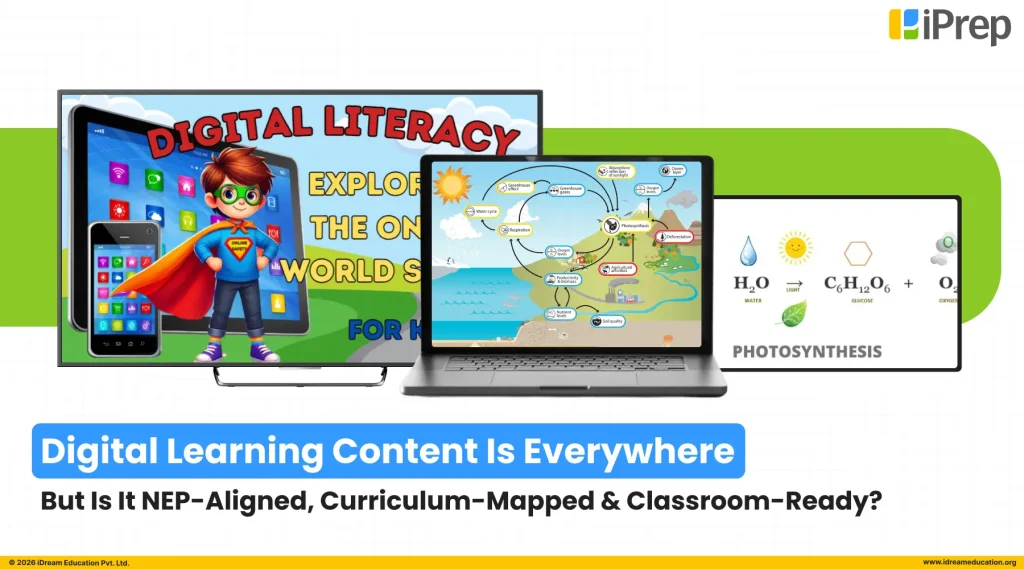
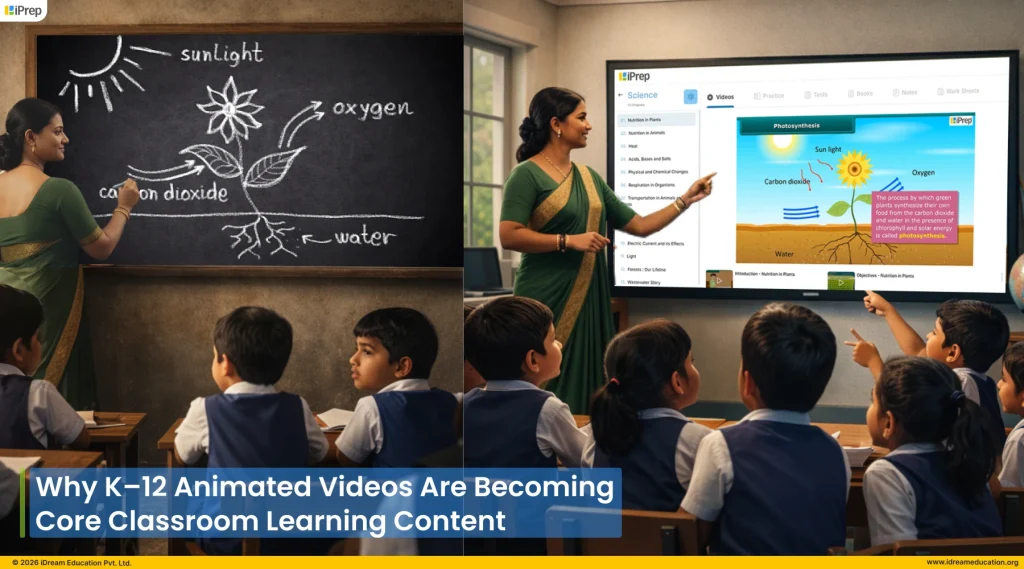
The teacher explains the process, supported by a static diagram on the board. While the information is present, the experience remains distant. The learner must imagine how sunlight, water, and cells interact. This reduces the struggle to visualize the sequence of a particular process.
Now imagine the same concept through an animated video. Sunlight visibly reaches the leaves. Water travels through the roots. Chemical reactions unfold inside the cell in a clear, step-by-step flow. The process feels alive and familiar. Learning shifts from memorising terms to understanding how nature actually works.
This difference reflects a broader shift in K-12 education. When concepts are visually sequenced and grounded in real-life contexts, learning becomes intuitive, engaging, and easier to revisit. Students can pause, replay, and return to ideas independently during class, at home, or while revising.
That is why K-12 animated videos are increasingly becoming a core digital learning content. They are not just tools for instruction, but foundational learning resources that help students connect concepts to reality, sustain curiosity, and build deeper understanding—anytime, anywhere.
Why Experiencing Learning Visually Often Works Better Than Just Hearing an Explanation
For most students, understanding does not happen by listening alone. It happens when ideas unfold in front of them, step by step, in a way that feels intuitive and connected.
When a concept is explained verbally, students are required to perform multiple mental tasks at once: listen carefully, remember previous steps, imagine abstract processes, and mentally connect cause and effect. This works for some learners, but for many, the effort goes into keeping up rather than truly understanding.
Visual learning changes this experience.
- When students see a process take shape – whether it’s a scientific reaction, a mathematical transformation, or a historical sequence – the brain no longer has to imagine the steps. The logic is visible. Each stage builds naturally on the previous one, reducing cognitive effort and making comprehension more immediate.
- This is especially powerful for concepts that involve movement, sequence, or transformation. In subjects such as science, mathematics, and geography, learning is not about isolated facts but about understanding how systems work. Animated visuals show progression, direction, and relationships in a way that static text or spoken explanations cannot.
- Another key advantage of visual learning is control. Students can pause, replay, and revisit a visual explanation as many times as needed. They are not dependent on real-time delivery or classroom pace. This sense of control encourages exploration and confidence, allowing learners to engage more deeply without fear of missing a step.
- This becomes even more critical for early learners. At younger ages, children are still developing reading ability, vocabulary, and attention span. They learn best through observation, movement, and visual cues, not lengthy verbal explanations. Animated visuals help young learners recognise patterns, associate words with actions, and understand ideas before they can fully articulate them. Learning feels closer to play – natural, exploratory, and instinctive.
- Over time, repeated visual exposure helps students build stronger mental models of concepts. Instead of memorising definitions, they remember processes. Instead of recalling isolated information, they understand connections. Learning becomes something they experience, not something they try to decode.
This is why animated videos resonate so strongly with K-12 learners. They transform explanations into experiences, making learning clearer, more engaging, and easier to retain for a long time.
If Visual Learning Works Better, How Do You Adopt Age-Appropriate Animated Content Across K-12?
Recognising the value of visual learning is only the first step. The real challenge lies in ensuring that students, across age groups, have access to animated content that is developmentally appropriate, conceptually accurate, and designed as per their school curriculum.
A five-year-old and a fifteen-year-old may be learning science, but they do not process information in the same way. Early learners need simple narratives, familiar visuals, limited on-screen elements, and clear cause-and-effect cues. As students grow older, they require deeper explanations, layered visuals, and representations that connect abstract ideas to real-world applications. Age-appropriate animation is not about simplifying content – it is about structuring complexity in the right way.
Effective adoption begins with curriculum alignment
Animated videos must follow grade-wise learning objectives, introduce concepts in a logical sequence, and use terminology that matches students’ textbooks. When visuals align closely with what students are expected to learn, animated content becomes a reliable learning reference – not just an engaging experience.
Consistency Ensures Seamless Learning Across Grades
Students benefit when K12 animated videos if it is an instructional approach. It should remain coherent across subjects and grades. This consistency helps learners focus on understanding concepts rather than adjusting to new formats or presentation styles each time they access content.
Promote Grade Level Learning
Finally, adoption succeeds when animated content is positioned not as supplementary material, but as core learning content. When students know that the animated video explains the concept clearly, completely, and in line with their grade level, it becomes their first point of reference for learning, revision, and reinforcement.
That is how age-appropriate K12 animated videos move from being visually impressive to being educationally impactful, supporting learners across the entire K-12 journey.
Finding a certified K12 Digital Learning Platform that offers K12 Video Animations
Why a certified K12 Digital Learning Platform? While deciding which K12 Animations to choose for your smart classrooms and students’ learning devices, it is important to avoid the trap of poor quality Animated video content. There are many providers in Edtech that do not lay emphasis on quality, depth, and instilling learning value in Animated learning content for K-12. Thankfully, credible certifications offer a practical way to filter such options. By examining how Animated learning content for K-12 are structured, curriculum-aligned, and supported through features such as navigation, practice, assessment, and revision material, these certifications help schools identify platforms that are designed for meaningful classroom learning rather than surface-level content.
But there are very few digital content providers in India who are certified as one of the best K12 Digital Content providers. We are one such provider, backed by recognised and credible certifications. Our work includes a signed MoU with NCERT to develop curriculum-aligned content and an LMS in line with the National Education Policy. We are also certified by EdTech Tulna.
Key insights on what to look for when evaluating a K-12 Animated Video for Digital Classrooms Solutions
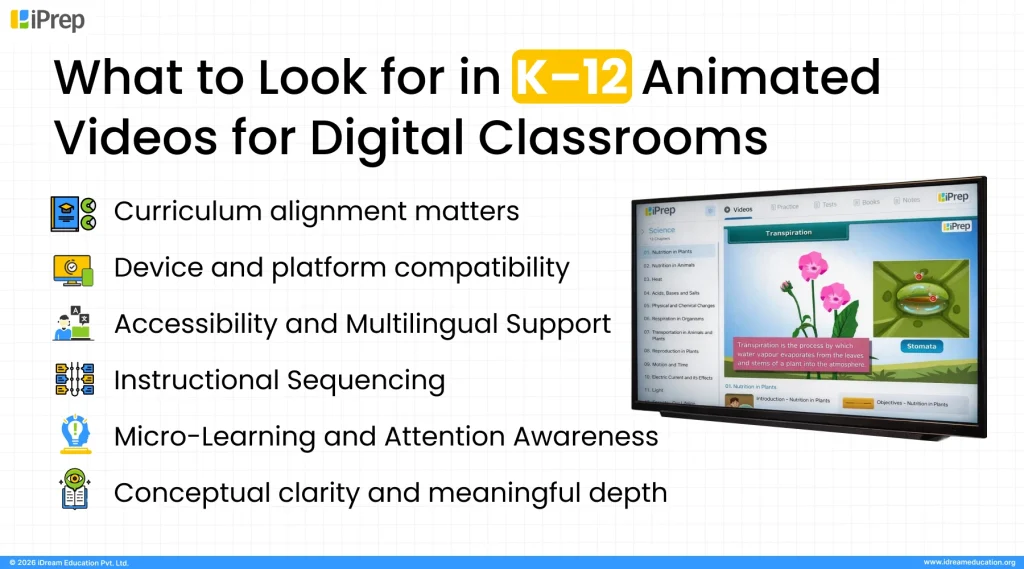
As K12 animated videos increasingly become core digital learning content, evaluating them requires more than checking visual appeal. The real question is whether the content genuinely supports how students learn, understand, and apply concepts across grades. Key things you should look at:
- Curriculum alignment matters: Is the content mapped to NCERT, CBSE, or State Board frameworks? Does it follow the right grade-level textbooks and objectives? When content mirrors what students are expected to learn in school, it becomes a reliable reference rather than parallel material.
- Conceptual clarity and meaningful depth: Good animation goes beyond simplification. It explains concepts with depth, showing students how ideas work, why they matter, and their real-life connections. Strong visuals move learners from memorization to true understanding of processes, relationships, and outcomes.
- Instructional Sequencing: Each K12 animated video should follow a clear, logical flow, where one idea naturally leads to the next. Well-sequenced visuals help students build mental connections, understand cause-and-effect relationships, and retain learning more effectively.
- Accessibility and Multilingual Support: In the Indian classroom context, language plays a critical role in comprehension. K12 animated video content should be available in the languages commonly used in classrooms, enabling students to learn comfortably in their familiar language.
- Device and platform compatibility: For animated content to be truly usable at scale, it must work seamlessly across devices, tablets, computers, Chromebooks, and smart classroom systems. Flexibility across platforms ensures that learning remains uninterrupted, whether content is accessed in school, at home, or through shared digital infrastructure.
- Micro-Learning and Attention Awareness: Students today engage better with bite-sized, well-structured videos. Short, focused K-12 animated modules respect attention spans, enable easy revisits, simplify revision, and help students stay engaged without cognitive overload.
Together, these factors determine whether animated videos function merely as engaging visuals or evolve into effective, student-centric learning solutions for digital classrooms across K-12.
If you’re looking for K12 animated videos for your digital learning program & wish to see the demo of it, you may contact us at +91 7678265039. You can also write to us at share@idreameducation.org or share your details here
Categories You may Explore
Related Articles