

For the last few years, the world has been witness to some serious wars and regional conflicts. In 2026, the situation has worsened and the need to stabilize the future of humanity, our children, is more grave than ever.
Sustaining Education amidst crisis
The pressing question is how can nations, that are already paying the price for serious conflict and wars, facing serious calamities, destroyed infrastructure and either a complete lack of internet connectivity or limited connectivity, survive their education systems.
In such a scenario, the challenge is not that there is a lack of intent or resource. Recovery is top of mind in the responsible offices of organizations such as UNICEF and other development organizations, IRC and other iNGOs, Multilaterals, National Governments, Education Planners. Nor is there a lack of action backed commitment to stabilize learning. But how can seamless learning not only survive but thrive with offline learning applications, ones that do not depend on internet connectivity?
In this blog, we will explore all resolute options that can ensure an urgent bounce back of learning. We will discuss sustainable and scalable solutions to the problems of these times. We will also briefly discuss and explore solutions to another war, one is happening in peacetime. How to secure and safeguard our children from the perils of Social Media, Internet and AI? These often take the form of cyberbullying, misinformation, student distraction & learning gaps, peer pressure and significant threats to the safety of children on the internet.
234 million school aged children are in urgent need of education support due to crises like armed conflict
This is what the current estimates of UNICEF indicate. 474 million children, which is one sixth of the number of children globally, live in conflict affected areas. The gruesome nature of this crisis is better understood when one realizes that for a large population of these children, this disruption may not be temporary, it extends over months and often years. Absence of structured learning directly impacts their foundational learning which compounds every year making students to be lower than their grade level.
I’ll give you an example of my own son here. During the pandemic we moved to remote learning and remote working. I was working from home, busy with my calls. My son would often be attending periods of his school day with little monitoring. A year after the pandemic, my son, now in grade 8, could not understand decimals because he did not learn fractions. When confronted why it is so (as I spotted there was a clear learning gap), he told me, ‘I used to skip some classes and oftentimes I would exit a class before it was over’. While the situation during the pandemic in India was not so grave as it is now or it was earlier for some war stricken countries, it took almost a year to come back to grade level and a lot of effort from both his side, his teachers and his parents. Now you can imagine the plight of children in war stricken nations. These students often miss learning and classes for long periods of time.
Which are the countries facing Disruption in Education due to Wars in 2026
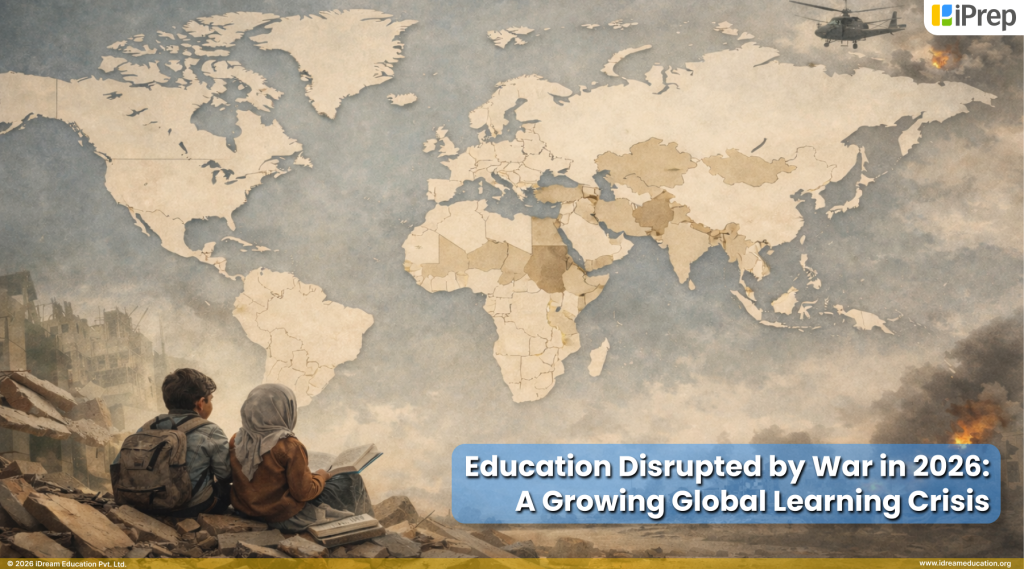
There is a large-scale disruption in Ukraine and Gaza, both nations have been in elongated wars while Syria, Yemen and DR of Congo are battling prolonged or recurring conflict leading to a complete or partial standstill in learning for millions of students.
What makes this situation more complex is that many of these countries were already grappling with fragile education systems. Conflict has only deepened the divide, pushing millions of children out of structured learning environments and into prolonged uncertainty. In Gaza alone, over 90% of school buildings have been either damaged or destroyed. Schools are now shelter places for displaced families with hundreds of thousands of children having completely lost access to formal education.
Recent Conflicts and Their Impact on Education Systems
In March 2026, many regions across the Middle East and parts of Asia are witnessing escalating conflicts that will have an immediate, mid-term and long term impact, leading not just to disruption but a structural breakdown of education systems and infrastructure.
In Iran, the situation is even grim, schools have been under direct attack by missiles and an estimated 100 children were killed during school hours. 65 schools have been destroyed with infrastructure collapse, electricity shortages, and safety risks.
In UAE, board exams have been cancelled due to regional instability and this has already impacted thousands of students. As per estimates of Save the Children, over 52 million students in Middle Eastern countries face Education disruption.
In Gulf countries, schools have moved to online only learning. There is rampant spill over of destruction and its results in neighbouring countries of Iraq, Jordan, Oman that are receiving an influx of refugees, displaced students, breaks in internet connectivity.
Cambodia is also at brink of wide-scale breakdown of the education system and the situation in the South East Asian Region such as the one with Afghanistan & Pakistan put further risk to countries like Cambodia that may not face direct large scale destruction but due to lack of preparedness, heavy dependence on physical schooling and limited digital infrastructure in rural areas make education vulnerable without continuity mechanisms in place.
What does this mean for Education Systems in these countries?
- Even stable countries are forced into temporary shutdowns of education systems
- Physical schooling can no longer be the status quo and there is need for digital learning
- Longer conflicts leading to higher changes of large scale permanent drop outs and generational losses of learning
This is precisely why offline-first, resilient digital learning ecosystems are no longer optional – they are essential infrastructure for education continuity in conflict-prone regions.
How can technology safeguard the education of children in conflict?
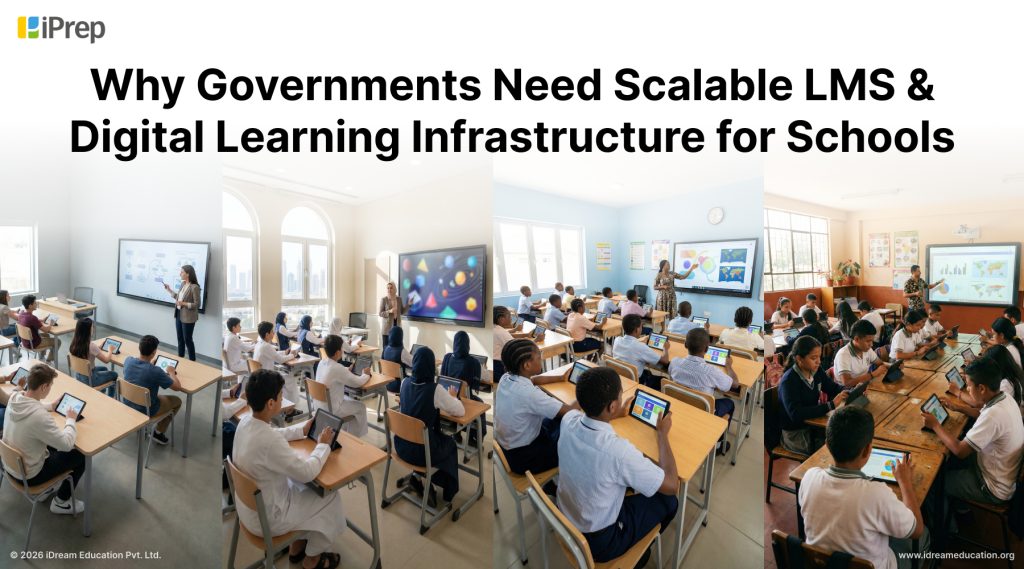
Technology in such environments has to shift from being a mere enhancement to becoming the backbone of education delivery. This will not only help in short and medium term recovery but especially in developing countries, this will yield long term dividends in terms of education outcomes and the quality of workforce. A structured LMS and Digital Learning Infrastructure can enable large scale education programmes that thrive in peace time and also during conflict.
Through education technology and careful & smart planning by the coveted offices of Development bodies of the world such as the Global Partnership for Education (GPE), independent work by bodies such as UNICEF, World Bank, Governments, NGOs, Multi-laterals, Education Programme planners, large School groups, a permanent and irreversible system can be set up using technology that only evolves with time.
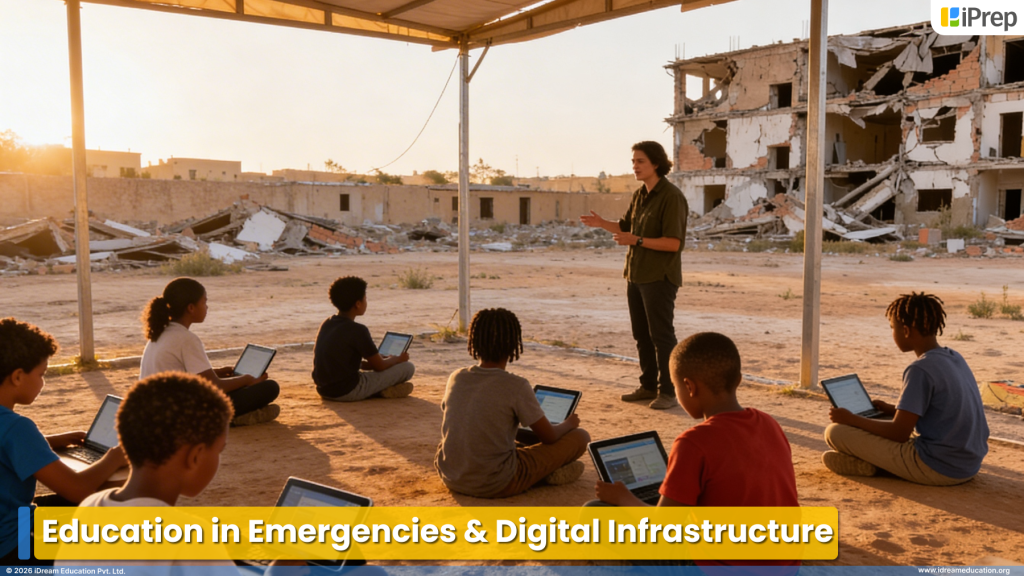
What is Education in Emergencies (EiE) and Why It Needs Digital Infrastructure
Education during Emergencies is the provision of safe, inclusive and continuous learning for children and youth who are affected by crises such as armed conflict, natural disasters, regional disturbances. It is a globally recognized framework led by organizations such as UNESCO, UNICEF. It goes beyond temporary schooling and focuses on providing students structured learning environments, protection from harm and distress, and continuity in their foundational learning. We’ve seen above how conflicts impact learning and how technology, digital learning infrastructure and Learning management systems emerge as a sustainable solution. Education during Emergencies therefore requires Digital Learning Infrastructure that enables learning in times of crises. Students should be able to learn at home in a controlled and secure environment that prevents them from the harms and distraction of the Internet and AI & misinformation, even when learning is accessible in school but surely when it is not!
Students and teachers must be connected with students engaged, monitored, assigned work, with progress tracking and transparent learning improvement measurement. Structured learning systems enabled with technology and rich academic content also enables inclusion of life skills, safety awareness and responsible use of AI leading to holistic growth of students to face and overcome challenges of both conflict and peacetime.
Digital Learning Solutions for war struck countries
Continuity of learning requires resilient and adaptable approaches beyond traditional systems such as:
Low-bandwidth and offline solutions become critical in such environments.
Alternative mediums like radio, TV, and portable digital content can bridge access gaps.
Community-driven efforts and local teacher support play a key role in sustaining learning.
Flexible curricula and delivery models help accommodate disrupted learning conditions.
Structured combination of digital content and a learning management system
In war stricken countries, the focus must shift to ensuring learning continuity, no matter the circumstances. A well structured combination of digital content and a learning management system ensures education remains organized and goal oriented, and caters to the unique needs of every geography. Digital learning infrastructure enables these programmes for success. It includes learning devices that work offline during peacetime and conflict, that enables personalized, hybrid and remote learning at school, and at home ensures learning continues anytime, anywhere.
Offline-first learning systems emerge as the most effective solution, enabling access to high-quality, curriculum-aligned content without dependence on continuous internet connectivity. Delivered through tablets or shared digital devices, these systems ensure that learning continues anytime, anywhere.
By enabling 20 to 60 devices to serve hundreds of students, they create a scalable and cost-effective model for large populations. When combined with curated digital book collections, they also help build a culture of reading—an essential component of long-term learning.
Adaptive learning systems play a transformative role in addressing learning gaps. By assessing each student’s level and providing personalized pathways, they help students recover lost ground and progress at their own pace. Additionally, enabling educators and planners to create and deploy customized content ensures that solutions remain relevant across geographies, languages, and curricula.
Sustainability of Digital Learning in Conflict zones
Sustainability in conflict zones is not just about continuity during disruption. It is about building systems that remain effective across both crisis and stability. Digital learning solutions, when designed thoughtfully, offer exactly this dual advantage.
Offline capability ensures resilience, while modular and scalable architecture allows programmes to expand across regions, states, and even countries. Integration with existing education systems and databases enables seamless reporting, monitoring, and long-term impact assessment. This data-driven approach empowers governments and organizations to make informed decisions and continuously improve programme effectiveness.
Cost efficiency also becomes a critical factor. Shared infrastructure, reusable digital content, and centralized management systems create economies of scale, making large-scale deployment financially viable. At the same time, ensuring data security and controlled access safeguards both the learning ecosystem and the students it serves.
Finally, let’s explore how Digital Learning Solutions can be enabled to ensure learning continuity during a crisis
Immediate and Mid term Solutions for Education during Crises
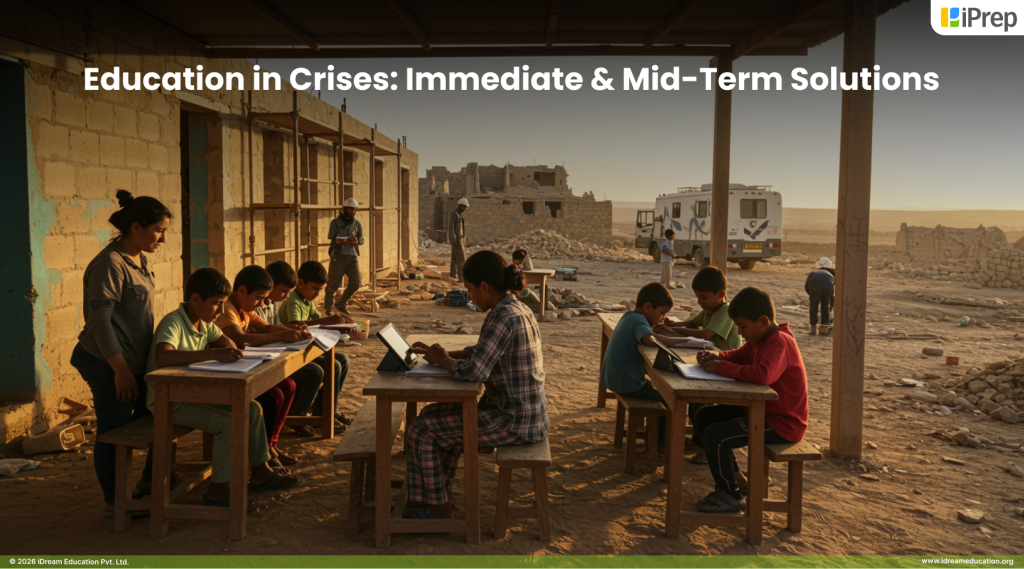
Temporary and Safe Learning Spaces
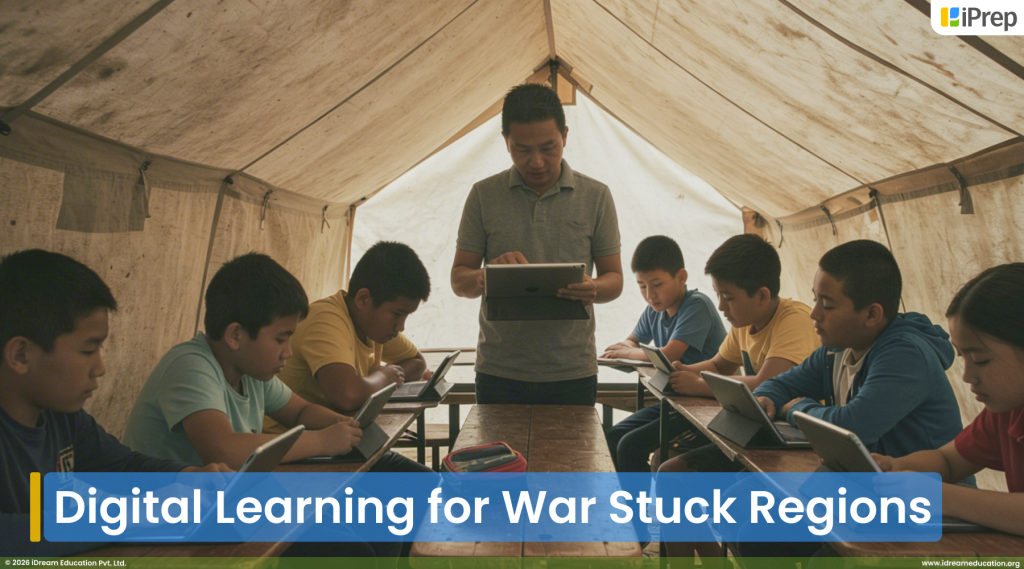
- Temporary Learning Centres in camps or affected communities
- “School-in-a-box” kits with books and teaching materials
- Community-based learning spaces
Shared Learning Infrastructure
- Learning hubs in refugee camps or communities
- Mobile libraries and pop-up digital libraries
- Community digital learning centres
No-Tech and Low-Tech Learning
- Radio-based education programs
- TV broadcast lessons
- Printed worksheets and home learning kits
Emergency Remote Learning
- WhatsApp or SMS-based assignments
- Basic mobile learning platforms
- Teacher-student communication via phone
Teacher-Led Continuity
- Teachers assigning work remotely
- Homework collection via phone or physical submission points
- Regular teacher check-ins with students
Psychosocial and Structured Learning Support
- Trauma-informed learning approaches
- Structured routines to maintain learning continuity
Digital Learning Platforms (Online and Offline)
- Learning Management Systems (LMS) with content, assessments, and tracking
- Offline-first learning applications
- National or regional digital learning platforms
Device-Based Learning Access
- Tablets or devices distributed by governments or NGOs
- Preloaded content for curriculum and skill development
Shared Device Models
- Digital libraries with shared devices serving large student groups
- Device-sharing in schools and community centres
Personalized and Adaptive Learning
- Diagnostic assessments to identify learning gaps
- Individualized learning pathways
- Learning recovery programs
Hybrid and Blended Learning Models
- Combination of classroom, digital, and home-based learning
- Flexible learning approaches based on context
Teacher Enablement Systems
- Teacher training in digital pedagogy
- Teacher dashboards and tools
- Remote monitoring and support systems
Learning Monitoring and Tracking
- Student usage and engagement analytics
- Progress tracking systems
- Remote assessments
Content Localization
- Multi-language content
- Curriculum aligned to local contexts
Long-Term and System-Level Solutions to sustain education in conflict affected nations
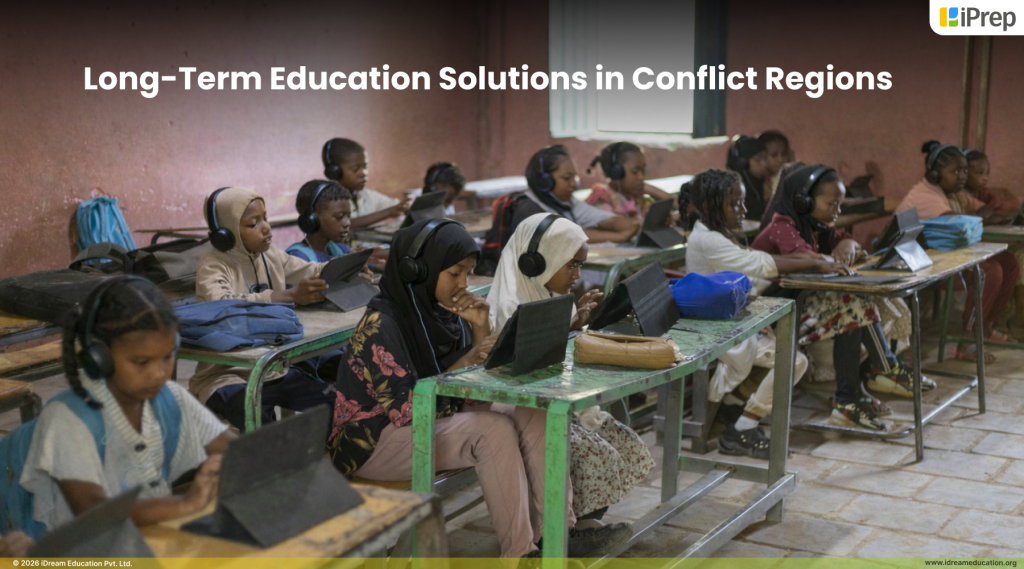
National Digital Learning Infrastructure
- Government-led LMS platforms
- Integration with education databases
- Scalable national systems
Offline-First Learning Ecosystems
- Preloaded devices and content
- Local servers or intranet-based learning
- Minimal or no internet dependency
Flexible Learning Models
- Learning across school, home, and remote environments
- Anytime, anywhere access to learning
Digital Libraries at Scale
- Regional or national digital libraries
- Access to academic and non-academic content
Learning Recovery Systems
- Large-scale adaptive learning programs
- Focus on foundational literacy and numeracy
Multi-Stakeholder Ecosystems
- Collaboration between governments, NGOs, and private sector
- Public-private partnerships
Data and Impact Systems
- Real-time dashboards
- Program monitoring and evaluation
- Evidence-based decision making
Crisis-Ready Education Systems
- Preparedness planning for disruptions
- Rapid response mechanisms
- Ability to shift between physical, digital, and hybrid learning
Globally, learning continuity during crises is ensured through a combination of temporary learning spaces, low-tech and digital delivery models, shared and personal device access, adaptive learning systems, and resilient digital infrastructure that enables education to continue anytime and anywhere.
Concluding:
In a world where disruptions are becoming the norm, education systems must be built to withstand them. Learning cannot pause every time a crisis unfolds.
The solutions already exist—offline-first digital learning, shared access models, adaptive learning, and connected teaching systems can ensure that education continues anytime, anywhere, even in the most challenging environments.
What is needed now is decisive action at scale.
If you are a government body, NGO, CSR leader, or education partner working in conflict-affected or low-connectivity regions, this is the moment to invest in resilient learning systems that safeguard the future of millions of children. Choosing the right partner is critical to ensure continuity, scale and measurable impact. Explore how offline-first, digital learning ecosystems can be deployed across your programmes-designed for low connectivity, crises, and large populations environments.
Let’s work together to ensure that no child’s learning stops—no matter the circumstance.
For queries, reach out to +91 76782 65039 or email us at share@idreameducation.org
Categories You may Explore
Related Articles