
Discover how School e-Library bridges learning gaps with offline, NEP-aligned e-resources for government schools.
In an urban private school, a student walks into a library that looks like a sanctuary of knowledge. It is filled with thousands of physical books, quiet reading nooks, and a specialised librarian who curates "reading paths" for every child.
Now, travel 500 kilometres away to a government school in a remote village. Here, the "library" is often a single locked almirah in the principal's office, containing a few dusty textbooks and outdated encyclopedias.
For decades, this has been the unspoken divide in Indian education. While Private school students have been culture of diverse reading. Government school students, who represent the vast majority of our nation's potential, have been limited to grade-level textbooks.
As senior leaders in CSR, NGOs, and the government, we must ask ourselves:
If we want the next generation to be "future-ready," how can we expect them to compete when they don't even have access to the same world of stories, skills, and knowledge?
Why are physical libraries not enough?
When we see this gap, our first instinct is often to build more physical libraries. It is a noble thought, but we must ask: Is the physical library system truly solvable for the remote corners of India?
The answer, unfortunately, is no.
Even if we had the massive budget required to ship thousands of books to every rare corner of the country, we face the Update Dilemma. A physical book is static. In a world where technology, vocational skills, and global trends change every six months, a physical library turns into a museum of the past almost instantly after construction. We cannot "update", i.e continuously add new books, once a library is set up in a mountain village.
Furthermore, today’s world has changed. Relying only on theory and academic learning no longer works. Students need exposure to life skills, financial literacy, and hobby-based learning. A standard government school library rarely has the space, the budget, or the specialized staff to curate these "non-academic" resources.
Yet, the potential in our government schools is immense simply because of the numbers. With a student population far larger than the private sector, these children are the future workforce of India. If we cannot reach them with a physical library, we must find an alternative that scales as fast as their curiosity.
This is where we move beyond the wooden cupboard and replace it with a digital window that fits in a student's hand.
What Does a School e-Library Look Like?
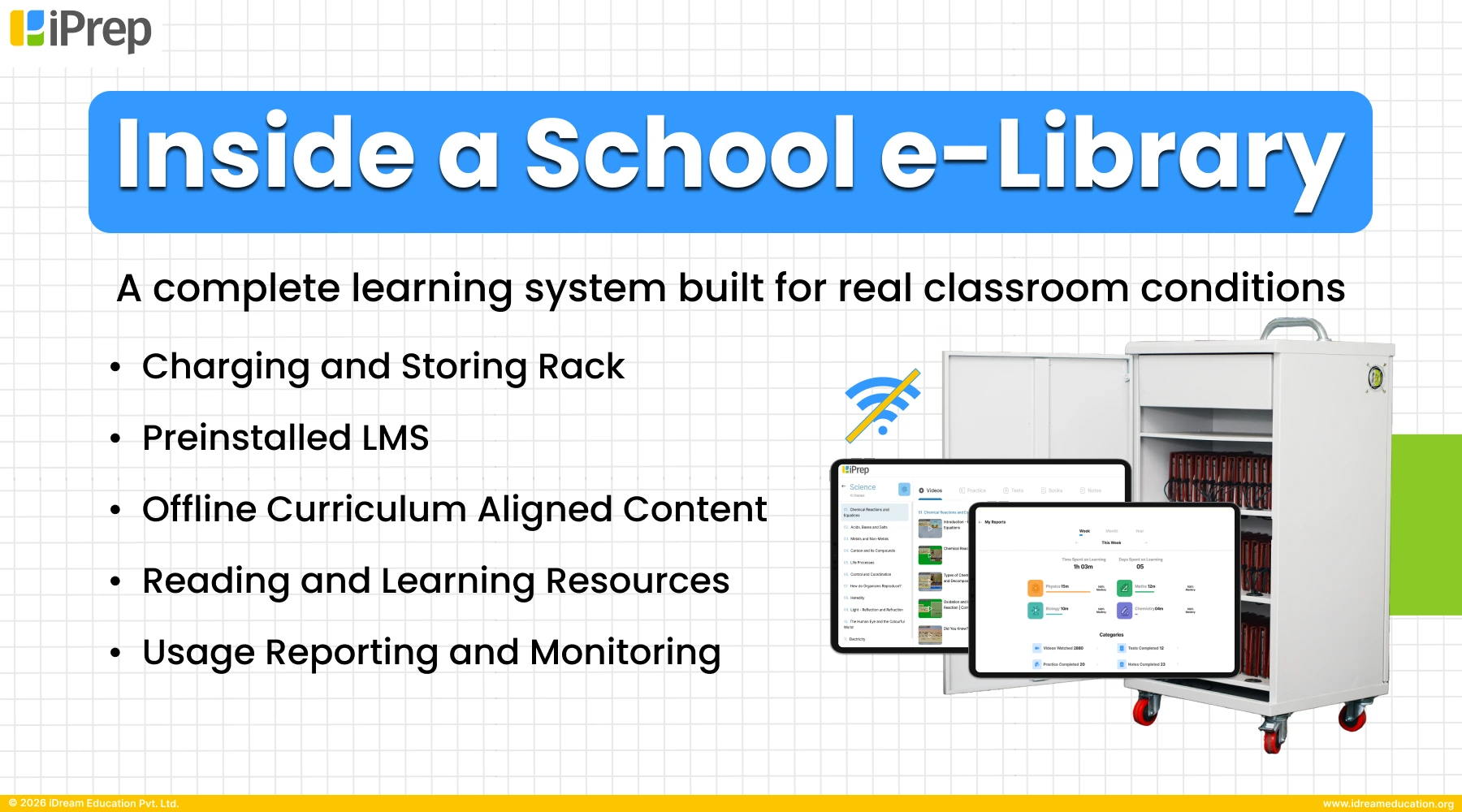
A School e-Library isn't just a "website" or a "concept", it is a robust, physical infrastructure designed specifically for the Indian heartland. To bridge the gap between the child and the world of knowledge, the system arrives as a complete, portable ecosystem:
- Hardware and Storage Devices: Instead of heavy, dust-gathering shelves, the e-library consists of a sleek Charging Rack housing 10, 20, or 30 rugged Tablets or Laptops. These are portable, easy to handle, and built for the durability required in a rural school.
- Preloaded Digital Content: Every device comes pre-configured with a universe of content from a K-12 learning platform, which includes curriculum and digital storybooks to vocational video tutorials and life-skills modules.
- The Offline LMS: The "brain" of the system is an Offline Learning Management System (LMS). It requires zero internet. Students log in, explore, and learn entirely offline, ensuring that a lack of connectivity never stops a child's curiosity.
- Data Synchronisation and Reporting: While the learning happens offline, the accountability is online. The system records every second of usage data. The moment a teacher connects to a local network via phone or dongle, the system syncs this data to an Online Dashboard.
How can an e-Library for schools be a Gateway to Unlocking Limitless Potential?
By moving from physical paper to digital storage, the limitations of geography simply vanish. This transition allows us to reach every corner of the country with Portability. Unlike a physical building, an e-library holds vast resources that would need a massive hall. Yet it reaches remote "PM SHRI" schools effortlessly.
Furthermore, resilience defines its core design. It functions in an offline world and scales beyond the power grid. A single charge delivers 5-6 hours of uninterrupted exploration. A child's learning continues even when the lights go out.
For a CSR leader and NGO partners, this is the moment of greatest opportunity. By investing in digital libraries for rural schools, you are not just giving gadgets. You are installing an infrastructure of equity. You are giving a child in a government school the same search and find power that a child in a high-end private school takes for granted.
Bringing a National Vision to Life through Schools and Beyond
This shift isn't just a dream, it is becoming a national mandate. Our government has recognized that the physical limitations of the past cannot dictate the future of our children.
Prime Minister Narendra Modi emphasised that in every corner of our country, digital library setups will be established. This vision is already being codified in the PM SHRI (Prime Minister Schools for Rising India) policy. The mandate is clear: PM SHRI schools are expected to feature digital libraries that provide personalized, NEP-aligned e-learning experiences.
For CSR leaders and NGO partners, this is the moment of greatest opportunity. By investing in School e-Libraries content, you are not just "donating gadgets." You are installing an Infrastructure of Equity. You are giving a child in a government school the same "search and find" power that a child in a high-end private school takes for granted.
School e-Library Is The 21st-Century Equalizer
The physical library was a 20th-century solution. The School e-Library is the 21st-century equalizer. It ensures no child falls behind just because they live in a remote corner of the country.
When the children of 2026 look back, will they remember the locked almirah or the digital window that opened the world to them?
If you are looking to implement NEP-aligned digital libraries in PM SHRI schools or CSR projects, reach out to us at +917678265039 or email us at [email protected]. You can also share your details here.


