48% of Smart Class Content Usage During Exams Came from One Category – What Did Teachers Use the Most?


When you invest in smart classrooms, the expectation is clear – better teaching, more engaging lessons, and improved learning outcomes. But in reality, the success of any smart class implementation depends on one critical factor: how effectively teachers use the smart class content available to them.
Because smart class content, by itself, does not drive impact. Its usage does. And that smart class usage is not automatic.
It is shaped by how comfortable teachers feel navigating smart class content, how easily they can integrate it into their daily teaching, and most importantly, how they have been trained to experience and use it in real classroom scenarios.
In many schools, smart boards remain underutilized not due to lack of content but due to a gap in experiential teacher training. Training that goes beyond features and focuses on how content can actually support teaching during real classroom instruction such as concept explanation, practice, reading sessions, exam revision and so much more.
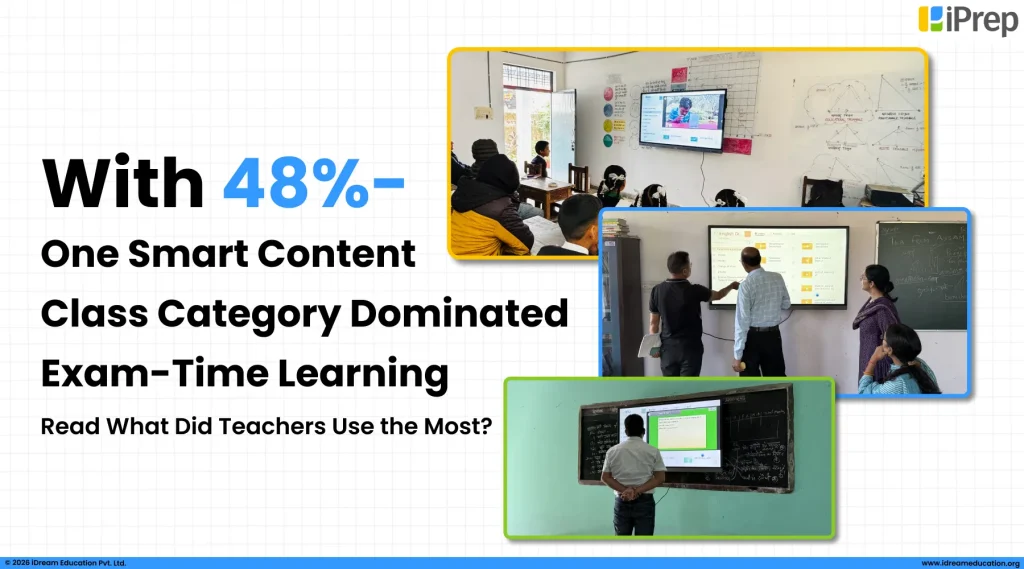
In one of our smart classroom implementations across schools in Pauri Garhwal, Uttarakhand, we observed this shift closely.
As teachers became more familiar and confident through continuous, hands-on support, their usage of iPrep smart class content evolved. From occasional usage of animated video lessons to purpose-driven practice, book reading and revision sessions, aligned with classroom needs.
During exam time, this behavior became even more focused – teachers weren’t exploring or experimenting; they were selecting what worked best for quick, effective revision. In fact, just a month before exams, 48% of all smart class content usage came from a single category – NOTES.
What Was Enabled for Teachers in This Smart Classroom Implementation?
To understand this shift in usage, it’s important to first look at what was made available to teachers.
This initiative was part of an NGO-led digital learning program across 12 schools in Pauri Garhwal, Uttarakhand, where each school was equipped with 12 smart classrooms. Teachers were given access to Uttarakhand board aligned smart class content for Classes 1 to 12, available in both English and Hindi.
But more importantly, teachers didn’t just receive content – they went through experiential teacher training. This training focused not on what the platform offers, but on how to actually use smart class content in the classroom, including:
- Conducting interactive classroom quizzes using practice questions
- Using animated video lessons for concept explanation
- Enabling guided reading sessions through books
- Supporting structured revision before exams through Notes
As a result, smart class content became an integral part of everyday teaching practice. Teachers regularly used a mix of content formats. They used video lessons primarily for lesson delivery, books and reading materials when conducting reading sessions, and practice questions and assessments to reinforce learning.
The most inspiring shift in smart class content usage pattern was seen in the month of February – right before exams
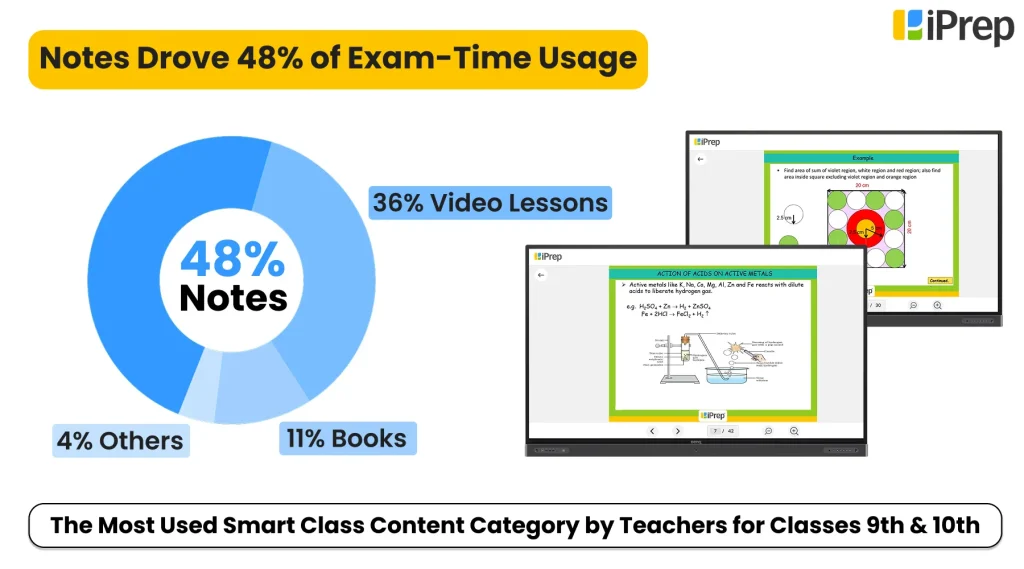
Instead of distributing their usage across multiple formats, their behavior became highly focused and purpose-driven. It was aligned with the immediate need for revision and exam preparation, especially for Classes 9 and 10. The data revealed a clear pattern:
- 48% – Notes
- 36% – Video Lessons
- 11% – Books
- 4% – Other multimedia content
Why Did Notes Emerge as the Most Used Smart Class Content Category in the month of February?
At first glance, the 48% usage of Notes may seem like a simple preference. But when viewed in the context of classroom realities, it reveals something far more meaningful. During exam time, especially for Classes 9 and 10, teachers operate under multiple pressures of:
- Limited time to revise vast portions of the syllabus
- The need to ensure conceptual clarity across all students
- The urgency to focus on what is most important from an exam perspective
In such moments, the choice of content is no longer about variety – it is about efficiency and outcomes.
This is where Notes stood out.
Unlike videos, which require time to watch, or practice questions, which depend on prior understanding, Notes offer immediate consolidation of learning. They act as a bridge between teaching and recall.
With a dedicated “Notes” category integrated into the smart class content, teachers were able to:
- Quickly navigate entire chapters in minutes, not periods
- Bring students’ attention to complex concepts
- Reinforce formulas, definitions, and key explanations in one place
- Create a shared revision experience where the whole class moves together
Instead of revisiting everything, teachers focused on what truly matters in a specific month of the academic year.
What This Tells Us About Smart Class Content Usage?
This shift toward Notes reflects a deeper evolution in how teachers engage with smart classrooms. When smart class implementations begin, usage is often exploratory: Teachers try videos, navigate different formats, and experiment with what works. But over time, especially with consistent, experiential training – the usage pattern changes. Usage becomes:
- Intent-driven, not feature-driven
- Contextual, not generic
- Focused on classroom outcomes, not just content consumption
The February data from a school of Pauri Garhwal captures this transition clearly.
Teachers were no longer asking, “What can I use?”
They were asking, “What will work best right now?”
And during exams, the answer was clear.
This case highlights a critical insight for everyone working on digital learning initiatives:
Content alone does not drive adoption – contextual usage does. No matter how rich or well-designed the content is, its real impact depends on how naturally it fits into the classroom and how confidently teachers can use it in real teaching moments.
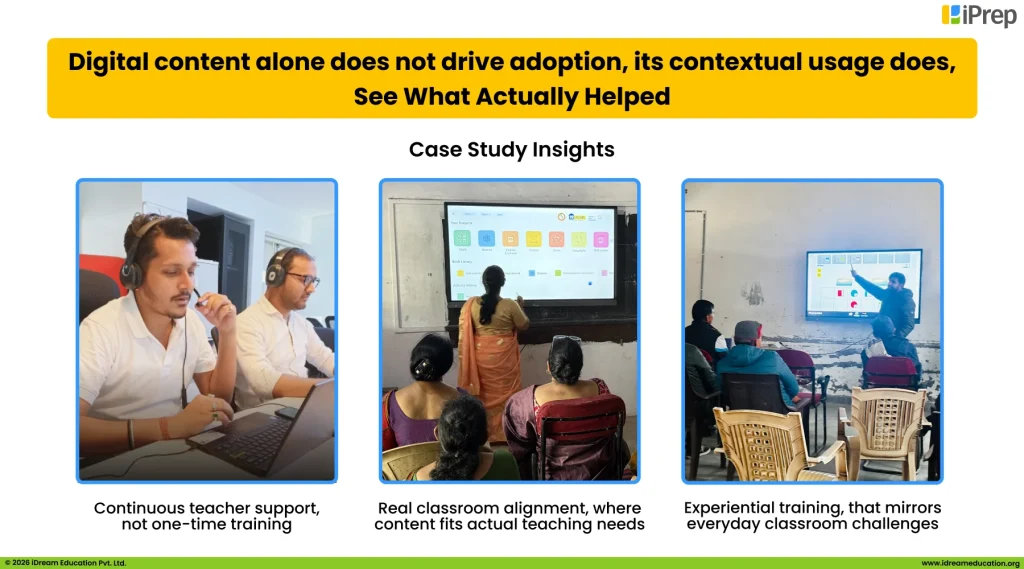
And contextual usage doesn’t happen by default. It is built over time by your digital content partner through:
- Continuous teacher support, not one-time training
- Real classroom alignment, where content fits actual teaching needs
- Experiential training, that mirrors everyday classroom challenges
At the core of every successful digital learning initiative is not just access to technology, but access to the right digital content used in the right way
Based on our work with government schools across India, we have seen that the real impact of digital learning initiatives comes when smart class content is not just available, but truly usable in everyday classrooms. When content is aligned with textbooks and state boards, available in multimedia formats, and designed to support different classroom needs, it naturally becomes more relevant for teachers. However, consistent usage is driven not just by access, but by the continuous support and experiential training provided to teachers. When teachers are regularly guided in real classroom contexts, they build the confidence to actively use smart class content and understand which content category works best at different moments. This is what enables a shift from passive usage to purposeful, contextual integration in daily teaching. Through this approach, we have been able to drive stronger and more consistent usage, while also improving learning outcomes across multiple digital/smart classroom projects in government schools.
If you would like to understand smart class content usage patterns, explore our smart class content, or learn more about our approach, you may connect with us at +91 7678265039. You can also write to us share@idreameducation.org or share your details here
Categories You may Explore
Related Articles


Ayushi Agarwal

Ayushi Agarwal
Ayushi Agarwal is a Manager - Marketing & Growth at iDream Education. With 8+ years of writing, her focus has shifted passionately to education over the past two years. Her dedication lies in researching and crafting content around solutions that address learning gaps, drive sustainable digital learning programs, empower last-mile learners, and ensure educational access for all. This commitment makes her work a valuable asset for social sector leaders seeking to drive change.