

Teaching today is like walking into a classroom already full of expectations. Students look for clarity, principals look for results, and parents hope their child gets attention. In the middle of all this, a teacher is expected to plan lessons, manage diverse learning levels/styles, build interest, assess progress, and still complete the syllabus in time.
But here’s the reality: most teachers don’t receive ongoing support on how to teach better, they are only guided on what to teach.
The government, through NEP 2020 and other guidelines such as ICT under Samagra Shiksha, recognises this gap and emphasises the need to equip teachers with structured tools, content and guidance. Also, when teachers receive easy-to-use resources linked to pedagogy, their classroom delivery improves and students learn better. In fact, structured teaching support leads to the most consistent improvement in learning outcomes in developing education systems.
That’s where a Teacher Resource Package (TRP) comes in.
Instead of leaving teachers to plan everything from scratch, a teacher resource package provides ready multi-category resources for lesson plans, activities, classroom strategies, assessments, and examples of how to teach concepts more effectively.
What is a Teacher Resource Package (TRP)?
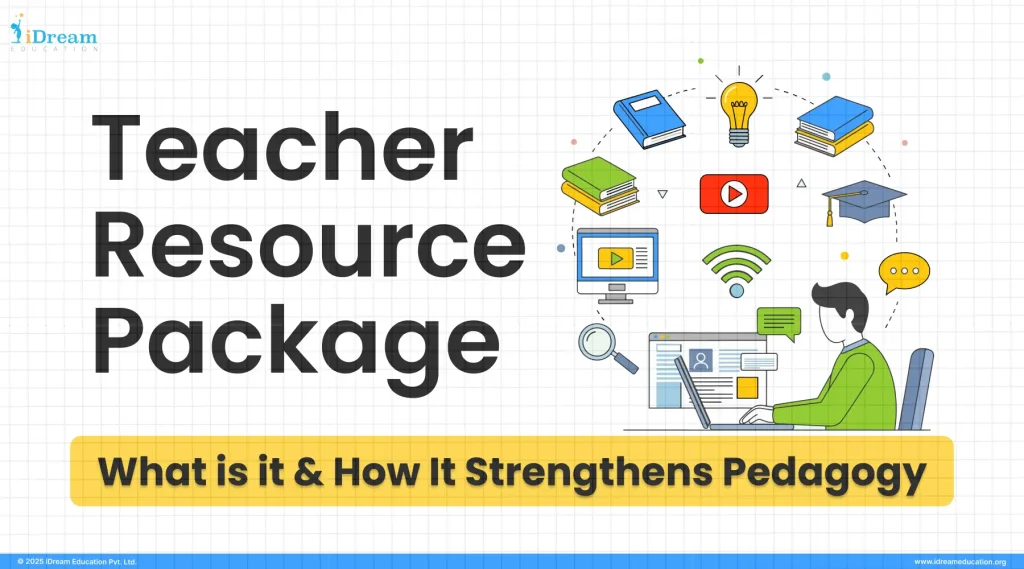
A Teacher Resource Package (TRP) is a curated set of teaching materials designed to support teachers in delivering concept clarity, improving pedagogy, and driving better learner engagement. Instead of expecting teachers to invest time and effort in designing lesson plans and activities from scratch, a TRP provides ready-to-use, structured, and pedagogy-aligned resources that they can directly implement in the classroom.
A comprehensive TRP typically includes:
- Printed materials (teacher manuals, lesson guides, books)
- Visual aids (concept diagrams, infographics, animated demonstration videos)
- Digital tools (interactive e-learning resources, simulations, presentations)
- Manipulative resources (flashcards, models, activity kits)
Each component plays a specific role in making the teaching-learning process more structured, engaging, and outcome-oriented.
What Does a Strong Teacher Resource Package Include?
A well-designed teacher resource package doesn’t just focus on content delivery but aligns with how the content should be taught. Ideally, it includes:
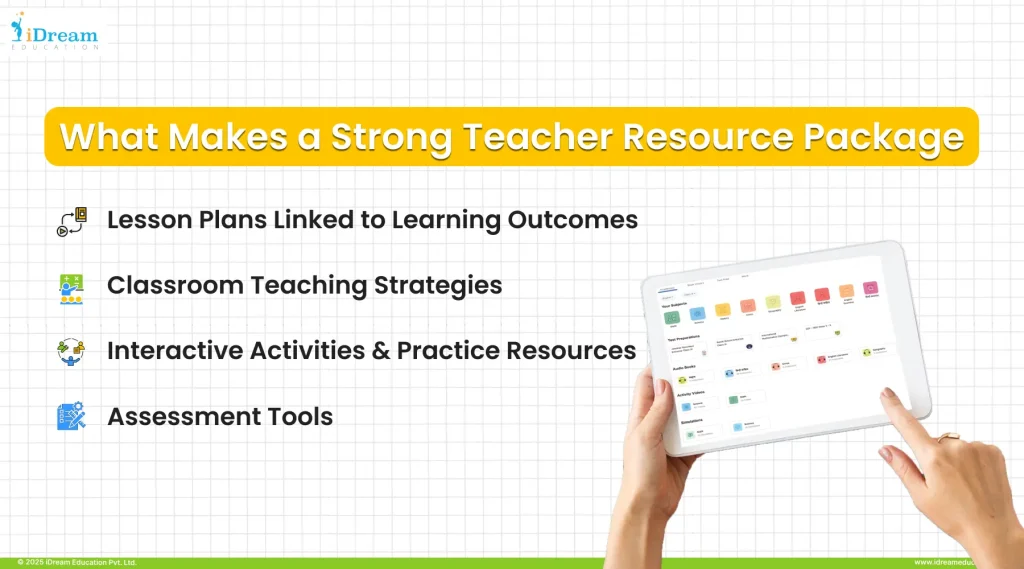
Lesson Plans Linked to Learning Outcomes
A well-designed lesson plan within a Teacher Resource Package ensures that a teacher walks into the classroom not just knowing what to teach, but how to teach it effectively. It offers step-by-step guidance on how to introduce a concept, build understanding through syllabus books, engage students with animated video lessons, and close the session with quick assessments or reflections.
- For instance, instead of a teacher figuring out how to explain fractions on their own, the lesson plan should have videos/simulation to demonstrate the same.
What makes this powerful is the direct alignment with curriculum objectives prescribed in NCERT and teaching practices encouraged under NEP 2020, ensuring every classroom activity directly contributes to intended learning outcomes. This structured approach helps teachers manage time better, supports them in using student-centric pedagogy, and makes learning more meaningful and connected to real life especially crucial in classrooms where students learn at varied speeds.
Classroom Teaching Strategies
A strong TRP provides teachers with clear strategies on how to engage students while teaching each concept. It explains which pedagogical approach to use whether it should be activity-based, inquiry-driven, experiential, or peer-learning.
- For example, for a topic like “water conservation,” instead of simply reading from the book, the package might suggest beginning with a discussion about daily water usage, followed by a group activity where students list ways to save water at home.
By guiding teachers on how to create interest and involvement, these strategies help shift the classroom from monologue-based teaching to interactive learning. Most importantly, such methods are aligned with NEP 2020’s emphasis on experiential learning and teacher training to help them confidently manage diverse learners without spending excessive time planning.
Interactive Activities & Practice Resources
Activities video/sessions and practice materials within a teacher resource package make learning more engaging and reinforce concept clarity. These could include worksheets, group tasks, flashcards, activity videos, and even interactive digital exercises.
- For instance, when learning about colors, the TRP may recommend a simulation activity where students combine different colours virtually and see outcomes. On the other hand, practice can be designed to suit different learning paces, allowing teachers to know how well students are grasping.
When these activities are mapped with curriculum objectives and supported by technology where available, they make the classroom more dynamic and help teachers cater to varied learning levels effectively.
Assessment Tools
Assessment tools in a teacher resource package go beyond just question banks. These are additional addons done to guide teachers on how to evaluate understanding continuously through assessment activities. A well-designed TRP may include assessments with multiple-choice questions that can be used by teachers to assess if students are progressing well, learning outcomes were achieved.
- For example, after teaching “geometric shapes,” the teacher might use assessment questions to identify students’ understanding after every lesson.
With assessments, teachers can track progress more meaningfully and identify students who need additional support early on, without much planning.
How Does a TRP Strengthen Pedagogy?
| Without TRP | With TRP |
| Teachers spend time planning instead of teaching | Teachers focus on explanation & student engagement |
| Lesson delivery is inconsistent | Structured, standardised teaching |
| Limited support for pedagogy | Pedagogy-guided teaching methodology |
| Hard to address diverse learning levels | Resources tailored for differentiated instruction |
| Concept remains abstract | Concepts become visual, practical, and easy-to-understand |
Example of TRP in Practice: Teacher Energized Resource Manuals (TERM) by CBSE
The CBSE has developed a comprehensive set of teacher resources under its competency-based education (CBE) initiative — known as the Teacher Energized Resource Manuals, or TERM – covering Science and Mathematics for grades 6 through 10.
Alignment with Curriculum and Learning Outcomes
Each chapter in TERM corresponds exactly to the chapters of the textbooks prescribed by National Council of Educational Research and Training (NCERT), and maps directly to the NCERT-defined learning outcomes. This ensures that teaching remains curriculum-aligned while giving clarity on what a student should know and be able to do by the end of each unit.
Competency-Based Pedagogy & Assessment Support
TERM emphasises competency-based learning. For every learning objective, the manuals provide suggested pedagogical strategies – including activities, conceptual discussions, and interactive teaching approaches – rather than just content delivery. Further, they include sample assessment items for each learning objective. These are not only knowledge-recall questions but competency-based questions designed to test understanding, application, and higher-order thinking.
Sample Lesson Plans & Resource for Teachers
Beyond chapter-wise guides, CBSE also offers “Sample Lesson Plans” built on the CBE principles for classes 6 – 10. These can act as ready-to-use lesson templates for teachers looking to implement competency-based instruction. There is also a “Teacher’s Resource for Achieving Learning Outcomes” document that helps teachers integrate learning outcomes into day-to-day teaching.
Support for Teacher Training and Capacity Building
Recognizing that a shift to competency-based pedagogy requires teacher readiness, CBSE provides a self-access training module on CBE. This aims to build teacher capacity to use the TERM resources effectively. The module is accessible via the national digital learning platform (DIKSHA).
Together, TERM acts much like a digital + print Teacher Resource Package: it reduces the burden on individual teachers to design lesson plans from scratch, provides a structured pathway from NCERT textbooks to competency-based teaching, supports assessment design, and strengthens pedagogical quality across schools in a scalable way.
Government Push for Digital Teacher Resource Packages through Samagra Shiksha
To strengthen classroom delivery and support teachers in using structured resources, the ICT scheme under Samagra Shiksha has enhanced financial assistance for tablet procurement for teachers from ₹10,000 to ₹18,000 per tablet. This increase has been introduced under the Learning Recovery Package, recognising the critical need for ready-to-use teaching resources that enable teachers to address diverse learning levels and overcome learning gaps post-pandemic.
The intent behind increasing this financial support is to align with current market prices and ensure that tablets provided to teachers are high-quality, durable, and capable of running rich digital content smoothly. With this revision, tablets are now recommended to be preloaded with comprehensive educational resources, including lesson plans, animated video lessons, activity ideas, assessment tools, and pedagogy-linked strategies – effectively serving as a complete Teacher Resource Package in digital format.
This government intervention signifies a powerful shift from expecting teachers to prepare everything to enabling them with the right tools to deliver better teaching.
The Way Forward
A Teacher Resource Package is not about adding more material – it’s about offering the right resources in a structured form so that teachers can focus on how to teach, not just what to teach. When teachers receive well-planned support through lesson guides, teaching strategies, activities and assessment tools, their classroom delivery becomes more confident, engaging and outcome-driven.
If you’re looking for a comprehensive digital Teacher Resource Package for any digital classroom device and would like to experience it through a demo, you may contact us at +91 7678265039. You can also write to us at share@idreameducation.org or share your details here.
Categories You may Explore
Related Articles