

For decades, school assessments in India have largely revolved around one central question: How much can a student remember? Marks, rankings, and board results have traditionally been treated as indicators of learning, often overlooking whether students truly understand what they are being taught.
However, with the introduction of CBSE SAFAL (Structured Assessment for Analyzing Learning), there is a visible shift in how student learning is being evaluated across schools.
What is CBSE SAFAL?
CBSE SAFAL (Structured Assessment for Analyzing Learning) is a competency-based diagnostic assessment introduced in line with the goals of the National Education Policy (NEP) 2020. SAFAL moves beyond rote memorization and places emphasis on competency-based learning, focusing on whether students can apply concepts, think critically, and demonstrate real understanding.
It is designed for students across key stages of Classes 3, 5, 6, 8, and 9, with the 2025–26 focus on Grades 6 and 9.
Unlike traditional exams, CBSE SAFAL Exams:
- Focuses on core conceptual understanding, not rote memorization
- Assesses skills in Language, Mathematics, and Science
- Provides diagnostic insights, not just scores
The aim is simple – help schools understand how well students are learning, not just how much they can recall.
Why Was SAFAL Introduced?
Certain grades such as Classes 3, 5, and 8 are critical turning points in a student’s learning journey. If foundational concepts are not clear at these stages, students often struggle in higher grades. CBSE SAFAL addresses this by:
- Identifying learning gaps early
- Providing actionable feedback to teachers, school leaders, and parents
- Considering background factors that may influence learning outcomes
- More importantly, it supports a larger shift from memorisation-based learning to understanding, application, and competency development.
In doing so, CBSE SAFAL is not just another assessment, it is a step towards preparing students for the real-world skills required in the 21st century.
What Goes Into Designing SAFAL Assessments?
Developed by CBSE, the SAFAL assessment framework integrates NCERT Learning Outcomes with the UNESCO Global Proficiency Framework, ensuring that it is both nationally relevant and globally aligned. This combination helps define what students should know and be able to do at each stage of their learning, while also benchmarking these expectations against international standards.
The development of this framework was not done in isolation. It involved extensive consultations with national and international agencies, bringing together diverse expertise to create a comprehensive and well-rounded assessment approach. This collaborative effort ensures that SAFAL is aligned not only with policy goals like NEP 2020 but also with globally accepted practices of competency-based education.
A key strength of SAFAL lies in its assessment design and item bank. CBSE invested in building the capacity of over 800 teachers for item development, resulting in a pool of more than 3,000 competency-based questions. Each of these items is designed to assess conceptual understanding and application rather than recall, and has undergone expert review to ensure alignment with global best practices and effectiveness in evaluating student learning.
How SAFAL is Designed to Be Used
To truly understand SAFAL, it is important to look at how the assessment is intended to be conducted and used within schools. Unlike traditional exams, SAFAL comes with a clearly defined purpose and guiding principles that shift the focus from performance to improvement.
A diagnostic tool, not an exam
SAFAL is designed to evaluate students’ attainment of competencies, not to rank or certify them. It is neither a qualifying exam nor a competition. Its primary role is to identify learning gaps and highlight areas where additional academic support is needed, enabling schools to strengthen the overall teaching-learning process in classrooms.
No special preparation required
Since SAFAL is competency-based, it does not require any additional coaching, special classes, or exam-focused preparation. If classroom teaching is already learner-centered and focused on conceptual understanding, students are naturally prepared for SAFAL. This reinforces the idea that meaningful, day-to-day learning is far more important than short-term exam preparation.
Focus on school-level insights, not comparison
SAFAL provides only school-level competency reports, which means each school can access insights related to its own students. There is no provision to compare results across schools. This ensures that the purpose remains internal reflection and improvement, rather than competition or ranking.
Complete confidentiality of results
The results of SAFAL are not made public and are not shared with other schools. This confidentiality allows schools to analyse their performance honestly and use the insights constructively, without the pressure of external judgment or comparison.
A tool to improve teaching-learning practices
At its core, SAFAL is meant to serve as a feedback mechanism for schools. It helps teachers evaluate the effectiveness of their teaching methods, identify gaps in student understanding, and make necessary improvements in pedagogy to enhance learning outcomes.
Responsibility and integrity in implementation
As per CBSE guidelines and standard operating procedures, it is the responsibility of school authorities to ensure that SAFAL is conducted with sincerity and honesty. Additionally, technological footprints are recorded throughout the process, and data analysis is carried out to maintain the credibility and reliability of the assessment.
All of this makes SAFAL a powerful tool, not for measuring performance in isolation, but for continuously improving how students learn.
How Can Schools Use SAFAL Insights?
While SAFAL is designed as a diagnostic assessment, its real value lies in how schools use the insights it provides. When interpreted thoughtfully, SAFAL reports can become a powerful tool for driving meaningful improvements in both teaching and learning.
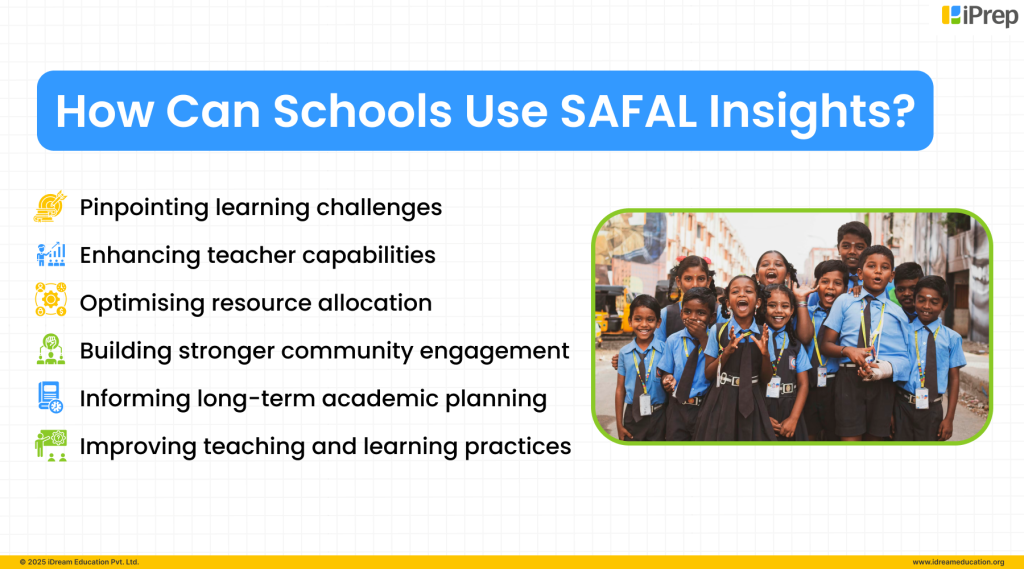
- Pinpointing learning challenges: SAFAL reports help schools clearly identify specific areas where students are struggling – whether it is a concept in Mathematics, comprehension in Language, or application in Science. Instead of broad assumptions, schools get precise insights into learning gaps, enabling more focused and targeted academic support.
- Improving teaching and learning practices: With a clearer understanding of where students are facing difficulties, schools can revisit and refine their teaching methods. This may involve modifying lesson plans, using different instructional approaches, or integrating more concept-based learning strategies to address the identified gaps effectively.
- Enhancing teacher capabilities: The insights from SAFAL also highlight areas where teachers may need additional support. Schools can organise targeted training and professional development sessions to help teachers better address specific learning challenges, making classroom instruction more responsive and effective.
- Optimising resource allocation: SAFAL enables schools to make smarter decisions about how they use their resources. Whether it is allocating additional teaching time, deploying specialised educators, or introducing relevant learning materials, schools can prioritise areas that need the most attention to improve student outcomes.
- Building stronger community engagement: By sharing key insights (appropriately) with parents and the wider school community, schools can create a more collaborative approach to learning. When parents understand where their children need support, they are better equipped to contribute to the learning process at home.
- Informing long-term academic planning: Beyond immediate interventions, SAFAL reports can guide schools in shaping their long-term academic strategies. The insights can influence curriculum planning, teaching approaches, and school-level goals, ensuring a sustained focus on improving student learning outcomes over time.
What Outcomes is SAFAL Expected to Achieve?
SAFAL is designed to create impact at multiple levels – starting with immediate improvements in classroom learning and extending to long-term systemic change in education.
- Short-term outcomes: In the immediate term, SAFAL helps schools identify learning gaps with greater clarity and precision. By diagnosing specific areas where students need support, it enables timely and targeted interventions, especially at critical transition stages in a student’s academic journey. At the same time, it encourages a shift away from rote memorisation towards the mastery of key competencies, helping students build a deeper understanding and the ability to apply concepts in real contexts.
- Long-term outcomes: Over time, SAFAL aims to improve overall learning outcomes by making teaching more responsive and effective. With access to meaningful assessment data, educators can continuously adjust their instruction to better meet student needs. Beyond the classroom, SAFAL also supports a larger ecosystem shift, encouraging data-driven decision-making, informing education policies, optimising resource allocation, and building greater accountability, transparency, and trust within the education system.
What Needs to Happen for SAFAL to Succeed?
While SAFAL sets a strong foundation for competency-based assessment, its success depends on how effectively it is implemented and supported across schools.
- A key requirement is the development and consistent use of a well-aligned competency-based assessment framework that reflects essential learning standards. This ensures that what is being assessed is truly meaningful and relevant to student learning.
- Equally important is collaboration with subject matter experts, educators, and stakeholders to design high-quality assessment items and tools. The strength of SAFAL lies in the quality of its questions and insights, which must accurately capture student understanding and learning gaps.
- Finally, schools and systems need to ensure the availability of adequate financial, human, and technological resources. From smooth administration of assessments to reliable data analysis, every step must be executed with high fidelity to maintain the credibility and usefulness of SAFAL insights.
Let’s look at SAFAL 2024–25 Findings
SAFAL Pilot 2022-23, CBSE conducted field trials and pilot tests across about 2,000 schools, with nearly 150,000 students involved. By 2024, the reach of SAFAL increased considerably to more than 1 million students from 11,000 schools. The SAFAL 2024 – 25 cycle marks an important milestone, as its findings are beginning to actively shape how schools understand student learning and teaching effectiveness. With results released in 2025, SAFAL is already influencing how schools interpret academic progress, not just through scores, but through deeper learning insights.
A clearer picture of learning levels across schools
One of the most significant outcomes of SAFAL has been its ability to provide a detailed view of student learning levels across competencies. Instead of a single score, schools receive insights such as average performance, competency-wise analysis, and proficiency distribution, often categorised into levels like Below Basic, Basic, Proficient, and Advanced. In 2024–25 school reports, average scores hovered around 278–284, indicating that a large proportion of students are still operating around the basic to grade-level proficiency range, rather than advanced mastery.
Clear evidence of learning gaps across competencies
The findings highlight that student performance varies significantly across competencies within the same subject. In some cases, only 30–50% of students answered certain competency-based questions correctly, especially in higher-order skills like inference, problem-solving, and application. This reinforces a critical insight – students may progress through grades, but conceptual understanding is often uneven and fragmented.
Signs of improvement but gradual
Encouragingly, SAFAL 2024–25 also shows incremental improvement in foundational skills. Several schools reported an increase in the percentage of students achieving grade-level proficiency compared to previous years, particularly in literacy and numeracy.
However, the improvement is gradual, indicating that while the shift to competency-based learning has begun, system-wide transformation will take sustained effort.
Data is starting to drive academic decisions
Perhaps the most important outcome is the role SAFAL data is beginning to play in schools. With access to competency-wise performance, proficiency distribution, and comparative benchmarks, schools are being empowered to take data-driven decisions, whether it is redesigning lesson plans, planning interventions, or supporting teachers more effectively.
Note: These insights are drawn from school-level SAFAL reports, as the assessment is designed to provide diagnostic data specific to each school rather than national comparisons.
What is the CBSE SAFAL Exam Process?
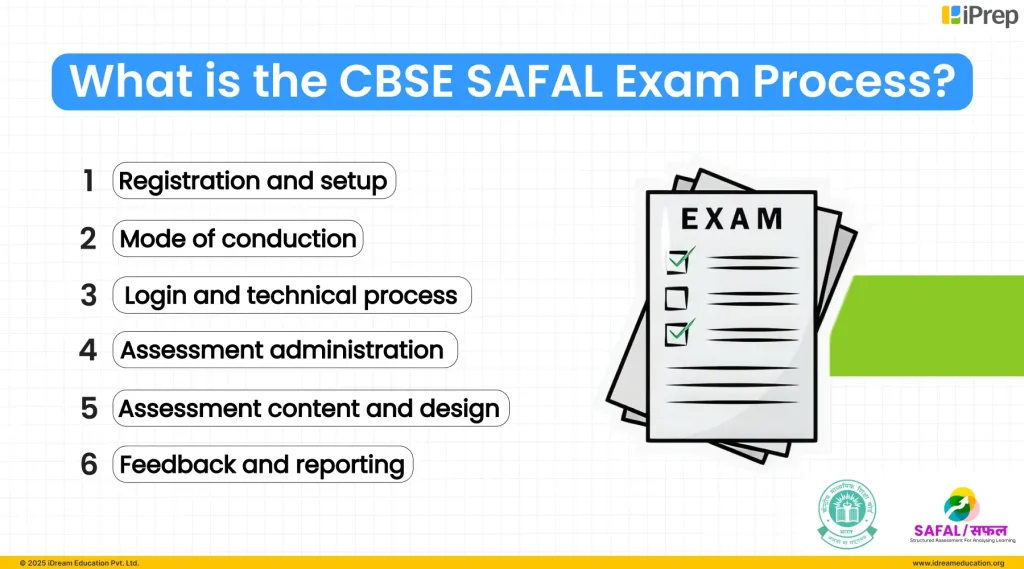
- Registration and setup: The process begins with schools registering on the SAFAL platform through the CBSE portal using their LOC/OASIS credentials. This step ensures that the assessment is formally integrated into the school’s academic process and that all required systems and data are aligned before the assessment is conducted.
- Mode of conduction: SAFAL is primarily conducted in a digital format, reflecting its focus on scalability and data accuracy. A dedicated exam server along with client machines connected through a Local Area Network (LAN) is set up. However, in cases where digital infrastructure is limited, a paper-based mode may also be permitted, ensuring inclusivity across diverse school contexts.
- Login and technical process: The administration of SAFAL involves a structured technical workflow. Teachers, acting as proctors, log into the school server, upload encrypted question papers, and manage student batches. This controlled process ensures the security and standardisation of the assessment across schools.
- Assessment administration: Students appear for the assessment by logging in using unique credentials, typically in batches. The process is designed to be secure and reliable, with technological footprints recorded throughout, similar to large-scale competitive exams. This ensures both transparency and credibility in how the assessment is conducted.
- Assessment content and design: At the heart of SAFAL are its competency-based questions. Instead of testing rote memorisation, the assessment focuses on core concepts, application, reasoning, and skills. This aligns with its broader goal of evaluating how well students understand and apply their learning.
- Feedback and reporting: Once the assessment is completed, schools receive detailed reports that provide insights into student performance and learning gaps. These reports enable schools to analyse outcomes at a deeper level and take informed steps to improve teaching strategies and student learning.
What SAFAL truly represents is more than just a new kind of assessment – it signals the beginning of a fundamental shift in India’s education ecosystem.
For the first time at scale, schools are being encouraged to look beyond marks and exams, and instead focus on learning gaps, conceptual understanding, and actual student progress. This is a significant departure from a system that has long been centred around rote learning, repetitive testing, and end-of-term performance.
SAFAL changes the starting point of the conversation. Instead of asking “How much did students score?”, it is pushing schools to ask “What are students struggling with, and why?”. This shift in perspective is critical, because it brings attention to the root of learning challenges, not just their outcomes. In many ways, SAFAL lays the foundation for a more responsive and student-centric education system – one where:
- Learning gaps are identified early
- Teaching is informed by real data
- Progress is measured through understanding, not just scores
SAFAL has made one thing very clear – schools today have better visibility into student learning than ever before. They can identify learning gaps, understand competency levels, and make more informed academic decisions.
But identifying gaps is only the first step.
The real challenge lies in bridging these gaps consistently, for every student, within the realities of everyday classrooms.
In a typical classroom, students are at different levels of understanding – some struggling with foundational concepts, others ready to move ahead. Addressing this diversity through a single teaching approach is not only difficult, but often ineffective.
This is where Personalized Adaptive Learning (PAL) emerges as a critical enabler.
PAL is designed to take the intent of assessments such as SAFAL forward by not just identifying gaps, but actively working to close them. It does this by creating a continuous, student-centric learning journey, where each learner receives remedial support based on their individual needs.
Through adaptive assessments, PAL can dynamically gauge a student’s current level of understanding, much like SAFAL but at a much more frequent and granular level. Based on this, it offers personalized learning pathways, ensuring that every student is learning at the right level, not just the grade level.
More importantly, PAL enables immediate and targeted remediation. Instead of waiting for periodic assessments to identify issues, students can receive support as they learn, bridging gaps in real-time before they widen further. This makes learning more effective, less stressful, and far more meaningful.
For teachers, this becomes a powerful support system. Rather than trying to manually track and address individual learning needs for an entire class, they gain access to actionable usage insights, allowing them to focus more on facilitation and less on diagnosis.
In essence, while SAFAL answers the question – “Where are the gaps?”,
Personalized Adaptive Learning answers—“How do we solve them, for every student?”
As India moves towards the vision of Viksit Bharat 2047, a competency-based education system will play an integral role in shaping future-ready learners. The combination of diagnostic assessments such as SAFAL and adaptive learning solutions has the potential to truly transform how students learn, shifting the focus from marks to meaningful understanding.
With Personalized Adaptive Learning (PAL) implemented across schools, not just within CBSE but across all state board schools – we can begin to systematically bridge historical learning gaps, support every learner at their level, and build a stronger, more responsive education ecosystem.
If you are looking to identify and address learning gaps, strengthen classroom outcomes, and implement a solution that continuously adapts to each student’s learning needs, you can reach out to us at +91 7678265039 to explore how this can be effectively implemented in your school or system. You can write to us at share@idreameducation.org or share your details here
Frequently Asked Questions -
1. What is the CBSE SAFAL exam?
CBSE SAFAL (Structured Assessment for Analyzing Learning) is a competency-based diagnostic assessment designed to evaluate students’ conceptual understanding in subjects like Language, Mathematics, and Science.
2. Is SAFAL a board exam or mandatory test?
No, SAFAL is not a board exam or a qualifying test. It is a diagnostic assessment meant to help schools identify learning gaps and improve teaching practices.
3. What is the objective of SAFAL exams?
The main objective of SAFAL is to shift from rote learning to competency-based education by assessing students’ understanding, application, and skills rather than memorisation.
4. Which classes are included in SAFAL assessments?
SAFAL is designed for Classes 3, 5, 6, 8, and 9, with recent focus on Grades 6 and 9 for wider implementation.
5. How is SAFAL different from traditional exams?
Unlike traditional exams that focus on marks, SAFAL evaluates competency levels, identifies learning gaps, and provides actionable insights for improving student learning.
6. Does SAFAL require special preparation by students?
No, SAFAL does not require any additional preparation. It is based on regular classroom learning and focuses on conceptual understanding.
7. How do schools use SAFAL reports?
Schools use SAFAL reports to identify student learning gaps, improve teaching strategies, train teachers, and plan targeted academic interventions.
8. Are SAFAL results publicly available?
No, SAFAL results are confidential and shared only with individual schools to support internal improvement rather than comparison.
9. How can personalized adaptive learning support SAFAL goals?
Personalized adaptive learning helps bridge learning gaps by providing customized learning paths, continuous assessment, and real-time remediation for every student.
Categories You may Explore
Related Articles