

Read to explore the key strategies driving India’s FLN mission, insights from experts and policy, and a deep dive into strengthening Foundational Literacy and Numeracy.
India has made visible progress in improving access to education. Classrooms are fuller, enrollment is higher, and digital initiatives are expanding rapidly.
But beneath this progress lies a quieter question we don’t ask enough: Are children truly learning?
If a child spends five years in school but cannot read fluently or solve basic math problems, can we call that progress?
Millions of children in India are moving through school without mastering the basics of reading and numeracy. They are attending classrooms, completing grades, and even passing exams. Yet, many struggle to read a simple paragraph or solve a basic arithmetic problem.
This is not just a learning gap. It is a systemic signal – quietly limiting progress at every level of education.
Because when foundational skills are weak, progress becomes superficial. Students move forward, but learning does not. And that gap only widens with time.
Improving Foundational Literacy and Numeracy (FLN) is not one of many priorities. It is the priority that determines whether the rest of education can succeed.
So, what exactly do we mean by Foundational Literacy and Numeracy (FLN)? What is FLN?
Foundational Literacy and Numeracy (FLN) refers to the basic ability of a child to read with understanding and solve simple mathematical problems such as addition and subtraction. As per NIPUN Bharat Mission, the goal is to ensure that every child achieves foundational literacy and numeracy by the end of Grade 3. This means, by grade 3 child can read with comprehension and solve basic numeracy problems independently.
At its core, FLN is about two essential skills:
- Foundational Literacy: The ability to read a simple text, understand what it means, and express ideas clearly in words. A child should not just be able to read aloud, but actually make sense of what they are reading.
- Foundational Numeracy: The ability to understand numbers, do basic calculations like addition and subtraction, and use math in everyday situations. A child should not just know the steps, but understand what the numbers represent and how to use them in real life.
These are not advanced skills. They are the foundation on which all future learning is built. Without these skills, even simple lessons become difficult to understand. That is why FLN is expected to be achieved in the early years of schooling, because it enables everything that follows.
FLN in India: The Structure That Drives Learning
India’s focus on Foundational Literacy and Numeracy is strongly guided by frameworks such as the National Education Policy 2020, NIPUN Bharat Mission, and the National Curriculum Framework 2022.
While the vision is clear: ensuring every child achieves FLN by Grade 3. What makes this approach powerful is how systematically it is structured.
Rather than treating learning as a set of disconnected skills, the National Curriculum Framework 2022 organizes FLN as a progression, where each layer builds on the previous one. It starts with a broad vision and gradually translates into what a child should be able to do in the classroom.
How FLN Learning Progresses in India: As Defined by NCF
At the highest level are the Aims of Education which define the larger purpose of education. This includes curriculum design, teaching approaches, institutional structures, and resource allocation. They define what kind of learners and citizens the system aims to nurture. These aims are translated into 3 FLN Development Goals, which outline what children should achieve by the age of 8. From these goals, more specific elements are derived including curricular goals, domains, competencies, and finally, clear learning outcomes.
The Three Core FLN Development Goals are:
- Children maintain good health and well-being: This goal focuses on the child’s overall development. This includes the development of physical health, socio-emotional well-being, and safe habits.
- Children become effective communicators: This goal emphasizes the ability to express and understand ideas clearly. It includes speaking with confidence, understanding language, developing reading and writing skills, and building a genuine interest in books and learning.
- Children become involved learners and connect with their environment: This goal focuses on helping children make sense of the world around them. Through everyday experiences, they develop early mathematical thinking, language skills, and environmental awareness, enabling them to observe, question, and learn actively.
In simple terms, this structure answers a critical question: What should a child be able to do, and how do we get there?
Why Early Years Are Crucial for Foundational, Literacy and Numeracy (FLN)?
The early years of a child’s life are the foundation of how learning happens. By the age of 6 -8, a child’s brain is at a stage where it is most receptive to language, numbers, patterns, and meaning-making. This is when children naturally develop the ability to connect sounds to words, understand quantities, and make sense of the world around them. If these FLN skills are built well during this stage, learning becomes smoother, faster, and more meaningful in the years that follow.
But if this stage is missed or rushed, the impact is long-term. As Mathematician Manjul Bhargava puts it, “Once students fall behind in fundamental skills, they rarely catch up, and their learning curves remain flat.”
Children who do not develop strong reading and numeracy skills early on often struggle to keep up with classroom instruction. Over time, this leads to confusion, reduced confidence, and eventually disengagement from learning itself. This is why FLN is not just an early-grade priority – it is a long term investment. Getting it right in the early years ensures that every child is equipped to learn, adapt, and grow throughout their educational journey.
Foundational Literacy and Numeracy: A National Priority for India’s Future
A child who cannot decode text by age 8 is unlikely to ever read for meaning. A child who cannot count and compute will struggle with every subject that follows. The research is unambiguous: FLN deficits compound over time, and recovering lost ground after the critical early years becomes exponentially harder. This is the concept of learning poverty and India carries a disproportionately large share of it.
- The National Achievement Survey (NAS) 2021 laid bare the scale of the crisis. At Grade 3, the national average score in language competency was just 59% and in mathematics 57%. More troubling, states in the top quartile scored nearly 20 percentage points higher than those in the bottom, revealing deep and systemic inequality in who gets a genuine start in learning.
- The COVID-19 pandemic made things worse. Children who were in Grades 1-2 during 2020-21 missed the most critical window for FLN acquisition. ASER 2022 confirmed what teachers feared: an entire cohort emerged from the pandemic years with sharply diminished foundational skills, and recovery rates are far slower than expected.
- According to the Annual Status of Education Report (ASER) 2023, only about 57% of Class V students in rural India can read a Class II-level text fluently, while barely 43% can perform basic division. These numbers again reveal a paradox at the heart of Indian education: near-universal enrolment coexisting with a deep, stubborn learning deficit.
The Stakes: Why Strengthening FLN Cannot Wait
The consequences of unaddressed FLN deficits stretch far beyond the classroom.
- Economically, the World Bank estimates that learning poverty affects the equivalent of 70% of children in lower-middle-income countries. In India’s case, a child who leaves primary school without basic literacy and numeracy is significantly less likely to complete secondary education, access skilled employment, or earn a living wage. The cost is not borne by that child alone, it is borne by the economy as a whole, in the form of reduced productivity and persistent intergenerational poverty.
- Socially, FLN gaps track almost perfectly with existing inequalities. Children from rural areas, tribal communities, low-income households, and first-generation learners are consistently the most underserved. Without deliberate intervention at the foundational stage, the education system does not neutralise disadvantage – it amplifies it.
- Developmentally, India’s aspiration to become a developed economy by 2047 (Viksit Bharat) depends fundamentally on the quality of its human capital. That quality is not shaped in colleges or even secondary schools. It is shaped in the first three years of formal schooling, often before. No skilling programme, no higher education reform, and no workforce initiative can compensate for a generation that never learned to read and count with confidence.
Why India Can No Longer Ignore FLN?
The National Education Policy (NEP) 2020 explicitly identified the FLN crisis as the most critical challenge in Indian education, calling for emergency-level attention. This recognition translated directly into the launch of NIPUN Bharat in 2021 – the country’s first dedicated national mission with a hard target: every child achieving FLN competency by the end of Grade 3, by 2026–27. This policy shift matters because it marks a fundamental change in how India thinks about educational accountability. For decades, success was measured by enrolment and infrastructure. NIPUN Bharat signals a pivot to learning outcomes as the central metric – a shift that education stakeholders have long called for.
Achieving it will require systemic change at scale: transformed classroom pedagogy, teacher capacity building, regular assessment cycles, community engagement, and targeted support for the most disadvantaged learners. None of this is simple. But the starting point is clear – and it begins with accepting that getting every child to read and count is not a minimum expectation. It is the foundation of everything India hopes to build.
NIPUN Bharat: India’s Mission to Fix Learning at the Root
Recognising that enrolment alone was never enough, India took a decisive step in July 2021 – launching NIPUN Bharat (National Initiative for Proficiency in Reading with Understanding and Numeracy) under the Ministry of Education. It is the country’s first dedicated national mission with a single, non-negotiable goal: every child achieving foundational literacy and numeracy competency by the end of Grade 3, by 2026–27.
NIPUN Bharat operates under the National Education Policy (NEP) 2020, which for the first time explicitly named the FLN crisis as India’s most urgent educational challenge. The mission is not a scheme – it is a structural shift in how India defines and measures educational success, moving from inputs (classrooms built, books distributed) to outcomes (can this child read, can this child count).
How the Mission Is Structured
NIPUN Bharat is built around five interconnected pillars that work together to change what happens inside the classroom:
- Competency-based learning goals: The mission defines clear, measurable targets for each grade. By the end of Grade 3, for instance, a child should be able to read 45–60 words per minute with comprehension, and solve two-digit addition and subtraction problems independently. These are not aspirational, they are the minimum benchmarks against which every child is tracked.
- Structured pedagogy: Rather than leaving teachers to improvise, NIPUN Bharat prescribes structured, activity-based teaching approaches rooted in play, storytelling, and hands-on numeracy. The emphasis is on making the foundational stage joyful and engaging, a significant shift from rote-heavy classroom traditions.
- Teacher capacity building: Over 25 lakh teachers have been trained under the mission as of 2024, with a focus on foundational-stage pedagogy. Training is delivered through DIKSHA – the national digital learning platform as well as in-person district and block-level workshops.
- Regular formative assessment: NIPUN Bharat introduces low-stakes, frequent assessments (oral reading fluency checks, number recognition tasks) to track individual child progress through the year rather than waiting for an annual exam. This allows teachers and school systems to identify and support struggling children early.
- Community and parental engagement: The mission includes a strong home-learning component, encouraging parents and family members to engage with children’s reading and numeracy through simple, language-accessible activities – recognising that learning does not stop at the school gate.
Alongside these pillars, NIPUN Bharat introduced Vidya Pravesh — a three-month school-readiness module for incoming Class 1 students, bridging the gap between early childhood education and formal schooling. This is a quiet but significant structural change: it acknowledges that foundational learning begins before Grade 1, and that the transition into school is itself a critical intervention point.
Each state under NIPUN Bharat develops its own State Implementation Plan, allowing the mission to adapt to local languages, teaching cultures, and ground realities.
Uttar Pradesh launched Mission Prerna with thrice-yearly assessments, reporting over 60% of Grade 3 students meeting reading benchmarks in covered districts by 2023. Rajasthan trained over 1.8 lakh teachers and built block-level FLN monitoring dashboards. Tamil Nadu deepened its community volunteer programme, Illam Thedi Kalvi, to extend learning beyond school hours. Odisha took a multilingual route, developing FLN materials in tribal mother tongues for children who enter school without speaking Odia. Delhi aligned its Chunauti 2.0 programme with NIPUN benchmarks through structured workbooks and diagnostic tools. The common thread across high-performing states is early investment in teacher training, structured pedagogy, and regular assessment. These are the states that moved first on these are visibly pulling ahead.
The mission has created a national accountability framework where none existed before.
What Actually Works: Key Strategies for Building Foundational Learning
Policy frameworks and national missions set the direction but what actually changes a child’s learning trajectory happens inside the classroom: in the daily interaction between a teacher, a child, and the material in front of them. Decades of research and ground-level evidence from India and comparable contexts point to a clear set of strategies that work. The challenge is not discovering them, it is implementing them consistently and at scale.
Structured Pedagogy
Structured pedagogy gives teachers a clear, sequenced daily plan on what to teach, in what order, and how. It builds skills the right way: oral language first, then reading and decoding, then number sense through physical objects before abstract symbols. When teachers have a access to structured FLN resources they are able to engage and make children learn faster and ensure no child quietly slips through the cracks.
Teacher Training and Coaching
A one-time training workshop changes little. What works is ongoing support through regular classroom visits, peer observation, and real-time feedback. Primary school teachers and Anganwadi workers benefit more from continuous guidance than from one-time enablement. Building this support chain for anganwadi centres and primary classrooms is what actually works and leads to meaningful outcomes
Assessment That Informs Teaching
Waiting for an annual exam to know if a child can read is too late. Simple, frequent checks – a one-minute oral reading task, a quick number recognition activity—empower teachers with easy to use ECE content help them act in time, not months later. The goal should be assessment for learning, not assessment of learning.
Learning Rooted in Development Goals
The National Curriculum Framework for Foundational Stage (NCF-FS) 2022 lays out five learning and development goals for children aged 3–8, covering physical development, social-emotional wellbeing, cognitive growth, language, and early literacy and numeracy. These goals are the backbone of what FLN content in classrooms should address. A classroom aligned to NCF-FS goes beyond textbooks – it is print-rich, playbased, language-rich, and developmentally appropriate, with story cards, word walls, games, stories, number puzzles, and reading in the child’s own language. Content that speaks to how a child actually develops at this stage, rather than simply delivering curriculum, is what makes foundational learning stick.
FLN Digital Resource Kits: Bringing Structured Learning to Anganwadis and Primary Schools
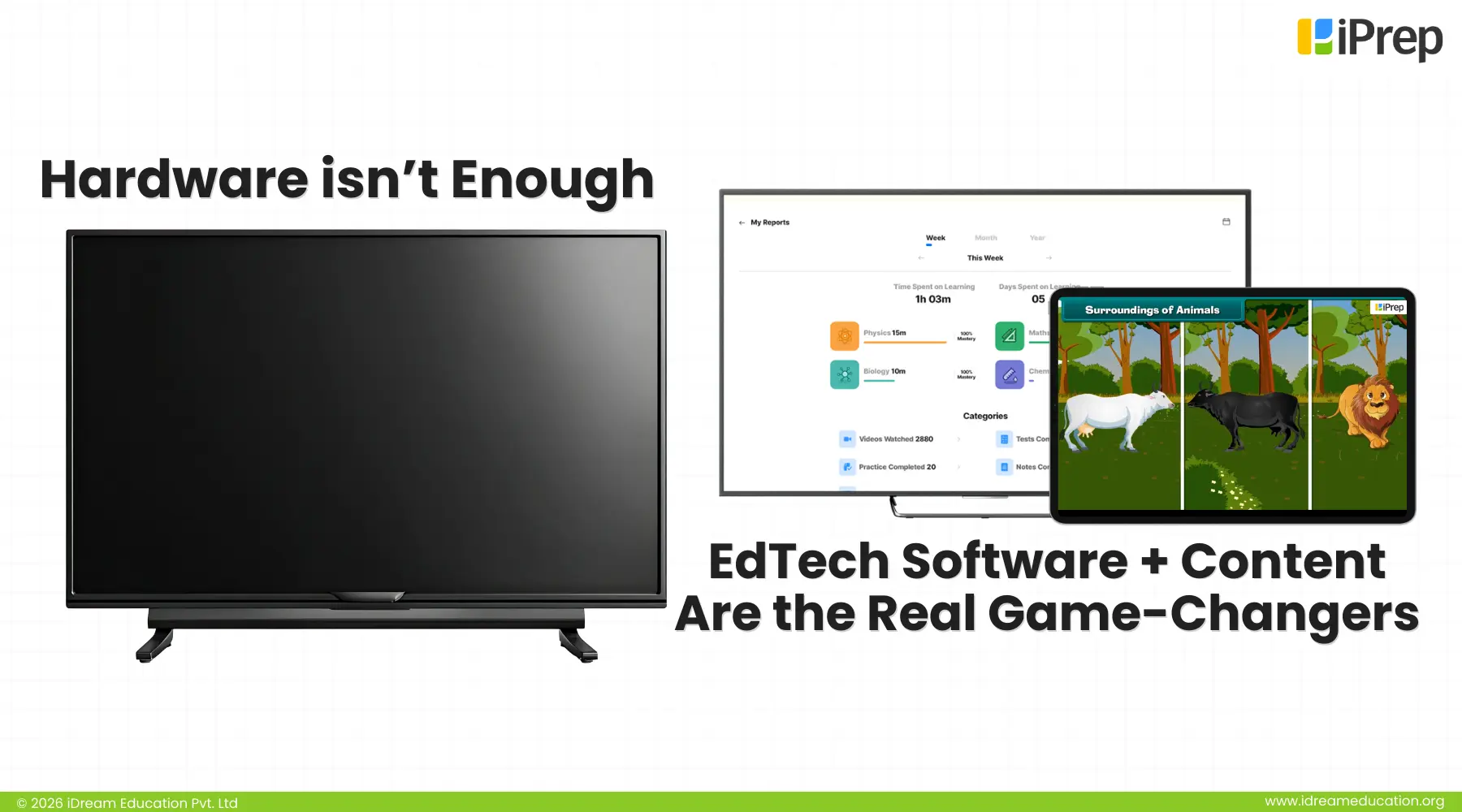
India’s anganwadis and government primary schools serve the most underserved children, yet these are often the settings with the least access to quality learning materials. FLN Digital Resource Kits are a targeted response to this gap and to improve FLN in India. Designed for anganwadi workers and primary school teachers, these FLN kits bring together audio stories, animated content, picture libraries, puzzles, phonics activities, and numeracy games in preferred languages, accessible on any smart device, online or offline.
The intent is practical. An anganwadi worker/teachers running a two-hour session with 15 children should have ready-to-use, age-appropriate content at her fingertips, not a blank screen, not multiple resources to hunt through, not tools that fail without connectivity. States such as Uttar Pradesh and Rajasthan have begun distributing such ECE Content under NIPUN Bharat, bundled with simple usage guides that make adoption realistic even for first-time users.
This is where the quality of ECE content design becomes the deciding factor & where structure, language, and developmental alignment separate a FLN kit that genuinely builds learning such as iPrep from one that merely fills time.
What Makes iPrep FLN Digital Resource Kits Meaningful?
iPrep’s FLN content is a complete FLN resource kit. It is thoughtfully created & curated to foster joyful, play-based learning experiences. Through stories, rhymes, activities, games, picture library and so much more, it nurtures curiosity and creativity, building a strong foundation for lifelong learning.
Aligned with the National Education Policy 2020 and the National Curriculum Framework for the Foundational Stage, the content structure is based on:
- 3 developmental goals
- 13 competencies
- 57 learning outcomes
This ensures that learning is not only engaging but also pedagogically sound and outcome-driven.
Further, the FLN content kit is segregated for structured digital Learning in early years like:
- Preschool 1 (PS1): Nursery (3–4 years)
- Preschool 2 (PS2): LKG (4–5 years)
- Preschool 3 (PS3 – Balvatika): UKG (5–6 years)
- Vidya Pravesh: A structured three-month school readiness program to prepare children for Class 1
Each stage includes multi-category content that sparks curiosity and ensures developmental continuity.
Entire FLN Resource Kit is Enabled Through iPrep’s Minimalist LMS for Universal Access and Ease of Use:
- Works across Android, Windows, Linux, and iOS
- Compatible with tablets, laptops, desktops, smart TVs, IFP panels, and more
- Fully functional in offline environments with reporting capabilities
This ensures seamless integration of FLN content into early childhood education programs in India, regardless of infrastructure limitations.
Rich, Multilingual FLN Content Library for Holistic Learning includes:
- Extensive English & Hindi Content: 1,673+ multimedia lessons, 421+ syllabus-aligned books, 215+ digital books, and 127+ audiobooks in English. Along with 1,627+ multimedia lessons, 310+ syllabus-aligned books, 100+ digital books, and 177+ audiobooks in Hindi.
- Comprehensive Learning Formats: A diverse mix of multimedia lessons, books, digital formats, worksheets, puzzles, games, stories, poems, and more to support different learning styles and contexts.
- Strong Assessment & Practice Support: 10,000+ assessment questions and 639+ worksheets designed for competency-based, joyful learning.
Offline-First Access for Uninterrupted Learning:
- Fully Functional Without Internet: All content is accessible offline, ensuring uninterrupted usage in low-connectivity environments
- Designed for Real Classroom Conditions: Ideal for anganwadis and schools where internet access is limited or inconsistent.
Built-in Reporting for Tracking Learning Outcomes:
- Offline Data Capture: Tracks FLN content usage even without internet connectivity.
- Simple & Actionable Insights: Provides easy-to-understand reports for teachers and project teams
- Supports Data-Driven Decisions: Helps improve classroom practices and program effectiveness through data driven measurable insights.
Teacher Training and Continuous On-Ground Support:
- Structured Onboarding for Effective Adoption: Comprehensive training for teachers and anganwadi workers to ensure smooth adoption and regular usage. This enables them to confidently engage early learners across diverse content formats
- Ease of Use with Guided Support: Simple user guides combined with an intuitive platform design make day-to-day classroom usage effortless
- Continuous Handholding for Sustained Impact: Ongoing on-ground support beyond implementation to ensure consistent usage of FLN content, timely issue resolution, and meaningful classroom integration.
Explore How Our FLN Content, with Vidya Pravesh can Bridge Learning Gaps and Ensures NCF-Aligned Readiness for a Child Enters Into Grade 1
Frequently Asked Questions -
1. What is Foundational Literacy and Numeracy (FLN)?
FLN refers to the ability to read with basic comprehension and perform simple arithmetic by the end of Grade 3. It is the foundation on which all future learning is built.
2. Why is FLN considered a national priority in India?
Because millions of children are completing primary school without being able to read or count at grade level. Unaddressed FLN deficits limit a child's entire educational and economic future.
3. What is NIPUN Bharat and what does it aim to achieve?
NIPUN Bharat is India's national mission launched in 2021 to ensure every child achieves FLN competency by the end of Grade 3, with a target deadline of 2026–27.
4. How does the NCF-FS 2022 shape FLN content and learning?
The NCF-FS lays out 3 developmental goals, 13 competencies, and 57 learning outcomes for children aged 3–8, providing the framework for what FLN content should teach and how it should be sequenced.
5. Can technology and EdTech tools genuinely improve FLN outcomes?
Yes — when designed well, used in the child's language, and integrated into teaching rather than deployed in isolation. Technology amplifies quality instruction; it does not replace it.
6. How do FLN kits support anganwadi workers and primary school teachers?
They provide ready-to-use, age-appropriate content that reduces planning time and helps educators conduct engaging, structured sessions without relying on multiple disconnected resources.
7. Are FLN Digital Resource Kits aligned with national education goals?
Yes, they are aligned with National Education Policy 2020 and frameworks like NIPUN Bharat, ensuring competency-based and outcome-driven learning.
Categories You may Explore
Related Articles