Digital Library with PAL in PM SHRI Schools: From Framework Vision to On-Ground Solution

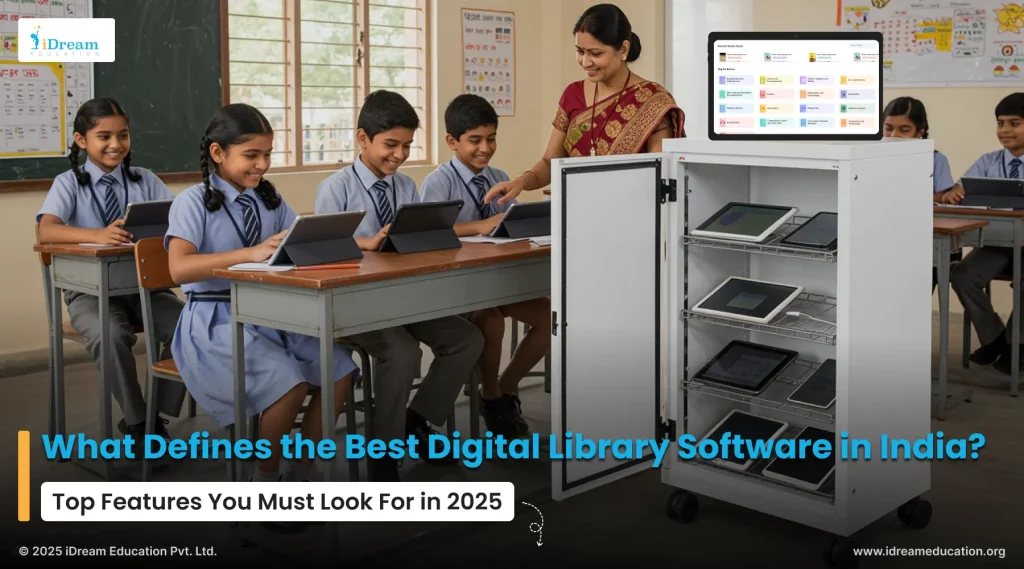
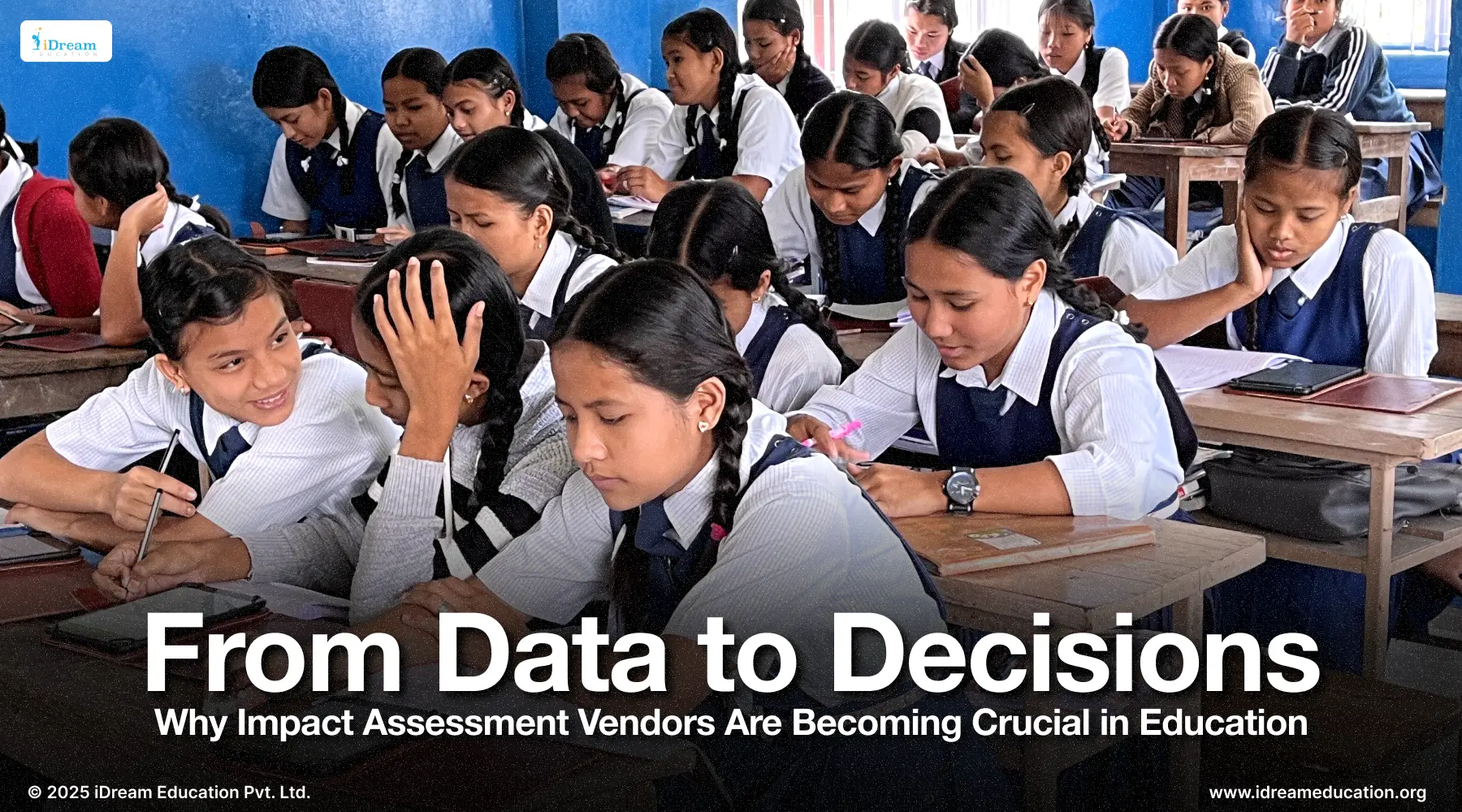
Cover image of the blog showing school students using a digital library with PAL Personalized Adaptive Learning solution on tablets in a classroom setting

To systematically upgrade schools into model learning environments, the Ministry of Education introduced the PM SHRI (PM Schools for Rising India) scheme. It is a flagship initiative that aims to translate the vision of the National Education Policy (NEP) 2020 into real, on-ground transformation.

To support this, the Ministry released three guiding frameworks that together serve as a roadmap for PM SHRI schools:

While each framework contributes to building well-rounded, future-ready schools. One particular powerful focus area lies within the second part – access and infrastructure. This is where the Digital Library with PAL in schools emerges not just as add-ons, but as central enablers of transformation.

Far beyond simply digitizing textbooks, this approach creates a smart, inclusive, and student-responsive learning environment. A learning approach where content adapts to individual needs, and every student can learn at their own pace.

Explore complete state-wise details of PM SHRI Schools directly on the PM SHRI Dashboard

Let’s take a closer look at how the Digital Library with PAL, envisioned in the 2nd Part of the PM SHRI framework

As per the Programmatic Norms, schools are encouraged to set up digital libraries. e-Libraries comprising tablets with pre-loaded educational content for students of Upper Primary level and above. This ensures that every student, regardless of background or pace of learning, can interact with quality digital resources at their own level.

To make this possible, the framework supports schools through:

  • Non-recurring grant: Provision of up to 40 tablets per school, with a one-time grant of up to ₹15,000 per tablet.
  • Recurring grant: An annual provision of up to ₹50,000 for content upgrades, device maintenance, and to integrate innovative techniques such as AR/VR and haptics.

But funding is only part of the solution. The real transformation comes through how schools implement this vision. 

Therefore, the framework outlines suggestive actions that turn the digital library into a daily, integrated learning tool:

  • Make tablets accessible to students with preloaded educational content. Tablets to students not as occasional tools, but as a regular part of their learning day.
  • Plan a balanced timetable and schedule to ensure the tablet-to-student ratio. This is to support equitable access and quality usage time for every learner.
  • Initiate creative incentives through classroom rewards, recognition systems, or group-based activities. This is to encourage all students to participate actively.
  • Align daily lesson plans with digital content so that what students learn through the tablets complements what is taught in class. This is to create a cohesive learning loop.
  • Provide worksheets and tasks linked to the digital content. This gives students a way to reflect, apply, and deepen their understanding.
  • Adopt a Personalized Adaptive Learning (PAL) approach. Digital Library with PAL allows students to interact with content at their own level and pace, which is especially beneficial in classrooms with varying learning needs.
  • Update tablet content regularly based on student progress and feedback. This ensures that the learning material stays relevant, fresh, and aligned with curriculum goals.

These steps ensure that the Digital Library with PAL is not a standalone element, but a deeply embedded part of the teaching-learning process. When thoughtfully implemented, it allows students to take ownership of their learning. On the other hand, gives teachers valuable support in addressing diverse classroom needs.

PART 2 PM SHRI Framework by MoE also outlines STANDARDS which says, 

To support Digital Library with PAL, schools must also ensure the presence of ICT labs or smart class facilities, seamless internet connectivity, and mechanisms for content relevance and periodic updates. These steps help ensure that the digital library is not a static resource but an evolving space that grows with the needs of students.

But the question now is – do we have solutions that make this easy to set up in schools across India? 

Let Look at How we can translate Digital Library with PAL  into meaningful reality as per aspirations of PM Shri

To truly bring the Digital Library with PAL into meaningful, widespread reality  as envisioned in the PM SHRI frameworks – what we need is digital library infrastructure that is simple, adaptable, and inclusive. A solution that doesn’t depend on a school’s location, available space, furniture, or extensive civil changes. Instead , we need a solution that aligns effortlessly with what the framework aspires to achieve: personalized, equitable access to quality digital learning for every student.

At iDream Education, we have been working and aligning closely with various government-led education initiatives. This is why our Digital Library with PAL exactly matches what is envisioned in the PM SHRI framework of school transformation.

What Does It Take to Set Up a Digital Library with PAL in Schools?

We’ve created a digital library solution that is easy to deploy, independent of infrastructure constraints, and built to empower both students and teachers from day one. Whether the school is in a remote village or an urban area, whether there is extra space or not, the entire setup is built to be plug-and-play, mobile, and accessible. Here’s what makes the setup complete and aligned with the PM SHRI vision:
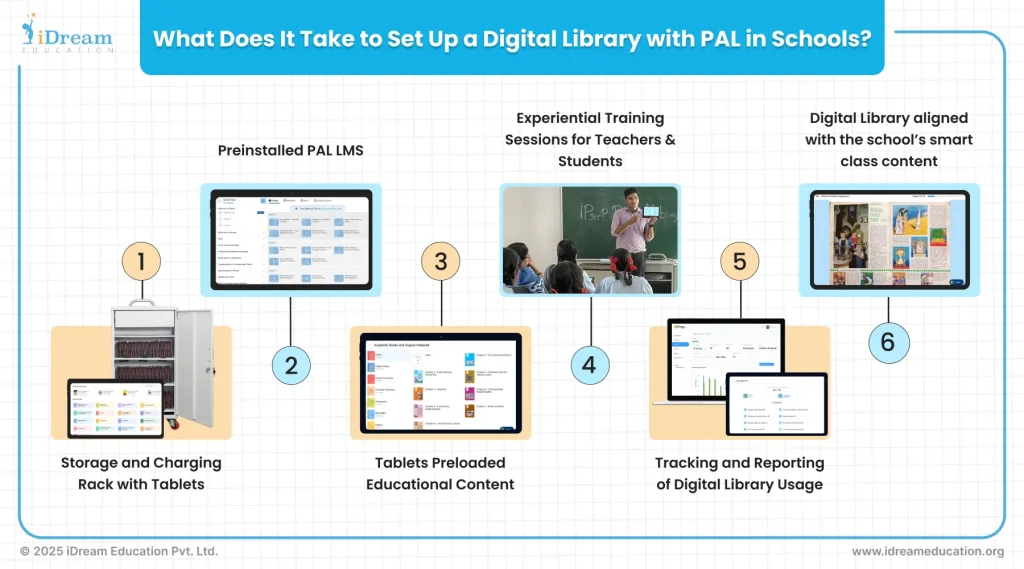
Illustration showing the list of components required to set up a tablet-based digital library with PAL as envisioned in the PM SHRI scheme

Storage and Charging Rack with Tablets

  • At the core of the setup is a smartly designed storage and charging rack. The rack houses 5-60 tablets, making this your complete Digital Library. It can be placed in any classroom, lab, or even a staff room. Moreover, the charging rack can be easily moved from one location to another as per the timetable and schedule. This will ensure the tablet-to-student ratio is balanced offering equitable access and quality usage time for every learner.
  • This mobility ensures that every student gets access, regardless of classroom size or school layout. The tablets can be stacked, stored, and charged together, making device management effortless for the school staff. With this, the Digital Library becomes flexible, portable, and usable throughout the school day. This is exactly as suggested in the PM SHRI programmatic norms.

Preinstalled PAL LMS

  • Each tablet in the setup comes preloaded with iPrep’s Adaptive Library LMS, built to accommodate all users. PAL LMS is designed for least tech-savvy to the most confident. Its universal design and simple navigation ensure inclusivity. While, the personalized engine behind the scenes offers each student a unique learning path.
  • Based on diagnostic scores, practice, and performance, the PAL LMS adapts and recommends content that helps students bridge historical learning gaps, build mastery, and progress at their own pace. This turns every device into a personal mentor, while also supporting teachers with insights and data-driven planning.
  • Basis student’s progress on PAL and mastery of topics, teachers can create creative incentives. This could be classroom rewards, recognition systems, or group-based activities.

Tablets Preloaded Educational Content

  • Every tablet comes with preloaded content aligned to the school curriculum, including: remedial video lessons and adaptive practice questions. With this students also get access to other curriculum aligned content such as syllabus books, notes, worksheets, workbooks and so much more.
  • All the content can be accessed fully offline, ensuring uninterrupted learning even in areas with limited or no internet
  • The content on the tablets is updated annually to reflect the latest changes in NCERT and state education goals.

Experiential Training Sessions for Teachers and Students

  • To ensure smooth and effective adoption, we conduct on-ground experiential training sessions at the time of installation. These sessions are designed to empower both teachers and students. The experiential session gives them the confidence to make the best use of the Digital Library with PAL. The training covers all essential aspects, including: Managing and handling the tablets, charging all devices simultaneously, locking and securing the charging rack, navigating the PAL interface, tracking student usage, progress, and mastery. 
  • Moreover, our support doesn’t stop at the first session. Follow-up training is conducted based on real student usage and progress data, which is continuously tracked through a centralized reporting dashboard. This ensures that the training remains relevant, responsive, and focused on improving learning outcomes over time.

Tracking and Reporting of Digital Library Usage

  • An essential part of any impactful digital library with PAL is the ability to track usage and learning progress and that’s exactly what the PAL LMS enables. The system captures detailed data on: Who is using the library? How frequently do they access it? What types of content are being used — whether books, videos, quizzes, or other formats. Breakdowns of usage is by individual student’s usage of content category, grade level, and time spent
  • This usage data gives deep insights into student learning behaviour. This highlights which content is most engaging, where students are struggling, and which resources may need enhancement.
  • For implementing partners, school leaders, and project administrators, this data becomes a powerful tool. This helps them fine-tune the content strategy, and ensure that every update is based on real needs and usage patterns.

Digital Library aligned with the school’s smart class content

  • All the content in digital libraries with PAL can be aligned with smart classes in schools. This allows seamless integration between classroom instruction and self-paced tablet-based learning. Teachers can confidently plan lessons and assign tasks that complement digital usage, as recommended by the PM SHRI guidelines. 
Together, these components form a complete Digital Library with PAL that’s ready to implement. It’s not just a solution, it’s a digital library infrastructure built to deliver the exact outcomes that the PM SHRI initiative hopes to achieve: inclusion, personalization, ease of access, and most importantly, empowered learning for every child.

If you are exploring a Digital Library with Personalized Adaptive Learning (PAL) for your school, we would be happy to guide you. You may contact us at +91 7678265039 to schedule a demo and see how our solution seamlessly aligns with the PM SHRI School Transformation framework laid out by the Ministry of Education. You can also write to us at share@idreameducation.org or share your details here.
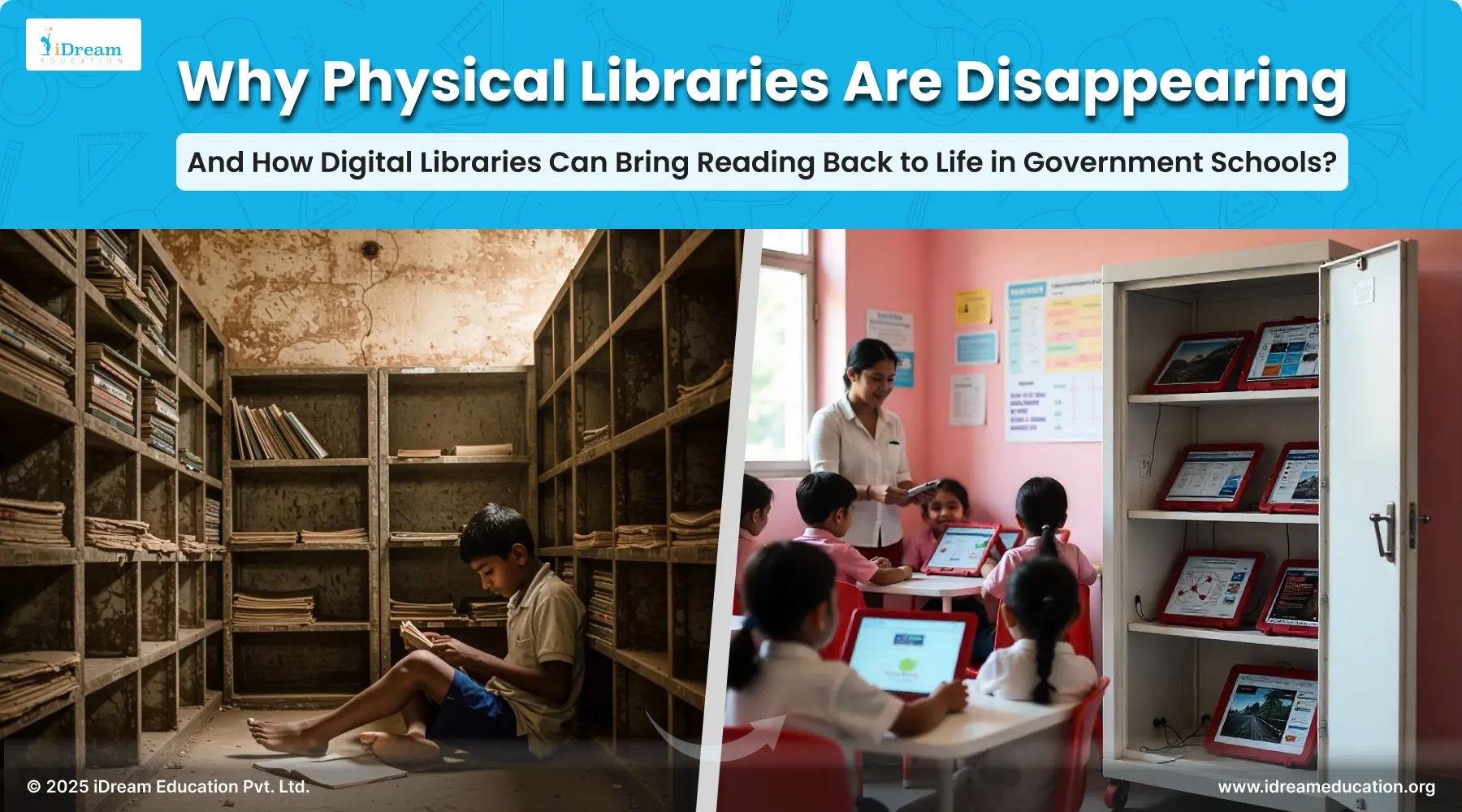
Why Physical Libraries Are Fading: And How Digital Libraries Can Revive Reading in Schools?

Once the soul of every school, libraries now gather dust. Is reading dying or just waiting for a digital rebirth? As physical shelves fade from memory, digital libraries are rising. Let’s explore how digital libraries can revive the joy of reading in schools.

Cover image guiding you to the blog on decline of traditional physical libraries and highlighting the growing importance of digital libraries in government schools

Historically, physical libraries in schools were once seen as essential spaces to nurture reading habits and open up the world of books to students. But over time, their presence and relevance, especially in government schools, has significantly declined. Many physical libraries in schools today are underutilized, poorly maintained, or in some cases, don’t exist at all.

There are several challenges of Physical libraries leading to fading

Physical libraries require infrastructure -space, furniture, proper lighting, and storage. They also need regular investment to keep books updated, add new books,manage catalogues, and ensure student engagement. In most schools, especially those in rural or semi-urban areas, these needs are rarely met. Either the books are outdated, too limited in number, or not aligned with the students’ interests or reading levels. Libraries, when available, are often treated as locked rooms, opened occasionally rather than being part of the daily school experience.

In government schools, the situation is more concerning. With limited budgets, high student-teacher ratios, and a strong focus on syllabus completion, the library often slips low on the priority list. Dedicated librarians are rare, and teachers already burdened with multiple responsibilities, finding it difficult to facilitate regular library periods. As a result, students are missing out on the chance to build a relationship with books outside their textbooks.

The fading of physical libraries has a direct impact on children’s reading habits 

Without regular access to age-appropriate, updated, engaging material in preferred language, reading becomes a task rather than a joy. This not only affects language skills but also hampers imagination, curiosity, and critical thinking.

But does this mean we should give up on libraries? Absolutely not.

It means we need to rethink them. What if a library didn’t need four walls, dusty shelves, or a librarian? What if books could reach through screens they’re already familiar with? This is where Digital libraries for schools offer a strong possibility. These will not be a replacement for reading, but as a modern revival of it. Digital libraries can bridge the reading gap in ways physical infrastructure often cannot.

Let’s look at how digital libraries can become the new foundation for bringing reading back into the everyday learning journey

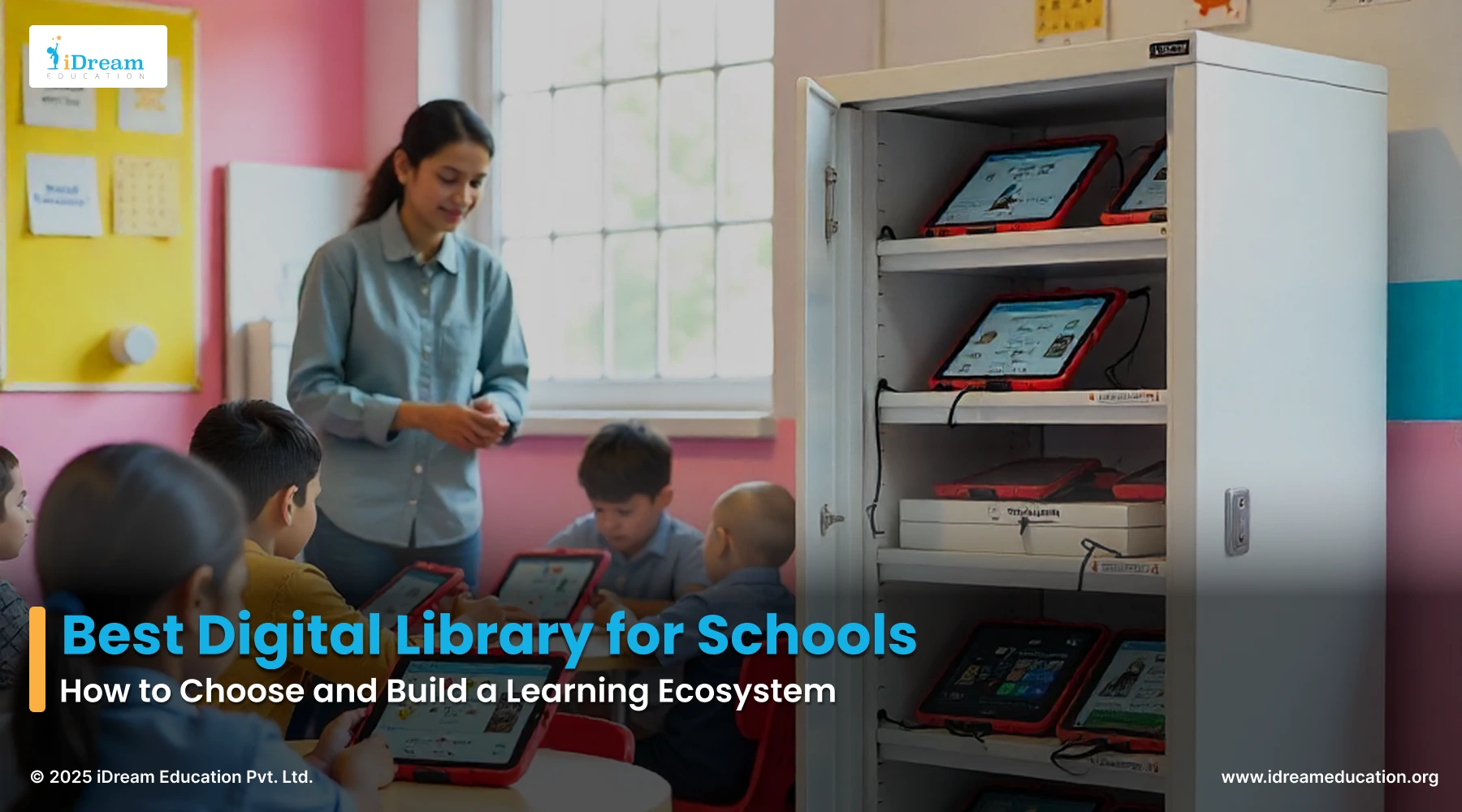
Image with list of reasons for setting up digital libraries in government schools

Seamless Implementation in Any Location

  • One of the biggest strengths of digital libraries is that they can be set up in any government school, whether in a remote village or a city slum. Unlike physical libraries that require large spaces, furniture, and hundreds of physical books, a digital library can run on tablets, smart TVs, laptops, or chromebooks.
  • With the right setup, even a single room or corner in the school can become a reading space. By using a local server or storage and charging rack, the digital library can be set up anywhere and run smoothly without needing constant upkeep or physical book management. This makes it ideal for government schools with limited space, budget, or staff. This gives students easy access to a wide range of books at their finder tips.

No Worries About Empty or Overloaded Shelves

  • One of the biggest pain points in physical libraries is the limitation of physical books. Either there are too few books, or too many outdated ones. With digital libraries, there is no shelf space limit. Thousands of books can be stored digitally and accessed through a simple, child-friendly interface. 
  • This means students of different age groups, learning levels, and interests can all find books suited to them. This could be journals, biographies, stories, poems, or other educational resources.

Language Flexibility: Hindi, English & Regional Languages

  • Students in government schools often come from diverse language backgrounds. Some are more comfortable reading in Hindi, some in English, and many in regional languages such as Marathi, Bengali, Telugu, or Kannada. A digital library makes it possible to offer books in multiple languages. This is something that’s rarely seen in traditional school libraries.
  • When students can read in the language they understand best, they develop a stronger connection with reading. It also supports language learning where students can gradually move from regional languages to globally common language English, building confidence and comprehension step by step.

Offline Access – Solving the Connectivity Barrier

  • A common myth is that digital libraries only work with internet access. But that’s not true. Today’s digital libraries are designed with government schools in mind. The best digital library vendor can provide completely offline access to books by providing preinstalled library lms and preloaded library content.
  • These digital libraries can work without the internet on a day-to-day basis. They only need the internet periodically, maybe once a month or once a term. This is needed to sync the devices and update the content as per government educational goals. This solves a major challenge for rural and remote schools where internet access is limited or unreliable.

Personalised Reading Experience

  • Unlike physical libraries where students pick whatever is available, digital libraries  are enabled with LMS that show books based on grade and language preference, and learning needs. This helps students not just read more, but read better and what’s right for them.
  • Such personalized reading pathways create better engagement. When students find books that match their interest and ability, they’re more likely to read willingly. Reading then becomes an enjoyable part of their daily learning, not just another classroom task.

Easy for Teachers to Integrate into Routine

  • Digital libraries are not just for free reading time. They can be a part of classroom learning too. Teachers can use them during language periods, reading hours, or even for subject-based learning through relevant stories or informational texts.
  • With proper training, teachers can encourage regular reading without needing to manage physical book logs or worry about missing books. You can also get content in digital libraries customized with books aligned to the school curriculum.

Usage Tracking to Improve Reading Outcomes

  • Unlike physical libraries, where there is rarely any record of which books were read or how often they were used after issuing, digital libraries come with built-in usage reporting. The library LMS can track what students are reading, how much time they are spending, and which books are most engaging for different groups.
  • This data can help teachers and school leaders understand students’ reading habits, identify students who may need support, and recommend books more effectively. For project administrators or managers, it offers a transparent view into how well the digital libraries are being used across schools. This makes it easier to track adoption, measure impact, and make data-driven decisions for expanding or improving the program.

Real change is best understood through real stories

Among the many stories we’ve seen during our work in government schools, one from Bhiwadi, Rajasthan, in 2017, continues to stay close to our hearts.

That year, we implemented a tablet-based digital library in a government school in Bhiwadi. Like in many such schools, students were excited, curious, and unsure of what to expect from this new setup. Among them was a quiet Class 7 girl named Nidhi. She was sitting at the back, listening carefully to the training sessions. She wasn’t the most vocal student in the room, but whenever she did speak, her questions showed a spark, genuine curiosity and a hunger to learn.

At that time, we didn’t realize, this was the beginning of something special.

A few months later, while reviewing usage reports from the digital library, one student’s reading activity stood out. Among all users, Nidhi had read an unusually high number of digital books. The usage was not just from her grade level, but from higher classes and across categories such as stories, poems, and general knowledge.

We decided to revisit the school, this time specifically to meet her.

In conversation, Nidhi shared how she had always loved books. Her mother had taught her alphabets and basic words using old, worn-out books at home. But growing up in a village without a physical library or access to new books, her reading journey had no place to grow. Buying books regularly wasn’t an option for her family either.

Everything changed when the school received a digital library on tablets. For the first time, Nidhi had access to hundreds of books at her fingertips, in Hindi and English, and suited to her age and beyond. She began reading regularly. Her interest and comprehension improved, her academic confidence grew, and she started exploring the world through words.

Nidhi’s story is a powerful reminder of why digital libraries matter, especially in government schools where physical infrastructure often falls short. She didn’t need a big library room. All she needed was access, and a screen that opened the door to stories, knowledge, and imagination.

You can also watch the video to hear her story in detail

As we reflect on stories such as Nidhi’s and the many realities of government schools across India, one thing becomes clear- access to reading should no longer depend on physical infrastructure alone. 

The traditional model of physical libraries, while valuable, simply cannot keep up with the scale, diversity, and needs of today’s learners, especially in government schools.

  • Digital libraries offer a practical, inclusive, and future-ready alternative. They break barriers of infrastructure, budget, connectivity, and language. They provide thousands of books in multiple languages, even without constant internet connectivity. And most importantly, they put the power of choice in students’ hands, allowing each child to explore, learn, and grow at their own pace.
  • The impact goes beyond students. With usage reports, teachers and administrators can track adoption, identify gaps, and make informed decisions to improve outcomes. When implemented well, digital libraries not only bring reading back into schools, they help build a culture of learning that stays for life.

It’s time we revive reading in government schools 

If you’re planning to set up Digital Libraries in government schools to revive reading habits, you may contact us at +91 7678265039. You can also write to us share@idreameducation.org or share your details here.
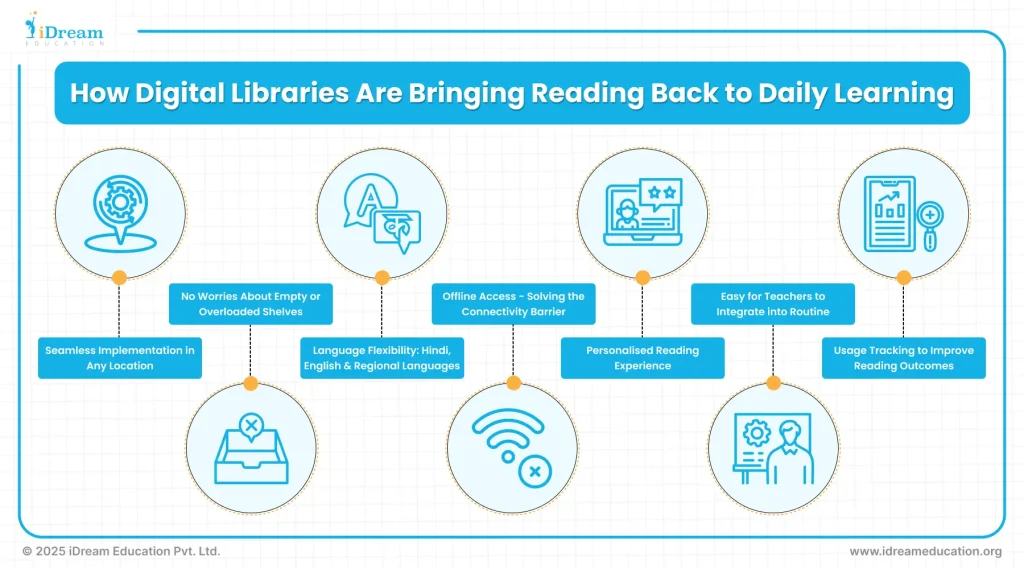
Best Digital Library for Schools: How to Choose and Build a Learning Ecosystem

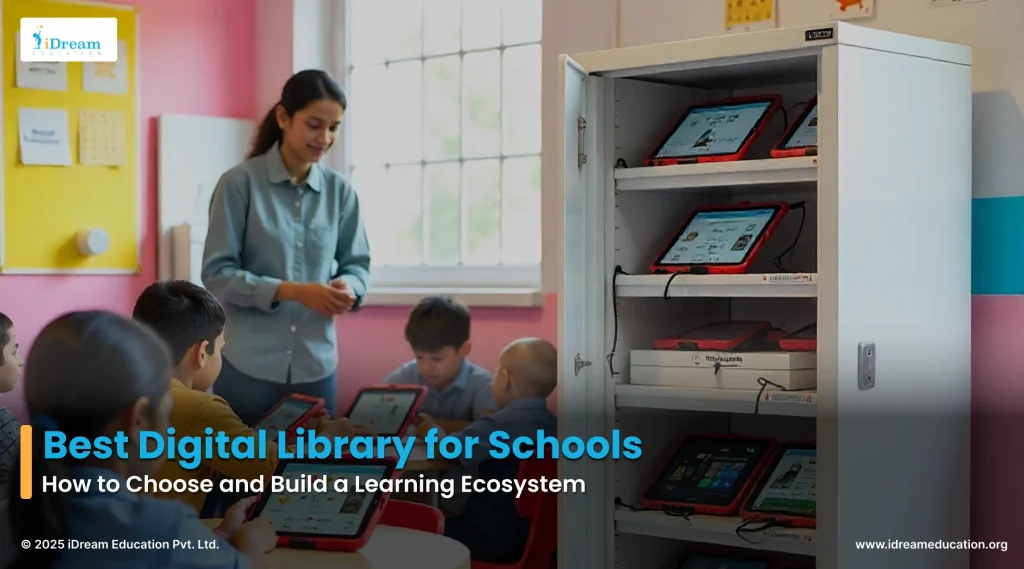
Children and teacher interact with a digital library cabinet, enabling smart learning solutions for Indian schools and rural education.

When we talk about a “digital library” for schools, we often imagine shelves of e-books, PDFs, and academic videos moved to a screen. But in reality, a meaningful digital library is much more than a content repository. It is the heart of a learning ecosystem – one that supports not just academic subjects, but also life skills, creativity, wellbeing, career awareness, sports, arts, and values. Learning does not happen only through textbooks; it happens through stories, experiences, curiosity, play, and exposure to the world beyond the classroom.

This idea becomes even more important in rural and underserved regions, where access to quality school education resources and digital library materials is extremely limited. Many schools still struggle with outdated textbooks, scarce reference material, and almost no exposure to multimedia or experiential learning. For students in these regions, a strong digital learning ecosystem through a digital library setup in school/ community or learning centre can become their window to the world – bringing in videos, simulations, stories, local language content, vocational exposure, and real-life learning experiences that their physical environment cannot always provide.

India’s National Education Policy (NEP) 2020 strongly reinforces this need

NEP talks about holistic, multidisciplinary education that develops not just cognitive skills, but also social, emotional, ethical, and practical capabilities. The policy emphasises experiential learning, creativity, sports, arts, vocational exposure, digital literacy, and inclusion – clearly stating that education must go beyond rote academics to prepare learners for life.

A best digital library therefore is the one that aligns with this vision: supporting both academic learning and non-academic development in an integrated way.

Thus, choosing the best digital library for schools is not just a technology decision – it is an educational design choice. Schools, CSR, NGO and all people in education ecosystem must think about integrating digital library that fits into a larger learning ecosystem. It should be the one that connects curriculum, teachers, students, community, and real-world learning. Especially in rural and resource-constrained settings, the right digital library can become the foundation for equitable, holistic, and future-ready education.

How can Digital Libraries for Schools Can Enhance Education in India?

Learning Without Limits

In many schools, especially in rural areas, learning is still limited to a few textbooks and old library books that rarely change. This restricts students’ exposure and keeps learning confined to fixed subjects and outdated material.

However, digital libraries remove these boundaries. They give students and teachers access to a vast range of e-library content including books, stories, poems, health and safety resources, inspirational biographies, AI and computer basics, journals, sample papers, festivals, Indian history, video lessons and much more. Digital libraries make learning open, flexible, and equal, so every child can learn without limits.

Bridging the Access Gap

In India, access to learning resources is highly uneven. Many rural and government schools have few books and poor or no internet connectivity, limiting what students can learn.

Digital libraries help bridge this gap by bringing multiple categories of digital library resources into one place – academics, stories, poems, science, health and safety, careers, culture, exam practice, and more. Most importantly, many digital libraries are designed to work offline. This means schools do not have to depend on constant internet access. Content can be accessed completely offline on shared devices in classrooms, labs, or community spaces.

By offering rich, multi-category content in a single offline-ready platform, digital libraries ensure that students in remote and underserved areas get the same learning opportunities as those in better-connected schools. This is how technology becomes a tool for equity, not just convenience.

Classroom-Aligned Learning

Digital libraries for schools are not just about general reading – they are built for classrooms. They include curriculum-aligned content mapped to NCERT and State Boards, so teachers can directly use them in daily teaching.

With lessons, videos, practice material, and assessments available in preferred regional languages, teachers can explain concepts more clearly and students can learn in the language they are most comfortable with. This makes learning more inclusive and effective.

Because the content follows the actual school syllabus, digital libraries fit naturally into lesson plans, revision, and exam preparation – making them a real teaching tool, not an extra burden.

What Defines the Best Digital Library for Schools?

When planning to set up a digital library for schools, it is important to understand what actually makes a digital library “the best.” It is not just about having digital content – it is about how well that e-library content supports learning.

Everything in One Place, Easy to Use

  • A good digital library  for school schools comes with a digital library platform. It brings all learning resources including academic and beyond academic into one single space. Instead of searching across multiple apps, websites, or folders, students and teachers can find everything in one platform.
  • From curriculum aligned subject material to book library – everything is organised in clear categories. With simple navigation, smart search, and class-wise filters, teachers and students can quickly find what they need.

When content is easy to find and easy to use, it actually gets used. A well-designed digital library saves time, reduces confusion, and makes learning smooth and enjoyable.

It’s Not Just Textbooks — It’s About the Right Mix

  • The best digital library for students should feel like a real learning space, not just a collection of e-books. It should offer the right mix of content including videos, interactive lessons, practice exercises, sample papers, PDFs, journals, stories, poems, biographies, and real-life learning resources.
  • Different students like to learn in different ways. Some prefer watching, some reading, some practicing, and some exploring on their own. When a digital library offers multiple formats, students stay engaged for longer and understand concepts better. They can revise through videos, test themselves with practice, and go deeper through reading.

When library content is interesting, simple, and easy to explore, students don’t stop at what is taught in class. They start searching, clicking, reading, and learning out of curiosity. This habit of self-learning is built through enjoyable content – stays with them for life.

Works on Existing and New School Devices

  • The best digital library for schools is not one that demands expensive new infrastructure. It should work smoothly on the devices schools already have. This includes desktops, laptops, chromebooks or tablets.
  • Schools should not have to replace their setup just to use a digital library. Whether a school is starting fresh or already has some digital tools, the digital library platform should easily fit into both old and new environments.

This flexibility saves cost, reduces complexity, and ensures faster adoption, so schools can focus on teaching and learning, not on managing technology.

Supports Regional Languages and Curriculum + Holistic Learning

  • The best digital library for schools speaks the language of its learners. It should offer content in regional and preferred languages so students can understand concepts clearly and learn with confidence.
  • At the same time, the content must be aligned with school curriculum – NCERT and State Boards, so students can directly refer to what they learn in classrooms. But it should not stop at textbooks. A strong digital library also supports holistic learning with content on stories, health, safety, history of India, festivals, inspirational biographies, Journals, About AI, Computers, Cyber Security, Digital Literacy, Programming Languages and lot more

This balance of curriculum-aligned and beyond-academic content ensures students grow not just as learners, but as confident, creative, and well-rounded individuals.

Tracks Usage and Learning Progress

  • The best digital library for schools does not just provide content—it shows how that content is being used. With inbuilt usage tracking and reporting, schools. project officials can see which resources are accessed most, which classes are active, and what students are exploring.
  • This data helps teachers understand learning patterns, identify gaps, improve usage,&  conduct more inclusive training. Plus, project officials can track adoption, measure impact, and ensure the digital library is actually adding value.

When a digital library comes with usage reporting and synching mechanisms, it turns content into insight, helping make better decisions for better learning.

Know how to set up your digital library here

If you are looking to set up the best digital library for schools, community centres, or learning centres – whether for a single school, a district, or an entire state, you may contact us at +91 7678265039. We would be happy to share what truly makes a strong digital library infrastructure and how we can help you build a complete digital learning ecosystem. You can also write to us share@idreameducation.org or share your details here

What Makes the Best Digital Library Software Platform in India? Key Features to Look For in 2025

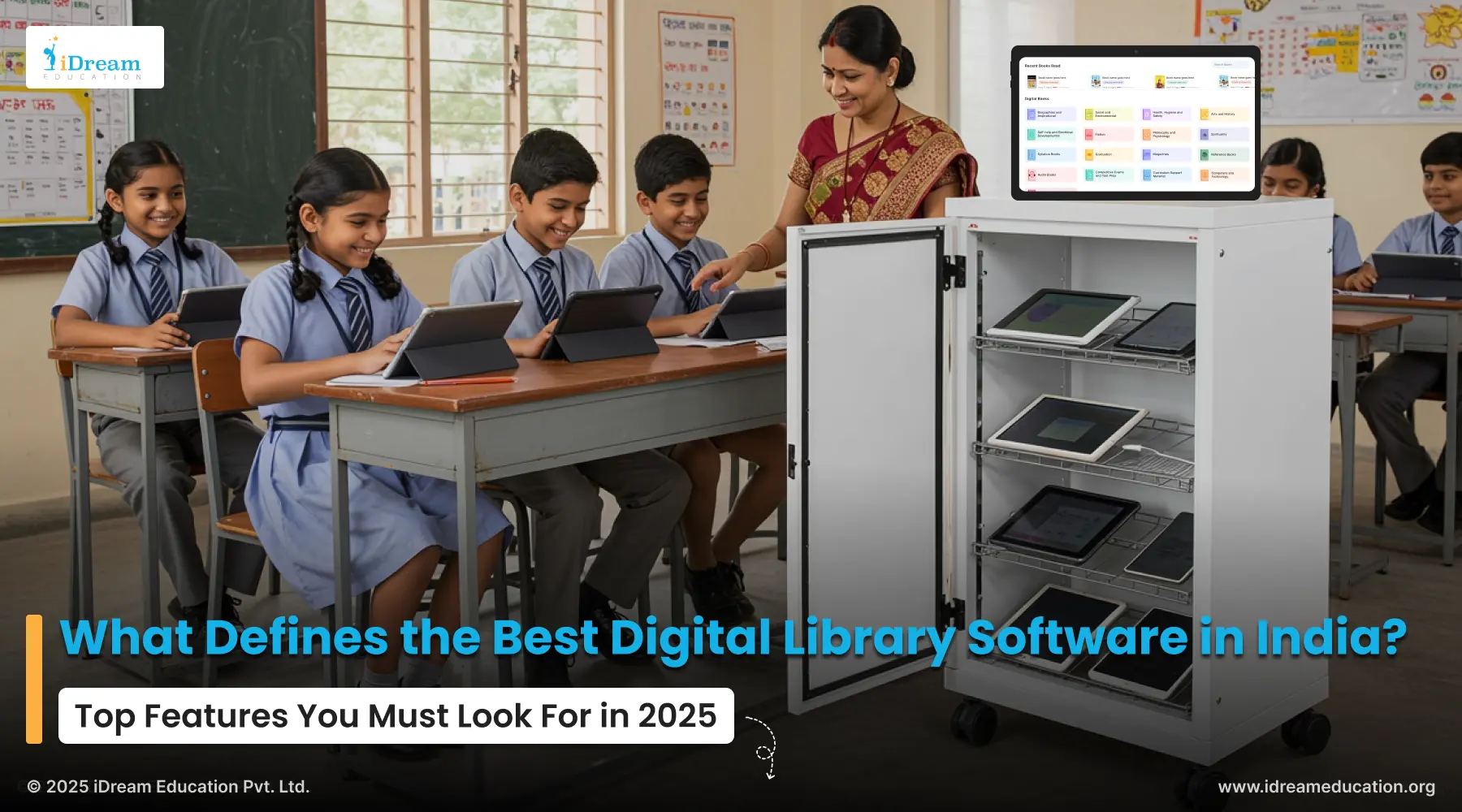
Cover image of a blog that guides schools in choosing the best digital library software

As India moves towards building a knowledge-based society. There is a growing emphasis from both government bodies and social organisations on establishing a robust digital library infrastructure. This is especially in schools, rural institutions, and community centres. 

What is the primary reason behind this?

The reason is not just the idea of offering access to a vast pool of books. But doing it in a way which offers well-structured Digital Library Software Platforms that can work even in offline environments. In fact, the focus is no longer just on digitising content. It has now shifted towards making access equitable, seamless, and user-friendly for learners of all ages and regions.

Historically, libraries in India especially in public and school settings have been underutilised. This is due to physical limitations, lack of up-to-date content, and maintenance challenges. Digital libraries, powered by software platforms, are changing that. They hold the promise of enhancing any space into a joyful and personalized learning zone by offering curated e-books, interactive resources, and even audio-visual learning content in multiple languages. And when equipped with offline functionality, they become highly relevant for rural or low-connectivity areas, supporting inclusive education goals.

The year 2025 is a turning point where the integration of technology with education is no longer optional—it’s essential 

Hence, choosing the best digital library software platform is critical. Stakeholders must look beyond flashy interfaces and consider how these platforms store, organise, recommend, and track usage of content. With the rise of NEP 2020-driven reforms and initiatives such as PM eVIDYA and DIKSHA, there’s a clear shift towards personalised, decentralised, and tech-enabled access to quality learning material. 

Let’s Look at Key Features of Best Digital Library Software Platform 

When evaluating a best digital library software platform, especially in the diverse and evolving Indian educational landscape, it’s important to look beyond just content availability. The best platforms are those that not only host a rich and varied collection of digital resources but also offer a seamless user experience, work reliably in offline mode, and align with the local needs of learners, teachers, and institutions. Here are the key features that can make your investment in a best digital library software platform truly impactful, both today and in the years to come:

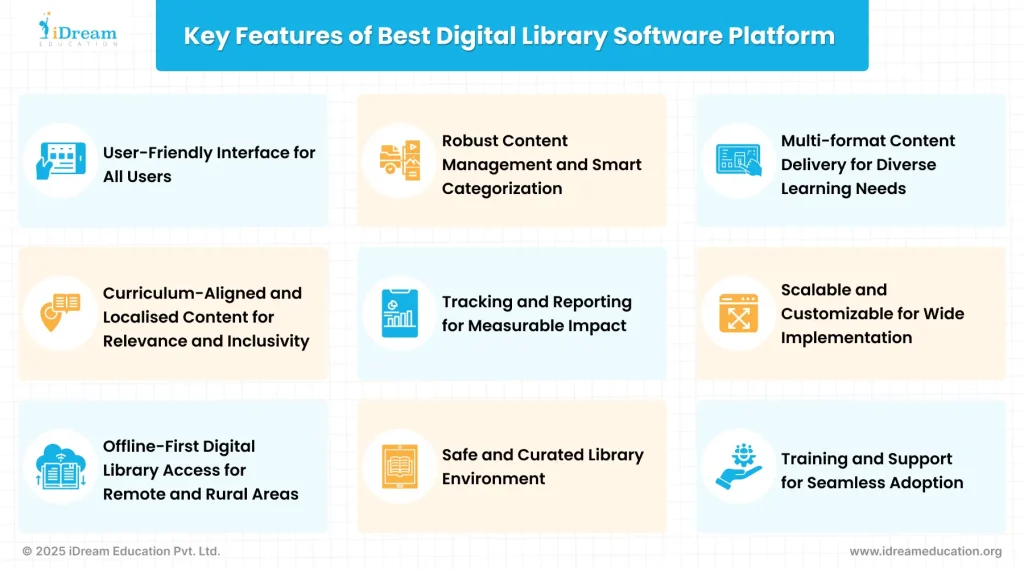
Infographic highlighting key features of best digital library software

User-Friendly Interface for All Users

One of the most essential features of a best digital library software platform is how user-friendly its design is. Especially in school settings, where users range from students and teachers to administrators with varying degrees of tech familiarity, an intuitive interface becomes critical. Here’s what to look for:

  • Designed on Universal Design Principles: The digital library platform should be built to accommodate all users, from the least tech-savvy to the most advanced. Universal design ensures inclusivity by making the navigation structure simple and predictable.
  • Easy Navigation for All: The interface should enable students, teachers, and administrators to find and access the content they need with minimal clicks and no confusion. 
  • Mobile-Responsive Design: The digital library software should work seamlessly across devices including tablets, desktops, laptops, and smart classroom setups. 
  • Optimized for Low-Tech Users: The design should reduce friction and be intuitive enough for users who may not be comfortable with technology. For example, features such as guided tutorials, visual cues, and contextual help buttons can support ease of use.
  • Minimal Learning Curve: One of the best digital library platforms is the one for which users should not need extensive training to start using the platform. A well-designed digital library software feels familiar and easy to use right from the first interaction.

Robust Content Management and Smart Categorization

The best digital library software platform must go beyond simply storing resources. It should organize and present them in a way that makes discovery effortless and intuitive for both students and teachers. Here’s what defines this feature:

  • Smart Tagging & Filters: The best digital library software platform uses smart tagging systems that classify each resource (books, stories, journals, sample papers, etc.) based on relevant metadata. With smart filters, students can narrow down content in just a few clicks so that no time is wasted searching aimlessly.
  • Multi-Level Search Functionality: The platform should allow users to search and filter digital library resources by class, subject, and language. This ensures personalized access, especially important when learners access the platform in shared/ short library sessions.
  • Quick Discovery of Resources: Whether it’s a Class 5 student looking for a Hindi storybook or a Class 10 teacher searching for science sample papers, the system should allow them to find exactly what they need quickly.
  • Dynamic and Up-to-Date Content Repository: The best digital library software platforms are not static. They get regularly updated with newly published books, fresh reading materials, and content aligned with evolving government guidelines, curriculum changes, and educational focus areas.
  • Categorized for Every Learning Need: Resources should be neatly organized under categories such as curriculum-aligned books, general reading, exam prep, activities, and more. This makes the digital library truly multi-purpose.

Multiformat Content Delivery for Diverse Learning Needs

With the reduced attention span of 21st-century learners and the varied preferences in how students consume content, the best digital library software platforms must offer content in multiple formats to keep learning engaging, inclusive, and accessible. Key aspects include:

  • Supports Multiple Content Formats: The digital e-library software should allow access to a wide variety of content types such as textbooks, eBooks, PDFs, biographies, quizzes, and interactive learning modules. This ensures students can engage with learning in the format they relate to best.
  • Online + Offline Access Capability: To make digital libraries scalable across urban and rural areas alike, the best digital library software should support offline access. This is crucial for low-bandwidth or no-internet zones, ensuring even last-mile learners can benefit from rich e-library content.
  • Content Accessibility Across Devices: Whether accessed on a tablet in a smart classroom or via a chromebooks, digital library software should be able to load all formats smoothly and consistently. This ensures a uniform experience to all users.

Curriculum-Aligned and Localised Content for Relevance and Inclusivity

With the increasing emphasis on digital learning across all grades and schools in India, the best digital library software platforms must offer curriculum-aligned and locally contextualized content to truly support school education. Here’s what this feature should include:

  • Mapped to NCERT and State Board Syllabi: The digital library software must provide reading resources and learning materials aligned with the NCERT as well as various State Board curriculums. This ensures that students and teachers can rely on the digital library for academically relevant content across classes. When searching for it, you can also explore specific needs such as a CBSE digital library, digital library for the Tamil Nadu Board, and more.
  • One-Stop Access to All Educational Resources: From textbooks to storybooks, reference materials, and practice papers, all should be accessible in one place. A well-structured and syllabus-linked e-library content helps teachers plan lessons and allows students to revise without needing to search elsewhere.
  • Includes Regional Language Content: To promote linguistic inclusivity, the e-library platform should offer content in multiple regional languages. This also ensures accessibility across India’s diverse classrooms. This is especially valuable in government and rural schools where regional language is the primary medium of instruction.
  • Age and Grade-Appropriate Coverage: The platform should offer a wide range of digital e-library resources catering to all grades (Pre-primary to Class 12) and all subjects. The best digital library software is the one that carefully curates to match the cognitive level and language understanding of students at different age groups.

Tracking and Reporting for Measurable Impact

In today’s education ecosystem, the focus of digital library solution and other digital solution implementation has shifted from just availability to actual usage, adoption, and learning outcomes. Therefore, a best digital library software platform must come equipped with strong tracking and reporting capabilities. Here’s what this includes:

  • Detailed Usage Analytics: The e-library platform should track who is using the library, how often, and what type of content is being accessed. Whether it’s books, videos, or quizzes, e-library usage data should be available by student, content category, grade level and overall/individual time spent.
  • Content Engagement Insights: e-library analytics should offer insights into which content is most preferred, which resources need improvement, and where there are gaps. This helps implementing partners and project administrators optimize the content strategy to improve both relevance and usage.
  • Supports Data-Driven Decision Making: For schools, NGOs, and government departments, this data becomes essential for planning interventions, identifying under-utilized resources, and measuring the impact of digital library implementation.
  • Monitors Learning Progress and Outcomes: By tracking how students engage with different types of content over time, the digital library software helps assess learning engagement trends, indirectly contributing to understanding student progress and performance.
  • Scalable Impact Measurement Across Centres: Whether it’s one school or 100 or more schools/learning centers, a strong reporting module of digital library software helps stakeholders evaluate success, decide where to expand next, and replicate high-impact practices at scale.

Scalable and Customizable for Wide Implementation

The best digital library software platforms are not one-size-fits-all. They are built to adapt to different educational settings, infrastructure setups, and project goals. A scalable and customizable platform ensures seamless rollout across schools, districts, or even entire states. Here’s what to look for:

  • Easy Scalability Across Locations: The digital library software should be capable of being deployed across multiple schools, learning centers, or geographies. Whether urban or rural, without needing extensive infrastructure changes. This supports statewide or education based NGO led rollouts with consistent quality.
  • Customizable for Different Needs and Budgets: Each school or project may have unique needs. The digital library software should support flexible implementation. Flexibility in terms of devices, features, and deployment scale based on the available budget and learning goals.
  • Compatible Across Devices and Hardware: Whether the school requires digital library software on tablets, Chromebooks, smart class setups, or basic desktops, the best one should work smoothly on all configurations. This ensures that schools can utilize existing hardware and don’t have to invest heavily in new infrastructure.
  • Supports Project-Specific Configuration: NGOs, CSR or government departments may have different focus areas. Thai could be foundational literacy, reading e-library content, or exam prep. A customizable platform allows tailoring the content categories to fit project-specific requirements.
  • Built for Future Expansion: As a project grows the best digital library software should allow adding more classes, subjects, without major system overhauls.

Offline-First Digital Library Access for Remote and Rural Areas

In a country as diverse as India, internet connectivity remains a challenge in many rural and remote regions. That’s why the best digital library software platforms must follow an offline-first approach. Offline digital library ensures access to quality digital learning resources even without continuous internet access. Here’s how:

  • Offline Access Through Multiple Mediums: The e-library platform should support content delivery via SD cards, pen drives, or local servers. These flexible formats allow deployment in areas with low or no connectivity.
  • Reliable Access Without Internet Dependency: Once e-library content is installed, students and teachers should be able to browse, search, and engage with the full digital library without needing to go online. This makes it highly reliable for uninterrupted usage.
  • Supports Periodic Sync and Updates: When internet becomes available (e.g., via mobile hotspot or limited broadband), the best digital library software is the one that allows content updates and usage data sync.

Safe and Curated Library Environment

A digital library software meant for school education must ensure a safe, distraction-free, and age-appropriate experience for its users. The best e-library platforms are thoughtfully designed to offer a secure digital space focused purely on learning. Key elements of this feature include:

  • Age-Appropriate and Curated Content: All resources such as stories, biographies, sample paper, etc. should be educationally relevant & student friendly. e-Library content should be carefully reviewed to suit the developmental stage of each grade group.
  • Ad-Free and Distraction-Free Interface: The platform must operate with no third-party advertisements, pop-ups, or unnecessary notifications. This ensures a focused learning experience, free from external influences or inappropriate content.
  • No External Links or Unsafe Redirects: A closed, secure system with no links to unverified websites or content. This helps maintain the integrity of the school-safe environment and builds trust among parents, teachers, and administrators.

Training and Support for Seamless Adoption

A digital library software is only as effective as its adoption in daily school life. To ensure smooth integration and sustained usage, the best platforms offer comprehensive training and ongoing support for both students and teachers. Here’s what this entails:

  • Student and Teacher Onboarding: A best digital library software provider would be the one who offers structured onboarding sessions. This helps students and teachers understand the platform’s features, how to navigate it, and how to access different types of content with ease from day one.
  • Technical and Functional Training: Hands-on training ensures that even low-tech users become confident in using the digital library software. This includes guidance on accessing offline content, using filters, search and tracking usage.
  • Support for Daily Integration into School Routine: A best digital library software provider will be the one who ensures teachers guidance. This should be focused on how to embed digital library usage into classroom activities, revision sessions and setting library timetables.

Bring the Best Digital Library Experience to Your Schools/Community Centre/NGOs with iDream Education

If you’re seeking for the best digital library software platform that truly checks every box – from user-friendly design and multiformat content to offline access and usage analytics. iDream Education is your ideal partner. We offer a robust, scalable, and inclusive digital library solution with thoughtfully curated for safe and age-appropriate e-library content

Whether you’re an NGO, a school, a CSR initiative, or a government body — we’re here to support you. We can be your technical partner for setting up a digital library. Plus, we can be your content partner by enabling a rich library of engaging and educational resources. Moreover, we can also support you in end-to-end implementation partner for deploying digital libraries in any location.

Our platform offers all the key features of the best digital library software, including:

  • Intuitive, device responsive design
  • Smart e-library content categorization and curriculum mapping
  • Multiformat e-library content 
  • Offline-first access via SD cards, pen drives, or local servers
  • Usage tracking and reporting dashboards
  • Teacher-student onboarding and continuous support
  • We are fully equipped to set up digital libraries on devices of your choice. This includes tablets, desktops, smart class hardware, or local server based digital libraries.

We’d be happy to share more details. We would be happy to guide you through our implementation process, and even organize a demo tailored to your needs. So, if you’re looking for the best digital library software that’s practical, inclusive, and outcome-focused, reach out to us at +91 7678265039. You can also write to us at share@idreameducation.org or share your details here.
₹900 Crore Sanctioned for 18,966 Smart Classrooms in Delhi: What Will Truly Drive Learning Outcomes?

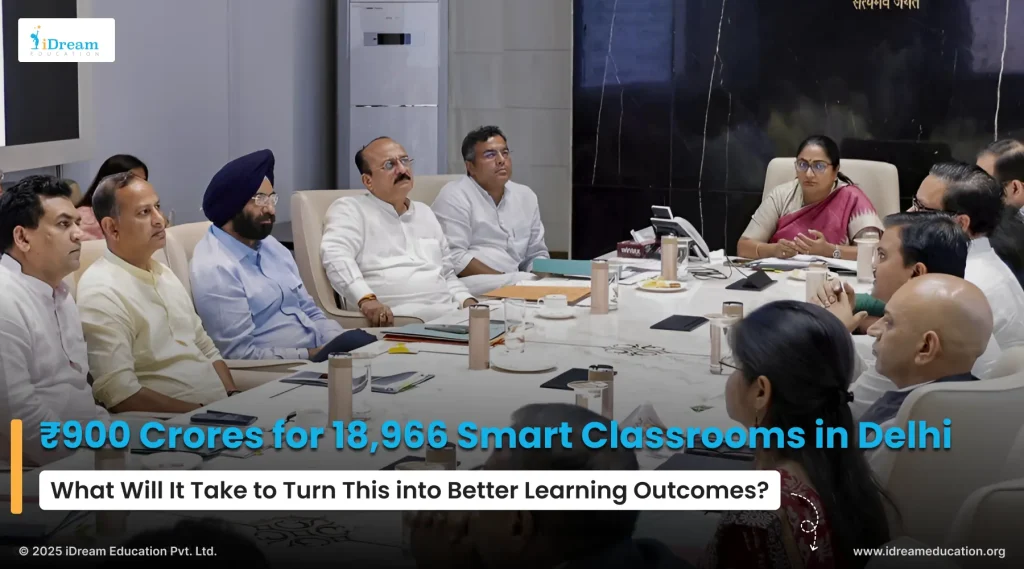
Image of Chief Minister Rekha Gupta chairing a cabinet meeting where ₹900 crore was approved for setting up 18,966 smart classrooms in Delhi public schools

The Delhi government has sanctioned a ₹900 crore investment to set up 18,966 classrooms into smart classrooms in Delhi across public schools. This happened in a cabinet meeting chaired by Chief Minister Rekha Gupta Ji on July 9. This initiative was discussed as a core step towards modernising education for Classes 9 to 12. This smart classroom in Delhi initiative includes Interactive panels, audiovisual aids, and smart blackboards. These will be set to become part of everyday teaching, aiming to change how learning happens in government schools.

Education Minister Shri Ashish Sood said

“The Delhi government will transform 18,996 classrooms in its schools into smart classrooms. This will include facilities such as interactive panels and audiovisual aids, for Classes 9 to 12 in a phased manner. This effort is part of a broader vision, a phased digital classroom expansion aligned with the National Education Policy (NEP) 2020.” 

Further, briefing the media he further said, 

“The additional classrooms will bring the total number of smart classrooms in the city to 21,412 by 2029-30″ He also said, “The plan to create additional smart classrooms is part of a comprehensive digital classroom expansion plan. The project is in line with the National Education Policy (NEP) 2020.”

He added,

Already, tenders are out for installing 2,446 smart blackboards in 75 CM Shri Schools as the first tangible step toward this vision.”

The Delhi government’s focus on education is clear. 

Out of Delhi’s total budget of ₹1 lakh crore, ₹19,291 crore – almost one-fifth has been set aside just for education. That makes it the highest-funded sector this year, showing a strong commitment to improving how students learn in schools.

But as Delhi moves forward with this bold investment, one critical question remains:

Will the shift to smart classrooms in Delhi be a turning point for students in Delhi, especially those in government schools? Or will the promise of technology remain underutilised without structured digital content as per NEP, and a teaching-learning platform that records and tracks usage?

Smart Classrooms in Delhi Need More Than Just Screens – They Need a Strategic Intervention

Over the past 9 years, working closely with government school teachers through smart classroom projects across India, one insight has become crystal clear: Smart classrooms without preloaded, curriculum-aligned content are just expensive hardware.

For many teachers, using such setups becomes a burden rather than a support. Why? Because they are expected to connect devices to the internet, search for relevant content, check if it matches the syllabus and language medium. Plus, all within their already packed 40–45 minute class time. This makes smart classrooms difficult to integrate into regular teaching and often leads to underuse.

Technology alone does not drive change. To drive change, we need meaningful content, easy usability and continuous reporting

If Delhi truly wants its ₹900 crore investment to create a long-term impact, smart classrooms must be given preloaded with high-quality digital content that matches the curriculum, the textbook structure, and the medium of instruction used in schools. When teachers can simply mirror the textbook lessons through multimedia content such as animated lessons, practice, notes, digital books –  it becomes a powerful tool for daily teaching. Lesson planning becomes richer, instruction becomes clearer, and learning becomes more engaging.

Plus, there’s another crucial piece that often gets ignored: DATA.

To make smart classrooms in Delhi effective and accountable, the government must implement them with a learning management system (LMS) that not only delivers content but also tracks usage. A system that gives subject-wise usage reports and insights into how classrooms are being used. This usage data should be further synced to central dashboards for project administrators. They can then monitor adoption, spot gaps, support teachers, and make data-driven decisions.

Without these two pillars: comprehensive offline content and a smart platform with analytics, smart classrooms risk becoming underutilised assets. At best, they’ll serve as display tools for occasional videos. At worst, they’ll gather dust, with no clear way to measure impact or improve learning.

The real opportunity here lies not just in digitising infrastructure. It also lis in digitising pedagogy to make teaching easier, more effective, and more aligned with NEP 2020’s vision of personalised, engaging learning for every child.

Closing Thoughts

At iDream Education, we have seen and experienced that when smart classrooms are thoughtfully implemented, not just with hardware, but with comprehensive offline educational content, a user-friendly LMS, and deep reporting and analytics – real change begins to happen.

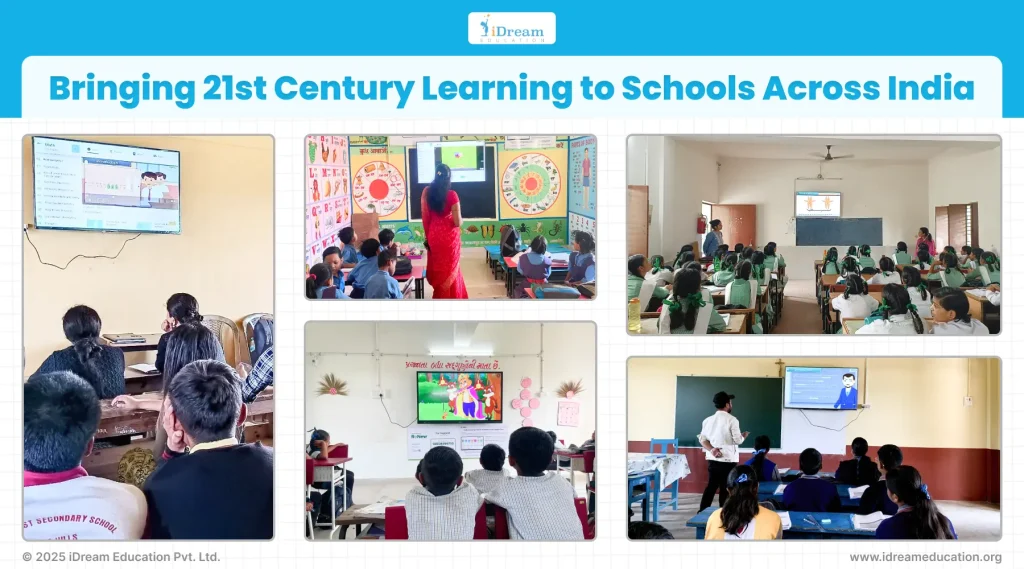
 Smart classrooms implemented by iDream Education in Schools across India

With the iPrep LMS and content, we’ve enabled thousands of schools across India to bring smart classrooms to life. These classrooms are not just screens on walls, they are active learning spaces. Spaces where teachers use preloaded, curriculum-aligned content in their preferred medium. This helps them to plan lessons better, explain concepts more clearly, and keep students more engaged. And because usage data is tracked, school/project administrators can monitor adoption. This can further help them identify specific needs, conduct focused teacher training, and assess students’ progress.

This is the path to truly driving learning outcomes

As Delhi prepares to roll out one of the country’s largest smart classroom projects. We hope this becomes more than a technology upgrade. We hope it becomes a teacher empowerment initiative, a student learning enhancement, and a model for other states to follow. Because in the end, it’s not the screens or blackboards that matter most, it’s how we use them to bring learning alive.

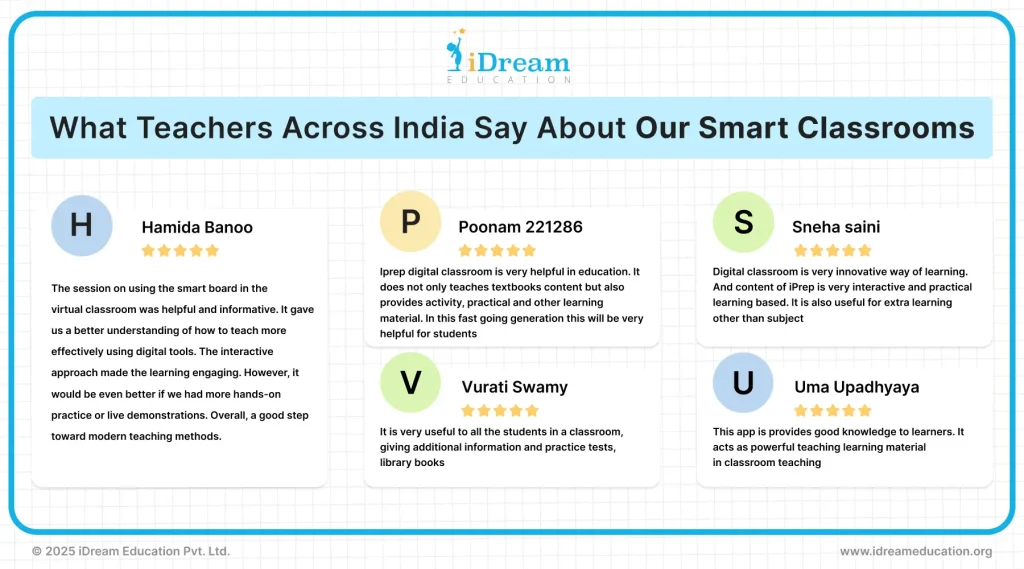
List of smart class reviews highlighting positive feedback on iDream Education's smart class solutions, showcasing why it is considered one of the best smart class providers in India

If you’re looking for offline educational content, learning platforms, and a reporting system  for smart classrooms, you may reach out to us at +91 7678265039. You can also write to us at share@idreameducation.org or share your details here.
Looking for the Best Digital Library Vendor? Here’s a Checklist for Schools

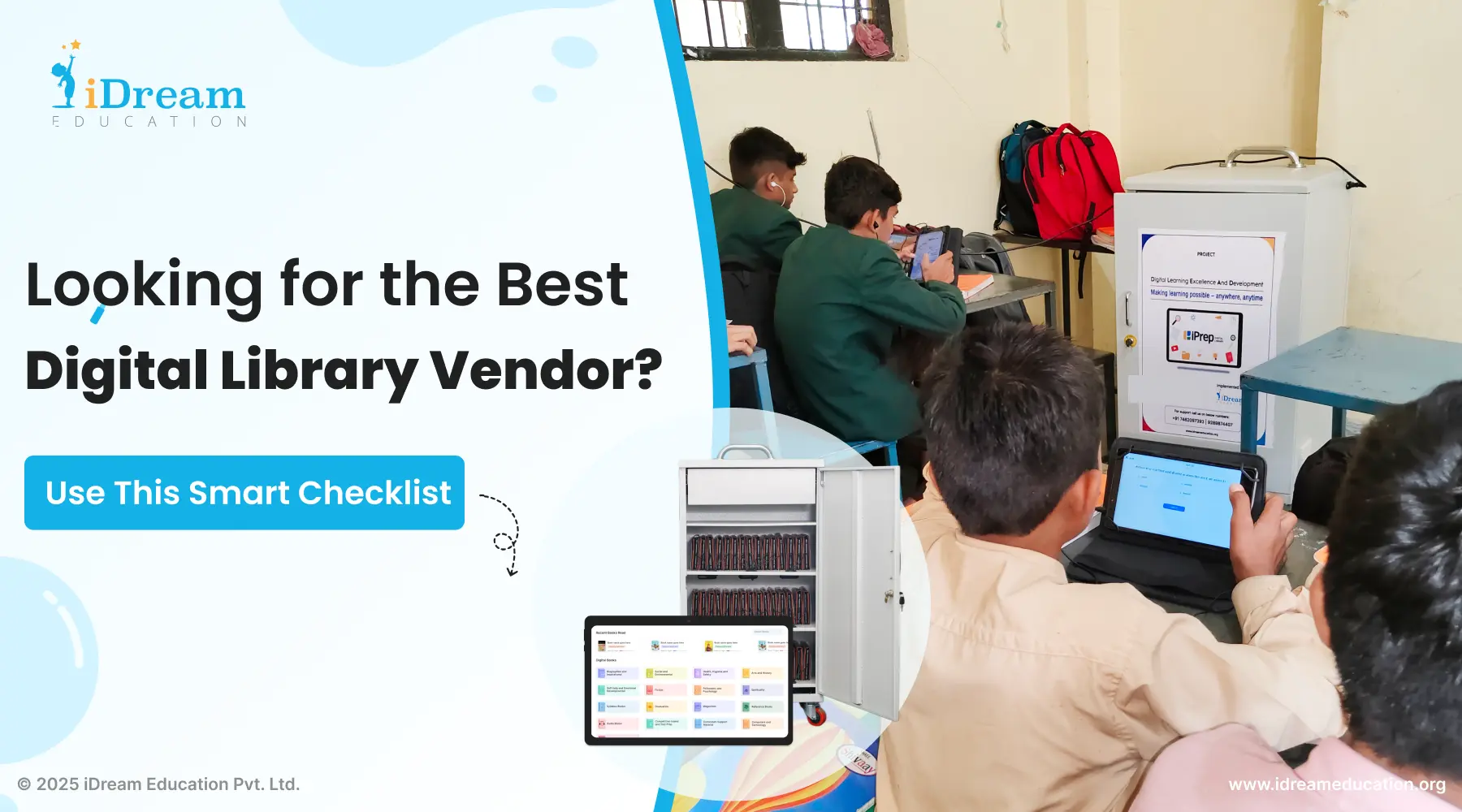
Cover image of the blog guiding readers on key factors to consider when choosing the best digital library vendor

In schools across India, especially in remote and underserved regions, a familiar pattern continues to unfold. Classrooms are full, curiosity is abundant, but access to diverse, engaging learning/teaching/reading materials remains limited. The traditional school library, where it exists, often consists of aging textbooks, outdated encyclopedias, and a handful of storybooks kept under lock and key. For many students, especially first-generation learners, the idea of exploring knowledge beyond textbooks is more a luxury than a norm.

If your goal is to build an environment where every child can read, explore, and learn at their own pace – anytime, anywhere, then choosing the right digital library vendor becomes a critical step. Not just any vendor, but one who understands your school’s unique context, learner needs, and project objectives.

Because in this journey, a Digital Library is no longer just a fancy term or a passing trend

e-Libraries hold the potential to be a powerful enabler. It is a means to truly democratize access to quality learning resources for all students, regardless of geography or background.

But here’s the ground reality – investing in digital infrastructure without clarity often leads to shelved solutions. Schools struggle with the “what” and “how”:

  • What kind of content will engage students across different grades and languages?
  • How will teachers and non-tech-savvy staff make the most of it?
  • And most importantly, how do we ensure it doesn’t end up as another digital library setup?

The intention is strong. The need is urgent. But the right questions must be asked before choosing a digital library vendor. 

Here’s a checklist to help you choose the Best Digital Library Vendor

Illustration of a checklist of choosing the best digital library vendor

Flexible Digital Library Setup Options to Match Your School’s Infrastructure

No two schools are the same. This is why the best digital library vendor offers flexible and customized setup models to meet varied needs and infrastructure realities. Look for a partner that empowers you with options such as:

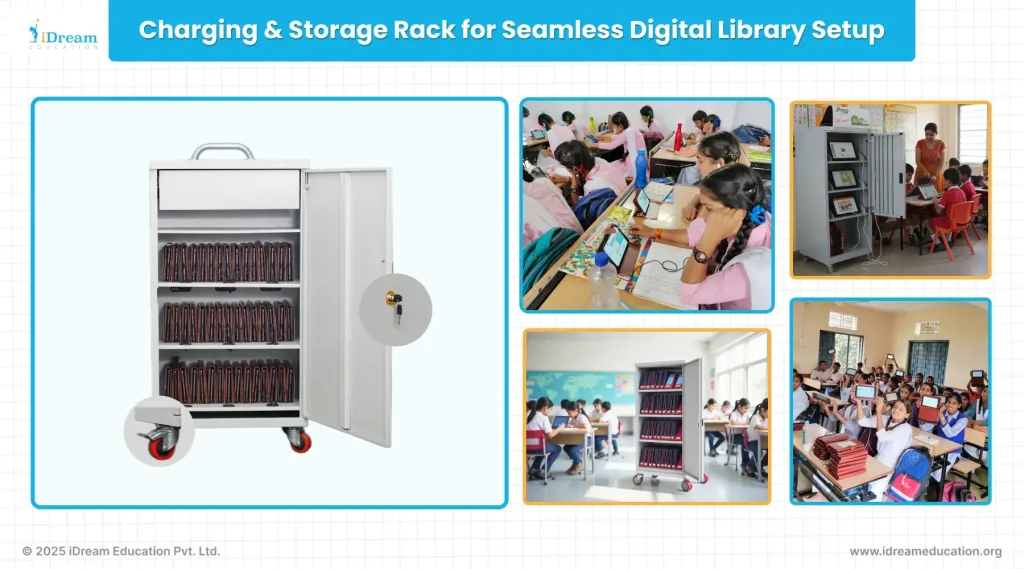
  • Tablet or Chromebook with Storage & Charging Racks Compact, safe, and easy-to-manage racks that can accommodate 5 – 60 devices. These setups are ideal for shared use in libraries or smart classrooms, ensuring devices are always secure and charged.
  • Integration with Existing/New Desktop Setups: If the school already has desktops or plans to add them, the best digital library provider should be able to deploy the best digital library for schools seamlessly on these systems. This will help you make the most of existing resources.
  • Local Server-Based Digital Library Setup: In cases where consistent internet is a challenge, best digital library vendors like us can set up a mini computer/server at the school, district/state data centre, or community hub. This enables offline access across multiple schools and devices, ensuring reliable access to content without depending on connectivity.
Storage and charging rack neatly organizing multiple tablets as part of a digital library setup in a classroom

Unified Learning Experience: Digital Library + LMS + Content Integration 

One of the key strengths of a truly effective digital library vendor lies in offering a unified learning experience. This combines a digital library with a Learning Management System (LMS) and e-library content. This unified experience is particularly valuable for Indian schools, where teachers and students need platforms that are simple, intuitive, and ready to use, without needing technical expertise or complex infrastructure. 

  • An easy-to-setup and manage digital library platform: The best digital library vendors would be the ones who ensure schools run e-libraries through cost-effective setups. It could be tablet-based or Chromebook-based mobile libraries, or local server-based digital libraries that work without the internet. These solutions ensure access in even the most resource-constrained environments.
  • Universal and intuitive Library LMS: The LMS provided should be as easy to use as a regular mobile app, helping teachers and students access content in a structured way. Best Digital library vendor would enable LIbrary LMS that offers organized by grade level, subject, age, or personal preference. This ensures that e-library resources are not just stored, but actually used in everyday teaching and learning.
  • Rich, structured content e-library: Equally important is the quality and relevance of the content. A credible and best digital library vendor will go beyond textbooks and offer a holistic repository. This includes curriculum-aligned materials, animated videos, e-books, interactive storybooks, journals, sample papers, workbooks, and more. This variety not only supports academic learning but also encourages reading as per interests, creativity, and independent exploration.
  • Updated e-library content:  A best digital library vendor is more than just a technology provider, they are also the right content partner, aggregator, or uploader who can fulfill your specific content requirements. Alternatively, they should offer you the flexibility to upload your own content, while ensuring seamless content updates whenever the device connects to the internet.

When these three components – library setup, LMS, and content — come together. This type of integration empowers schools with a sustainable and impactful e-library solution that works in real classrooms, with real students.

Built-in Usage Reporting and Impact Tracking Tools

When choosing the best digital library vendor, it’s not enough to just set up the infrastructure. You need to know how well it’s being used, what’s working, and where improvements are needed. That’s why a robust reporting and monitoring process should be a non-negotiable part of your digital library vendor checklist. The best digital library vendors empower schools, and partners with:

  • Detailed usage reports that break down engagement by school, class, grade, and even individual student categories. This helps you identify what’s working, which grades are benefiting the most, and where strategic support or scaling might be needed.
  • Real-time visibility into reading habits, content consumption trends, and active usage across devices. This gives you data-driven insights to fine-tune your digital library initiative.
  • Impact collateral and documentation support – including periodic updates, photos, videos, training progress, and feedback reports. This ensures that your school or organization can showcase progress without relying on separate monitoring teams, saving time and effort.

This kind of scalable reporting, transparency and ongoing support helps ensure your investment in digital libraries is not only impactful but also visible, measurable, and ready for future expansion.

Choose a Partner Who Understands Education on the Ground

Setting up a digital library in a school is not just a tech upgrade. It’s a step toward building a more equitable, engaging, and self-driven learning environment for students. But to make this step truly effective, schools and educational organisations need more than just devices and content. They need a reliable partner who understands the day-to-day realities of Indian classrooms and can offer flexible, end-to-end solutions tailored to local needs.

At iDream Education, we are committed to being that digital library partner. As one of the best digital library vendors in India, we ensure that every implementation is not just about setup, but about seamless integration, practical usage, and long-term impact. We have a proven track record of impact with extensive experience in implementing large scale projects bringing tangible results.

We work closely with schools, NGOs, CSR teams, and government departments to:

  • Identify the most suitable setup model — whether tablet-based, desktop-integrated, or server-enabled
  • Ensure easy-to-use LMS integration with structured access to rich, multilingual content
  • Deliver continuous updates and training to build confidence among teachers and students
  • Provide usage reporting and impact collateral to track progress and ensure success

What makes us different is our focus on simplicity, affordability, adaptability, and inclusivity. We ensure that every school, no matter how remote or under-resourced, we offer students the joy of reading and the freedom to learn.

If you are looking to set up a digital library in your school, community, or organisation from the best digital library vendor, we would be happy to join you on this journey. Reach out to us at +91 7678265039 or write to us share@idreameducation.org. You can also share your details here

Why Local Server Based Digital Libraries Are the Future of Scalable School Learning Infrastructure?

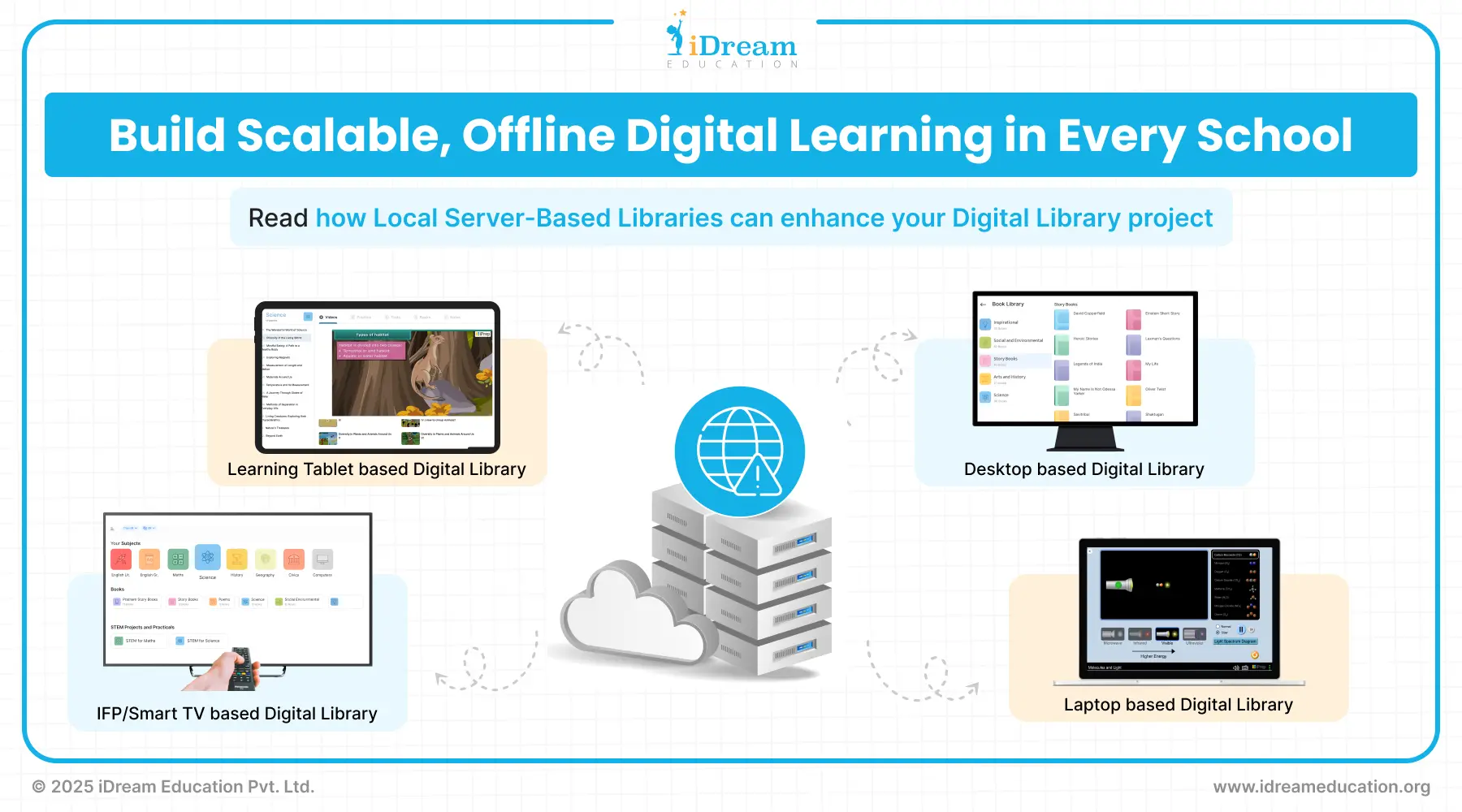
Cover image of a blog guiding to the blog of local server-based digital libraries, showcasing offline access to digital library resources for schools education projects

Across India, especially in rural and government schools, the lack of reliable digital infrastructure remains a major barrier to equitable learning. While national education policies promote digital inclusion, the reality on the ground tells a different story – unreliable or no internet connectivity, limited availability of smart devices, and insufficient access to quality digital content. Even where computers exist, they often remain underutilized due to the absence of stable connectivity or structured digital resources. This digital divide disproportionately affects students in remote and under-resourced areas, limiting their exposure to engaging and updated e-learning resources. To truly scale digital learning across schools in India, we need solutions that work without depending on the internet. We need a solution that is robust, cost-effective, and easy to deploy in any school environment.

What’s the Solution?

Local Server Based Digital Library. This is the solution that can bring scalable, inclusive, and enriching digital learning/reading to schools across India. It enables access to a wide range of educational resources. This includes curriculum-aligned as well as beyond the curriculum to support a more holistic learning experience for students. Serving as a central repository for teaching, learning, and reading materials, this library can offer seamless access to content on devices within schools even without internet connectivity. Whenever schools get access to the  internet, the library can be remotely updated via the cloud. This ensures that schools always have updated and relevant content.

Let us now understand what a Local Server Based Digital Library is?

A Local Server-Based Digital Library is a digital library system. It is set up using a small computer or device placed within a school, community, or state center. This device works as a local server and comes preloaded with learning and reading materials based on the school syllabus and more.

Even a single computer can be turned into a local server. Once it’s loaded with all the digital resources and connected to a local network using a router, any number of devices in the school can connect to it and access the materials anytime — even without the internet.

How Does This Enable Access to Digital Library Resources?

Once installed in a school, community centre, or in a state data center, the local server sets up a Wi-Fi network. This further connects to devices with students and teachers. This could be any device such as tablets, Chromebooks, desktops, or even smartphones. Their devices need to have a pre-installed digital library platform. This will enable offline access to a wide range of resources including animated videos, e-books, audio lessons, practice quizzes, reading materials, and more directly on devices.  Many schools are now exploring inclusive tools that blend technology with local needs. The best digital library for schools supports offline, bilingual, and curriculum-aligned access for every student.

Features of Local Server Based Digital Libraries

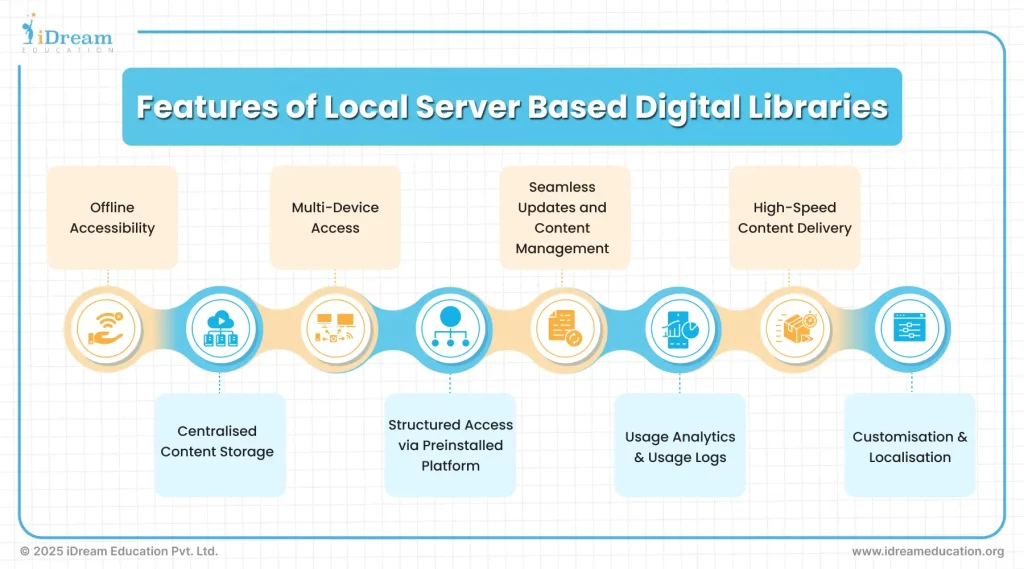
A Local Server Based Digital Libraries are a compact yet powerful solution that brings a complete educational content ecosystem directly into schools/community centers, without relying on constant internet connectivity. Here are its key features that make it ideal for scalable school learning infrastructure:

Infographic highlighting features of local server-based digital libraries setup by iDream Education

Offline Accessibility

All digital library resources including videos, PDFs, quizzes, interactive modules, journals, stories, reading resources, activities aligned to curriculum and beyond are hosted locally on a server installed within the school/state/community premises. This ensures uninterrupted access to learning materials even in remote areas with unreliable or no internet connectivity.

Centralised Content Storage

The server acts as a central hub for storing all the digital library content. Whether it’s NCERT-based resources, state board-specific lessons, custom-created materials, or content designs for holistic learning. Everything is housed in one place, making content management efficient and scalable.

Multi-Device Access

Students and teachers can access the digital library resources on any device connected to the school’s local Wi-Fi. Devices could be tablets, desktops, laptops, or even smartphones, without needing internet data. 

Structured Access via Preinstalled Platform

Devices connected to the local server must have the preinstalled Digital Library platform, which automatically fetches and displays all digital library resources in a well-organized structure. This creates a unified and seamless learning experience across different devices. Whether it’s a tablet, desktop, laptop, or smartphone, the platform ensures consistent access and navigation, encouraging truly device-neutral learning.

Seamless Updates and Content Management

Administrators can update or add new content periodically through USB drives or a one-time sync via the internet, ensuring the digital library remains current without daily bandwidth consumption.

Usage Analytics and Usage Logs

Even without the internet, local server based digital libraries can track student logins, content access patterns, and time spent. This data can later be exported for comparing usage and outcomes, taking data driven decisions on improvement/expansion. This data also helps teachers to monitor usage and learning progress.

High-Speed Content Delivery

Because the server is within the school’s network, loading times for video and interactive content are fast and smooth, offering a high-quality user experience that’s not dependent on broadband speed.

Customisation and Localisation

You can enable customized digital library content to suit regional languages, specific curriculum goals, learning needs, project specifications or local teaching approaches. This makes learning more relatable and contextually relevant.

Together, these features make Local Server Based Digital Libraries a smart, scalable, and NEP aligned 21st century learning solution. This is designed and set up in the projects/schools aiming to deliver high-quality digital learning without being limited by internet connectivity or infrastructure gaps.

Benefits of Local Server Based Digital Libraries

Works Without Internet on End Devices

Once the digital library server is connected to power and has initial internet access for content loading or updates, it broadcasts resources to all nearby devices through a local Wi-Fi network. Students and teachers can access the full digital library offline on individual devices. Only the server requires minimal connectivity for updates or syncing.

Safe and Distraction-Free Learning

Since students and teachers aren’t connected to the open internet, they stay focused. They remain free from online distractions like social media or unrelated content.

Covers Multiple Schools and Devices from One Setup

A single Local Server Based Digital Library, when deployed, serves multiple devices and even more than one school in close proximity. This reduces hardware costs and simplifies content deployment. Schools, NGOs, and government bodies can plan for wider reach without multiplying infrastructure investments.

Behind every education-based NGO are stories of children who found hope and learning. This blog captures the impact of education-based NGO working across India.

Caters to Diverse Learning Needs with Rich, High-Volume Content

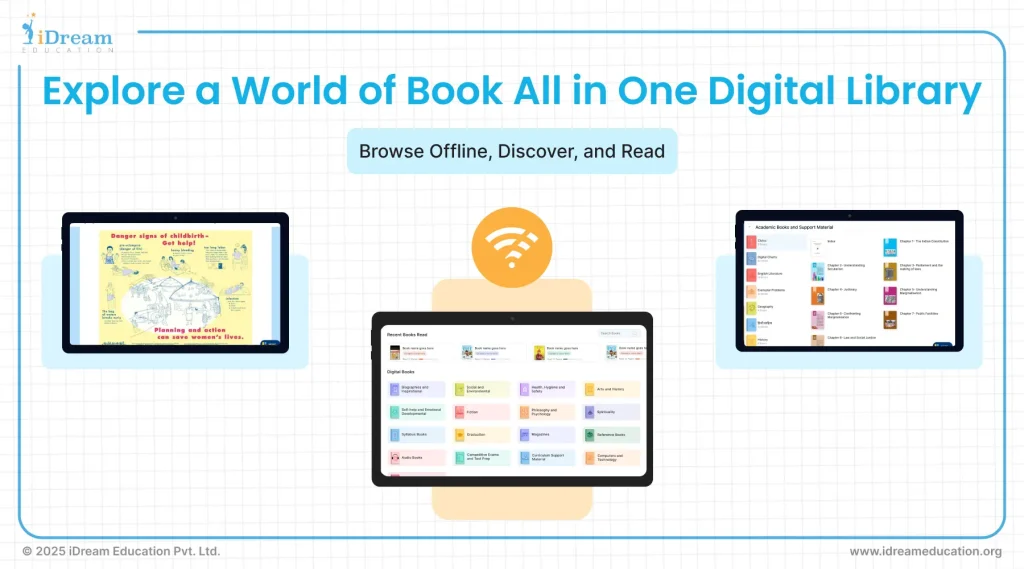
Image showing Digital book library platform and resources on iPrep Digital Library by iDream Education

With high server storage, the digital library can house not just basic curriculum materials, but an expansive set of resources. This includes curriculum-aligned videos, digital textbooks, PDF notes, sample papers, reading material. This further includes access to high quality animated content such as Ramayana, DIY activities, video solutions, and more. All in all students get access to multimodal learning that suits their interests and learning styles, whether they’re preparing for exams or simply exploring concepts or just wish to read.

Strengthens Teaching with Readymade Resources

Teachers benefit immensely from having structured, reliable resources at their fingertips. From visual aids to lesson-aligned videos and activity ideas, everything in a digital library platform. This makes lesson planning faster and instruction more engaging. Digital library resources also comprise of content that can be used when a teacher is unavailable. This helps maintain learning continuity in all circumstances. Our digital library content includes stories, health, safety, history of India, festivals, inspirational biographies, Journals, About AI, Computers, Cyber Security, Digital Literacy, Programming Languages and more such content

Supports Equitable and Scalable Implementation Across India

This model aligns with the realities of Indian schools. It does not depend on high-speed internet, is relatively low-maintenance, and can be deployed affordably at scale. Whether in a rural government school or a low-infrastructure urban setup, the Local Server Based Digital Libraries can function reliably and inclusively. Setting up a digital library isn’t just about technology. This digital library implementation guide offers practical insights to plan, budget, and execute effectively.

Let’s Move Towards Scalable and Inclusive School Learning Infrastructure

As we look ahead at building an inclusive and future-ready school education system, the answer may not always lie in expensive hardware or high-speed internet infrastructure. Often, the most powerful solutions are also the simplest such as a Local Server Based Digital Libraries that becomes the heart of a school’s digital ecosystem.

This  digital library infrastructure can transform a single school server into a local network-based central repository of teaching, learning, and reading resources. It ensures that every student and teacher, regardless of their background or infrastructure, can access high-quality educational content – offline, uninterrupted, and free from internet distractions. 

Such a solution is not only practical but deeply aligned with the goals of government and social impact initiatives—to reach the last-mile learner and democratise access to quality education.

If you are someone from the education department, a CSR organisation, or an NGO exploring how to set up a digital library – whether at the state level or in a single school or community—we’re here to collaborate.

At iDream Education, with over 9 years of experience in K–12 digital learning, we’ve built many easy to set up, manage and use digital learning solutions. iPrep Digital Library is one of the solutions which is a scalable, sustainable, and affordable digital library platform designed to work both offline and online. Hosting thousands of multilingual, curriculum-aligned resources across subjects, life skills, and more, iPrep delivers learning for all regardless of device or connectivity.

With our on-ground experience of setting up digital libraries in multiple formats, we can be your technical partner in implementation of digital libraries. We offer a simplified Local Server/Desktop Based Digital Libraries with the iPrep Digital library platform pre-installed. This device connects to a local router, and then any number of tablets, laptops, or desktops in the school that join the same network can access the full digital library without needing the internet.

For more information you may contact us at +91 7678265039. You can also write to us at share@idreameducation.org or share your details here.
NEP 2020 Aligned Digital Content: Key Integration Strategies

NEP aligned digital content

The National Education Policy (NEP) 2020, and its latest expected iterations in NEP 2025, paint a powerful picture: education that is personalised, inclusive, and honours each student’s potential. For education leaders across India, it brings both excitement and immediate, practical questions.

If NEP 2020 is reimagining education, why is so much digital content still stuck in the past?

The National Education Policy 2020 called for a fundamental shift – from rote learning to competency-based education, from uniform instruction to personalised learning journeys, and from textbook dependency to rich, multimodal learning experiences. Yet, in many classrooms and digital platforms, “NEP-aligned content” often means little more than restructured chapters or repackaged PDFs. Alignment, however, is not about formatting – it’s about intent, pedagogy, and integration.

Truly NEP 2020–aligned digital content must work with the learning ecosystem, not sit alongside it. It should enable experiential learning, support multilingual and inclusive classrooms, adapt to learner pace, and seamlessly integrate with existing LMS, smart class, and assessment systems. The real challenge – and opportunity lies in how this content is designed and how strategically it is integrated to transform teaching practices and learner outcomes.

This blog explores the key integration strategies that move digital content from being merely “NEP-compliant” to becoming a powerful enabler of NEP’s vision.

What Does “NEP 2020–Aligned Digital Content” Really Mean?

Alignment with NEP 2020 is often misunderstood as a checklist exercise – adding competency tags, inserting a few activity-based questions, or mapping chapters to learning outcomes. In reality, NEP alignment is far deeper and far more systemic.

It begins with asking a critical question: Does this digital content change how teaching and learning actually happen?

  • NEP 2020 emphasises holistic development, conceptual understanding, critical thinking, multilingual learning, and flexibility in learning pathways. Digital content aligned to this vision must therefore move beyond linear consumption. It should encourage exploration, enable practice at multiple levels, and create space for reflection and application – both inside and outside the classroom.
  • Equally important is context. India’s classrooms are diverse across languages, infrastructure levels, teacher readiness, and learner abilities. NEP-aligned digital content must be adaptable enough to serve a smart classroom in an urban school and a blended or assisted-learning environment in a rural or resource-constrained setting. Without this flexibility, even the most well-designed content risks remaining underutilised.
  • Most importantly, alignment is incomplete without integration. Content that cannot seamlessly fit into existing teaching workflows, LMS platforms, assessment systems, or state digital infrastructure becomes an add-on rather than an enabler. NEP 2020 envisions technology as a facilitator of change – not a parallel system. This is why the way NEP aligned digital content is integrated is just as critical as what the content contains.

Key integration strategies that help digital content truly operationalise NEP 2020

Operationalising NEP 2020 through digital content is not about adding more technology, it is about making technology disappear into teaching and learning workflows. When integration is done right, teachers don’t feel like they are using a separate digital system; learners don’t experience content as an add-on; and administrators don’t struggle to justify adoption. The following integration strategies are critical to making NEP 2020’s vision work at scale.

Anchor Content Integration to Learning Outcomes, Not Textbook Chapters

NEP 2020 shifts the focus from syllabus completion to competency development. Digital content must therefore integrate at the level of clearly defined learning outcomes. It should be mapped to competencies, skills, practice, and real-world application rather than being locked to chapter sequences. This allows teachers to use content flexibly: for concept introduction, reinforcement, remediation, or enrichment, aligned with diverse learner needs.

Embed Content Seamlessly into Teacher Workflows

For NEP-aligned digital content to be used consistently, it must fit naturally into existing classroom practices. Integration should support how teachers already plan lessons, conduct classes, and assess learning. Content that requires minimal navigation, fewer clicks, and clear instructional cues is far more likely to be adopted and sustained.

Design for Multilingual and Inclusive Access at the Integration Layer

NEP 2020 places strong emphasis on multilingual education and inclusivity. This vision can only be realised when digital content integration supports language flexibility, accessibility features, and differentiated learning paths. Integration strategies must allow schools and states to deploy the same content framework across regions, languages, and learner profiles without duplicating effort.

Enable Interoperability Across Digital Ecosystems

NEP 2020 envisions an interconnected digital education ecosystem. Digital content should be designed to integrate smoothly with LMS platforms, assessment engines, smart class hardware, and state digital infrastructure through APIs and standardised formats. Interoperability ensures that content scales across geographies and institutions while remaining future-ready.

Align Content Integration with Continuous Assessment and Feedback

Competency-based education requires visibility into learning progress. Integrated digital content should support formative assessment, learning analytics, and feedback loops that inform teachers in real time. When content, assessment, and insights are connected, digital tools move from content delivery to learning enablement. This is exactly what NEP 2020 envisions.

Plan Integration for Scale, Sustainability, and Teacher Capacity

Finally, NEP 2020 alignment cannot be episodic. Integration strategies must consider long-term scalability, offline or low-bandwidth access, teacher onboarding, and ongoing support. Content that integrates easily today but cannot adapt tomorrow risks becoming obsolete. Sustainable integration ensures that NEP-aligned digital content continues to evolve alongside classrooms.

From Policy Vision to Classroom Reality: A NEP-Ready Implementation

NEP 2020 sets a bold direction for India’s education system but its success ultimately depends on partners who can translate policy intent into on-ground impact. With over a decade of experience in developing and deploying digital content for school education, we have consistently worked at the intersection of curriculum, pedagogy, and technology.

Key details you may find useful:

  • Crucially, NEP-aligned content must work across India’s linguistic and contextual diversity. Our digital content is developed as NCERT/Stateboard in Hindi, English, and multiple regional languages. Every asset: videos lessons, practice, interactive simulations, assessments, and more – all is designed to be fully aligned with NEP 2020 principles, not just in structure, but in classroom usability.
  • Beyond content, we focus on end-to-end education-to-technology integration. This includes seamless deployment across hardware of choice, integration of LMS within existing or new devices with offline digital content, structured teacher training and onboarding, and continuous academic and technical support. Integration is treated as a long-term partnership – not a one-time rollout. This helps us ensure sustained adoption, teacher confidence, and measurable learning outcomes.

Our formal collaboration with NCERT, through a signed MoU, reflects this commitment

Under this partnership, we are developing NEP-aligned digital content and LMS solutions that are rooted in national curriculum frameworks, competency-based learning, and inclusive pedagogical practices. This years of experience and now working extensively with NCERT is helping has ensure that our digital content alignment is not theoretical – but deeply operational as envisioned in NEP.

As NEP 2020 continues to reshape school education, the need is no longer for isolated digital tools, but for deeply integrated, scalable, and future-ready learning ecosystems. With policy-aligned content, proven implementation experience, and continuous support models, we can remain focused on one outcome that truly matters: enabling meaningful learning for every child, in every classroom.

If you are looking for NEP-aligned digital content for schools or a complete implementation covering hardware integration, teacher training, progress tracking, and continuous support, we can help. For more information, you may contact us at +91 7678265039. You can also share your details here or write to us share@idreameducation.org.


Everything You Need to Know About ASER: India’s Landmark Annual Education Report

Cover image for blog explaining what ASER is and why it matters for understanding foundational learning levels in India

In a country as vast and diverse as India, how do we truly know whether children are learning? That’s the question ASER – which means ‘impact’ in Hindustani – seeks to answer.

What Does ASER Stand For?

ASER stands for Annual Status of Education Report

How It All Began: The Story Behind ASER

The roots of ASER go back to 1996, when the non-profit Pratham began working to help children in India’s villages and urban slums acquire basic reading and arithmetic skills. Throughout its early years, Pratham focused on one clear goal: ensuring that every child could learn, not just attend school. As their reach expanded, Pratham needed a simple and consistent way to assess children’s progress. 

This led to the creation of a practical tool just one sheet of paper with four levels of reading:

  • Letters
  • Simple and commonly used words
  • A short paragraph with basic sentences
  • A longer story with more advanced vocabulary

This tool was used widely across states, enabling field teams to speak a common language about children’s learning. It helped measure progress in a way that was easy to use, understand, and compare across locations.

By 2004, India had nearly achieved universal enrollment at the primary school level. But a big question remained: Were children actually learning? No large-scale data existed to answer this. Pratham’s grassroots work showed that many children in school were still struggling with basic reading and math.

This concern sparked the idea of Annual Status of Education Report (ASER): India’s Largest Citizen-led Survey

ASER dives deep into what children in rural areas are actually learning, especially in basic reading and arithmetic. Conducted every year, the ASER Centre brings to us a clear picture of what’s really happening in classrooms and homes across rural India. Using simple yet powerful methods, they gather large-scale evidence on learning outcomes, especially in reading and arithmetic. But ASER goes beyond just numbers. It helps us understand the actual impact of government programs and education policies on the ground.

Born in 2008 as an independent unit within the Pratham network, ASER Centre carries forward Pratham’s mission of helping every child learn well. By combining grassroots experience with data-driven assessments, ASER not only tells us where we stand, but also guides us on what needs to be done.

The Vision Behind ASER: Evidence for Action

At the heart of ASER lies a powerful belief: when people understand the problems around them, they can bring about extraordinary change.

The ASER Centre envisions a world where evidence is not just collected by experts, but by everyday people such as parents, teachers, and volunteers who care deeply about improving their communities. They believe that measurement doesn’t need to be complicated. It should be rigorous, yes – but also simple enough for anyone to do, understand, and act on.

When ordinary citizens are equipped with the tools to measure learning, they begin to ask the right questions. They talk to one another, recognize gaps, and take steps. Their steps could be small or big but the motive will be to make things better. This is what “evidence for action” truly means.

The Mission: Turning Measurement into Meaningful Action

ASER Centre’s mission goes beyond just collecting data, it’s about empowering people and institutions to understand that data and use it to drive change. By building the capacity of individuals, communities, and organizations, ASER enables large-scale measurement that is both accurate and actionable. The goal is to create a culture where decisions in education are based on what’s really happening, not just on assumptions or theories.

Now, education industry is at the stage whether it’s a teacher in a village school, people in the social sector, or a policymaker at the national level, ASER helps bridge the gap between what we think is true and what the evidence shows, so that action is rooted in reality and impact becomes measurable. ASER is creating a  movement of informed citizens who can drive real change in education and beyond.

The first nationwide ASER survey was conducted in 2005

This marked a major shift in how India approached measuring learning outcomes. But as ASER expanded year after year, it uncovered deeper gaps not just in children’s learning, but in how the country understood and measured educational progress.

Through its early years in the field, ASER brought to light a striking reality: India lacked a culture of measurement and analysis, especially when it came to learning outcomes. There was little independent and timely data available at the district level, and most existing assessments focused more on processes than actual learning.

Further, within these years it also became clear that a large number of stakeholders such as teachers, NGO workers, citizen groups, even government functionaries, lacked access to the basic technical knowledge needed to collect and interpret data. There was a widespread need to build skills in areas such as sampling, survey methodology, and data analysis.

In response to these insights, ASER Centre was established in January 2008 as an independent research and capacity-building unit within the Pratham network. Its goal was not only to continue the ASER surveys, but also to strengthen the ecosystem by building capacity, promoting evidence-based advocacy, and making rigorous measurement accessible to all.

From Annual to Alternate Years: Adapting to a Changing Educational Landscape of India

After running the ‘basic’ ASER survey annually for a decade, 2015 marked a pause. The national education landscape was evolving. Government-led assessments such as the National Achievement Survey (NAS) and State-Level Assessment Surveys (SLAS) were gaining prominence. However, these were school-based assessments focused on grade-level content unlike ASER, which looked at foundational learning across all children aged 5–16, whether in school or not.

Recognizing the unique value of ASER’s community-based, household survey model, a new approach was adopted.

The ‘basic’ ASER survey was then conducted once every two years, while the alternate years would feature thematic surveys focusing on different age groups and aspects of education.

Some key milestones in this new cycle included:

  • 2016 & 2018 – Basic ASER surveys continued, measuring foundational reading and arithmetic skills.
  • 2017 – ASER Beyond Basics assessed 14–18-year-olds across 28 districts, exploring life skills, digital access, and career aspirations.
  • 2019 – ASER Early Years focused on children aged 4–8, studying school readiness and early childhood learning across 26 districts.

Responding to the Pandemic: ASER Goes Remote

In 2020 and 2021, the COVID-19 pandemic disrupted field operations. ASER adapted quickly, shifting to phone-based surveys. While direct learning assessments weren’t possible, these surveys explored children’s access to digital learning, home learning support, and the overall impact of school closures. This flexible approach helped keep a pulse on education during one of its most challenging periods. 

In 2022, the ‘basic’ ASER survey resumed its on-the-ground implementation, reaching nearly all rural districts across the country 

Since then, two reports have been released: ASER 2022 and ASER 2024.

Explore all ASER reports organized by various categories to help you find exactly what you need here

One of the most impactful aspects of ASER Centre’s work – beyond data collection and reporting, is its focus on capacity building

Through a wide range of workshops and training programs, ASER Centre equips individuals and organizations with the skills needed to collect, interpret, and apply evidence for meaningful action. These workshops are designed not just for the Pratham network but also for partner institutions that seek to deepen their understanding of ground realities and evidence-based decision-making.

What sets these capacity-building modules apart is their dynamic design

  • Each training integrates classroom learning with hands-on field activities, ensuring that participants experience a real-world connection between policy frameworks and the everyday challenges of education on the ground. By moving constantly between theory and practice, the workshops foster deeper understanding and long-term retention.
  • Sessions are highly interactive, employing a mix of individual tasks, small group collaborations, and large group discussions. This variety not only keeps learners engaged but also caters to different learning styles, ultimately preparing them to lead, adapt, and innovate in their own education ecosystems.

Here’s what sets ASER apart:

  • Available in Multiple Languages: All reports are published in both Hindi and English. This makes ASER report accessible to a wide range of readers across the country.
  • State-wise Reports: Along with the national report, state-level data is also published separately. This allows for deep dives into local realities and comparisons across states.
  • Multiple Formats: ASER reports are available in PPT, PDF and video format, with visual summaries, charts, and concise briefs. This makes the findings easy to understand and grasp.
  • Supportive Team: What truly stands out is the ASER Centre team’s openness to engagement. They are extremely supportive if you wish to understand the data in more detail, use it in your work, or share it accurately. They believe that when evidence is understood well, it leads to better decisions and stronger impact.

In a space often filled with complex jargon, ASER continues to be a source of clear, grounded, and actionable insight into the real status of education in India.

Unmatched Reach and Scale of ASER Across Rural India

The ASER survey stands out not just for its methodology, but also for its extraordinary scale. Conducted annually, the basic ASER survey reaches nearly every rural district across India, covering over 15,000 villages and assessing more than 650,000 children. To put this in perspective, ASER’s sample size is more than double that of the survey rounds conducted by the government’s National Sample Survey Organization (NSSO), making it one of the largest citizen-led household surveys of children’s learning outcomes in the world.

Illustration showing the reach and impact of the ASER report across rural India

This expansive reach ensures that ASER captures a truly representative snapshot of rural education across diverse geographies, communities, and contexts. Beyond the main survey, ASER Centre also undertakes a variety of research, assessment, and capacity-building projects, each with its own scope and scale. This allows the organisation to remain responsive to local needs while informing national and state-level education policy.

Key Highlights You Should Look At From The Recent Report: ASER 2024

The ASER 2024 report offers a comprehensive view of learning levels across rural India, focusing on foundational skills and digital access. Based on a survey of 6.5 lakh children, here are the most noteworthy takeaways:

Visual summary of key findings from the ASER 2024 report, highlighting major trends in student learning and education indicators

Improvement in Learning Levels

  • Notable gains in reading and arithmetic skills among students in Classes 3, 5, and 8
  • This marks the largest improvement in reading abilities since 2022, attributed to focused foundational learning efforts

Persistent Foundational Gaps

  • Despite progress, a majority of Class 3 students still cannot read a Class 2-level text, signaling the need for sustained foundational interventions.

Government-Led Collaborative Success

  • The report recognizes the collective push by governments and partners, especially under initiatives such as NIPUN Bharat, as key to the learning recovery post-pandemic.

Early Education Trends

  • Increased enrollment in pre-primary classes and Anganwadis, reflecting a growing awareness of early childhood education’s importance.

Rising Digital Literacy

  • Smartphone penetration continues to grow, especially among teens aged 14–16, indicating expanded digital access and potential for tech-enabled learning.
  • However, girls still lag behind boys in access to digital devices and usage, highlighting a gendered digital divide.

Learning Inequities Persist

  • Students from disadvantaged communities and government schools continue to perform below their peers in private institutions, though the gap is narrowing in some states due to targeted interventions.

Let’s Move from Insight to Action

It has been over six months since the release of the ASER 2024 findings, and encouragingly, several initiatives have already begun to address foundational learning gaps and improve education access for last-mile learners. However, to make real academic progress in the current academic year, we must accelerate our collective efforts and focus on solutions that truly meet learners where they are.

Approaches such as Personalized Adaptive Learning (PAL) can help bridge individual learning gaps, smart classrooms can enhance teaching instruction, and digital libraries can open up a world of educational resources for every child. These interventions when thoughtfully implemented have the potential to drive both equity and excellence in learning outcomes.

If you’re working to resolve learning gaps and enhance educational delivery, we invite you to connect with us. You may contact us at +91 7678265039  or write to us at share@idreameducation.org. You can also share your details here. We’d be happy to understand your context, recommend the right solutions, and even co-create a customized program to assess, implement, and continuously improve impact on the ground.
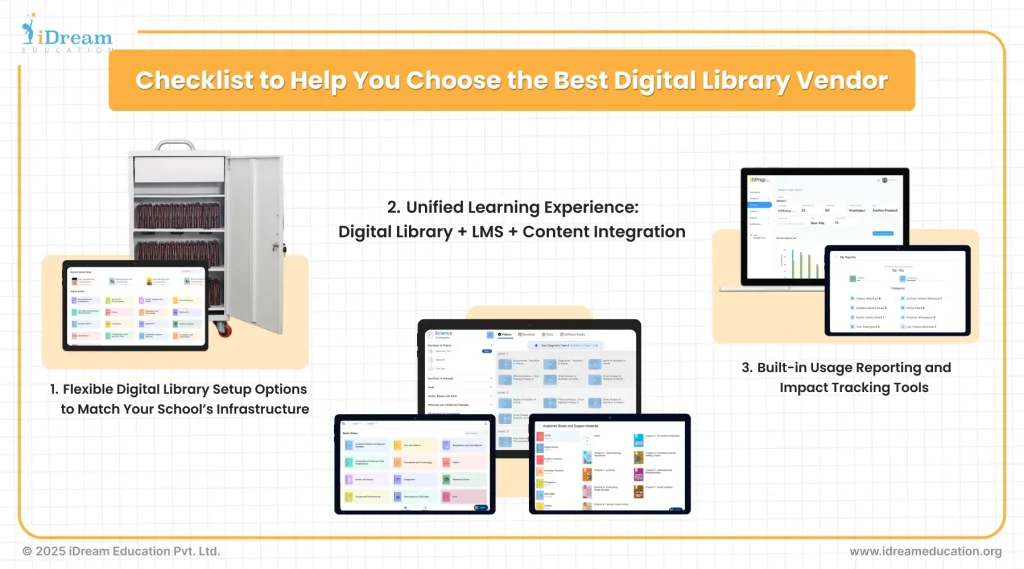
The Rise of Impact Assessment Vendors in Education: Trends, Challenges, and Opportunities

Behind the growing buzz around impact in education lies a rising wave of Impact Assessment Vendors in Education—let’s explore what’s driving their growth, the challenges they face, and what you should know before choosing one.

Cover image of a blog titled 'Guiding You to Impact Assessment Vendors in Education and Why They Matter' featuring visuals of students taking assessment on tablets

Over the past decade, India’s school education system has seen a wave of transformative changes. From curriculum changes under the National Education Policy  (NEP) 2020, to digitisation of learning, infrastructure upgrades, and increased funding through government, NGO, and CSR channels. In fact, the collective education ecosystem is putting its best foot forward.

Schools are increasingly seeking context-specific content, aiming to close learning gaps and reach grade-level competencies. Technology-led tools, smart classrooms, teacher training, and innovative pedagogies are being implemented across the country. Yet, despite all these efforts, one uncomfortable truth persists: learning outcomes remain limited.

While we speak often of implementation, scale, and innovation, there’s comparatively little focus on tracking progress, measuring effectiveness, or understanding what’s actually working in classrooms. This lack of continuous, data-driven feedback has left a crucial gap in the system.

And this is where we see the rise of impact assessment vendors in education. Organisations dedicated to evaluating what really changes in learning when programs are implemented. Much like salt in a dish, their role might not always be visible, but it’s absolutely essential. Without credible, contextual, and timely assessment, even the most well-intentioned education initiatives risk losing their purpose and direction.

NEP 2020 Has Also Accelerated the Need for Impact Assessment

In India, the rise of impact assessment in education isn’t just a global trend taking root — it’s a direct response to the ambitious vision outlined in the National Education Policy (NEP) 2020. As NEP pushes for a fundamental shift from input-based to outcome-based education, the need for credible, data-driven insights into “what’s working” on the ground has become urgent.

NEP 2020 focuses on goals such as:

  • Foundational literacy and numeracy by Grade 3 (NIPUN Bharat)
  • Competency-based learning and formative assessment
  • Equity and inclusion across diverse learner groups
  • Use of technology for better learning outcomes
  • Vocational integration and 21st-century skill-building

But these goals cannot be tracked through traditional means alone. This is where impact assessment vendors in education are stepping in. They are helping governments, NGOs, CSR arms, and other organizations in the education ecosystem to move beyond anecdotal evidence to measuring real, learning-linked outcomes.

The trends Highlights a Clear Shift from Monitoring to Measurement

Traditionally, educational programs in India were often judged by outputs: how many tablets were distributed, how many sessions conducted, or how many teachers trained. Today, the focus is shifting to actual impact on learners — are students reading with comprehension? Are they applying mathematical concepts? Are teachers changing their classroom practices?

This evolution is giving rise to:

  • Baseline and endline assessments across government and NGO/CSR initiatives
  • Third-party evaluations for CSR-funded programs to ensure accountability
  • State-level partnerships where vendors design contextualised learning measurement tools 
  • Integration of real-time dashboards and learning analytics for adaptive feedback loops

With government programs such as Samagra Shiksha, PM SHRI, and district-level FLN missions, there is a growing demand for independent assessment partners who can deliver actionable insights that go beyond basic reporting. At the same time, CSR initiatives increasingly seek to co-create programs that not only focus on implementation but also integrate impact assessment from the ground up.

Key Opportunities to Explore with Impact Assessment Vendors in Education

Impact Assessment Vendors in Education are no longer just evaluators. They are becoming strategic partners in the end-to-end implementation of digital learning programs, right from diagnosing learning gaps to measuring real learning outcomes. Here’s how you can unlock powerful opportunities by integrating them into the program lifecycle:

Co-Create a Digital Education Program Backed by Data

  • The journey begins with a baseline assessment designed to capture students’ current learning levels. The assessment will not be of just their present grade, but also two levels below. This diagnostic approach helps establish a clear picture of foundational understanding, which is often the key to effective intervention.
  • Based on this baseline, the right digital learning solution is selected. This could be Personalized Adaptive Learning (PAL) platform to bridge deep-rooted gaps or Smart Classroom tools to boost engagement and classroom instruction. Once implemented, monthly progress is monitored through a mix of teacher interactions, usage data, and real-time reporting dashboards.
  • At the end of the academic cycle, a detailed Endline Assessment measures learning outcomes against the baseline. This comparison brings out the true impact of the intervention, offering data-driven insights to both funders and implementers and building a strong case for investing in need-based, measurable digital education programs.

Start with Baseline, End with Measurable Results

  • Conducting a baseline and Endline assessment is another crucial first step for impact assessment. In this you first determine the exact needs of a learner group or school system. The digital solution is then chosen based on this insight — followed by continuous monitoring, including usage analytics, adoption tracking, and mid-cycle feedback loops. Finally, an endline assessment completes the loop with clear, comparable data to showcase what changed and improved.

Monthly Learning Assessments for Real-Time Insights

  • Impact Assessment Vendors in Education can also enable monthly performance tracking to monitor incremental learning gains. Tools such as iPrep’s Clicker functionality, for example, offer interactive, in-class assessments using roll number–linked clicker devices. These are integrated with IFP panels (Interactive Flat Panels) where students respond to questions displayed onscreen. Responses are captured instantly via Bluetooth, and automated scorecards are generated for both students and teachers. This can enable micro-level progress tracking throughout the year.

Progress Mapping Through Comparative Assessments

  • If baseline data exists, impact assessment vendors in education can conduct endline assessments to create a clear progress map over the academic year. These comparisons don’t just validate the effectiveness of a program, they also help implementers refine strategies midstream. Whether the project operates on a modest CSR budget or through large-scale government funding, the choice of solution can be guided by real learning needs, and measured with precision.
In essence, impact assessment Vendors in education are offering opportunities to help shift digital education efforts from hopeful implementation to strategic, results-driven transformation. By building in assessment at every stage, educational programs gain not just credibility, but also the flexibility to adapt and succeed at scale.

Now lets looks at some challenges that comes with Impact Assessment Vendors in Education

While the role of impact assessment vendors in education is undeniably valuable, engaging them comes with its own set of challenges.  One of the significant points to note is some impact assessment vendors may stretch the budget and operational bandwidth of even well-intentioned programs. Let us guide to some more limitation you should be aware of when planning to integrate third-party impact assessments into their education initiatives:

Time-Consuming and Detail-Heavy

Impact assessments are not quick exercises. The process is multi-staged, and when done rigorously, it demands weeks (if not months) of planning, fieldwork, analysis, and reporting. In many cases, assessments tend to gather more data than necessary, which can overwhelm implementers and delay action on insights.

High Resource and Manpower Demands

From designing the framework to field execution, some impact assessment vendors may suggest the process that requires specialised personnel, researchers, data collectors, analysts, and coordinators. This often means diverting internal teams or hiring external experts, both of which can strain available capacity and increase dependency.

Cost Escalation

A full-scale impact assessment vendor may significantly increase the overall cost of the project. For CSR or NGO-led programs operating within strict budgets, allocating funds for assessment alongside implementation can sometimes feel like a trade-off.

Finding the Right Balance Between Rigor and Practicality

There’s always a tension between wanting a rigorous, scientific assessment and maintaining practicality and agility on the ground. Especially in the school ecosystem where time with students is limited and teachers are already stretched. Here,  embedding assessments without disrupting regular learning is a constant balancing act.

In short, while impact assessment vendors in education are becoming critical partners in education enhancement, their choice and involvement must be strategically planned. When done right, the benefits are substantial but so are the investments required.

Not all impact assessment vendors are the same. Therefore, choosing the right one can make or break the success of your education initiative. The ideal partner should not only help you measure outcomes but also simplify the assessment process, enable real-time feedback, and align with your on-ground realities, including budget, geography, and infrastructure constraints.

Here are key factors to consider while selecting the right impact assessment vendor in education:

Illustration highlighting key factors to consider when selecting the right impact assessment vendor in education

Look for End-to-End Capability

Choose an impact assessment vendor in education who can offer an end-to-end solution. This comprises baseline diagnostics to solution deployment, regular monitoring, and final impact measurement. This ensures your implementation and assessment are aligned from day one, reducing fragmentation and easing coordination across partners.

Ensure Flexibility in Assessment Modes

Every geography and context is different. Some schools may be ready for tablet-based assessments, while others might benefit more from clicker-based evaluations using Interactive Flat Panels (IFPs). The right impact assessment vendor will offer multiple modes and help you choose based on what works best in terms of cost, infrastructure, and ease of use.

Insist on Customisation of Assessment Tools

One-size-fits-all assessments don’t work in diverse education ecosystems such as India’s. Opt for an impact assessment in education that offers custom impact assessment design. This includes grade-level appropriateness, language options, competency mapping, and integration with the impact of your implemented solution. This ensures the results are meaningful and actionable.

Check for Integration with Solution Usage Monitoring

Impact isn’t just about learning outcomes at the end. It’s about continuous usage and adoption of the implemented solution. Choose an impact assessment vendor that can track engagement metrics (like usage time, adoption, module completion, and more.) to correlate adoption with outcomes and guide ongoing improvements.

Prefer Vendors Who Have Train Local or Internal Teams

Sustainability matters. Vendors who have trained on-ground teams not only reduce costs over time but also build local ownership of the process. This also helps ensure better data quality and consistency in execution.

Look for Experience in Similar Ecosystems

Choose an impact assessment vendor in education who has experience working with schools or geographies similar to yours. Whether that means government schools in rural areas, low-infrastructure contexts, or multilingual regions. They will be better equipped to anticipate challenges and design context-relevant solutions.

Evaluate the Vendor’s Reporting and Visualization Tools

Impact is only as good as how well it’s communicated. A good vendor will offer clear, easy-to-understand dashboards and reports that help you share results with stakeholders. Hence, look for visualizations that go beyond data dumps and tell a compelling story of change.

Closing Thoughts

The right impact assessment vendor in education should act as a true collaborator, not just a service provider. By aligning with your goals, your ground realities, and your preferred digital solution, they can help you generate insights that lead to measurable, scalable improvement in student learning outcomes.

Looking for the Right Impact Assessment Partner for Your Education Project?

We’d be happy to support you. You may reach out to us +91 7678265039. You can write to us at share@idreameducation.org or share your details here, and our team will get in touch. We’d be glad to walk you through our impact assessment process, share relevant case studies, and discuss how we can help you design a solution that delivers measurable outcomes.