Walk into any government school in India, and you’ll hear children learning with confidence in their mother tongue — Hindi in Uttar Pradesh, Telugu in Andhra Pradesh, Marathi in Maharashtra, Tamil in Tamil Nadu. This is not just a coincidence, it reflects a fundamental principle of education: learning is most effective when it begins in the language children understand best.
The National Education Policy (NEP) 2020 reinforces this principle: NEP emphasizes that strong foundations come when teaching aligns with the child’s language of thought. NEP recommends using the mother tongue, local language, or regional language as the medium of instruction for students, ideally until at least Grade 5, and preferably through Grade 8 and beyond.
The Challenge Beyond Grade 10: Language Shift and Learning Barriers
As students progress beyond Grade 10, a stark shift takes place. By the time students reach Grade 11, the medium of instruction abruptly changes to English. What was once a familiar and confident learning environment suddenly becomes steep and unfamiliar. For many students, this shift is not just academic, it becomes a silent barrier, separating understanding from aspiration.
In most government schools, early education up to Grade 10 happens in the local language, creating strong foundations in the mother tongue. But as students transition to higher secondary (Grades 11 and 12) and eventually higher education, English becomes the dominant medium of learning.
And while English continues to be a subject that students need to study, most government schools often lack dedicated and highly trained English teachers. Without well-qualified educators to build English as a second language, students are left without the support they need to thrive in higher grades.
On top of the language barrier, there is also a learning gap challenge that continues to persist in our government school students as they move to higher classes. Since the government school they go to is the only source of learning for them, they do not receive any additional support to help them cover these gaps.
The data below is a reflection of the challenges mentioned above:
- India’s post-Grade 10 dropout rate of 12.6% (UDISE+ 2021–22).
- According to ASER 2023, only half of youth aged 14–18 can read a simple English sentence, showing how language continues to limit access to higher learning.
How to Bridge the Gap: Bilingual PAL Supports the Transition
While the long-term solution to the English-language barrier in government schools remains clear: It requires more dedicated, highly trained English teachers. In the interim, bilingual digital education can provide a practical, scalable way to support students as they navigate the difficult transition from local-language learning to English-medium instruction while at the same time covering up their historical learning gaps and achieving grade-level educational outcomes.
This is where Bilingual Personalized Adaptive Learning (PAL) can make a meaningful impact.
By combining instruction in the mother tongue with structured exposure to English, bilingual PAL in school addresses two critical challenges simultaneously:
- Covering Learning Gaps: Students can first grasp concepts in the language they are comfortable with, ensuring a strong foundational understanding. This helps reduce the knowledge gaps they carry into higher secondary grades, building both confidence and competence.
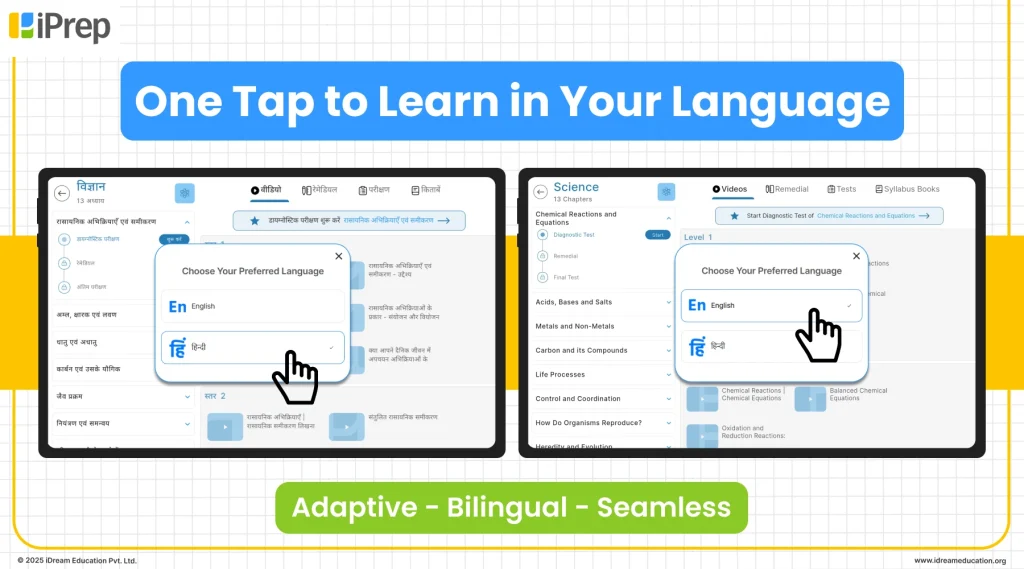
- Structured Language Transition: Through programmatic interventions, teachers can guide students to use a language toggle feature, revisiting the same concepts in English after mastering them in their local language. Over time, this repeated bilingual exposure gradually strengthens English comprehension without overwhelming students.
The Dual Impact and Benefits of Bilingual PAL
While it cannot entirely replace the need for qualified English teachers, it enables students to manage the transition more effectively, equipping them with the skills and confidence needed to handle higher education. With consistent use, bilingual PAL solutions have the potential to reduce dropout rates and create a smoother, more equitable learning journey for students navigating the shift from local-language instruction to English.
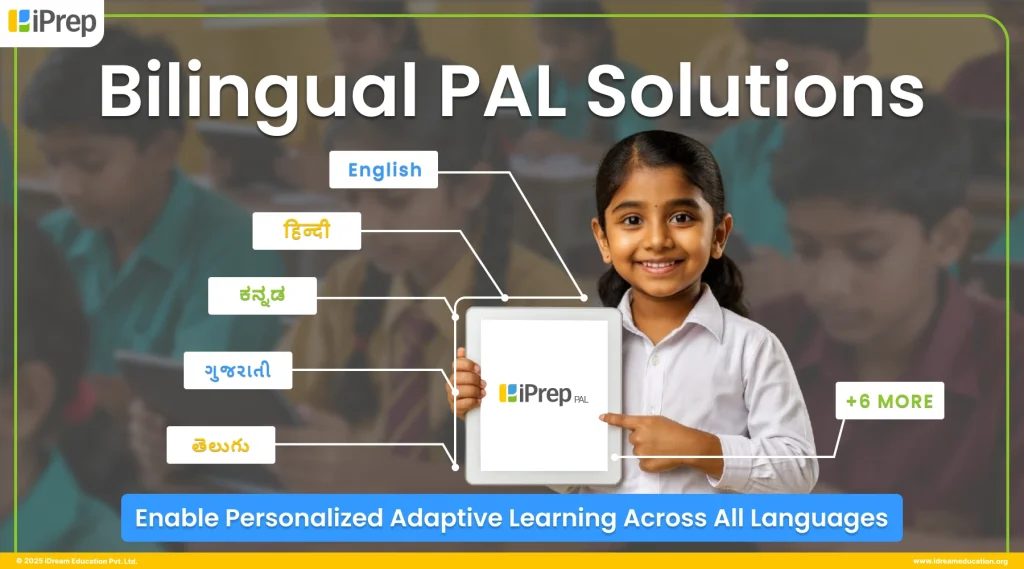
By strategically integrating bilingual digital learning content into classrooms, schools can bridge the hidden learning gap, giving students the support they need today, even as systemic improvements are implemented for tomorrow. Bilingual Personalized Adaptive Learning (PAL) bridges learning gaps and helps students build English proficiency over time using adaptive content in multiple languages on iPrep PAL.
With this approach, educators can empower learners to build strong foundations and progress confidently toward higher education goals.
If you would like to know more about how the Bilingual PAL solution can help overcome learning gaps and language barriers from real use cases, you can contact us at +917678265039 or write to share@idreameducation.org. You also share your details here.
Categories You may Explore
Related Articles