A Classroom That Had Everything—Except Usage
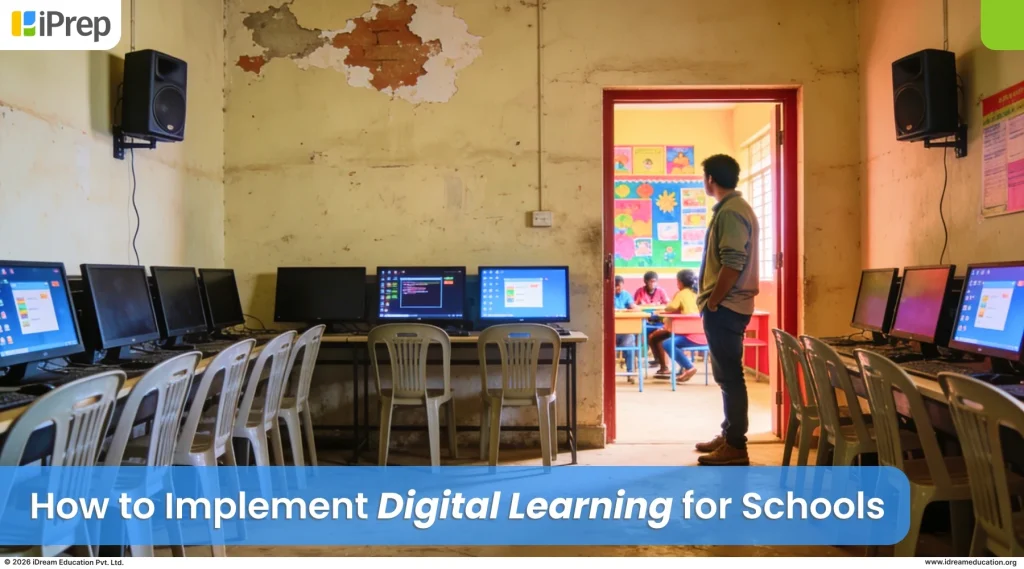
In a school in a rural part of the state of Uttar Pradesh, India, we walked into a fully equipped “digital classroom.”
There was a projector.
A desktop computer.
Preloaded digital content.
And yet, the room was locked.
When we asked why, the teacher said:
“The Internet doesn’t work and we don’t have the time to use this setup.”
This is not an isolated story. It repeats across geographies, whether it is the public schools across Africa, remote islands in Southeast Asia, and underserved regions in Latin America and the middle east.
The intent to adopt digital learning is widespread across all learning programmes. Whether it is a large scale Government programme, or a programme by a multilateral such as World Bank, UNICEF, or DIFD, or a multi school group or a big NGO, a learning center or a school. All planners want the best learning outcomes for their students and improvement of human capital in their countries.
But we have often seen in our experience that when it comes to implementation, that is when things break down.
This blog is about what actually works when it comes to implementing digital learning programmes. We will deep dive into understanding the context of Digital learning across different countries. We will understand why many digital learning initiatives fail, practical approaches, importance of offline first digital learning programmes and the key elements of a successful digital learning programme,

Why Most Digital Learning Initiatives Fail
Most digital learning programs don’t fail due to lack of funding or intent.
They fail because they are designed for ideal conditions, not real ones.
A common pattern seen across regions is the device-first approach. Devices are distributed at scale, with the assumption that learning outcomes will automatically improve. But once the initial excitement fades, usage drops. Teachers are unsure how to integrate the content into their teaching, and students use the devices inconsistently.
Another major issue is dependency on internet connectivity. In many parts of India, Africa, and Southeast Asia, stable internet access inside classrooms is still unreliable. When digital learning depends entirely on connectivity, it becomes inconsistent by design.
Even in regions where internet access is strong, such as parts of the Middle East or developed economies, unrestricted access introduces a different challenge—distraction, lack of control, and exposure to non-educational content.
Lack of engaging, and curriculum aligned content is another challenge due to which several digital learning programmes have failed.
Then comes the human factor. Teachers are often expected to adopt new systems with minimal training. A one-time orientation is rarely enough. Without continuous support, even well-intentioned teachers revert to familiar methods.
- Are teachers using the system regularly?
- Are students engaging with the content?
- Is learning actually improving?
Without this feedback loop, programs lose direction over time.
Digital Learning Is Not a Product, It’s a System
Digital learning is often misunderstood as something that can be purchased and installed.
In reality, it behaves like a system—one that must align with:
- The rhythm of a school day
- Teacher comfort levels
- Infrastructure constraints
A typical classroom in many parts of the world may have:
- 40–60 students
- Limited or inconsistent electricity
- Shared devices
- Students at different learning levels
When digital learning works, it is because these realities are accounted for—not ignored. It is important to deeply understand the unique goals and challenges of a digital learning programme to be able to deliver a programme that works and delivers targeted learning outcomes.
A Practical Approach to Implementation
If you remove complexity, successful programs follow a simple structure:
- Define a clear objective
(e.g., foundational learning, exam readiness) - Choose the right model
- Teacher-led (smart classroom)
- Student-led (tablet-based learning)
- Hybrid learning
- Learning at home
- Design for real conditions
- Limited connectivity
- Shared infrastructure
- Time constraints
- Budgets
In some regions like Indonesia or parts of Africa, offline systems are essential due to connectivity challenges.
In other regions like the Middle East, digital learning may involve API integrations and advanced use cases.
The context changes, but the principles remain constant.
Why Offline-First Systems Make the Difference
From years of experience in implementing digital learning programmes in India and outside India, one thing emerges as a reality.
When digital learning works without the internet, usage increases.
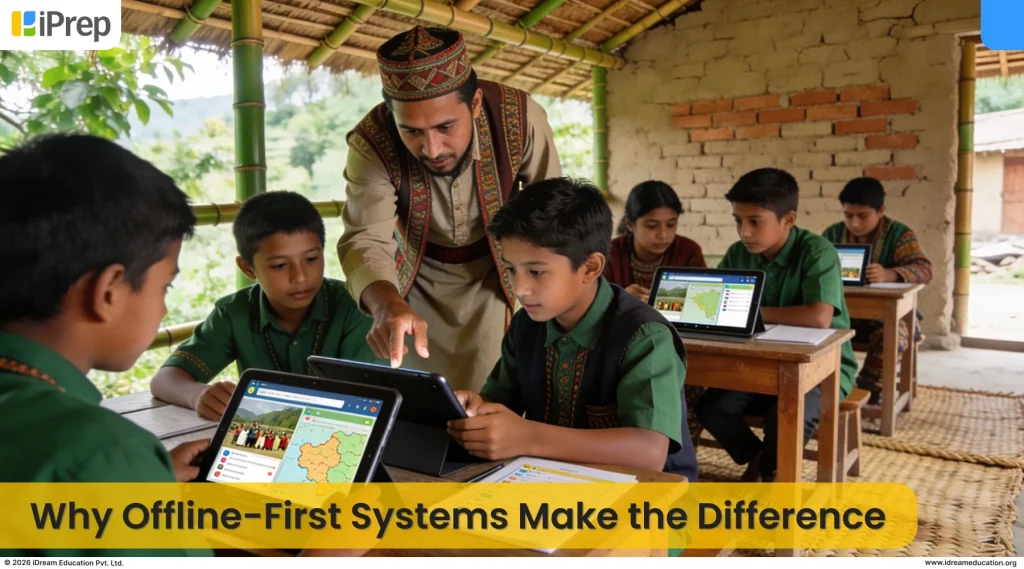
We have seen a clear co-relation between usage of devices in offline environments and learning outcomes. One of the examples of this is our implementation in a district where over 200 schools in Meghalaya were provided with our content and LMS. Pass percentage moved from approximately 20% to 92% in this 3 year programme with excellent indicators such as student performance in targeted grades i.e. 8-10th. We conducted a baseline assessment to understand the learning levels of every student. Once we found that students are not at the grade level, we customized our LMS and content to meet the unique requirements of the programme. We also introduced some additional lessons on English language learning, as several students had trouble consuming academic content in the English language. With monthly midline assessments and annual end line assessments we were able to chart and understand student progress. The data was used to tailor the programme towards the unique needs of the students. We undertook master training of teachers, regular facilitation and teacher certification. Had our content being internet dependent, in such a hilly region, there would have been a challenge of scaling the programme. Offline learning was one of the ket reasons why the programme succeeded and it is running even today.
Let’s look at a different country’s context as well. In 2025, we embarked on a journey to bring 40000 students in Afghanistan at grade level. Again, the terrain of Afghanistan is not ideal for an ideal learning programme. We pivoted towards PAL (personalized adaptive learning) on Tablets with our application pre-loaded with content & app on the individual learning devices. Our adaptive learning application. Students of grade 5 to 7 were given access to iPrep PAL, our adaptive learning application. After almost a year, we have seen some very encouraging results.Students have improved from 43% to 92% in Maths and 45% to 91% in science. Offline learning ensures seamless and continuous access to learning without any dependence on the Internet. A similar approach can be taken to set up digital learning in Africa, Middle east and North Africa, and Latin America where internet availability is not consistent and there are diverse learning environments.
Offline-first systems:
- Remove dependency
- Increase reliability
- Improve adoption
- Enable scale
At scale, reducing friction is everything. It ensures always available access to quality learning resources to students and teachers.
Common Mistakes That Are Easy to Avoid
Across regions, the same mistakes appear repeatedly:
- Distributing devices without a usage plan
- Expecting teachers to adapt independently
- Relying heavily on internet connectivity
- Designing pilots that cannot scale
- Not measuring usage or impact
The key considerations when planning & implementing a digital learning programme:
- Needs assessment: Thorough planning basis researching the ground level realities, challenges and goals
- Baseline assessment: Getting baseline data on existing learning indicators by circulating questionnaires to students and understand their current learning levels
- Digital Content and LMS: This forms the base of the programme. A well structured and easy to use LMS, pre-loaded with curriculum aligned rich digital learning content is essential to the success of any Digital Learning programme. An offline first and secure & reliable LMS that has security features and ability to scale while providing a good teaching-learning experience. Therefore, it is always good to go with a certified & recognized Digital Content & LMS.
- Hardware procurement: Procuring the right hardware, ensuring safety features such as Mobile Device Management to control which application(s) students have and don’t have access to if Internet is available on the device.
- Bilingual Learning: The LMS in a multi country context should be able to host content in different languages so that users can switch from one language to another. In many International contexts, bilingual learning and availability of content in languages such as English and the local languages is of paramount importance.
- Monitoring and Reporting: There should be clear and real time monitoring and reporting of usage and learning improvement to ensure that there is evidence to prove that the programme has been implemented successfully. There should be constant learning and feedback into the programme planning, so that it evolves and improves over time.
- Student & Teacher Training and Support: Regular training and interaction between project staff and teachers/ students should be undertaken, with training videos and training modules available for students and teachers, acting as ready reckoners. There should be a single window reporting & ticketing system with proper SLAs signed off to resolve queries and concerns in time.
- Mid-line, Endline and Student Performance tracking: Regular assessments to measure how the students are progressing whether using questionnaires given to students at regular intervals, followed by end line assessment and an Impact Report preparation. An alternative is using applications and devices such as clickers in the class for formative assessment of students for immediate and lesson level student wise and class level feedback..
- Lesson Planning support and AI: Teachers should be able to integrate AI to create their own lesson plans and generate questions irrespective of the class or subject. This can be assigned to students over a student application so that the latter can comfortably practice with different levels of questions. In iPrep, we’ve carefully incorporated AI to help teachers get lesson plans and questions for enriching the teaching and learning experience.
- Custom Content Creation: Teachers and administrators should be able to create their own content and assessments and assign the same to the students, while students through a student learning app should be able to upload their assignments and take assessments assigned by teachers which the teachers in turn are able to access in a teacher app.
- Personalized and Adaptive Learning: It is crucial that students not only have access to all the digital learning material for their personalized and non judgemental learning but also adaptive learning available for each topic they learn. This is because different learners learn differently, and are at different levels of learning. PAL not only adapts to the student’s level of proficiency, but also offers remedial learning to bridge any foundational learning gaps.
- Content for Growth & Ebooks: In today’s world where students are often exposed to the perils of AI, Internet and Social Media, it is imperative that we provide them with such quality content & meaningful learning that enriches them, gives them a better perspective, and opens their minds to real world challenges. This is what modules on growth do, they guide students on the right things such as sports, climate change, arts, STEM, business, communication, social emotional learning and more. Additionally, there are not many things that replace the knowledge, confidence, and language enrichment students get from reading. It also improves their cognitive abilities, that help them in their life long learning, career development and lives. Therefore, in our LMS, iPrep, we’ve given a lot of importance to modules on growth and age appropriate books across diverse categories with an e-book library that has over 10000 books for K12 learners and over 8000 books for learners beyond K12, and many of these books are suitable as much for a student in Africa, to a student in UAE, New York, Brazil or Afghanistan.
A Practical Way To Implement Digital Learning
If you strip away the jargon, successful implementations tend to follow a simple, grounded approach.
It usually starts with clarity on why digital learning is being introduced in the first place. In some cases, the focus is on improving foundational literacy and numeracy. In others, it is about completing the curriculum more effectively or supporting exam preparation. When the objective is clear, decisions become easier.
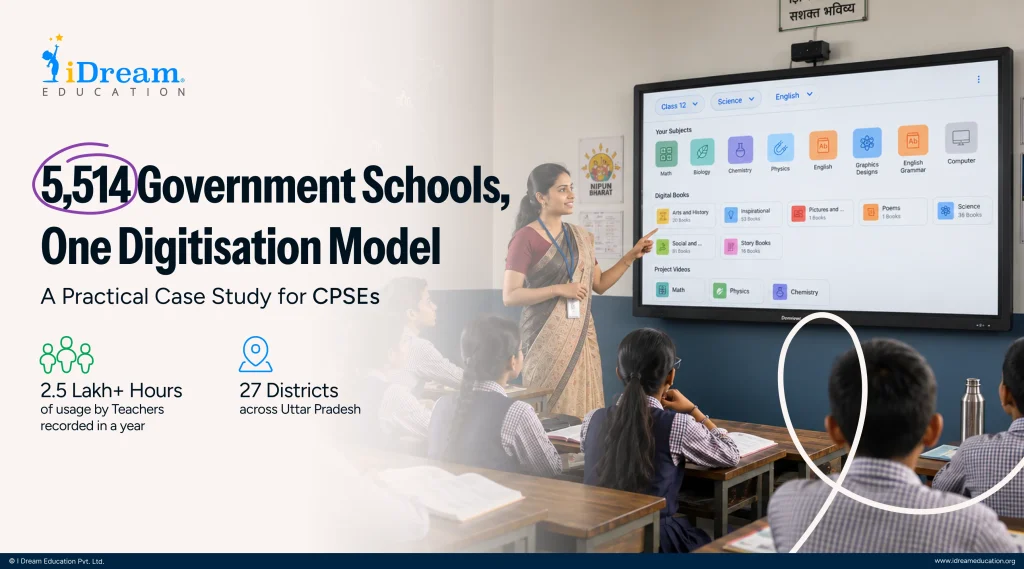
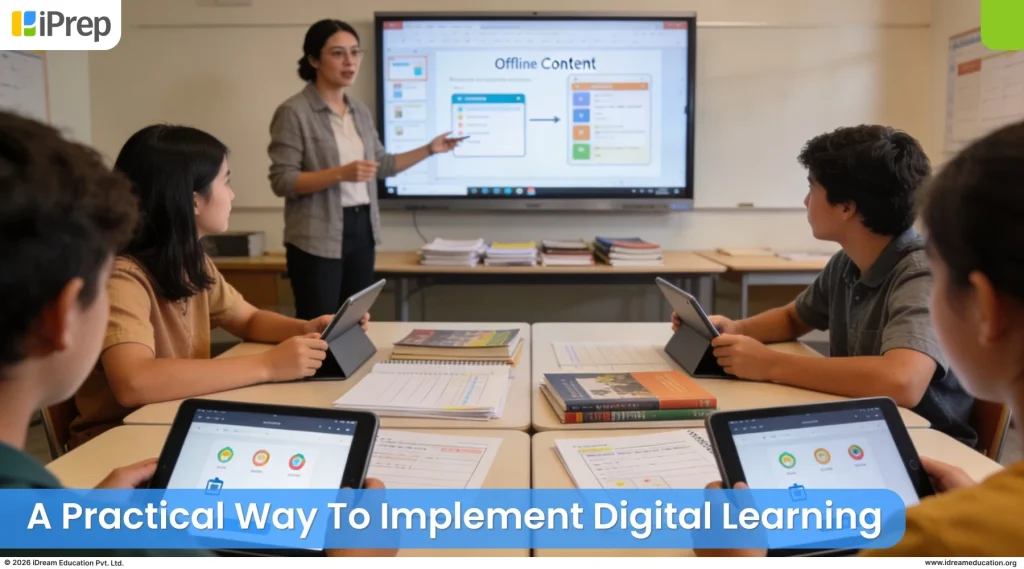
The next step is choosing a model that fits the context. In many Indian government schools, a teacher-led smart classroom works well when teachers are confident and comfortable with technology. In contrast, tablet-based models can be more effective in environments where self-paced practice is needed, especially for remedial learning. But, the real shift happens when planning is done for real conditions, not ideal ones.
What happens when the internet doesn’t work?
Can the system function entirely offline?
Can multiple students use the same device without friction?
And then there are cases where the conditions are ideal, in those cases the considerations become, what best can we do for the students and for the programme. Can there be ways and means hitherto lesser known, tried or unexplored that could be implemented?
What are some of the latest interventions that can enrich programmes, whether internet deficient or not?
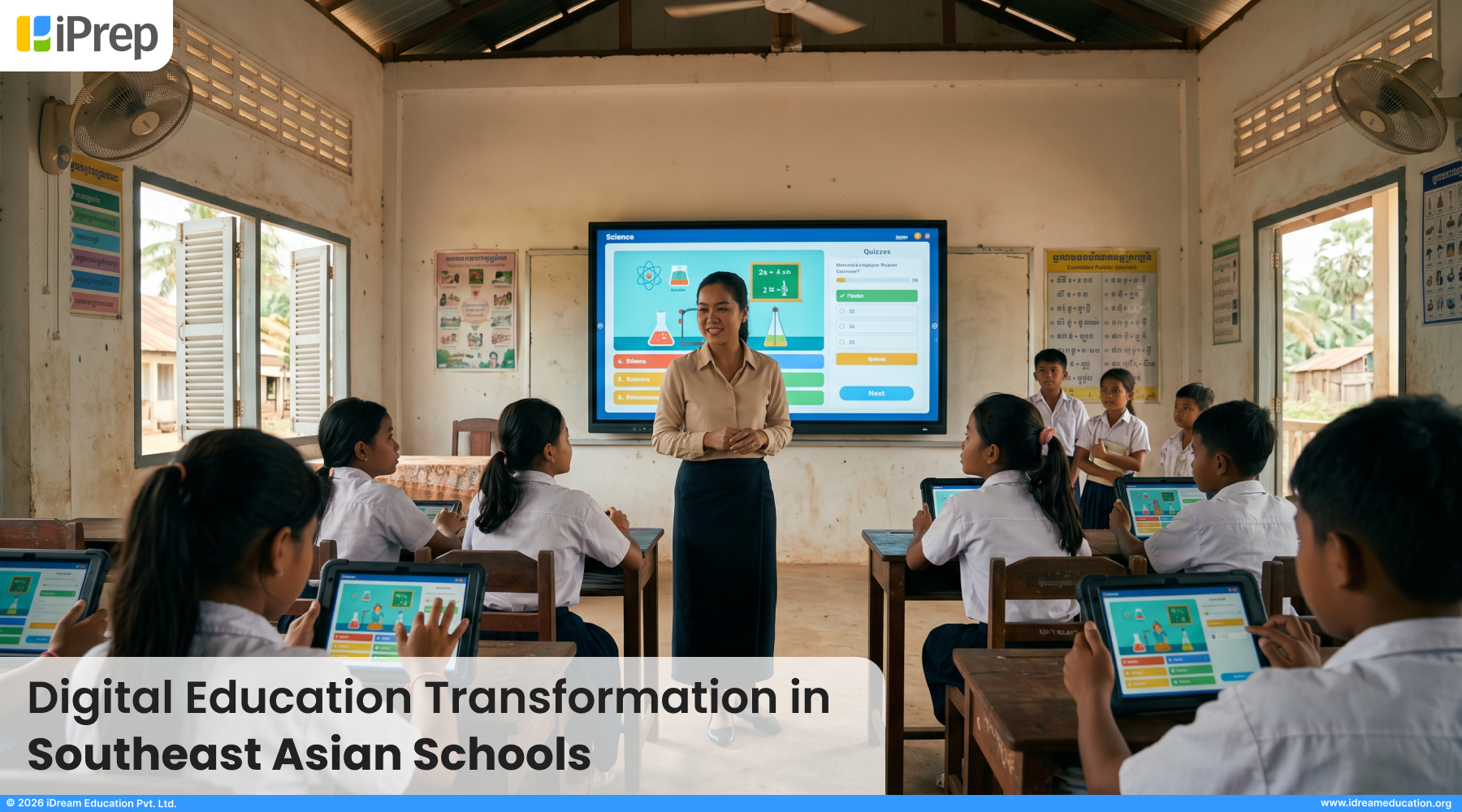
In countries like Indonesia, where schools are spread across islands, or in parts of Africa where connectivity varies drastically, offline-first systems are not an advantage, they are a necessity. In middle eastern countries where the internet is not really an issue, we’ve done some api led interventions supporting the learning of thousands of students. We implemented digital learning for an academic enrichment center in Dubai. They outsourced our content and pulled our app via an api to give its students access to test preparation and academic support from our existing content that aligns to their curriculum & testing standards.
Content selection is another area where shortcuts are costly. If the content is not aligned with the curriculum or is too complex for the learner’s level, it simply won’t be used. the best implementations we’ve seen use content that is simple, structured, and easy for both teachers and students to navigate.
And then comes the most important piece-teacher adoption.
In every successful program we’ve observed, there is one common factor: teachers feel comfortable using the system. not because they were trained once, but because they were supported continuously, in ways that made sense in their daily teaching.
Finally, there needs to be a way to see what’s happening. not just for reporting, but for improvement. simple usage data-how often content is used, which topics are accessed, where students struggle can make a significant difference in how programs evolve.
A simple way to think about scale
A model that works in 5 schools but breaks at 50 is not a scalable model.
True scalability comes from simplicity. Systems that are easy to deploy, easy to use, and do not rely heavily on external conditions tend to perform better when expanded.
This is especially important for governments and NGOs working across districts or states, where consistency matters more than sophistication.
Conclusion
Digital Learning Doesn’t Succeed Just Because Of Technology.
It succeeds when it fits into the classroom and learning ecosystem, quietly, reliably and consistently.
Across India, Africa, Southeast Asia, and Latin America, the story is the same. The constraints may differ slightly, in the US and the Middle East and North African nations, the nuances of challenges to digital learning or requirements of digital learning may be different and perhaps more evolved , but the principles remain constant. Digital learning in all of these countries can be met with a carefully planned programme, using a reliable, scalable, secure LMS that can work offline if required, and most importantly, the right digital content that can support learning programmes in different countries, as per their curriculum and requirements.
If implementation is grounded in reality, adoption follows.
And when adoption happens, outcomes improve. If you are planning a digital learning initiative, whether as a CSR leader, government body, school group or NGO, the success of your program will depend less on the technology you choose and more on how well it fits real classroom and learning ecosystem conditions.
If you’re interested to learn more on how we can help you plan your digital learning programme, write to us at [email protected]
Categories You may Explore
Related Articles