

When you decide to buy an Interactive Flat Panel, what is really being purchased?
A screen?
A specification sheet?
A brighter display, louder speakers, faster processor?
Or a better learning experience?
Let’s pause and ask a deeper question.
If a classroom installs the most advanced interactive panel, but the teacher still struggles to find the right content, align it with the curriculum, engage different types of learners, and actually use the technology meaningfully – has your investment truly delivered value?
Because in education, technology is not successful when it is impressive.
It is successful when it is used. And it is used when it is useful.
Think about how most IFP hardware purchases happen. Decisions are often driven by inches, ports, warranty years, resolution, and price comparisons. Demo rooms are visited. Panels are touched. Features are tested. Deals are negotiated.
But how often is this question asked with equal seriousness: “What will actually run on this panel every day in the classroom?”
Not just PDFs. Not just videos.
But, what should be checked is availability of structured, interactive, offline, structured curriculum-aligned content that matches exact teaching requirements of teachers in the classroom.
An interactive panel without a strong content ecosystem is like building a highly equipped school without teachers — impressive infrastructure, limited impact.
The real transformation does not come from the IFP hardware on the wall.
It comes from what learning it is driving..
And that is why choosing the right interactive panel content partner matters just as much as choosing the IFP hardware itself.
What Actually Completes Your Interactive Panel Investment
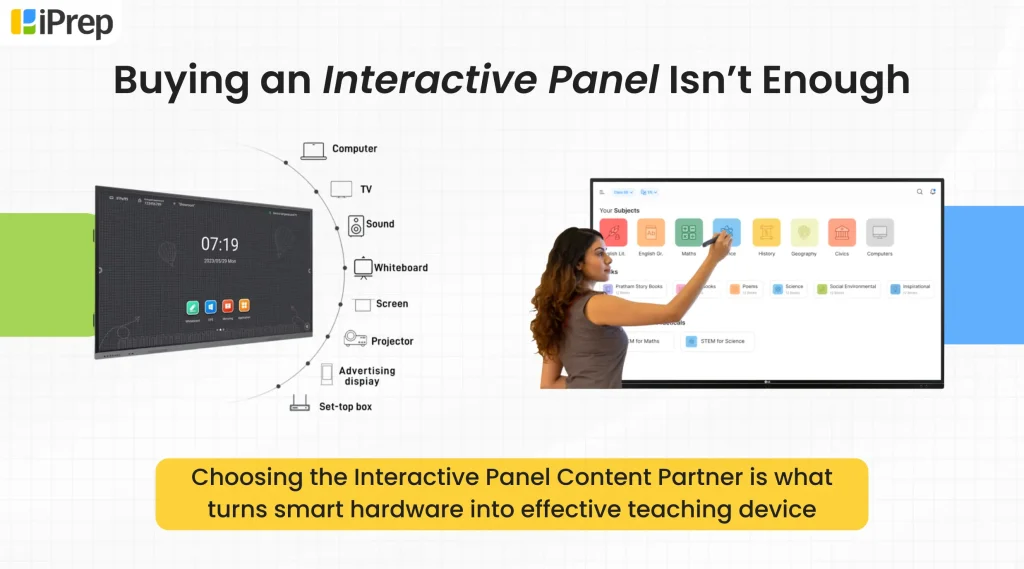
An Interactive Flat Panel for schools, by itself, is a capable device. But its educational value is determined less by what it can do and more by what it is enabled to do in everyday teaching conditions.
In most schools, classroom time is structured, syllabus-bound, and pace-driven. Teachers are not looking for tools to experiment with — they are looking for tools that fit directly into their lesson flow. That requires curriculum-mapped, ready-to-use, interactive resources that reduce preparation effort and increase instructional clarity.
This is why institutions/decision makers that plan panel deployments at scale increasingly look beyond hardware features and ask operational questions:
- What content will run on the panel across subjects and grades?
- How easily can teachers access it?
- How aligned is it with their board and textbooks?
- How much preparation time does it save?
- How easy is it to access digital content on IFP hardware?
- How easily can teachers switch from digital content to other features of IFP panel?
- How would they know if interactive panel content is being used regularly?
When these questions are addressed upfront through an interactive panel content partner, panel adoption becomes predictable rather than dependent on individual teacher initiative. In that sense, the panel is the medium — but the LMS & content ecosystem determines whether it becomes a daily teaching tool or an occasional display device.
What Decision-Makers Should Evaluate in an Interactive Panel Content Partner?
Once the IFP hardware is shortlisted, the next evaluation layer should be equally structured: the interactive panel content partner. Not in terms of how visually rich the content looks in a demo, but how reliably it supports day-to-day teaching across classrooms as per school curriculum. You can evaluate interactive panel content partner on a few operational parameters:
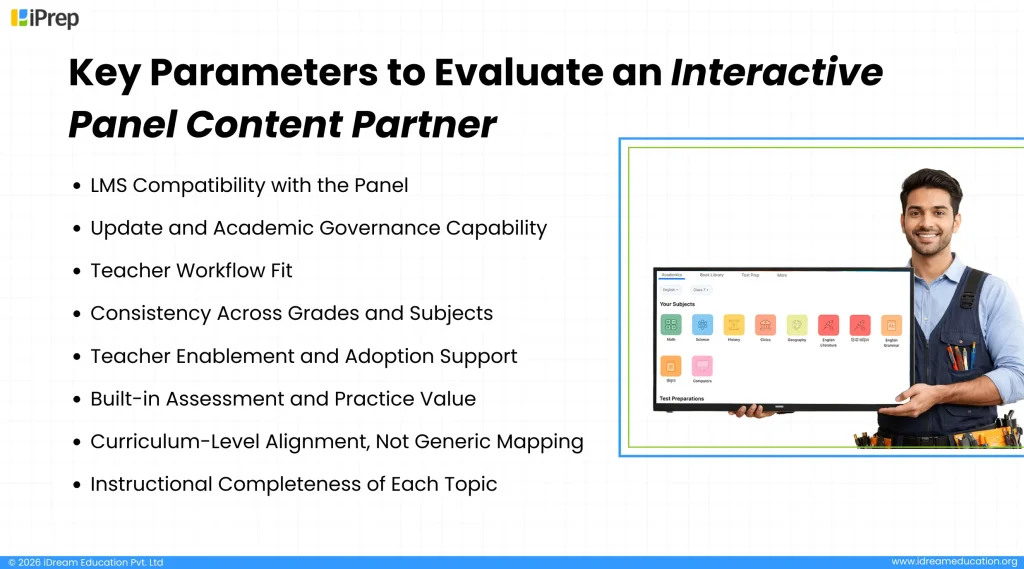
Curriculum-Level Alignment, Not Generic Mapping
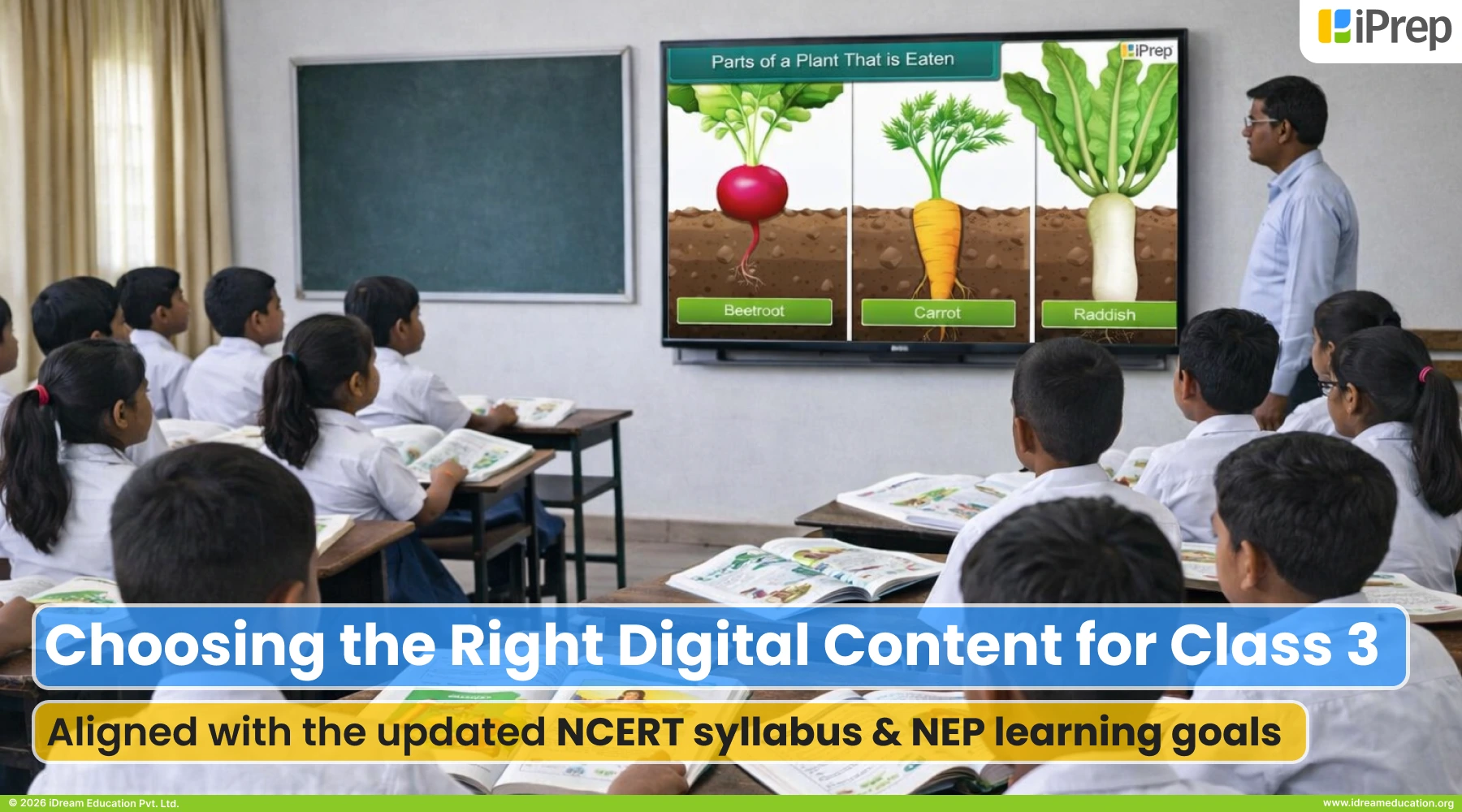
Content should map directly to the NEP guidelines, NCERT/State Board, language and prescribed textbooks at lesson level. When alignment is precise, teachers don’t need to reinterpret or rearrange material before using it. This reduces preparation load, and improves lesson planning, classroom instruction and ensures consistency across classrooms.
Instructional Completeness of Each Topic
A useful interactive panel content partner does not stop at explanation videos. Each topic should ideally include concept explanation, visualisation, practice, reading, assessment, and recap elements. This completeness by K12 content provider allows the panel to support the full teaching/learning cycle.
Consistency Across Grades and Subjects
Another significant point to be checked when choosing interactive panel content partners: Does the same instructional quality and structure exist across all grades and subjects you plan to deploy? Any gaps in coverage can quickly reduce trust and usage continuity.
Teacher Workflow Fit
Content on IFP hardware should match how teachers actually conduct periods. It should be chapter-wise, topic-wise, category-wise, grade-wise. If finding the right teaching asset takes longer than explaining the concept, adoption drops. Experienced interactive panel content partner design navigation and structuring around classroom flow, not content cataloging.
Built-in Assessment and Practice Value
Interactive panels deliver real instructional value when they are used for active learning not just visual presentation. The content ecosystem should therefore be designed to promote interaction at multiple levels during the lesson. A strong interactive panel content partner should offer structured interactive elements such as simulations, practice exercises, interactive presentations, and response-based activities. These allow teachers to explain, demonstrate, and immediately engage students within the same teaching flow.
LMS Compatibility with the Panel
A strong interactive panel content partner should not treat panel content and K-12 LMS delivery as separate silos. The content should be available through an LMS layer that works seamlessly with interactive panels, so classroom teaching and structured digital learning remain connected. An LMS-backed content ecosystem brings consistency and structure, ensuring that all learning material is organized, easily accessible, and delivered in a defined academic flow.
Update and Academic Governance Capability
Curricula evolve. Textbooks change. Academic priorities shift. A dependable interactive panel content partner should have a defined update process — so your investment remains current over years, not just at installation time.
Teacher Enablement and Adoption Support
Even well-designed content needs structured onboarding. Look for content providers who offer experiential teacher training, usage updates, conduct activities and provide ongoing support.
When interactive panel deployments succeed, the difference is rarely hardware capability alone. It is usually the presence of a well-structured LMS-content ecosystem that supports consistent classroom usage.
Treat Content as Core, Not Complementary
Interactive panels are now a central part of classroom technology planning. But their long-term value is determined less at the point of purchase and more at the point of daily use.
- Hardware decisions answer the question: What can the device do?
- Content decisions answer the question: What will actually happen in the classroom?
Partners that see sustained impact from panel deployments typically plan both layers together — device capability and instructional readiness. They evaluate not only performance specifications, but also curriculum alignment, teacher usability, LMS continuity, and academic support.
This shift in evaluation approach is important. Because in classroom technology, adoption drives impact — and adoption is driven by usable, structured, interactive content.
If you are looking for an interactive panel content partner, you can schedule a virtual or in-person demo to assess fit for your academic and implementation needs with us. You may contact us at +91 7678265039 or write to us share@idreameductaion.org. You can also share your details here
Categories You may Explore
Related Articles