

For decades, India’s school system followed the familiar 10+2 structure, where students spent ten years in general schooling followed by two years of higher secondary education. While this model served its purpose in a traditional, exam-driven era, it has struggled to keep pace with the rapidly changing demands of the 21st century. With evolving learner needs, globalized career pathways, and a growing emphasis on skills, creativity, and flexibility, a new approach to education became essential – one that looks beyond rote learning and rigid subject boundaries.
This is precisely what the Revised NEP Education Framework sets out to achieve.
As part of the ambitious National Education Policy (NEP) 2020, the framework replaces the old structure with a more learner-centric 5+3+3+4 model, reorganizing schooling from ages 3 to 18. Guided by the National Curriculum Framework for School Education (NCF-SE) 2023 and the National Curriculum Framework for Teacher Education (NCFE), this transformation redefines not just how students learn, but also how teachers teach, schools design their curriculum, and the entire ecosystem nurtures future-ready citizens.
With its emphasis on foundational learning, holistic development, vocational exposure, flexible subject choices, and even an Academic Bank of Credits at the higher education level, the new framework is more than a structural shift – it’s a roadmap to building a well-rounded, adaptable, and skilled workforce equipped to thrive in India’s knowledge-driven economy.
What Does the New 5+3+3+4 Structure Mean?
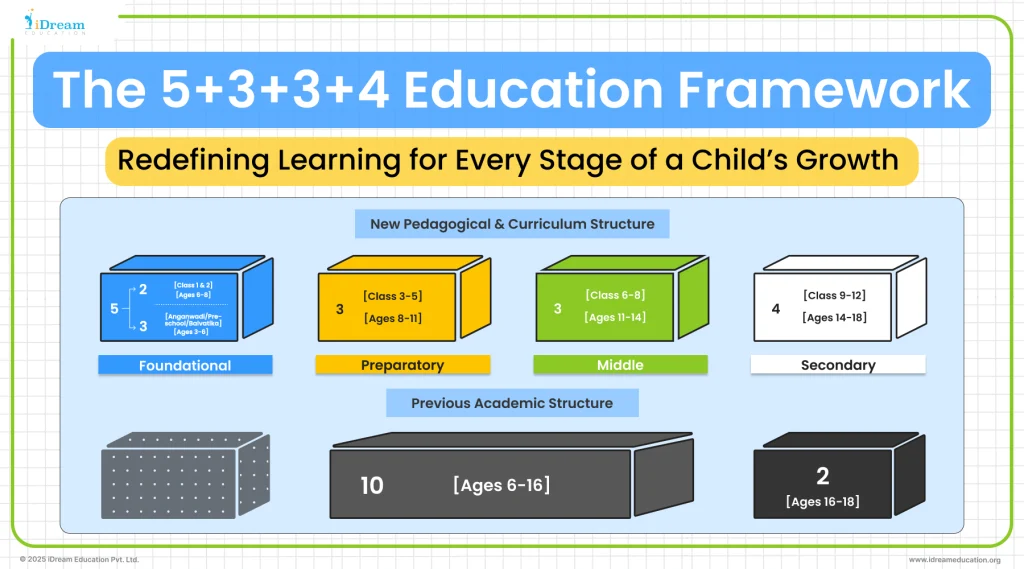
The NEP 5+3+3+4 framework is a new Indian school education structure introduced under the National Education Policy, replacing the traditional 10+2 model. It divides schooling into four key stages: Foundational, Preparatory, Middle, and Secondary. Each stage is aligned with a child’s cognitive and developmental milestones. The goal is to make education more holistic, flexible, and learner-centric by emphasizing play-based learning in early years, shifting to competency-based education in middle and secondary stages, and offering multidisciplinary subject choices in higher grades.
Here’s a breakdown of the new structure:
Foundational Stage (5 years, ages 3–8):
- Includes 3 years of Anganwadi/pre-school and 2 years of primary schooling (Grades 1–2).
- Focuses on play-based and activity-based learning to support critical cognitive, social, and emotional development in early childhood.
Preparatory Stage (3 years, ages 8–11):
- Includes classes 3 to 5
- Builds upon the foundational years by blending play with more structured academic learning.
- Emphasizes language development, foundational literacy and numeracy, and early subject exploration through interactive classroom experiences.
Middle Stage (3 years, ages 11–14):
- Includes classes 6 to 8
- Focuses on critical learning objectives, conceptual understanding, and experiential learning.
- Students are introduced to more abstract concepts across subjects and are encouraged to build critical thinking, analytical, and problem-solving skills.
Secondary Stage (4 years, ages 14–18):
- Covers Grades 9 to 12, marking the final and most flexible phase of school education.
- Encourages multidisciplinary learning, allowing students to choose subjects across disciplines and move away from rigid stream-based choices. This stage aims to reduce board exam pressure by redesigning assessments for comprehensive and holistic evaluation.
This NEP revised education framework offers a restructured approach toward transforming the learning experience in schools. This is making education more aligned with real-world skills, personalized to student needs, and capable of nurturing well-rounded learners ready for higher education and beyond.
Beyond the Structure: Key Emphasis of NEP’s Revised Framework Also Includes:
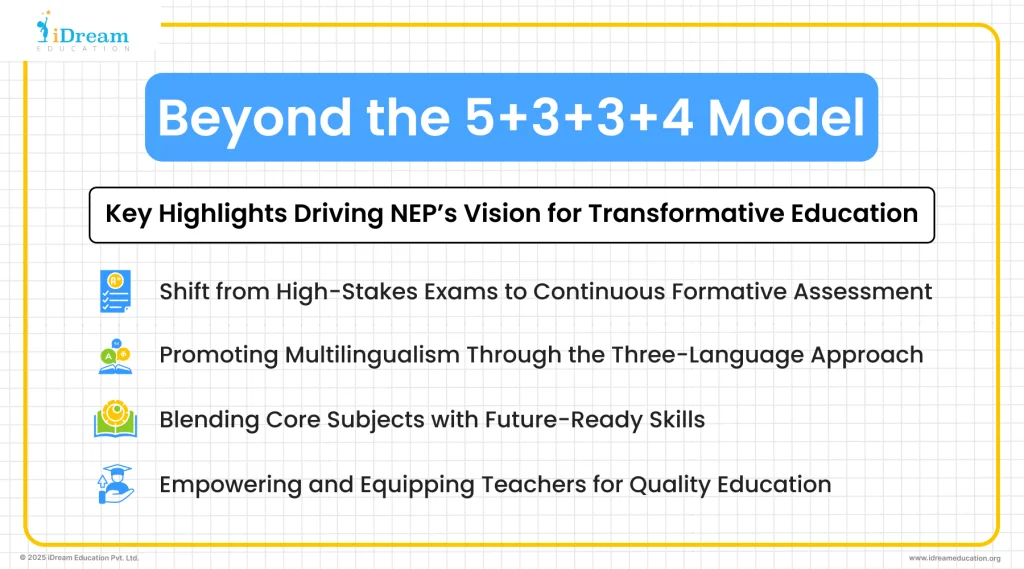
Shift from High-Stakes Exams to Continuous Formative Assessment
- The NEP 2020 moves beyond a marks- and grade-centric system to one focused on continuous learning and growth. Instead of relying solely on end-of-year exams, the new framework emphasises regular formative assessments that track a student’s progress throughout the year. This approach reduces exam pressure, encourages deeper understanding over rote memorisation, and gives teachers actionable insights into each learner’s strengths and challenges. Students now have the option to appear for board exams twice a year, and assessments will focus on core competencies rather than memorised facts.
- In addition, the National Testing Agency (NTA) is conducting high-quality aptitude and subject tests across disciplines – further personalising learning paths and reducing the dependence on coaching classes.
Promoting Multilingualism Through the Three-Language Approach
- To make education more inclusive and relatable, NEP revised education framework places strong emphasis on teaching in the mother tongue or local language, especially in the foundational years. Schools are encouraged to use the home language as the primary medium of instruction till Class 5, and preferably till Class 8 and beyond, to strengthen conceptual understanding and emotional connection with learning.
- The policy also reimagines language learning through the three-language mechanism, where every student will study three languages chosen by the state, region, or the learner – with at least two being native to India. This approach not only nurtures cultural diversity and linguistic heritage but also builds stronger cognitive skills. Additionally, schools must ensure high-quality learning materials in local languages and adopt bilingual teaching methods, enabling smoother transitions and deeper comprehension.
Blending Core Subjects with Future-Ready Skills
- NEP 2020 recognises that – academic knowledge alone is not enough to prepare students for real-world challenges. To address the persistent skill gap, the revised NCERT curriculum is designed to seamlessly integrate essential subjects with critical skills and capacities. Along with strong language proficiency, the focus is on developing evidence-based thinking, problem-solving, collaboration, communication, and teamwork skills that are vital in higher education and the workplace.
- Moreover, schools are now introducing contemporary subjects such as Coding, Computational Thinking, and Digital Literacy, ensuring that learners are not just exam-ready but also career- and life-ready. By blending conceptual understanding with practical application, NEP aims to nurture holistic, adaptable, and future-ready learners.
Empowering and Equipping Teachers for Quality Education
- Recognising that the quality of education is directly linked to the quality of teachers, NEP revised framework also places significant emphasis on teacher training, recruitment, and continuous professional growth. The policy promotes merit-based scholarships for students pursuing 4-year integrated B.Ed. programmes, encouraging talented individuals. This is especially for local and female candidates entering the teaching profession and delivering instruction in learners’ home languages.
- Additionally, now the Teacher Eligibility Tests (TET) will undergo major improvements, with updated content focused on pedagogy and practical classroom skills. The recruitment process now prioritizes classroom demonstrations and interviews. This is to ensure that teachers are not only academically qualified but also effective communicators and facilitators of learning. Through these measures, NEP aims to build a highly skilled, motivated, and empowered teaching workforce capable of delivering transformative learning experiences.
The introduction of the 5+3+3+4 education structure under NEP 2020 is more than just a structural overhaul – it is a paradigm shift that reimagines the very purpose and process of learning in India.
By moving away from rote learning and rigid grade-based progression, NEP revised education framework emphasizes foundational literacy and numeracy, experiential learning, and holistic development from the earliest years.
- It places students at the center of the education ecosystem, allowing them to explore interdisciplinary subjects, cultivate critical thinking, and develop socio-emotional skills alongside academic knowledge. F
- For teachers, it signals a renewed focus on competency, training, and professional growth, ensuring that they are equipped to nurture the next generation effectively.
- For policymakers, parents, and educational institutions, it offers a blueprint to align curricula, pedagogy, and assessment with the evolving needs of learners and the demands of a rapidly changing world.
Ultimately, the 5+3+3+4 model embodies NEP 2020’s ambition to transform India’s education system into one that is inclusive, flexible, and future-ready – laying the foundation for generations of learners who are not just academically proficient but also creative, adaptable, and socially responsible.
Experience and Enable NEP-Aligned Digital Learning with Us
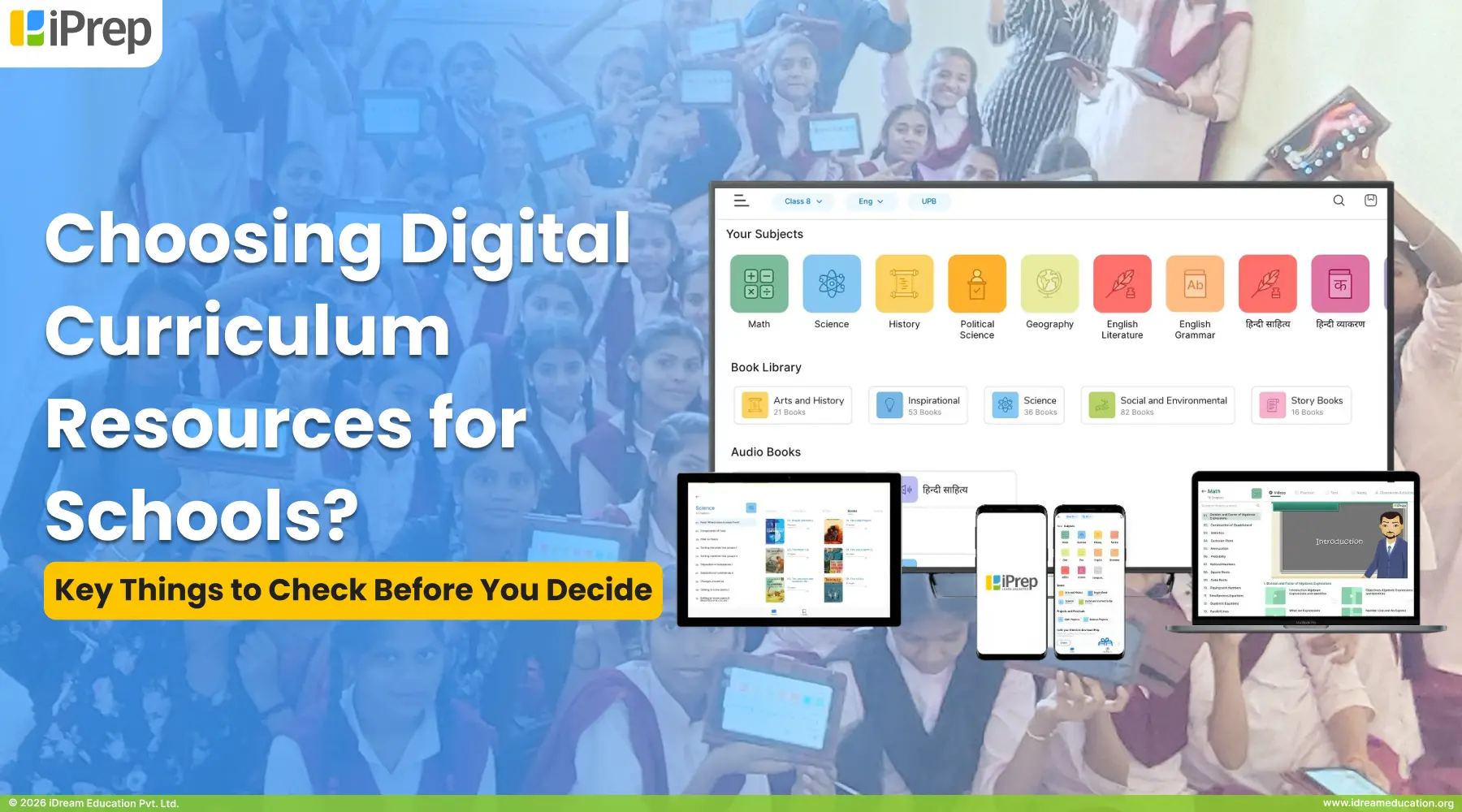
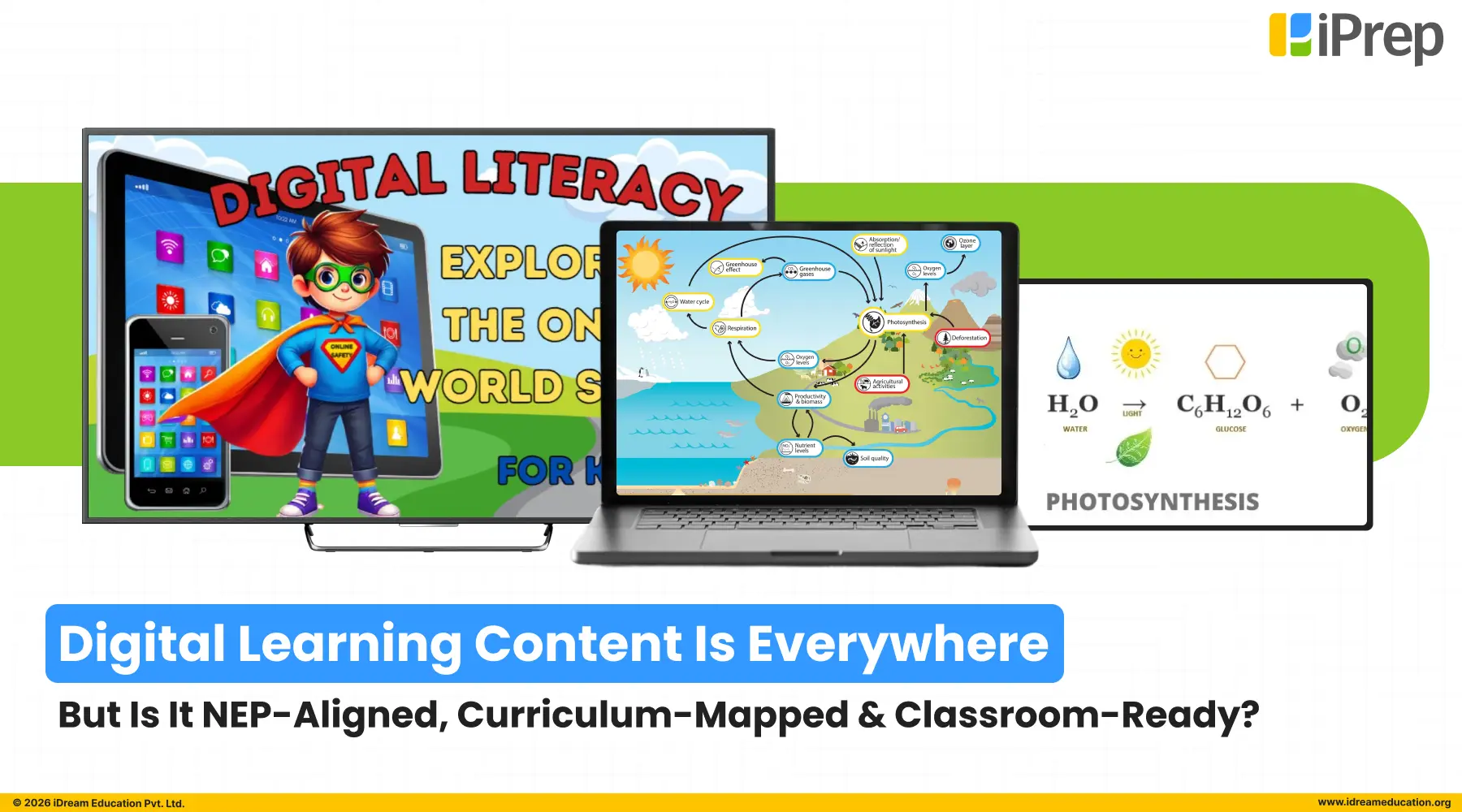
At iDream Education, we have been actively updating our content and curriculum to align with the changes introduced by NEP 2020. Our digital learning solutions and content is designed to complement the revised education framework, ensuring that students experience a seamless, student-centric, and multi-disciplinary learning journey. Whether it’s adapting to the new 5+3+3+4 structure, integrating experiential learning, or supporting competency-based assessments, our NEP-aligned digital content is built to meet the evolving needs of learners and teachers alike.
If you would like to see a demo of our NEP-aligned digital content and explore how it can enhance school education, you may contact us at +91 7678265039. You can also write to us at share@idreameducation.org or share your details here
Discover detailed insights into the National Education Policy, updated annually with the latest changes
- Stay updated on the latest changes and insights in NEP 2023—read our detailed blog here
- Get the complete overview of NEP 2024 and discover what’s new in India’s education policy
- Explore the latest updates, key expectations, and potential changes in NEP 2025 here
- Understand the crucial role of Personalized Adaptive Learning (PAL) in effectively implementing the National Education Policy. Read Here
Frequently Asked Questions -
1. What is the 5+3+3+4 education structure in NEP 2020?
The 5+3+3+4 structure divides school education into four stages: Foundational Stage (5 years): Includes 3 years of pre-primary and 2 years of Grades 1–2, focusing on play-based and activity-based learning. Preparatory Stage (3 years): Grades 3–5, introducing more formal classroom learning. Middle Stage (3 years): Grades 6–8, emphasizing experiential and discovery-based learning. Secondary Stage (4 years): Grades 9–12, offering multidisciplinary learning, critical thinking, and flexibility in subject choices.
2. How does the NEP revised education framework benefit students?
NEP 2020 aims to create a student-centric system where learning is holistic, inquiry-based, and competency-focused. It emphasizes foundational literacy, critical thinking, socio-emotional skills, and flexibility in choosing subjects.
3. How are EdTech companies adapting to NEP 2020?
Edtech providers such iDream Education are continuously updating our content and curriculum to align with NEP 2020. Our solutions support the revised education structure, experiential learning, competency-based assessments, and the integration of digital tools to enhance learning outcomes.
Categories You may Explore
Related Articles