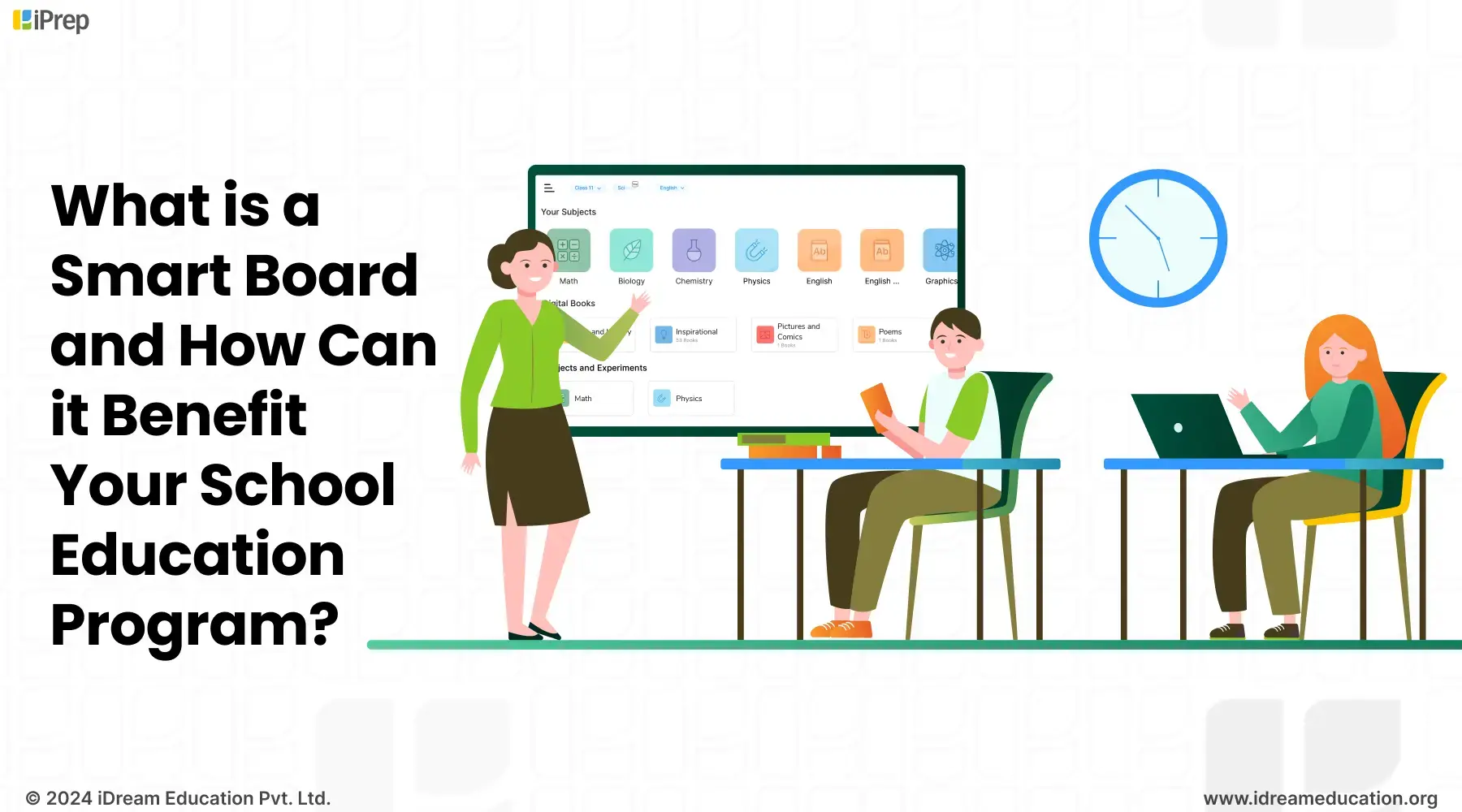


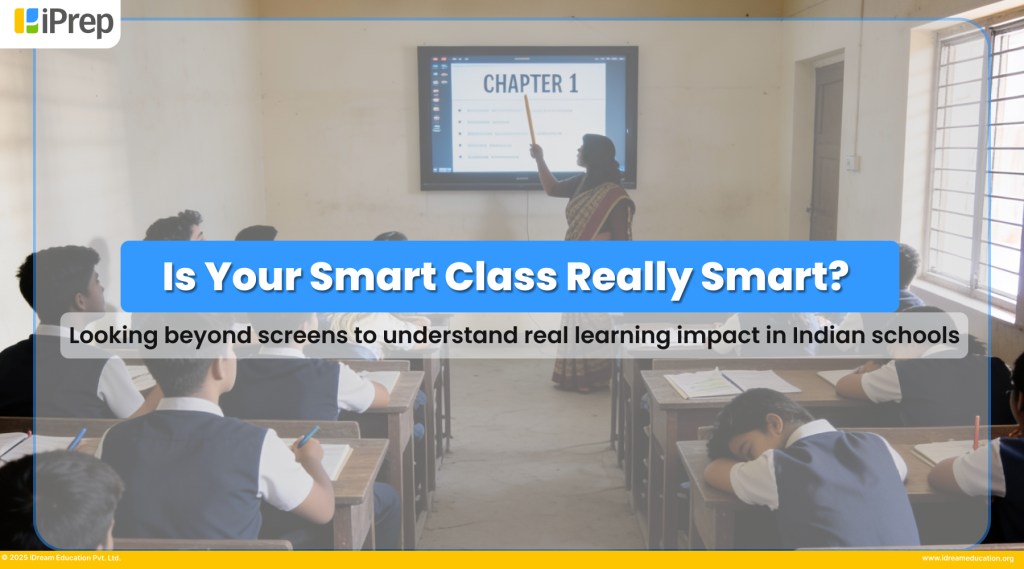
For more than a decade, India’s education system has invested heavily in smart classrooms. The motivation was straightforward and necessary. Large numbers of government and aided schools lacked access to consistent teaching resources, structured content, and engaging instructional tools. In classrooms where learning depended almost entirely on a blackboard, a single textbook, and the teacher’s voice, smart classes represented a long-overdue structural upgrade.
This first phase of digitisation mattered. Without screens, content libraries, and visual explanations entering classrooms, discussions about learning quality would not even begin. Smart classes expanded access. They standardised the content. They brought visual clarity to abstract concepts. Most importantly, they changed how classrooms felt. Students were more attentive. Teachers had more support. Instruction became more uniform across schools.
Yet, as smart classroom adoption matured, a quieter question surfaced across states, districts, and programmes.
If access and engagement were largely addressed, why did learning outcomes still vary so sharply between schools that appeared similarly equipped?
That question signals the point where the conversation around smart classes must move deeper.
When the Content Became Visible, But Understanding Remained Hidden During Smart class
As smart classes became routine, a pattern emerged across many implementations. From the outside, classrooms appeared successful. Screens were in use. Lessons are played on schedule. Students sat quietly.
Inside the lesson, however, a critical limitation remained.
Teachers still could not see:
- Which students were actually understanding the concept
- Where confusion was emerging
- Which learners were disengaging silently
In large classrooms, verbal participation continued to come from the same few students. Others remained invisible, not disruptive, but not necessarily learning.
Smart classes solved the visibility of content.
They did not solve the visibility of understanding.
This distinction matters because learning gaps do not appear suddenly at exam time. They accumulate quietly, lesson by lesson, when misunderstandings pass unnoticed.
Once this gap becomes clear, the system has no choice but to move forward.
The First Shift Beyond Videos: Practice and Testing Inside the Smart Class

Before classrooms moved toward advanced tools or new hardware, teachers instinctively tried a simpler step.
They began using practice questions, quizzes, and short tests embedded within smart classroom content. These helped teachers make rough estimates:
- How many students followed the lesson
- Whether the class could move forward
- Which topics require repetition
This was an important transition. Smart classes were no longer just about watching content. They began incorporating checkpoints.
But this approach still had limits.
In large classrooms, only a fraction of students responded. Teachers continued to infer understanding from partial signals. The same confident students answered repeatedly. Many remained unseen.
As learning gaps became more visible, especially post-COVID, it became clear that estimation was no longer enough. Teachers needed visibility into every student, not just a sample.
That requirement pushed the system to its next stage.
Learning Gaps Improve When Understanding Is Addressed During the Lesson, Not After the Year Ends
Field experience and educational research converge on a shared insight: learning outcomes improve when teachers receive feedback during instruction, not after it.
Two schools may have identical smart class infrastructure and access to the same digital content. Yet their learning outcomes can differ significantly. The difference is rarely the hardware. It is whether teaching decisions are informed by evidence of student understanding while the lesson is still underway.
Without feedback, even high-quality content remains one-directional. Teachers move sequentially through chapters, unaware of where comprehension breaks. Assessment is delayed until tests or exams, when corrective teaching is no longer timely.
At this point, assessment is no longer about evaluation. It becomes about instructional visibility.
This is where the smart classes in schools begin to evolve, from a content delivery setup into a learning system.
Making Student Understanding Visible Without Waiting for Personalised Devices
Once instructional visibility becomes the goal, another constraint surfaces. In Indian classrooms, particularly government and aided schools, any solution must work within real conditions: large class sizes, shared infrastructure, limited connectivity, and high teacher workload.
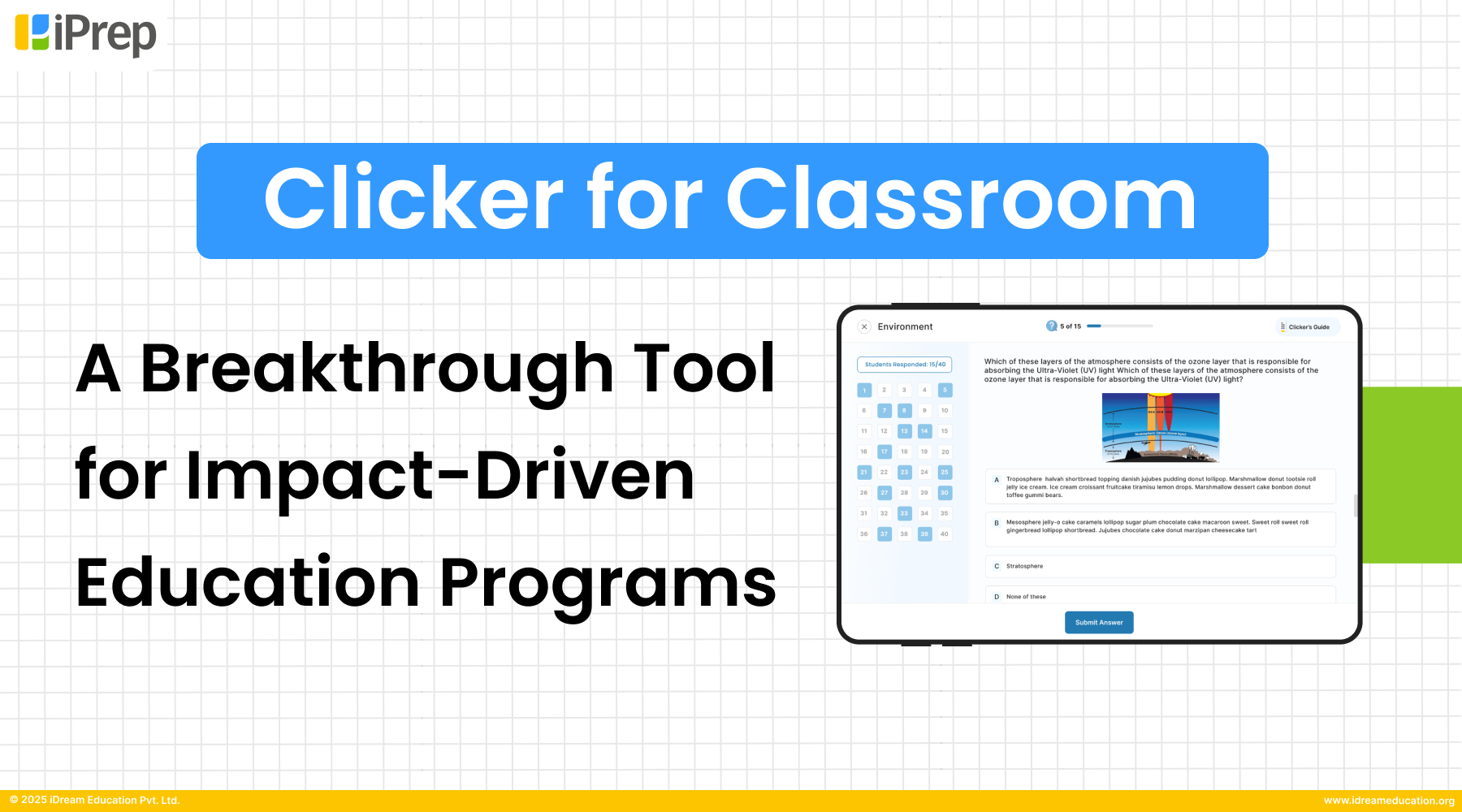
This is where classroom-wide assessment tools, which allow every student to respond simultaneously during instruction, are often implemented through simple clicker-based systems. These tools are a part of the evolution of smart classrooms.
Clicker-based assessment allows every student in a classroom to respond simultaneously during the lesson. Instead of relying on verbal answers from a few students or waiting for periodic tests, teachers see response patterns across the entire class in real time. Confusion becomes visible while teaching is still in progress.
This matters because fully personalised, one-device-per-child learning systems, while valuable, remain expensive and operationally demanding to implement at scale. Clicker-based assessment does not attempt to replace personalised learning. It addresses a more immediate and foundational need: restoring visibility into student understanding at the right moment, using shared classroom devices.
In this role, clickers function as a practical bridge. They allow smart classrooms to move from passive viewing to responsive teaching without adding infrastructure burden or complexity.
At this stage, the system begins asking a different question, not about effectiveness, but about longevity.
Why Sustainability Determines Whether Smart Classes Matter?
Many education initiatives show strong early results and fade over time. What separates those who endure from those who decay is rarely innovation. It is aligned with real school conditions.
Smart classroom systems that sustain impact tend to:
- Function offline
- Require minimal maintenance
- Integrate into existing teaching routines
- Reduce uncertainty for teachers rather than add effort
Classroom-wide assessment tools align with these conditions. They operate without continuous connectivity, require limited training, and generate usable learning insight without creating parallel reporting systems.
This explains why some smart class investments continue delivering value years later while others stagnate. Sustainability depends less on novelty and more on whether the system consistently helps teachers teach better within their constraints.
Smart Classes Are Foundations for Digital Learning in Schools
The evolution of smart classrooms reflects a broader system journey. What began as an effort to improve access and engagement is now progressing toward improving learning quality through visibility and feedback.
The future of smart classrooms points toward:
- Continuous insight into student understanding
- Teaching decisions informed by real-time evidence
- Gradual integration of analytics and AI aligned with classroom realities
- Teacher capacity building consistent with NEP priorities
Smart classes are not the destination. They are the foundation upon which smarter learning systems are built.
What “Smart” Ultimately Means in 21st Century School Learning?
The real measure of a smart class is not the screen it installs, but the understanding it reveals, every day, in every classroom, through clear insight, timely feedback, and measurable learning outcomes.
For leaders examining how existing smart classroom investments can evolve toward stronger learning impact, the role of measurement and feedback is becoming central to that conversation. To explore how smart classrooms can deliver clearer learning outcomes through better visibility and feedback, you can reach out at +917678265039 or write to share@idreameducation.org.
Categories You may Explore
Related Articles