

Early childhood is universally recognised as the most critical phase of learning and development. It is during these formative years that a child’s cognitive, emotional, social, and language foundations are shaped. Unlike formal schooling, early learning does not begin with textbooks, examinations, or rigid curricula. It begins with joy, stories, play, music, movement, curiosity, and imagination. Children learn by observing, interacting, asking questions, and making sense of the world around them – often without realising that learning is happening at all.
For young learners, especially in the 3–6 age group, joyful and playful learning is not merely an engaging methodology – it is the most effective one. Visuals, storytelling, rhymes, activities, and hands-on exploration help children grasp concepts, develop vocabulary, and nurture curiosity. This approach gently prepares them for structured education before they step into primary school. The importance of such experiential learning becomes even more significant in rural and underserved regions, where early exposure to quality learning resources can meaningfully bridge developmental gaps.
Smart TVs in Anganwadis: A National Step Towards Digital Early Childhood Education
Recognising this, the Government of India, through the Ministry of Women and Child Development, has taken a progressive step by introducing Smart TVs in Anganwadis across the country. The intent is clear and commendable: to digitalise early childhood education, empower Anganwadi workers with better teaching aids, and provide children with rich, audio-visual learning experiences aligned with modern educational thinking. On paper, this initiative holds immense promise and reflects a strong commitment to strengthening the early learning ecosystem at scale.
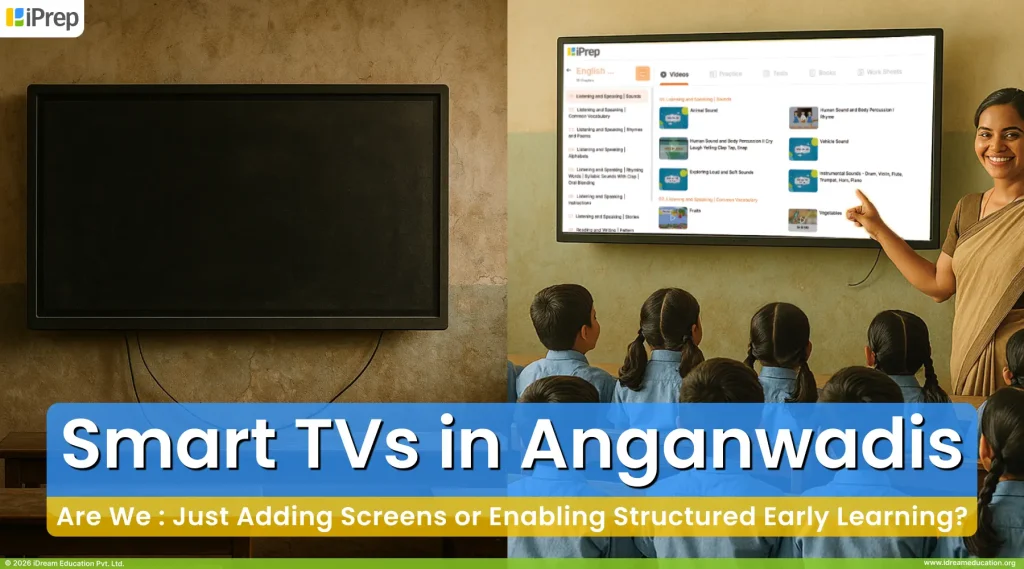
However, as implementation unfolds on the ground, an important question emerges: are Smart TVs in Anganwadis truly enabling structured, meaningful learning or are we simply installing screens?
While the hardware is reaching centres rapidly, the learning outcomes often remain inconsistent and limited. In many cases, Smart TVs function as passive display devices rather than purposeful learning tools. Videos are played, screens are switched on, and digital presence is established but the deeper impact on learning, engagement, and continuity is not always evident. This gap does not stem from lack of intent or effort, but from a critical component that is frequently overlooked in digital education initiatives.
What’s missing is not technology, but structure
- There is a pressing need for well-defined, comprehensive specifications for early learning digital content. The content that is age-appropriate, pedagogically sound, and aligned with the National Education Policy (NEP). This includes structured lesson flows, interactive teaching resources, stories, rhymes, activities, worksheets, and guided play-based modules that Anganwadi workers can easily use.
- Equally important is the teaching and learning application installed on these Smart TVs. An application that works seamlessly offline, supports local languages, guides daily classroom use of smart classes, and captures usage data for reporting and analytics.
Without this foundation, Smart TVs in Anganwadis risk becoming isolated interventions rather than transformative learning enablers. As India invests in digital infrastructure for early education, the conversation must now shift from installation to intentional design. The real measure of success lies not in how many screens are deployed, but in how effectively they support structured, joyful, and developmentally appropriate learning experiences for every child.
Where the Gaps Begin: When Hardware Moves Faster Than Learning Design
While the intent behind installing Smart TVs in Anganwadis is progressive, the ground-level execution of many such projects reveals a common pattern: technology is deployed first, while learning design and governance are left under-defined. As a result, Smart TVs in Anganwadis often enter classrooms without a clear instructional purpose or framework to guide their daily use. Across most Anganwadi Smart TV initiatives currently being implemented, one critical issue stands out—the absence of comprehensive, well-defined specifications for digital learning.
Let us look at some critical gaps:
- There is usually no clear articulation of what constitutes appropriate digital content for early learners. Specifications rarely define alignment with NEP 2020 and NCF 2022, particularly around foundational literacy and numeracy, play-based pedagogy, multilingual exposure, and holistic child development. Without this alignment, content selection becomes arbitrary, inconsistent, or driven purely by availability rather than educational intent.
- Secondly, the coverage of joyful and playful learning resources is often limited or loosely defined. Early childhood education thrives on animated lessons, interactive games, puzzles, stories, rhymes, movement-based activities, and hands-on engagement. Yet, many projects do not explicitly mandate such resources, resulting in static videos or generic visuals that fail to sustain attention or encourage participation.
- Another significant gap lies in the teaching and learning application installed on the Smart TVs in Anganwadi’s. In most cases, there are no specifications for an offline-first application that can systematically organise content, guide Anganwadi workers through daily learning flows, and record usage data. Without offline functionality and periodic data syncing, digital learning becomes unreliable in low-connectivity environments – precisely where Anganwadis operate.
- Equally concerning is the lack of quality benchmarks and certifications for digital content. When no standards are defined for pedagogical accuracy, age appropriateness, language clarity, cultural relevance, or visual quality, it becomes difficult to ensure that children are consuming meaningful and safe learning material.
- Finally, most projects overlook the need for dashboards and monitoring systems. Without centralised visibility into usage data such as frequency of use, duration, content accessed, or centre-wise adoption project officials and departments have no reliable way to track implementation effectiveness or learning engagement.
The outcome of these gaps is predictable.
Smart TVs are installed, powered on occasionally, and gradually become underutilised. With no usage data, no reporting, and no accountability framework, it becomes impossible to assess whether these screens are actually supporting early learning or simply occupying wall space.
When learning outcomes cannot be measured, improvement becomes guesswork. And when systems are not designed for consistent use, even the most well-intentioned digital initiatives risk falling short of their transformative potential.
This is where the conversation must shift – from deploying devices to designing structured digital learning ecosystems for Anganwadis.
What Is Needed? Moving from Installation to Impact
If Smart TVs in Anganwadis are to become meaningful enablers of early learning, the focus of future initiatives must shift from hardware deployment to well-defined, outcome-driven digital learning design. This transformation begins at the RFP and project planning stage itself.
Let us look at what RFPs and project specifications must clearly mandate:
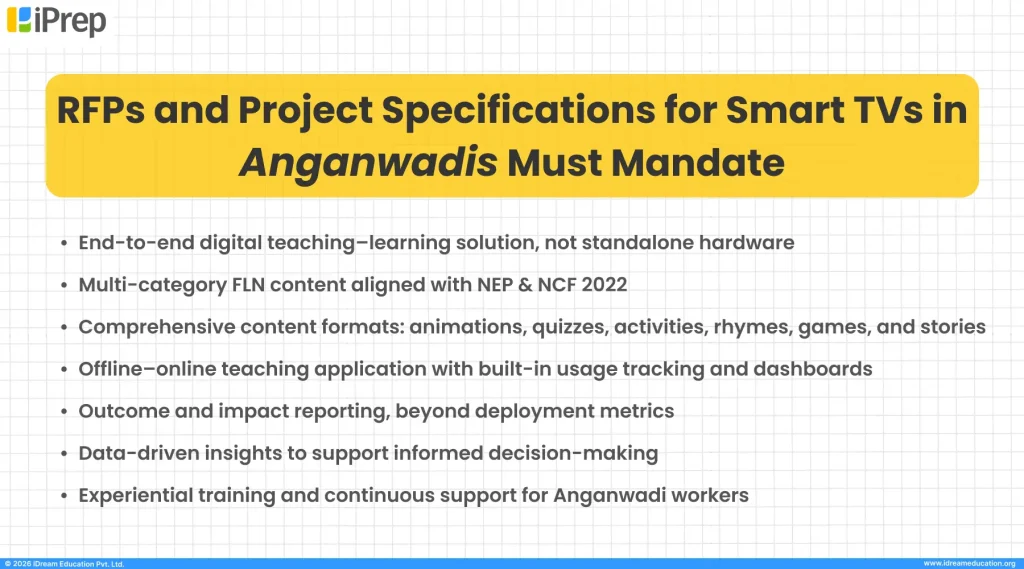
End-to-End Teaching–Learning Solution
First and foremost, projects must clearly mandate a complete teaching–learning digital solution, not just a display device with loosely defined content. This includes detailed specifications that outline what will be taught, how it will be taught, and how learning engagement will be tracked.
NEP- & NCF-Aligned FLN Content
At the core of this solution should be multi-category Foundational Literacy and Numeracy (FLN) content, carefully aligned with NEP 2020 and NCF 2022. Content must support holistic development—language, numeracy, cognitive skills, social-emotional learning, motor skills, and early curiosity – rather than focusing only on rote exposure.
Multi-Format, Play-Based Learning
Equally important is clear and comprehensive coverage across formats. Early learners engage best when concepts are reinforced through multiple modes—animated lessons, interactive quizzes, hands-on activities, rhymes, games, and story-based learning. Specifications must explicitly call out these formats to ensure a balanced, play-based learning experience rather than passive screen time.
Robust Teaching–Learning Application
The teaching–learning application installed on Smart TVs plays a pivotal role in bridging intent and implementation. This application must work seamlessly in both offline and online environments, organise content in a structured manner, guide Anganwadi workers through daily or weekly learning flows
Built-in Monitoring & Reporting Dashboards
Built-in usage tracking on Dashboards at centre. This is to provide block, and district officials a visibility into adoption, frequency of use, and engagement patterns. Beyond implementation metrics, projects must emphasise reporting on impact and outcomes. Understanding how often Smart TVs are used is important but understanding how they influence learning engagement and classroom practices is far more valuable. Data-driven insights enable departments to refine strategies, optimise content, and make informed decisions for scale and sustainability.
Experiential Training & Continuous Handholding
Finally, no digital initiative can succeed without experiential training and continuous support for Anganwadi workers. Technology should simplify their work, not add complexity. Hands-on training, contextual guidance, and ongoing handholding are essential to ensure confident and consistent classroom use.
We strongly believe that by incorporating these focused yet practical steps, initiatives such as Smart TV in Anganwadis can move beyond symbolic digitalisation. Together, they can transform the delivery, usage, and achievement of early learning outcomes. This will ensure that every screen installed truly contributes to structured, joyful, and impactful learning experiences for young children.
Watch this short video to understand what our FLN content includes and how it supports structured early learning
If you are exploring a complete Smart TV setup for Anganwadis, or are specifically looking for NEP- and NCF-aligned FLN content supported by an LMS with built-in reporting and monitoring, we would be happy to connect. You can contact us at +91 7678265039. Our team can walk you through our content framework, explain what a comprehensive Smart TV–enabled Anganwadi solution entails, and help you understand how it can align with and strengthen your program goals. You can also write to us at share@idreameducation.org or share your details here
Categories You may Explore
Related Articles