Why Digital Classrooms Need More Than Hardware: The Missing Link in Digital Learning
Picture a classroom somewhere in a small town in Uttar Pradesh or Madhya Pradesh. A shiny new digital device has arrived — a mark of progress, a line item in someone’s report about school modernization. The teacher unpacks it with real hope. And then comes the quieter, more familiar problem: the internet drops, or was never reliable to begin with. There’s no steady library of lessons built for this device, for this curriculum, for this classroom. The screen goes dark more often than it lights up. The hardware becomes a cabinet fixture instead of a teaching tool.
This is the gap that quietly undermines so many well-intentioned digital education efforts across India — not a lack of ambition or investment, but a missing middle layer: content that’s actually built for the realities of the classroom it lands in.
It’s the exact gap that one of leading technology company, set out to close when they partnered with us to enable digital classrooms across schools in Uttar Pradesh and Madhya Pradesh.
The two regions share a familiar set of constraints. Many schools here contend with limited access to reliable digital infrastructure, inconsistent internet connectivity, and a persistent shortage of quality teaching-learning resources. For teachers trying to deliver engaging, technology-enabled instruction, these aren’t abstract policy challenges — they’re daily obstacles that determine whether a lesson plan actually survives contact with a Tuesday morning.
The company knew from the start that hardware alone wasn’t enough. A device is only useful if it has quality learning content and is easy for teachers to use in their everyday classrooms.
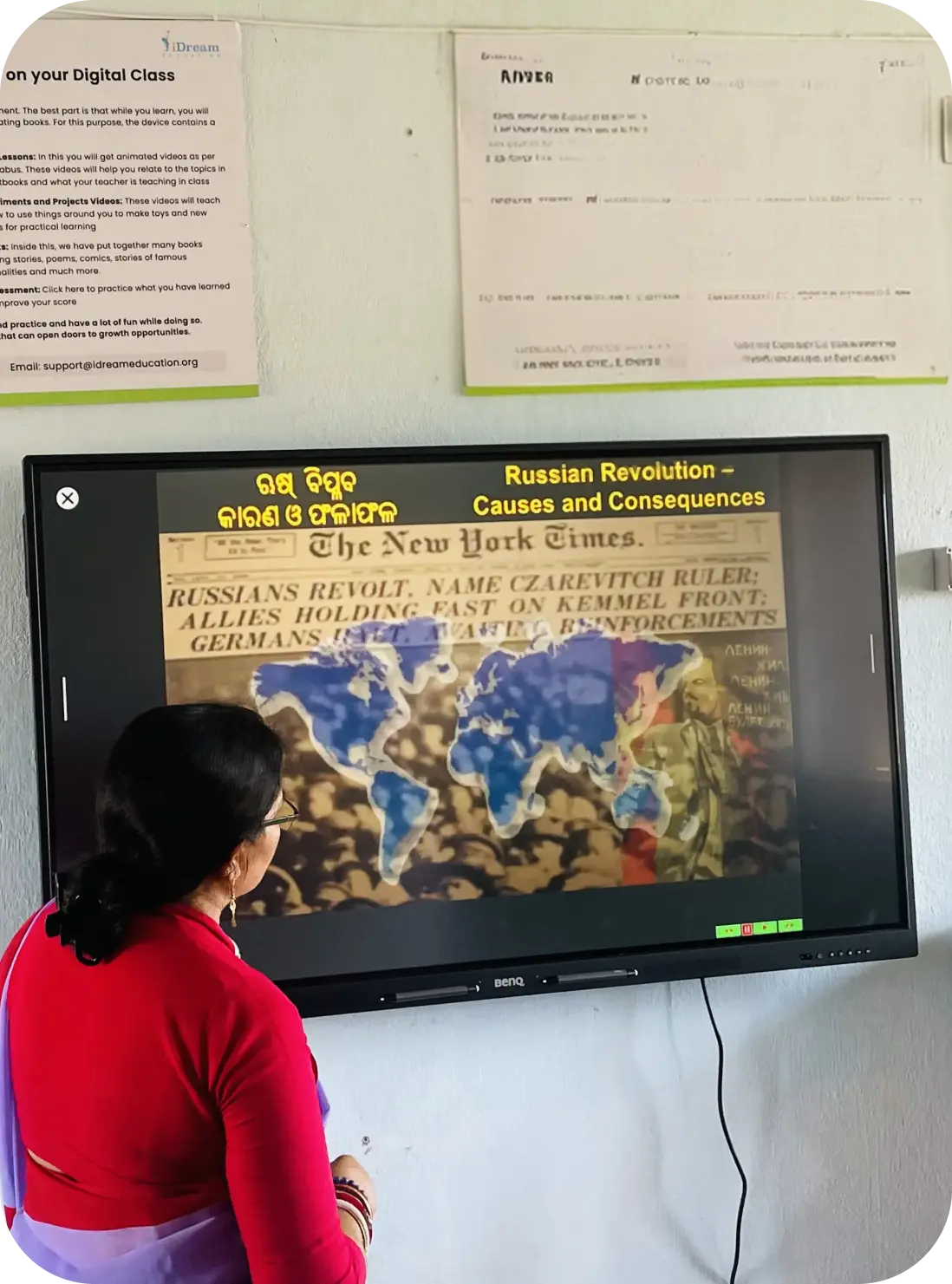
So instead of stopping at deployment, they worked with us to integrate our smart class content directly with the hardware being rolled out. The approach centers on curriculum-aligned digital content engineered to work completely offline — a deliberate design choice for regions where connectivity can’t be assumed. Interactive videos, animations, assessments, and other multimedia learning resources were bundled together, giving teachers a ready-made library they could draw from without needing a live internet connection to make it work.
For a teacher, this changes the daily hassle in a real way. Instead of hoping the connection holds, or skipping the digital lesson altogether when it doesn’t, technology becomes something dependable enough to plan around. A video that illustrates a science concept, an animation that makes an abstract idea concrete, an assessment that gives immediate feedback — all of it becomes part of the normal rhythm of teaching, not a special occasion that depends on network luck.
For students, that shift matters just as much. Learning becomes more interactive and visual, less dependent on chalk-and-talk alone, and more consistent — because the content is there every day, not just on the days the signal cooperates.
And for the system as a whole — the schools, the state education landscape, the broader effort to bring digital learning to underserved regions — the hardware + LMS + digital content with reporting model offers something valuable: proof that hardware and content don’t have to be procured, planned, or delivered as separate problems. When they’re integrated from the start, a device stops being standalone classroom equipment and becomes a complete teaching and learning solution.
Across schools in Uttar Pradesh and Madhya Pradesh, this integration has helped make technology-enabled teaching more consistent and classrooms more engaging — for teachers who now have a reliable digital toolkit, and for students experiencing multimedia learning that reflects their actual curriculum, delivered in a form built to work with the infrastructure they actually have, not the infrastructure planners might wish they had.
It’s a small but telling reframe: digital transformation in schools rarely fails for lack of devices. It succeeds or falters based on whether someone thought carefully about what runs on them — and whether that someone designed for the classroom as it is, not as it appears on a spec sheet.