

Key Takeaways
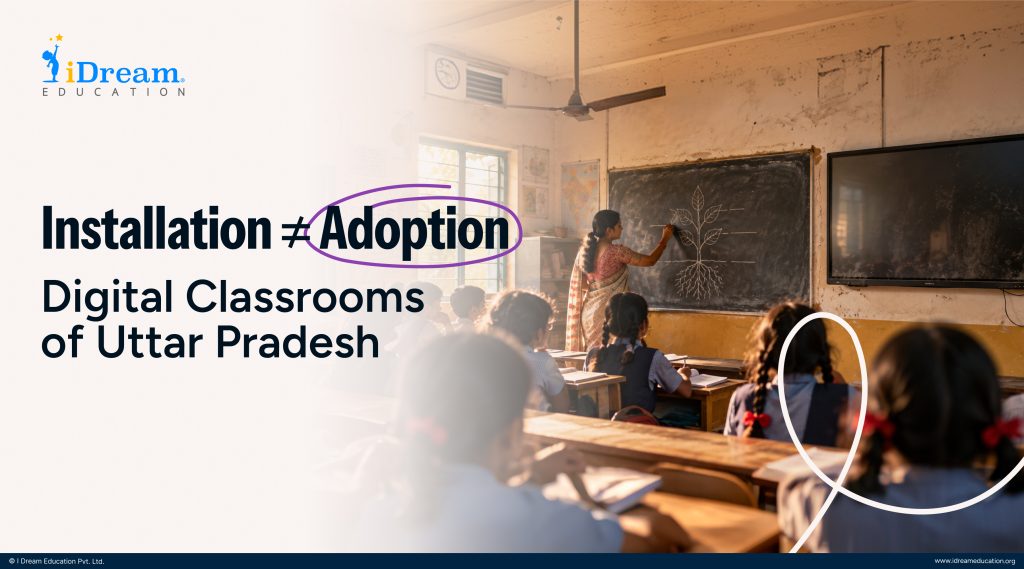
- School digitisation succeeds through implementation, not installation. Digital infrastructure creates value only when teachers use it consistently in everyday classrooms.
- Scaling digital education requires a structured implementation model. Large government programmes need standardised deployment, teacher training, programme management, and continuous support.
- Successful school digitisation is built on six core implementation capabilities: reliable infrastructure, curriculum-aligned digital content, an offline-first learning platform, standardised teacher enablement, continuous teacher support, and real-time monitoring and governance.
- Delivering at scale and at pace go hand in hand. The same implementation model that reached 5,514 government schools across Uttar Pradesh has also been deployed across hundreds of PM Shri Schools within weeks.
Over the next two years, thousands of government schools are likely to receive new digital infrastructure through Central Public Sector Enterprise (CPSE)-funded Corporate Social Responsibility (CSR) programmes.
The Ministry of Finance, in its Office Memorandum for FY 2026–27 and FY 2027–28, has identified Smart Classrooms, Digital Anganwadis, and Digital Learning Infrastructure as common CSR themes for CPSEs. This creates an opportunity for organisations to strengthen digital learning at scale while aligning with national priorities.
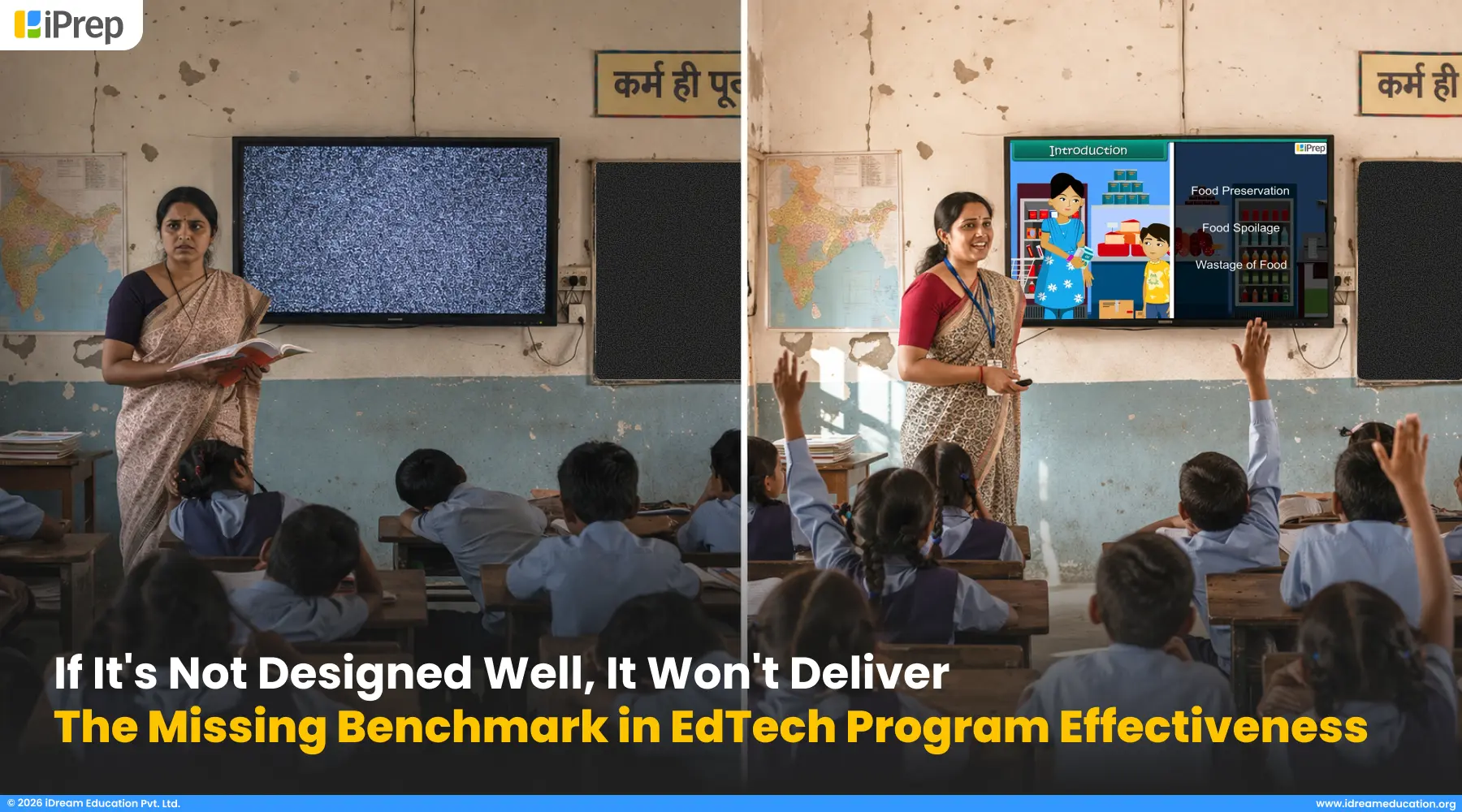
The bigger question, however, is not how quickly these classrooms can be installed, but how many of them will still be actively used a year later.
When investments happen at scale, impact is often the first thing that gets compromised. It is genuinely difficult to find a partner who can deliver across thousands of schools and still generate real classroom outcomes in each one – not just impact in one school, but impact sustained across all of them. What follows is a look at an implementation that has done both, and what we believe is worth looking for before committing CSR funds to a partner.
At first glance, school digitisation appears straightforward. Equip classrooms with digital infrastructure, provide curriculum-aligned content, and complete the rollout.
In practice, however, the real challenge begins after installation. The success of a programme depends on whether teachers are able to integrate those resources into everyday classroom practice, consistently and at scale. That requires far more than hardware. It requires thoughtful implementation, sustained teacher support, and systems that continue to work long after the rollout is complete.
What we’ve learnt about creating impact at scale
One question has guided our work over the years: What does it take for digital infrastructure to become an integral part of everyday teaching across every school in an education programme?
Over time, we realised that the answer lies in building an implementation and usage model that works consistently across diverse geographies, varying school contexts, and thousands of teachers. In our experience, successful education programmes are designed around the realities of government schools. They combine reliable infrastructure with curriculum-aligned digital content, offline accessibility, structured teacher training, responsive programme management, and continuous support long after deployment.
These capabilities become even more critical as programmes scale. What works in a handful of schools cannot simply be replicated across districts or states. Large-scale education programmes require strong implementation systems, structured teacher training, and execution models designed for consistency from the outset. This ensures reliable delivery across diverse contexts while enabling sustained classroom adoption.
What does this look like in practice?
Over the years, we have built and refined this implementation model through partnerships with state governments across India.
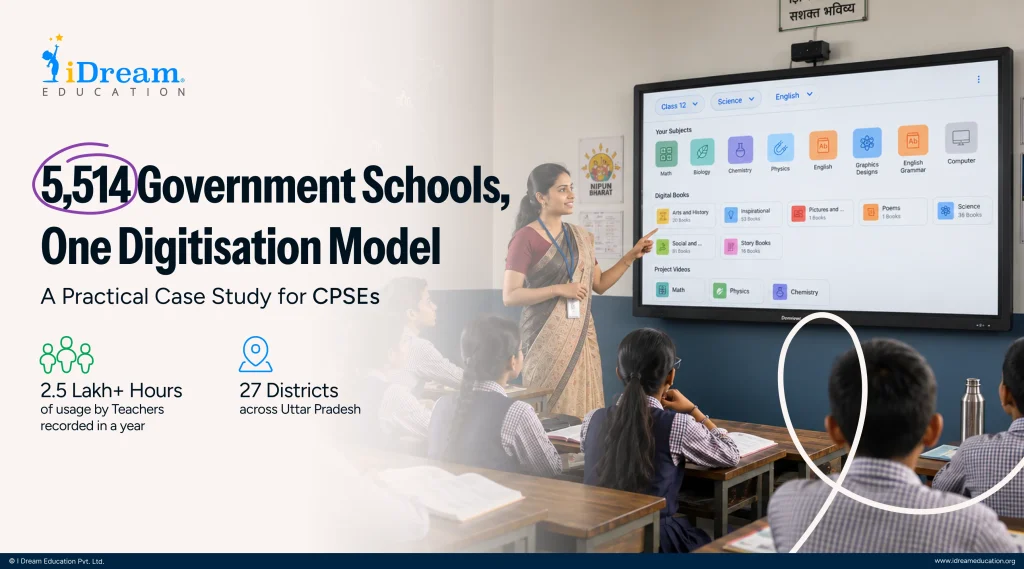
One recent example is our work with the Department of Basic Education, Government of Uttar Pradesh, where 5,514 government schools across 27 districts were equipped with Smart Classrooms featuring Interactive Flat Panels (IFPs), offline access to the iPrep Learning Management System, and curriculum-aligned digital learning content in Hindi and English for Classes 1 to 8, mapped to the Uttar Pradesh State Board.
The implementation was supported by large-scale teacher training, structured programme management, continuous teacher engagement, responsive on-ground support, and real-time usage monitoring, ensuring that teachers are empowered to use it effectively.
Implemented within a programme valued at over ₹130 crore, teachers recorded more than 2.5 lakh hours of usage within one year of implementation. For us, this showed that teachers had begun integrating digital learning into their everyday classroom practice.
The Uttar Pradesh implementation was the result of years spent building an implementation model that could consistently deliver across diverse geographies, thousands of schools, and teachers with varying levels of digital readiness.
Moreover, this pace of delivery isn’t limited to Uttar Pradesh. Our team has completed the implementation of PAL Labs and ICT Classrooms across 124 PM SHRI Schools in Himachal Pradesh. Separately, we enabled Personalised Adaptive Learning (PAL) and Digital Learning (DL) infrastructure across 559 PM SHRI Schools in 75 districts in just two weeks, demonstrating our ability to execute at speed and scale. These are among the fastest large-scale rollouts we have completed and have also generated meaningful local visibility for the programme.
As CPSEs begin implementing the Ministry of Finance’s priorities on Smart Classrooms, Digital Anganwadi, and Digital Learning Infrastructure, the need for such implementation capability becomes even more relevant.
This makes partner selection critical. CPSEs will need implementation partners who can not only deploy digital infrastructure across thousands of schools within a short timeframe, but also ensure that it is adopted and used consistently by teachers.
From our experience, creating impact at scale requires six core implementation capabilities:
- Reliable, deployment-ready infrastructure: Hardware that is easy to procure, transport, install, and maintain at scale, such as Interactive Flat Panels (IFPs).
- Curriculum-aligned digital content: Ready-to-use learning resources in vernacular language, aligned to the respective State Board curriculum.
- An offline-first learning platform: A platform that enables teachers to access and use digital content without dependence on internet connectivity.
- Standardised teacher enablement: Ready-to-deploy training resources, implementation playbooks, and structured training collaterals that ensure consistency across districts.
- Teacher engagement and support systems: Dedicated programme management, continuous teacher support, regular engagement and recognition mechanisms that encourage sustained classroom usage.
- Continuous monitoring and governance: Real-time dashboards that track implementation progress, platform usage, and programme performance, enabling timely interventions and transparent reporting.
These capabilities have not been built for a single programme. They have evolved over years of implementing digital learning initiatives across government schools and continue to shape how we approach every large-scale partnership.
Driving usage means acting as partners, not vendors
Building the infrastructure is only the starting point. What determines whether a programme succeeds is whether teachers keep using it, month after month, long after the initial rollout is complete.
This is where we have focused much of our effort over the years. Our programme management team works directly with teachers on the ground – offering pedagogical support, sharing data-backed insights drawn from their own classrooms, and helping them plan remedial sessions for students who need extra support. A dedicated support team stays available to teachers throughout the programme, so questions and issues are resolved quickly rather than left to slow adoption down.
We think of this as the difference between being a vendor and being a partner: a natural extension of the teacher’s own classroom, rather than an external service checking in occasionally. iPrep, our learning platform, has also been built around an understanding of how teachers actually work and adapt to new tools in the classroom – which is part of why it becomes part of daily teaching practice rather than an add-on competing for their time.
As CPSEs scale their CSR investments, governance becomes equally important
As CPSEs align their CSR investments with the Ministry of Finance’s focus on Smart Classrooms, Digital Anganwadis, and Digital Learning Infrastructure, the expectation from implementation partners should go beyond deploying infrastructure within defined timelines. Equally important is the ability to provide the governance, documentation, and reporting required to monitor programme progress, demonstrate accountability, and support CSR compliance.
This is why governance has been built into our implementation model from the outset. Real-time dashboards, structured documentation, utilisation certificates, government sign-off workflows, and usage and outcome tracking give CSR teams continuous visibility into programme implementation while creating a reliable audit trail. Beyond compliance, these insights enable organisations to communicate the progress and value of their CSR investments through credible, evidence-backed stories for government stakeholders, employees, and the wider public.
Our capability to innovate in Mahoba, Uttar Pradesh is one example of how strong implementation can translate into both on-ground impact and meaningful public visibility. With 20 play tables deployed across five Anganwadi centres, the initiative introduced play-based learning while also generating PR coverage around the intervention. Such visibility can help CSR programmes demonstrate broader impact and value created through the investment.
If you’re exploring large-scale solutions for smart classrooms or Digital Anganwadis, we’d be happy to share our implementation learnings, frameworks, and experience from working with state governments across India. Connect with our team to discuss how your CSR investment can create sustainable impact at scale.
Categories You may Explore
Related Articles