Government schools are getting a lot of hardware with AI built in these days. The sales pitch sounds familiar: teachers won’t need much help anymore, since the tool will write lesson plans, mark assessments, and finish in minutes what used to take a teacher days.
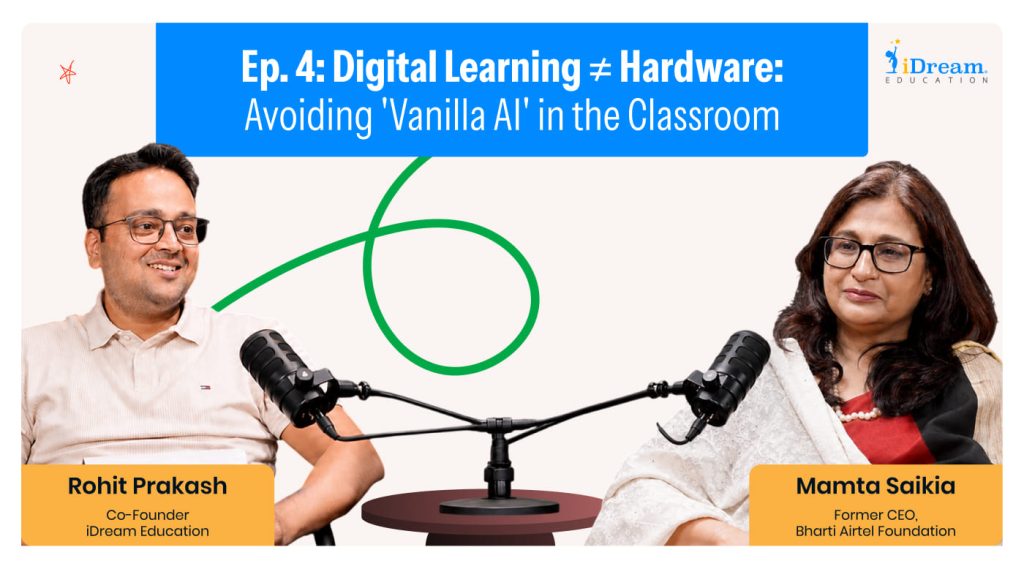
Mamta Saikia has watched that gap between pitch and classroom for close to two decades. She ran one of India’s largest corporate-funded school programmes as CEO of Bharti Airtel Foundation, and today works independently across NGOs and education initiatives.
In episode 4 of Digital Learning ≠ Hardware, Rohit Prakash, co-founder of iDream Education, asks her directly: is AI about to solve everything in the government school classroom, or is this headed somewhere more complicated?
Mrs Saikia’s answer starts somewhere unexpected: her own LinkedIn posts.
Prefer to read? The key insights follow.
Why Everyone’s AI-Written Posts Started Sounding the Same
About six months ago, she started using AI to draft her LinkedIn posts. She wrote two or three of them before she noticed something. Everyone else’s posts, written the same way, had started to read like hers.
“I felt it [the AI result] was almost like vanilla ice cream. Everybody’s posts were becoming identical.”
— Mamta Saikia, former CEO, Bharti Airtel Foundation
She stopped and decided that if she was going to write on a platform built for connecting with people, she wanted it to sound like her. She didn’t want her posts to be a smoothed-out average of everyone else’s.
One school principal, who she calls her “first coach in AI,” had been using it in his school for a year and a half. He told her something similar had happened to his School Development Plan (SDP). The plan used to take him months to write, full of debate and disagreement with his staff over every line. Now he finishes it in a day, but the passion is gone along with the months of arguing over each line.
Getting a document faster and getting a better one turned out to be two different things.
There’s nothing wrong with either output on its own. The post reads fine, and the SDP is a complete, usable document. What’s missing in both is the thing that only shows up when a person does the slow, difficult version of the work themselves.
Why General AI Isn’t Built for the Classroom
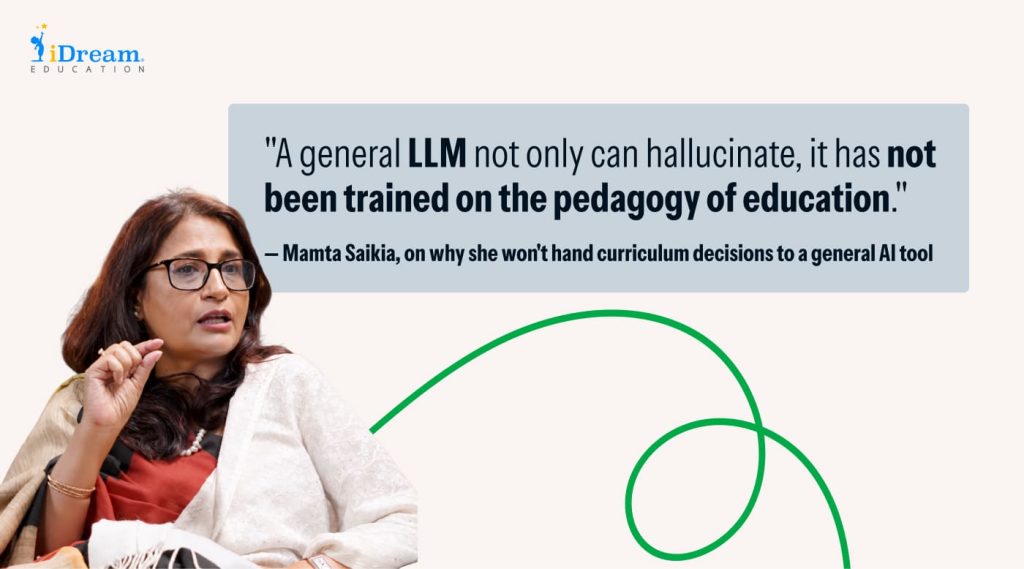
Mamta Saikia uses AI daily and rates herself better at prompting it than most people she knows. But she draws a hard line around what it can be trusted with in a school.
“A general LLM not only can hallucinate, it has not been trained on the pedagogy of education.”
— Mamta Saikia, on why she won’t hand curriculum decisions to a general AI tool
She recently attended the CSF-organised AI Impact Summit. Research presented there showed that learning outcomes had gotten worse over a year where a general AI tool was used. Her wider point: guardrails, and training by educationists, are what make the difference
A general-purpose model is trained on the internet at large. It has no reason to know how a seven-year-old learns to read, or where a curriculum tends to lose weaker students.That has to be built in deliberately, by educationists and researchers who’ve studied how children actually learn, not assumed to already be there.
AI Is an Intern, Not a Teacher
This is where Mrs Saikia gets specific about what she considers a low-hanging fruit rather than real progress: press-of-a-button AI lesson plans and AI-marked assessments.
“AI is but an intern. It’s like a junior you’ve hired. How can a junior decide your lesson plan?”
— Mamta Saikia, former CEO, Bharti Airtel Foundation
An AI-generated lesson plan, in her view, starts at level zero. It doesn’t know which concept the class struggled with yesterday, or which child needs a different explanation of the same idea.
Organisations with a genuinely strong content base, she points to Khan Academy as an example, produce better starting material than most. But the plan a teacher actually uses in front of her class still has to be hers.
Efficiency is what current AI tools are giving schools. Quality is a separate question, and it’s still the teacher’s to answer.
Where AI Actually Earns Its Place in the Classroom
There’s one application Mrs Saikia is excited about, and it’s not the one getting most of the attention.
She wants AI reading a child’s performance data from Grade 1 onward, then using it to build an individual learning pathway. It could flag, for instance, when a particular child would benefit from a hands-on project instead of another worksheet.
That’s not something a teacher can do at scale. Mamta Saikia points out that even a teacher who knows all twelve children in her class well would struggle to build twelve different learning pathways for them.
For a full classroom of children, it isn’t practical at all.
That’s what Saikia would call a breakthrough: an AI system built on solid, well-researched content, working quietly in the background to surface what a teacher couldn’t otherwise see.
The One Test That Applies to Every Shortcut
The thread running through all of it, efficient LinkedIn posts, a fast SDP, a one-click lesson plan, comes back to the same warning.
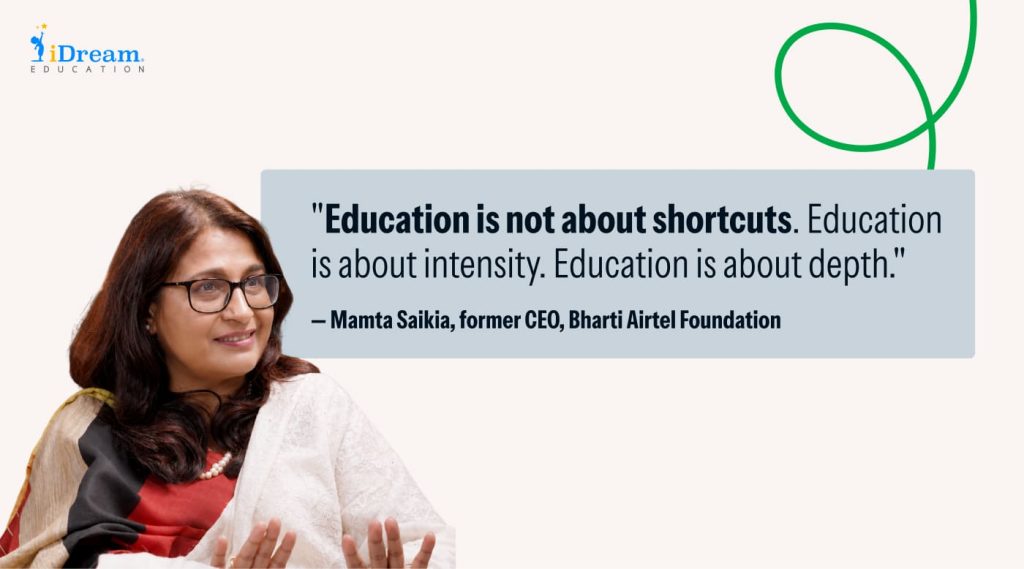
“Education is not about shortcuts. Education is about intensity. Education is about depth.”
— Mamta Saikia, former CEO, Bharti Airtel Foundation
Saikia has a direct test for CSR teams and NGOs evaluating edtech partners on this exact question.
- First, ask whether the content behind a tool has been benchmarked against real research; she points to CSF’s TULNA certification as one example.
- Second, ask how many teachers actually use the tool day to day, rather than leaving it untouched.
She cites a CSF survey that found only 6% of users were on specialised edtech tools, against 90% on YouTube and 60% on WhatsApp.
A tool that isn’t built on real pedagogy, or isn’t simple enough for a teacher to want to open twice, fails the same test whether or not it has AI inside it.
Watch the full conversation between Rohit Prakash and Mamta Saikia above.
Categories You may Explore
Related Articles