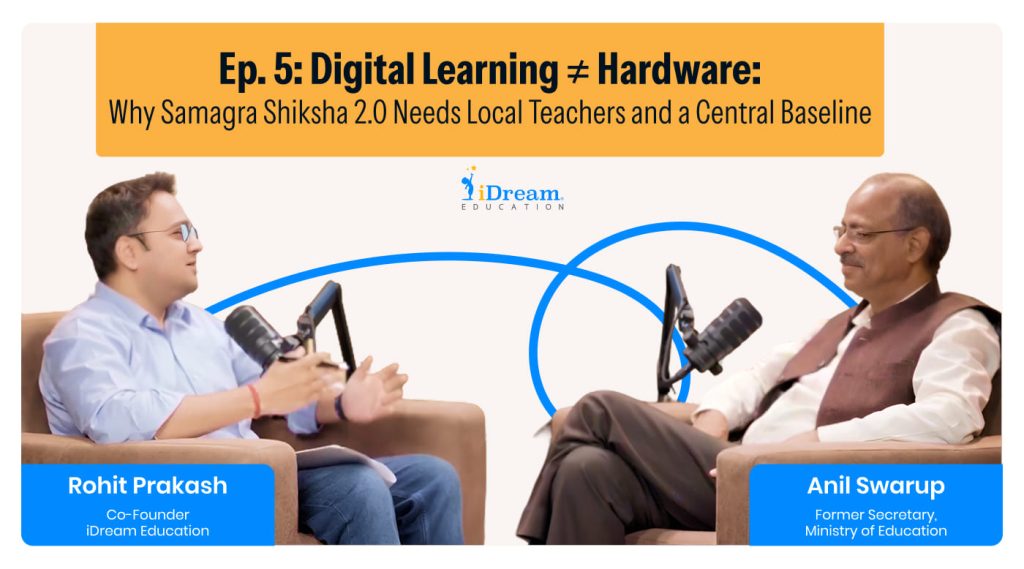
Most conversations about Samagra Shiksha 2.0 start with the same question: what hardware goes into the classroom. Rohit Prakash and Shri Anil Swarup start somewhere else.
In episode 5 of the Digital Learning ≠ Hardware podcast series, Rohit Prakash, co-founder of iDream Education, continues his conversation with Shri Anil Swarup, former Secretary of School Education, Government of India.
Episode 3 set out what Samagra Shiksha 1.0 got wrong, from procurement sequencing to the missing habit of evaluation. This conversation picks up from there, getting specific about which of those fixes belong at the district level, which have to stay centralised, and where artificial intelligence actually helps.
The two lists don’t overlap the way you’d expect.
Prefer to read? The key insights follow.
Local Teachers, Centrally Set Formats
DIKSHA already holds an enormous amount of teacher-made content. The problem there was finding the right piece for the right classroom, which is why Ep. 3 argued for a district-level team to curate a shortlist. Shri Swarup’s focus here shifts from what to surface to who gets to create it in the first place.
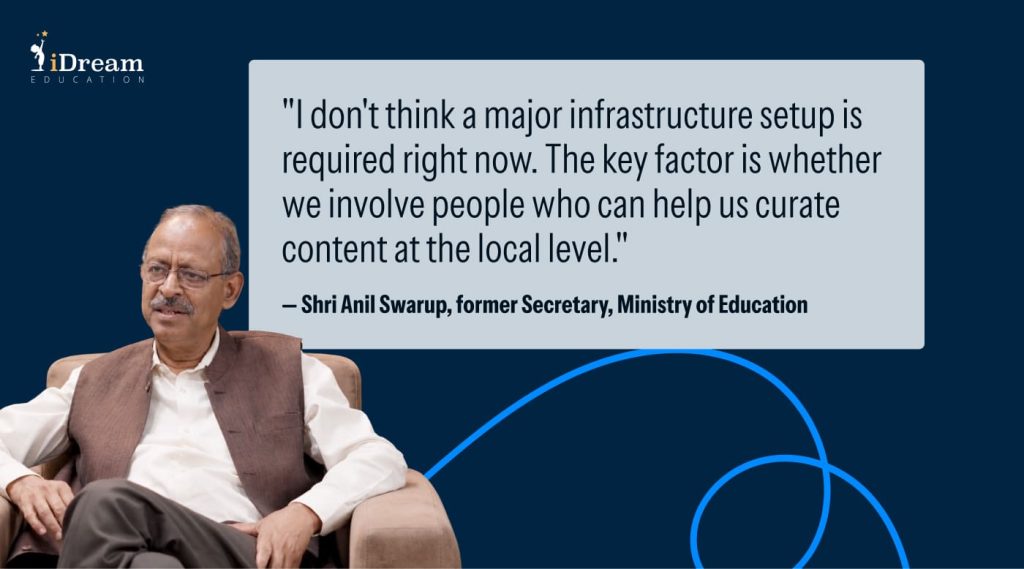
Swarup dismisses the idea that this needs new infrastructure at all:
“I don’t think a major infrastructure setup is required right now. The key factor is whether we involve people who can help us curate content at the local level.”
— Shri Anil Swarup, former Secretary, Ministry of Education
He points to what the DIKSHA platform has already shown: teachers filming lessons on their own phones, some good enough to circulate. The gap isn’t capability. It’s identifying who should be doing it and giving them a shared format to work within.
Anil Swarup offers three markers for that selection:
- How creative the teacher is.
- Whether what they create actually lands with a child, since a story a teacher finds compelling can still leave a student cold.
- And technical appreciation, not technical skill.
“I had no knowledge about technology. I could barely operate my laptop, but I knew how to communicate with the technical person to tell him what I wanted, so that he could use his language and convert it into the thing.”
— Shri Anil Swarup, on what technical competence for content actually requires
The format and protocol get decided centrally, so there’s some consistency across a district. The material itself doesn’t.
Connectivity Gap Doesn’t Need New Infrastructure. It Needs a Hybrid One.
In practice, closing the connectivity gap means building around whatever connectivity already exists, not waiting to deploy an entirely separate offline system.
He points to an example from outside education: a health insurance scheme he ran, where benefits had to work across a country that wasn’t fully connected.
“It has to be hybrid to begin with, wherever you don’t have an online system. But this is a temporary problem. I see connectivity improving by the day.”
— Shri Anil Swarup
Rohit grounds this with iDream’s own experience in a remote district in Meghalaya, where even mobile signal was inconsistent. Preloaded offline content was what actually reached students there, with additional material syncing whenever a connection was available- not a stopgap, but the model these schools actually ran on.
Design Has to Fit the Person Using it
Rohit lays out four principles he believes any software design for government classrooms needs:
- Bilingual functionality so teaching can move between local language and English.
- Offline delivery.
- The ability to capture usage data.
- And ease of use, since procurement specifications often favour hardware that’s technically capable but rarely touched once installed.
Anil Swarup extends that to the physical and human conditions the hardware actually has to survive. He tells a story from the late 1980s, when the first desktops needed air-conditioned rooms to function in India’s heat and dust. And fitting an air conditioner into every room made the whole rollout far more expensive than anyone had planned for.
The same logic applies to language. A device that doesn’t work in the language its user understands fails regardless of how sophisticated it is. Contextual fit, in. Shri Anil’s framing, isn’t a nice-to-have layered on top of good design. It’s the condition that makes design good in the first place.
The Best Trainer is Already in School
Both Shri Anil Swarup and Rohit agree that one-time training events don’t work, and that periodic, repeated training is a necessity rather than an upgrade. The more interesting point is where Mr. Swarup thinks the trainers should come from.
Instead of bringing in outside experts, he recommends looking within the school itself. Identify the teachers who picked up the technology fastest, and have them train their colleagues.
“He’s [a teacher from the school itself] lived in those conditions. He understands the environment. He’ll be able to convey something the others can relate to.”
— Shri Anil Swarup, on why teachers make better trainers than outsiders
It’s cheaper than hiring external trainers. And it’s more credible too: a colleague who has lived through the same constraints carries an authority an outsider doesn’t.
Learning Outcomes Can’t be Evaluated Locally
This is where the two threads of the conversation split. Content works best when it’s local, but evaluation, Mr. Swarup insists, cannot be.
Evaluating whether students are actually learning, he says, has to be designed at the top, because nobody evaluates themselves fairly.
His sharper point is about baselines: assessing impact a year into a programme, with no baseline taken at the start, isn’t evaluation. It’s a comparison against nothing.
“If there’s no foundation, no baseline [for learning outcomes], how will you even know if any improvement happened?”
— Shri Anil Swarup
Why this doesn’t happen more often, in his view, comes down to a simple admission: an attitude of procurement leaves no room to care about outcomes.
AI Belongs in a Teacher’s Prep Time, Not the Classroom
The conversation closes on a question that’s easy to get wrong: what role artificial intelligence should actually play in a government classroom.
Mr. Swarup’s answer is narrower than the current narrative around AI in education. He sees real value in it, but strictly as preparatory work.
AI can help build content and evaluation frameworks in advance, not something a teacher improvises live in front of students.
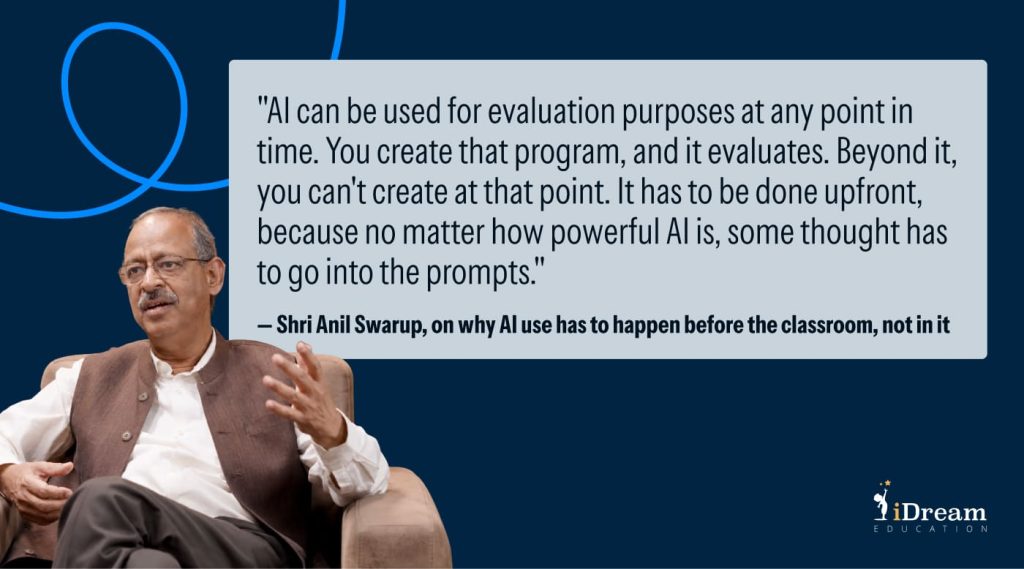
“AI can be used for evaluation purposes at any point in time. You create that program, and it evaluates. Beyond it, you can’t create at that point. It has to be done upfront, because no matter how powerful AI is, some thought has to go into the prompts.”
— Shri Anil Swarup, on why AI use has to happen before the classroom, not in it
Rohit ties this back to the offline-content point from earlier. If a teacher wants a two-minute video on photosynthesis, it has to already be sitting there, ready to use. A 40-minute class is not the time to generate it on the spot. And there’s a firmer line still on who gets to use AI at all.
“For teachers is an amazing tool. For students is dangerous.”
— Shri Anil Swarup
That’s the boundary Mr Swarup draws: prepared by a teacher in advance, never generated live by a student.
What Ties These Decisions Together
Across content, connectivity, design, training, evaluation and AI, one idea keeps resurfacing. Some decisions belong at the ground level, and some don’t.
Mistaking one for the other is usually where these programmes lose their way. Mr Swarup’s own summary of it is blunt.
“If my attitude is procurement, then I will not even care about evaluating the outcomes.”
— Shri Anil Swarup
All points discussed above from local content, offline delivery built for places like Meghalaya to baselines set centrally and AI kept in the teacher’s hands, none of this is a hardware decision. It’s an attitude Samagra Shiksha 2.0 still has to get right.
Watch the full conversation above.
Categories You may Explore
Related Articles