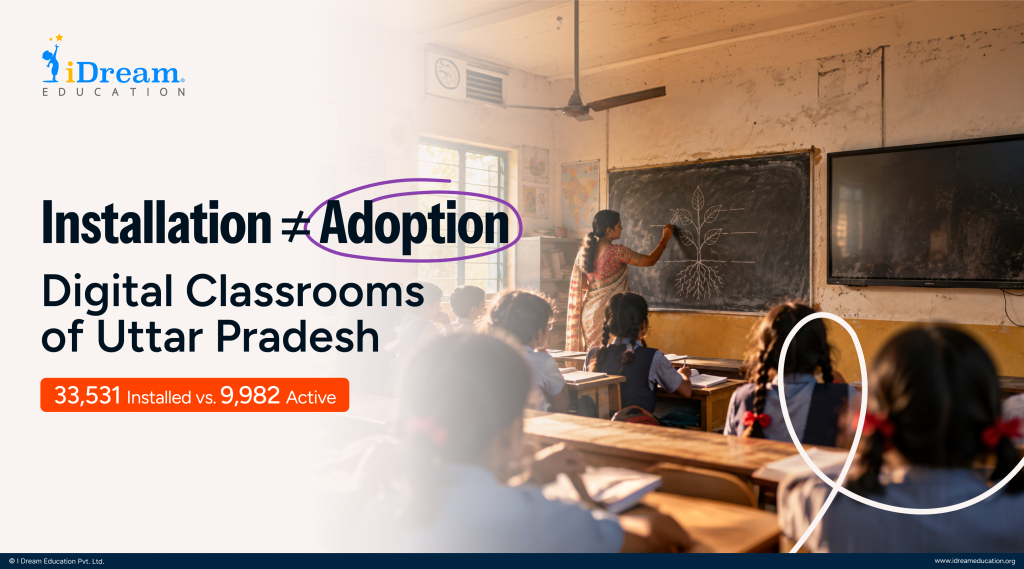
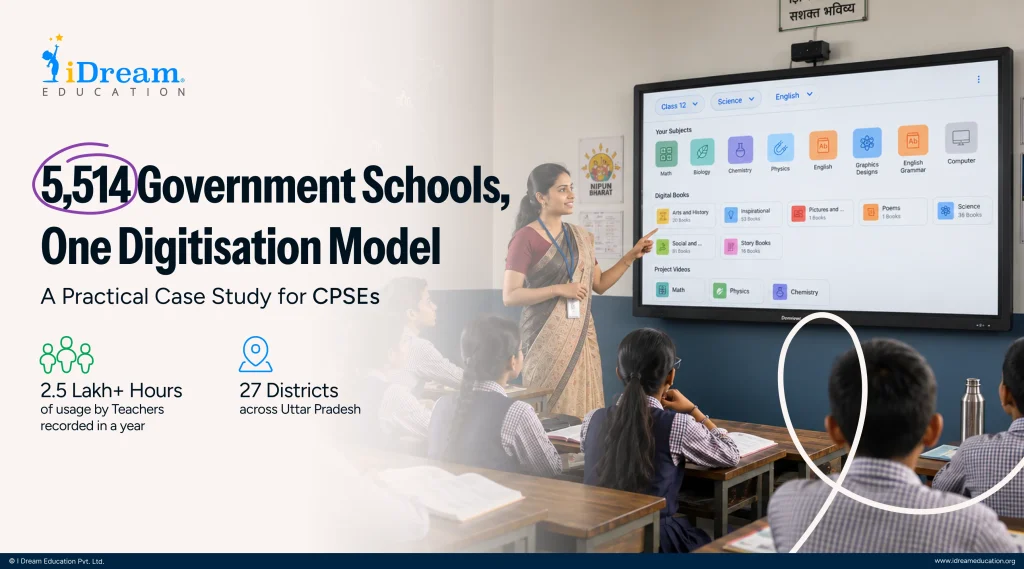
Across Southeast Asia, the momentum behind digital education has accelerated sharply since 2020. The Philippines’ DepEd has been piloting smart classroom configurations across public schools. Indonesia’s ed-tech roadmap earmarks significant investment for rural districts. In Cambodia, international education donors are actively funding digital learning infrastructure for government schools. The question is no longer whether to adopt. It is how to do it in a way that genuinely improves learning at scale — in schools that look nothing like the pilot schools in capital cities.
India offers the most directly relevant reference point for this question that exists anywhere. Not because India has solved the problem, it has not, but because India has been running smart classroom programmes in government schools at scale for over fifteen years, in conditions that map closely to what programme managers face in rural Mindanao, or in the outer islands of Indonesia, or in Kampong Cham province.
The similarities are structural. A government school in rural Samar in the Philippines and a government school in rural Jharkhand in India share more in common than either shares with a private school in Manila or Bangalore. Both face: multi-grade classrooms where one teacher handles more than one class level simultaneously; significant absenteeism driven by agricultural calendars, weather, and economic pressure on families; teachers who are formally qualified but practically isolated, without meaningful access to peer support or curriculum resources; textbook shortages that leave students without the basic materials the curriculum assumes; and a testing system that measures recall rather than comprehension, masking learning gaps until they compound into dropout.
What India has done, through fifteen-plus years of government smart classroom programmes across states like Rajasthan, Karnataka, Andhra Pradesh, Bihar, Jharkhand, and Uttarakhand, is to accumulate a body of implementation knowledge, what works, what fails, why, and under what conditions. That knowledge is not well documented in academic papers. It lives in the experience of organisations that built and ran these programmes, iterated through failures, and arrived at models that actually function in the field. iDream Education is one of those organisations.
iDream works with Aide et Action in India and sets up digital learning with them for the under served students. SE Asia Programme manager at Aide et Action has also echoed the need of expanding PAL in SE Asia. Taking a leaf from what we’ve seen in India with PAL, with iDream itself having some encouraging stories (Half a million students using PAL in a state wide implementation, thousands using PAL with Bharti Foundation, a CSR initiative and a programme implemented in Afghanistan for 40000 students to use PAL on tablets to bridge learning gaps), and the nobel laureate Michael Kremer conducting a study on PAL that found significant impact on improving student learning outcomes, PAL must be expanded to improve the future human
Three Mistakes India’s Early Smart Classroom Programmes Made – So You Don’t Have To
The first mistake was hardware without structured content. Early Indian government school programmes installed projectors and screens and gave teachers a pen drive with PowerPoint presentations. Teachers did not use it because it added to their workload rather than reducing it. They were expected to find content, prepare presentations, and manage a technology they were not comfortable with, all on top of their existing teaching load. The inevitable result was that the hardware gathered dust. The lesson was hard-won: the technology must come with curriculum-aligned content that is immediately usable, indexed to the syllabus, requiring no teacher preparation. Content is not a feature that can be added later. It is the point.
The second mistake was building for connectivity. Programmes that required internet access for content delivery immediately excluded the schools most in need. The top tier of government schools in India’s cities often had reasonable connectivity; the schools in Jharkhand’s forested districts or Rajasthan’s desert villages did not. A programme that works for sixty percent of schools and excludes the forty percent that need it most is not a government programme, it is an urban supplement. In most South and Southeast Asian government school contexts, offline-first is not a compromise. It is the only realistic architecture that reaches the full system.
The third mistake was treating all schools identically. A Class 5 government school in a remote mountain district of Meghalaya is not the same as a Class 10 school in suburban Manila. The former may have a single teacher handling three grade levels, no electricity after 4pm, and students who have never seen an animated science lesson. The latter has multiple subject teachers, reliable power, and students who have smartphones at home. A single deployment model applied uniformly to both will serve neither well. The solution must be modular enough to adapt to single-teacher schools, multi-grade classrooms, and varying device availability.
What iPrep Digital Class Looks Like on the Ground
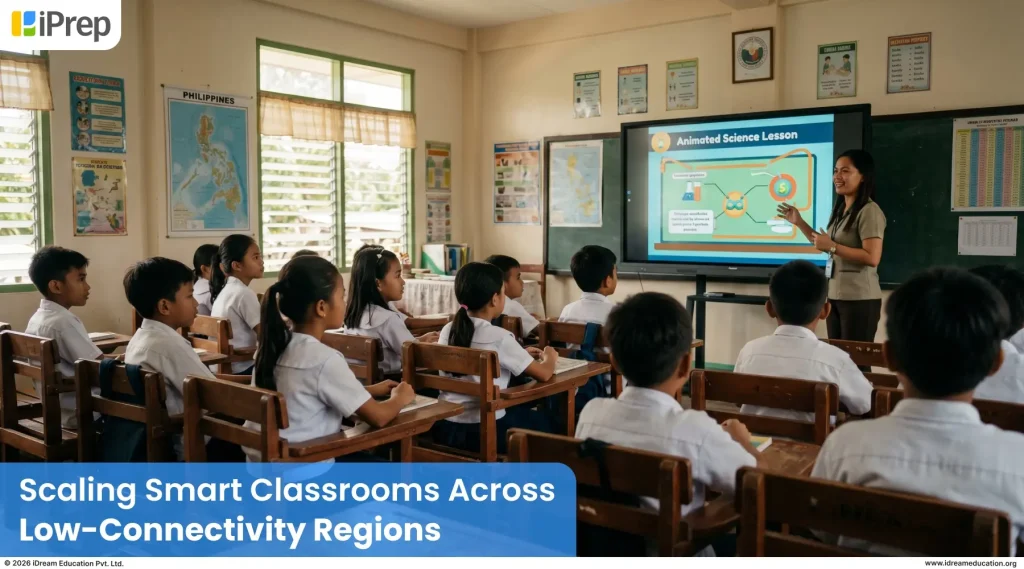
iPrep Digital Class is built on a single-device architecture. A teacher plugs in a pen drive or opens the application on an interactive flat panel and the full content library is available, organised by subject, grade, and chapter. Animated video lessons, simulations, digital textbooks, practice questions. The interface is in the teacher’s language. The content is aligned to their syllabus. Setup takes under an hour. Maintenance is near-zero. A teacher with no IT support and intermittent electricity can run a structured digital lesson every day of the year.
This architecture matters enormously in the field. A programme manager who has designed a technology deployment in rural Southeast Asia knows that the support infrastructure that works in a pilot of ten schools does not scale to five hundred schools. When each school requires a trained IT person to maintain it, or regular connectivity to function, or periodic visits from the deploying organisation to reload content, the programme’s total cost of ownership increases in ways that donor budgets rarely accommodate. iPrep’s design philosophy has always been to minimise the dependency of individual schools on external support. Once it is set up, it works independently.
In the iDream deployments in Meghalaya’s East Jaintia Hills, one of India’s most geographically remote school environments, the deployment model demonstrated this principle at scale. Schools were set up with a smart classroom, a tablet library, and iPrep preloaded on both. Teachers received an orientation. Field teams visited monthly, not weekly. The system ran independently between visits, with usage data captured on the device and synced during field visits. By the second year of the programme, usage had grown significantly without a corresponding increase in support intensity, demonstrating that the platform had genuinely become part of the school’s routine rather than a programme-dependent addition.
For a programme manager in Cambodia designing a digital learning intervention across fifty or a hundred schools in Kandal or Takeo province, this model is directly replicable. The content would need to be in Khmer and aligned to the Cambodian national curriculum, which requires a localisation exercise — but the deployment architecture, the teacher training model, the device management approach, and the reporting framework are ready to transfer.
The Teacher Confidence Question
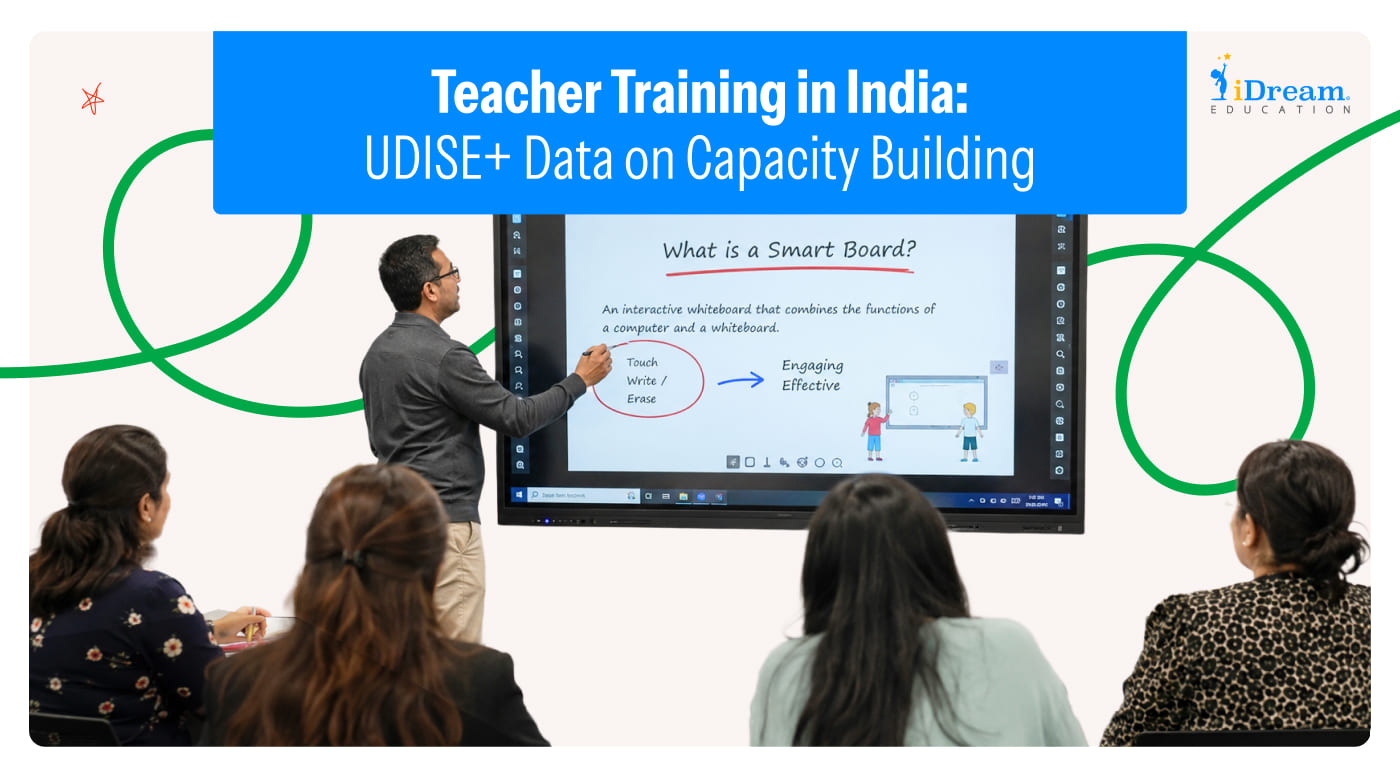
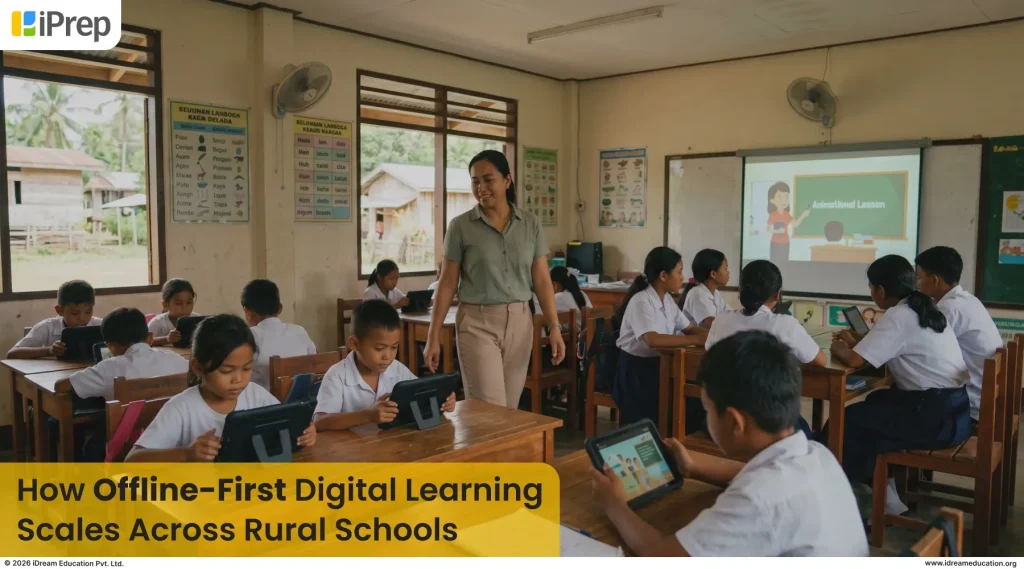
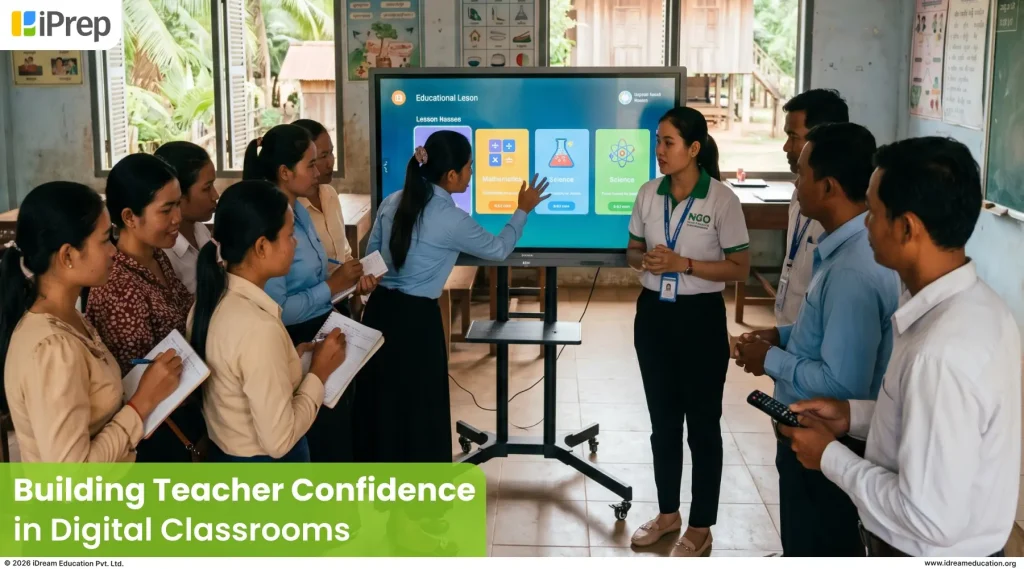
One of the most consistently underestimated challenges in smart classroom deployment is teacher confidence. A teacher who is uncertain about a technology will not use it in front of students, the fear of visible failure in a classroom context is a powerful inhibitor. India’s early smart classroom programmes often made the mistake of treating teacher training as a one-time event: a two-day workshop, a certificate, and the expectation that adoption would follow. It did not. What produced adoption was repeated low-stakes exposure, in-school peer support, and the experience of seeing students respond positively to digital content.
iPrep’s teacher orientation model has been refined through this experience. It is not a training course in the traditional sense. It is a structured introduction to the platform built around concrete classroom scenarios: what does a Class 7 Science lesson look like with iPrep? How does a teacher use the chapter assessment to check understanding at the end of a lesson? What happens if the hardware behaves unexpectedly? Teachers leave orientation with the experience of having taught a simulated lesson, not just having listened to a training presentation.
For Southeast Asian programme partners, this approach to teacher support is directly transferable. The content of the orientation changes, the curriculum, the language, the specific classroom scenarios, but the philosophy does not. Build confidence through doing, not just listening. And build in a mechanism for teachers to support each other, because the most credible advocate for a new teaching tool is always another teacher who has used it successfully.
Implications for SEA Education Programmes
For NGOs running community schools in the Philippines or Cambodia, for education ministries in Myanmar or Laos exploring smart classroom pilots, and for CSR foundations funding digital education in rural Indonesia, the iPrep architecture offers a reference model validated across 21 Indian states, in 9 languages, across schools ranging from single-teacher rural outposts to 2,000-student urban government schools. The technical and programmatic learning from those deployments is directly transferable.
The honest message from India’s experience is this: digital learning infrastructure that reaches the last-mile school is not harder than digital learning infrastructure that reaches the well-connected school. It requires different design decisions, decisions made at the foundation of the product, not added as accessibility features later. iPrep was built for the last-mile school first. That is not a marketing claim. It is the reason the platform works in Meghalaya and the reason it can work in rural Mindanao or Kampong Cham.
Organisations considering a smart classroom programme in Southeast Asia are welcome to request a review of iDream’s India deployment data, implementation protocols, and teacher training materials. We offer no promise of an easy programme, but we offer the hard-won knowledge of what makes these programmes work when the conditions are genuinely difficult. Write to us at [email protected].
Frequently Asked Questions -
1. Can iPrep be aligned to the Filipino K-12 curriculum or Indonesian national curriculum?
Yes. Alignment to DepEd (Philippines) or Kemendikbud (Indonesia) curricula requires a mapping exercise. We welcome conversations with programme teams or ministries who would like to co-develop this alignment.
2. What are the minimum hardware requirements?
A projector or interactive flat panel, a USB or HDMI connection, and any basic computing device running Windows or Android. No server, LAN, or internet required.
3. Does iPrep support teacher training for non-Indian school contexts?
Yes. All deployments include teacher orientation. For large-scale deployments we work with master trainers and education officials to build sustainable training capacity locally.
4. How does iPrep handle multi-grade classrooms where one teacher covers more than one class level?
iPrep's content is organised by class, subject, and chapter, allowing a teacher to navigate fluidly between class levels within a single lesson period. This is one of the scenarios we have designed and tested for specifically, it is a common reality in the Indian government schools where we have deployed, and the platform accommodates it without technical complexity.
5. What is a realistic pilot programme for a Southeast Asian NGO to begin with?
A pilot covering 10–20 schools over one academic term, with baseline and endline assessments, teacher orientation, and a programme report, is the standard starting point. We can design the pilot around the funder's reporting requirements and the partner's field capacity.
Categories You may Explore
Related Articles