Samagra Shiksha, launched in 2018-19, combined three separate government school schemes, Sarva Shiksha Abhiyan, Rashtriya Madhyamik Shiksha Abhiyan, and Teacher Education, into one programme, covering pre-primary to Class 12.
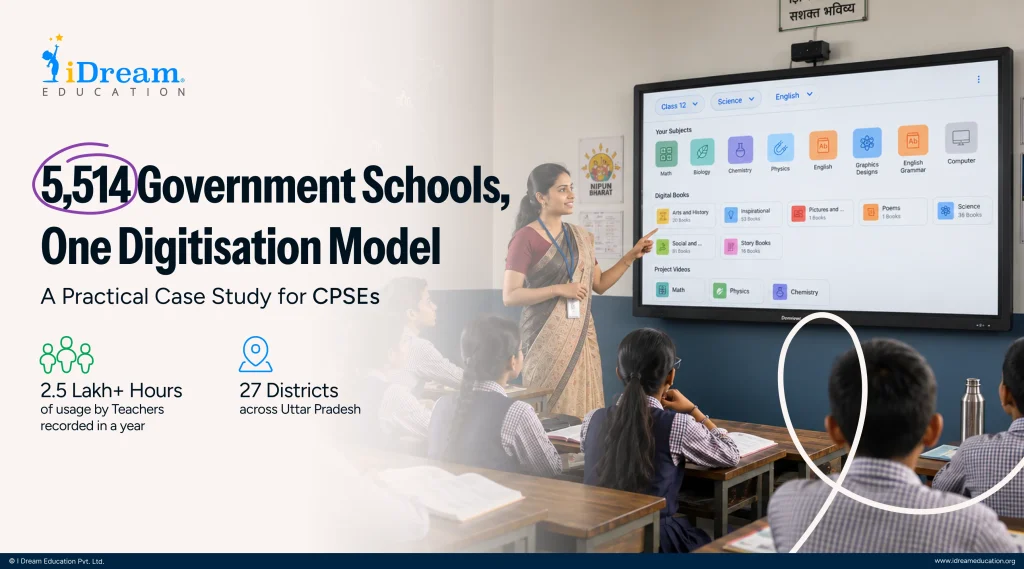
Over the years, more than 15 lakh smart classrooms have been set up across the country, and nearly 25 crore children got enrolled.
By the numbers a government scheme is usually judged on, it worked. But whether those children are learning anything once they’re in the classroom is a different question, and it’s the one Samagra Shiksha 2.0 has to answer.
In the first two episodes of Digital Learning ≠ Hardware, Shri Anil Swarup, former Secretary, Ministry of Education, sat down with Rohit Prakash, co-founder of iDream Education. They covered why hardware procurement runs ahead of monitoring, and why teacher training rarely survives contact with the classroom. Episode 3 turns to the scheme both conversations kept circling back to.
Mr. Swarup was the chief architect of Samagra Shiksha 1.0. Here, he sets out what the scheme got right, what it missed, and what 2.0 needs to fix if a decade of hardware spending is going to really translate into children who can read and count.
Prefer to read? The key insights follow.
What Samagra Shiksha 1.0 Was Built to Fix
When Shri Anil Swarup took over as Secretary of School Education in 2016, the existing programmes had clear gaps. Nothing covered classes 11-12, and pre-school education, an omission the National Education Policy would later address on its own timeline. And every stage of school education ran as a separate scheme with its own budget, unable to borrow from the others.
Samagra Shiksha merged the three schemes into one programme and pushed spending decisions down to the states.
Kerala’s problems aren’t Uttar Pradesh’s problems. So someone in Delhi deciding how much each state spends on primary versus secondary education made little sense.
States needed room to put money where their own data showed the gap. Samagra Shiksha rested on three moves, really: merge the schemes, decentralise the spending, and only then bring in technology.
“Technology was there to support the fix, not to become the fix itself. “
The goal, as Swarup puts it, was always to improve learning outcomes. Hardware and software were only ever meant to be the instruments.
Hardware Came First, Purpose Came Second
Ask Swarup where Samagra Shiksha 1.0 went wrong, and he points to one thing: the order in which decisions got made.
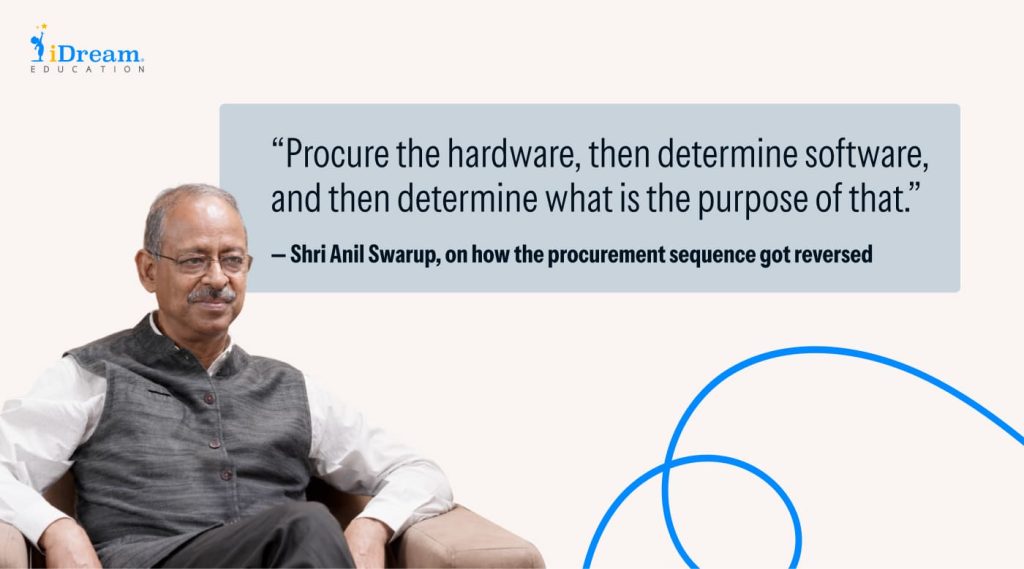
“Procure the hardware, then determine software, and then determine what is the purpose of that.”
— Shri Anil Swarup, on how the procurement sequence got reversed
It should have run the other way: decide the purpose, work out what software serves it, and only then buy the hardware that runs it.
Nobody was confused about the intent; improving learning outcomes was always the stated aim. But intent and execution diverged once the money started moving. And once classrooms had their smart boards and tablets, there wasn’t a clear mechanism checking whether any of it was working. That money, as Mr. Swarup put it, gets wasted if nobody looks back to ask whether it actually worked.
Why Smart Classrooms Alone Won’t Move the Needle
The equipment matters because it lets a teacher assess a child individually and act on what that assessment shows. But an assessment tool only helps if someone knows how to use it, and that’s where the gap sits.
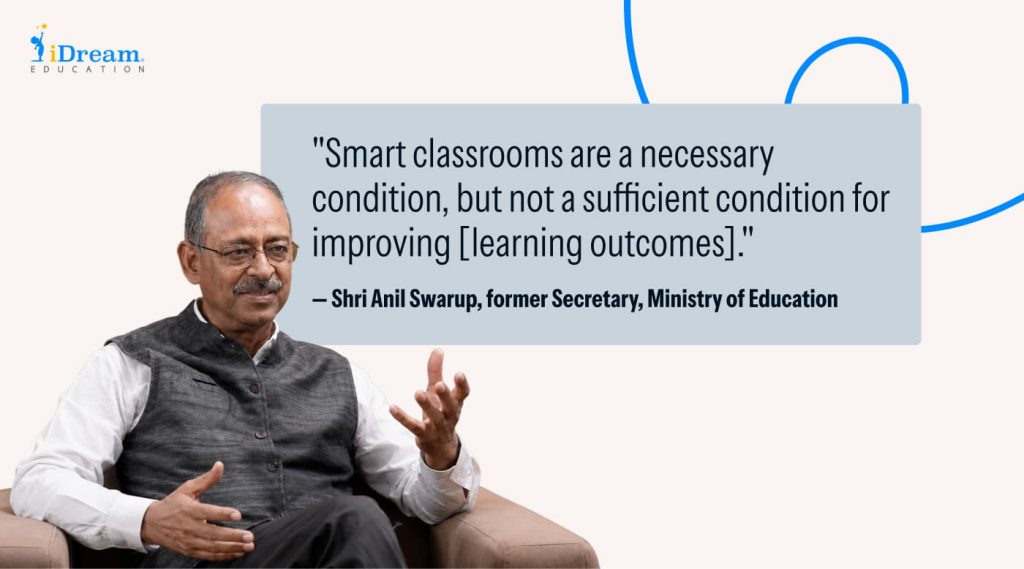
“Smart classrooms are a necessary condition, but not a sufficient condition for improving [learning outcomes].”
— Shri Anil Swarup, former Secretary, Ministry of Education
There’s a second version of that same gap, one level up. It’s not just about using the tool in front of you. It’s about finding the right material in the first place, and that’s where DIKSHA (Digital Infrastructure for Knowledge Sharing), the government’s content platform, comes in. It holds an enormous amount of material; videos, question banks, simulations, most of it created by teachers themselves. The volume is the problem, not the content.
Expecting every teacher to browse the platform, judge what suits their own students, and adapt it for their classroom is asking too much of them.
A teacher in Tamil Nadu has no obvious reason to reach for a video made by a teacher in Rajasthan. And most teachers won’t have time to find out whether something better exists anyway.
Mr. Swarup’s fix sits above the individual teacher. He wants an institutional mechanism, run at the district level, that decides which videos or programmes suit which class and subject. And then hands teachers a shortlist they can adapt locally.
The same logic, he points out, applies to the newer push toward AI-generated content. Handing a teacher an AI tool and expecting them to build their own material from scratch is the same discoverability problem wearing a different label.
Take one example: a lab that explained viscosity with a single kerosene sample, then used AI simulation to extend it to other liquids. That’s the kind of use he thinks smart classrooms are already capable of, once teachers know it’s there and have been shown how.
What Teacher Training Needs to Cover
When Rohit asked what a meaningful training programme should look like, Shri Anil Swarup broke it into 3 parts:
- Teachers need to understand what a smart classroom can actually do, not just that one sits in their room.
- They need to know what’s usable on DIKSHA and how to judge it.
- Training has to work with something teachers already have: they know their own students better than any platform does. Shri Anil Swarup keeps returning to this point. Skip it, and the borrowed content stays generic no matter how good the first two parts are.
Mr. Swarup keeps circling back to one point across the conversation: the teacher is the pivot connecting hardware, software, and outcome, and training has largely skipped over building that connection.
Handing over a device and a login isn’t training. Neither is a one-day workshop. What he describes instead is closer to an ongoing habit: teachers getting monthly data on how their own classroom is using the tools, and adjusting rather than repeating the same session every year.
The Missing Evaluation Habit
“We are shy of evaluating ourselves.”
— Shri Anil Swarup, former Secretary, Ministry of Education
Mr. Swarup doesn’t think Samagra Shiksha is unusual in that. Hardware gets procured, software gets loaded, teachers get some version of training, and then nobody goes back to check whether learning outcomes moved.
His point isn’t that the tools for evaluation are missing. Technology can measure this precisely: identify which programmes are working, flag which children still have gaps, and show it month on month. What’s missing is a habit of reviewing the results and acting on what they show.
Mr. Swarup wants Samagra Shiksha 2.0 to make that evaluation explicit rather than optional. This is so because without it, there’s no way to tell whether a decade of hardware spending changed anything for the children sitting in those classrooms.
“If we don’t know where we stand, how are we going to improve?”
— Shri Anil Swarup, former Secretary, Ministry of Education
Rohit’s closing summary ties the conversation to what he thinks Samagra Shiksha 2.0 should include:
- Personalised adaptive learning to close individual gaps.
- An offline version of DIKSHA, so a lack of internet doesn’t lock teachers out of its content.
- Teacher training that runs as a continuous process rather than a single workshop.
- Monthly data showing each school how its classroom is being used.
Samagra Shiksha 1.0 got children back into government schools. Whether 2.0 gets those same children learning is the question this episode leaves open.
Watch the full conversation above.
Categories You may Explore
Related Articles