Key Takeaways
- Samagra Shiksha is India’s largest school education scheme, with an approved outlay of ₹2,94,283 crore for FY2021-22 to FY2025-26.
- “Samagra Shiksha 2.0” is the name for the current five-year phase. It’s a continuation of the same scheme first launched in 2018, not a new one.
- The scheme funds infrastructure, ICT (Information and Communication Technology) labs, teacher training, and foundational learning support for schools from pre-primary to Class 12.
- In FY2024-25, states spent only 62% of their approved budget on average. Tamil Nadu and West Bengal spent under a quarter of what they were approved for.
- Approval, release, and spending are three separate stages, and each one narrows what actually reaches a school. A state’s release rate in one year does not predict its utilisation rate the next.
- Northeastern states consistently show the highest utilisation. Larger states with bigger allocations often show the widest gap between what’s approved and what’s spent.
Introduction
Samagra Shiksha is the Government of India’s flagship scheme for school education, covering everything from pre-primary classrooms to Class 12. It was created in 2018 by folding three older schemes together: Sarva Shiksha Abhiyan, Rashtriya Madhyamik Shiksha Abhiyan, and the Centrally Sponsored Scheme on Teacher Education. Its current phase, running from FY2021-22 to FY2025-26, is known as Samagra Shiksha 2.0. [1]
The scheme itself doesn’t instruct or guide how schools run. It funds states and Union Territories to improve their schools with new classrooms, digital infrastructure, teacher training, and support for children at risk of dropping out. Essentially, states plan the work, and the Centre approves and pays part of the cost.
Samagra Shiksha’s outlay numbers are large and well documented. What is less visible is how much of that approved money is actually spent by the states. That figure varies a lot from state to state, and it matters for anyone planning education programmes in government schools.
The Scale of the Scheme
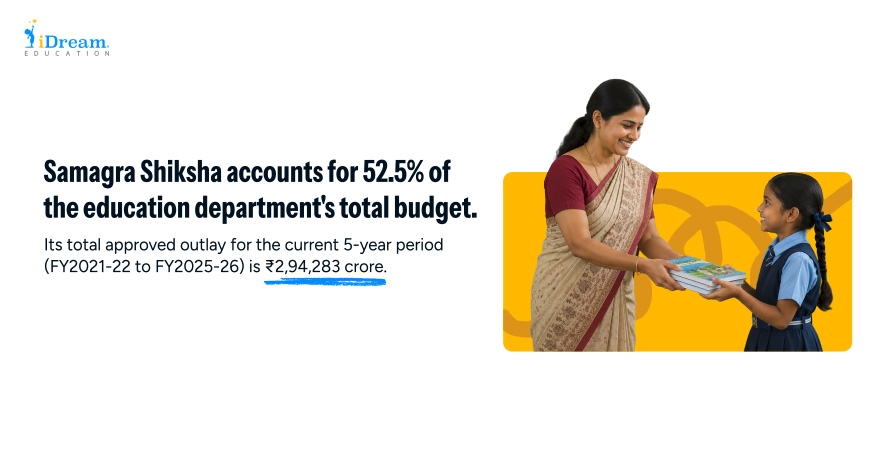
Samagra Shiksha is the largest Centrally Sponsored Scheme run by the Ministry of Education. Its total approved outlay for the current 5-year period (FY2021-22 to FY2025-26) is ₹2,94,283 crore, of which the Central government bears ₹1,85,398 crore. [2]
Samagra Shiksha accounts for 52.5% of the department’s total budget. Every other scheme the department runs, combined, is smaller than this one.[4] And the Central budget allocations have only grown steadily:
| Year | Central Allocation (₹ crore) |
| FY2024-25 BE | 37,010 |
| FY2025-26 BE | 41,250 |
| FY2026-27 BE | 42,100 |
(BE: Budget Estimate. FY2024-25 and FY2025-26 figures.[2] FY2026-27 figure: added this round.[7])
The scheme’s Cabinet-approved period was till 31 March 2026. But the Union Budget 2026-27 still carries Samagra Shiksha as a live budget line, at ₹42,100 crore, under the Department of School Education and Literacy’s Demand for Grants.[7]
Glimpse of What Samagra Shiksha 2.0 Funds
Samagra Shiksha 2.0 covers a wide span of school needs. The main components are:
- Early Childhood Care and Education: Support for pre-primary classes in government schools, with a recurring grant of up to ₹2 lakh per school.[1]
- Foundational Literacy and Numeracy (FLN): Funds the NIPUN Bharat Mission (scheme aimed to ensure every child achieves FLN skills by the end of Grade 3) at the state level, covering learning materials, assessments, and teacher training for Grades 1 to 3.[1]
- Infrastructure and civil works: New classrooms, toilets, drinking water, boundary walls, ramps, furniture.[1]
- ICT and digital education: Schools can set up ICT labs or smart classrooms under the scheme. The non-recurring grant is up to ₹6.40 lakh per school for an ICT lab and ₹2.40 lakh for a smart classroom. From Project Approval Board (PAB) 2025-26, the scheme also funds teacher tablets at ₹10,000 to ₹18,000 each for primary school teachers who haven’t received one yet.[5]
- Teacher training: Funds NISHTHA (National Initiative for School Heads’ and Teachers’ Holistic Advancement), the national in-service training programme for school heads and teachers.[1]
- Inclusive education: Support for children with needs, including aids, appliances, and resource teachers.[1]
- Vocational education: Skill-based learning for Classes 9 to 12 in government schools.[1]
- Library and sports: Books, reading corners, sports equipment, physical education infrastructure.[1]
Each of these gets its own approved allocation in a state’s Annual Work Plan and Budget (AWP&B). Whether that allocation turns into an actual ICT lab or trained teachers comes down to utilisation.
How Money Reaches States
Each state submits an AWP&B to the Ministry of Education, laying out what it wants to build and train for the year. PAB reviews these plans and sets state-wise budgets, which are almost always lower than what states initially ask for.
Once approved, the cost is split between the Centre and the State:
- Most states: the Centre pays 60%, the State pays 40%.
- Northeastern and hill states: the Centre pays 90%, the State pays 10%.
Approval isn’t the same as money in hand. The Centre pays out its share in instalments, and States have to meet spending and reporting conditions to get each one.
In FY2023-24, the Centre released only 72% of the approved Central share nationally, improving to 75% in FY2024-25. Only a few states received 90% or more of their approved Central share that year: Meghalaya led with 99%, followed by Jharkhand at 91%. On the other end of the spectrum, West Bengal received the least, just 18%.[3]
That percentage is just the release stage, meaning how much money reached the state that year. The next stage is: what a state then does with it, and how much actually becomes classrooms and trained teachers. This is a separate question.
Where the Utilisation Gap Shows Up
Approval, release, and spending are separate stages, and each one narrows how much of the approved budget converts into spending on the ground.
The National Picture
Between FY2018-19 and FY2021-22, states utilised less than two-thirds of their approved budget in every single year. In FY2024-25, the national average utilisation rate was 62%, meaning more than a third of approved funds were unspent by year-end.[2][3]
State-wise Picture
The state-wise picture is far more uneven than the average suggests[3]:
| State | Budget Utilisation, FY2024-25 |
| Nagaland | 90% |
| Tripura | 89% |
| Meghalaya | 88% |
| Uttar Pradesh | 72% |
| Rajasthan | 65% |
| Punjab | 46% |
| West Bengal | 24% |
| Tamil Nadu | 23% |
Northeastern states have the highest utilisation rates. Tamil Nadu (23%) and West Bengal (24%), despite carrying some of the largest allocations in the scheme, spent under a quarter of what they were approved for.
Release and Utilisation Are Not the Same Thing
Release is about money reaching the state. Whereas utilisation is about money actually spent. A state can score high on one and low on the other in different years.
For instance, Rajasthan was one of the five states that received over 90% of its approved Central share in FY2023-24. Yet in FY2024-25, it utilised only 65% of it.[3]
The gap builds up in stages, and each one shrinks the total further:
- PAB approves less than what the States plan.
- The Centre then releases less than what’s approved by PAB.
- At last, the States spend less than what’s actually released.
By the time money reaches a classroom or a trained teacher, it’s a smaller amount than the original budget promised.
What the Utilisation Gap Means, And Why It Matters
Northeastern states spending close to 90% of their approved budget, against Tamil Nadu and West Bengal spending under a quarter, isn’t just two facts sitting side by side.
The Northeast’s high utilisation suggests these states can plan, procure, and report fast enough to keep up with what’s approved.
On the other hand, larger states like Tamil Nadu and West Bengal’s low utilisation isn’t a story about them executing badly.
A more likely explanation is scheme-specific: large states’ procurement and civil works timelines often move more slowly than the scheme’s release conditions allow for.
For anyone deciding where and how to put money into government school infrastructure, this difference is a planning signal.
- In a high-utilisation state, Samagra Shiksha is likely already doing most of the infrastructure and training work it’s designed to do.
- In a low-utilisation state, a school’s approved ICT lab or smart classroom grant can sit delayed for reasons that have nothing to do with whether the money was ever meant to arrive: slow procurement, paperwork, administrative backlog.
CSR and NGO capital can play a different role in low-utilisation states. The constraint usually isn’t a shortage of money, since the budget is already approved. It’s the speed at which a state can plan, procure, and report against it. A partner that brings project management, procurement support, or on-ground implementation capacity can help turn an already-approved allocation into a working classroom faster than a state’s own systems currently manage.
Conclusion
Samagra Shiksha is the largest Central scheme funding India’s government schools. It covers everything from pre-primary classrooms to ICT labs to teacher training, at a scale no other scheme in the department matches.
What the utilisation data makes clear is that an approved allocation and money that actually reaches a school are two different things. A national utilisation rate of 62% means more than a third of approved funds didn’t convert into spending in FY2024-25. Moreover, in some large states, the gap runs far deeper than the national average suggests.
The scheme’s ICT and smart classroom grants are the primary funding route for the digital infrastructure government schools are meant to build toward.
iDream Education works inside this same framework, helping state education departments turn approved digital classroom grants into working classrooms, especially where that gap is widest.
Source list
- Samagra Shiksha: Scheme Overview, Department of School Education & Literacy, Ministry of Education:
https://dsel.education.gov.in/sites/default/files/2021-12/samagra_shiksha.pdf - Accountability India, Samagra Shiksha Budget Brief 2023-24:
https://accountabilityindia.in/wp-content/uploads/2023/01/Samagra-Shiksha-2023-24-Pre-Budget.pdf - Foundation for Responsive Governance (ResGov), Samagra Shiksha Budget Brief (Vol 3, Issue 1), 1 February 2026:
https://resgov.org/contents/reports/129_Samagra%20Shiksha%20Budget%20Brief.pdf - Education For All in India, Analysis of School Education Budget 2025-26:
https://educationforallinindia.com/analysis-of-department-of-school-education-budget-allocations-2025-2026/ - Ministry of Education, ICT@Samagra page:
https://dsel.education.gov.in/en/scheme/ict-samagra - PAB minutes (state-wise, FY2024-25 and FY2025-26), Department of School Education & Literacy, Ministry of Education:
https://dsel.education.gov.in/en/pab-minutes
Frequently Asked Questions -
1. What is Samagra Shiksha Abhiyan?
Samagra Shiksha is the Government of India's integrated scheme for school education, launched in 2018 by merging Sarva Shiksha Abhiyan, Rashtriya Madhyamik Shiksha Abhiyan, and the Centrally Sponsored Scheme on Teacher Education.
2. What is Samagra Shiksha’s budget?
Its total approved outlay is ₹2,94,283 crore for FY2021-22 to FY2025-26. Centre's share is ₹1,85,398 crore, and the rest is the State’s share.
3. What is the difference between Samagra Shiksha and Samagra Shiksha 2.0?
Samagra Shiksha 2.0 refers to the scheme's current phase, FY2021-22 to FY2025-26. It's a continuation of the same scheme, not a redesign, incorporating National Education Policy (NEP) 2020 priorities such as Foundational Literacy and Numeracy, early childhood education, and expanded ICT support.
4. How is Samagra Shiksha funded?
The Centre and states share the cost. Most States pay 40% while the Centre pays 60%. Northeastern and hill States pay only 10%, with the Centre covering the remaining 90%.
5. What does Samagra Shiksha fund for digital classrooms and ICT?
An ICT lab grant of up to ₹6.40 lakh (non-recurring), a smart classroom grant of ₹2.40 lakh (non-recurring), and, from PAB 2025-26, teacher tablet funding of ₹10,000 to ₹18,000 per tablet for primary teachers who haven't yet received one.
6. Why doesn't Samagra Shiksha's approved budget reach schools in full?
Because approval, release, and spending are separate stages, each narrows the total. States plan for more than the Project Approval Board approves. The Centre releases less than approved, tied to spending and reporting conditions. States then spend less than what's released, often due to procurement delays and administrative capacity. By FY2024-25, this left national utilisation at 62%.
Categories You may Explore
Related Articles