

AI is no longer a distant concept in education. It has moved firmly into mainstream conversation, featured in policy papers, NGO reports, and state-level edtech discussions across the country. Yet for millions of students studying in government schools and underserved communities, one fundamental question remains largely unanswered: How can AI actually become usable, practical, and meaningful for teachers and students in low-resource environments?
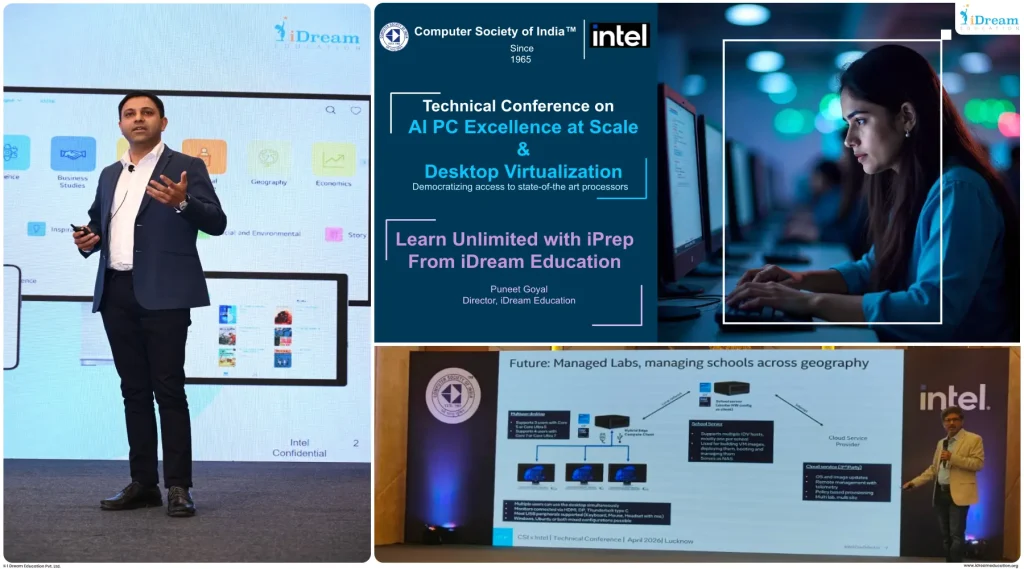
We recently had the opportunity to engage with this question directly, as Intel’s Learning Partner at the conference co-organised by Intel Corporation and the Computer Society of India (CSI) in Lucknow on April 29. The discussions that day centred on a challenge that sits at the heart of our own work: enabling AI-powered learning solutions that can function effectively even in low-bandwidth and infrastructure-constrained school environments. The coming together of iPrep’s adaptive learning ecosystem and Intel-powered Next Gen Virtual Machines at this conference represented an important step in that direction, towards enabling more advanced, AI-driven personalised learning at scale across India.
Recent research reinforces just how urgent this conversation is.
The BaSE Survey by Central Square Foundation highlights a growing AI gap in India’s last-mile learning ecosystems. 90% of households surveyed now own a smartphone, and 99% of children report having internet access on these devices. Yet meaningful adoption of AI in government schools in India remains limited, held back not by the absence of devices, but by low awareness and practical usability challenges. In many government schools, the deeper challenge is enabling AI-powered learning in environments where internet bandwidth is inconsistent, classrooms are already time-constrained, teachers cannot wait for heavy AI systems to load or generate outputs, and deploying large-scale device infrastructure remains financially difficult.
Why Affordable AI Infrastructure for Schools Matters in India
The gap between AI’s promise and its classroom reality in India isn’t primarily a technology gap. It is fundamentally a challenge of affordable AI infrastructure for schools, especially in government and low-resource learning environments.
For example: Personalised Adaptive Learning (PAL) for government schools is increasingly recognised as one of the most effective approaches to addressing learning gaps among children. The logic is sound: every child learns at a different pace, carries different gaps, and needs instruction that meets them where they are, something a single teacher managing a classroom of forty students simply cannot deliver alone, no matter how skilled. Plus, current PAL implementations have made meaningful progress in this direction. But the next phase of impact – where AI can identify learning gaps with greater precision and deliver genuinely personalised interventions in real time, requires stronger compute capabilities than what most government school infrastructure currently support.
And this is where the real challenge sits. In a typical government school classroom, internet bandwidth is inconsistent. Instructional time is already stretched thin. A teacher cannot afford to wait for an AI system to load or for an output to generate mid-lesson. And for school systems and state governments looking to scale digital learning, the cost of deploying high-end individual devices across thousands of schools remains a significant barrier.
These aren’t exceptions. They are the everyday conditions under which any practical AI solution for last-mile education must be designed to work; not around. Building affordable AI infrastructure for schools is therefore not simply a technology conversation, but a foundational requirement for making AI-enabled learning truly inclusive at scale.
It is this very challenge that shaped the conversations at the Intel event in Lucknow.
Three Possibilities Worth Pursuing
The conversations at the Intel × CSI conference weren’t about AI in the abstract. They were grounded in a specific question: what does it actually take to make AI work in government schools of India? Three possibilities emerged from those discussions that we believe are worth taking seriously.
Bringing Low-bandwidth AI solutions for education
Much of the current conversation around AI in education assumes reliable connectivity. The reality in most government schools is the opposite. What the discussions around Intel® Core™ Ultra Series 3 processors and Intel-powered Next Gen Virtual Machines demonstrated is that AI-ready infrastructure need not be cloud-dependent to be powerful.
Local AI processing on-device or through shared computers can support adaptive learning, multilingual content delivery, and AI-assisted teaching even where bandwidth is limited or unpredictable. This is where affordable AI infrastructure for schools becomes critical, enabling AI-powered learning experiences without dependence on continuous high-bandwidth connectivity.
Making AI Genuinely Useful for Teachers, in Real Time
For a teacher in a government classroom, usefulness matters far more than sophistication. Instead of waiting for AI systems to load or generate outputs online, local AI-powered infrastructure can support faster content access, classroom delivery, worksheet generation, and student assessments in real time, making AI practical within actual classroom workflows.
When designed thoughtfully, affordable AI infrastructure for schools can help ensure that AI becomes an everyday classroom support system for teachers rather than an additional operational burden.
Reducing the Cost of Scale Through Hardware Virtualisation for Schools
A key highlight was Intel’s approach to hardware virtualisation for schools, which enables multiple systems to share compute power efficiently. This has the potential to significantly reduce deployment costs for government schools while still enabling access to powerful digital learning environments.
In the long run, affordable AI infrastructure for schools could accelerate the adoption of adaptive learning across remotest parts of the country at a much lower infrastructure cost compared to deploying large numbers of individual high-end devices.
The Road Ahead
What the Lucknow conference reinforced is that the pieces needed to make AI practical for last-mile learners are finally beginning to come together.
Together, we are creating the possibility of an integrated ecosystem that combines state-of-the-art yet affordable hardware with rich digital content, LMS, adaptive learning, and real-time analytics, all in vernacular languages, designed specifically for government schools and last-mile learners.
Take a look at this short video to get a glimpse of the session
This is not just about introducing AI into classrooms, but about ensuring AI becomes truly usable, equitable, and impactful for the schools and learners who need it the most.
If this aligns with your organisation’s vision for education programs, we would be happy to explore a joint demonstration together with the Intel team to discuss how such models can support your initiatives. For more information, you may contact us at +91 7678265039 or write to us at [email protected]
Categories You may Explore
Related Articles