Key Takeaways
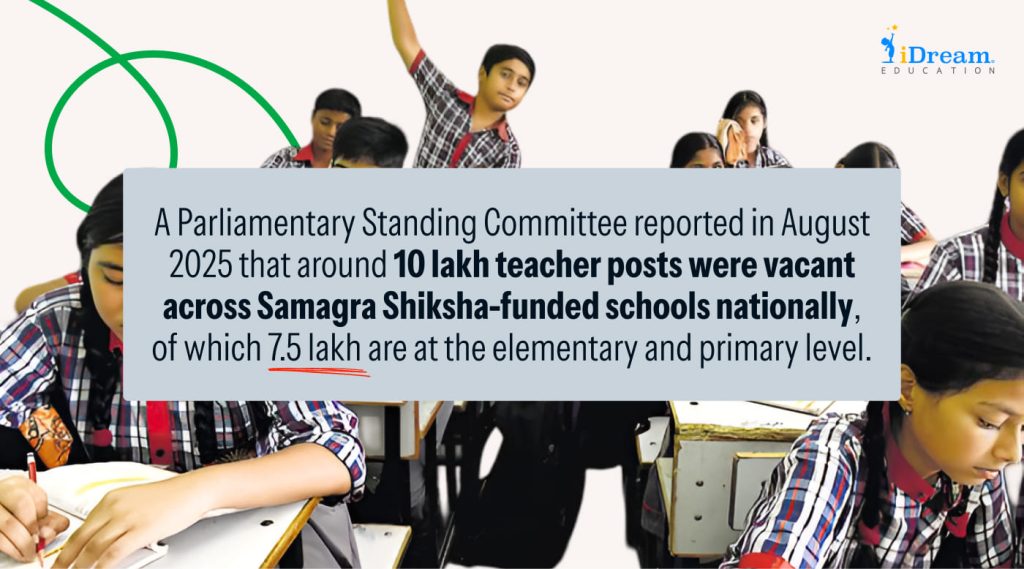
- A Parliamentary Standing Committee reported in August 2025 that around 10 lakh teacher posts were vacant across Samagra Shiksha-funded schools nationally, of which 7.5 lakh are at the elementary and primary level.
- India’s overall teacher vacancy rate fell from 19.69% in 2021-22 to 15.17% in 2023-24. Elementary vacancies dropped by nearly 5%. Secondary vacancies barely moved.
- The most recent national data, for 2024-25, shows secondary and higher secondary vacancies nearly doubled in a single year, from 2.34 lakh to over 4.09 lakh, precisely the level where subject-specialist teachers matter most.
- Central government schools carry vacancies too. Kendriya Vidyalayas report 13.1% teaching vacancies and Navodaya Vidyalayas 24.8%.
- 5 states, Uttar Pradesh, Madhya Pradesh, Karnataka, Rajasthan, and Assam, account for most of the reported vacant posts. Kerala, Odisha, and Nagaland report none.
Picture a government school with a healthy staffing ratio on paper, with one sanctioned teacher post for every handful of students. Yet in one classroom, the maths post has stayed empty long enough that the subject barely gets covered.
The budget’s approved and the post exists on paper. What’s missing is a person in the room, and until recruitment catches up, someone still has to decide what those students do in that period.
This article looks at that gap, between a sanctioned post and a subject that’s actually taught. Vacancy counts alone don’t help much if you’re planning an education programme. Where vacancies are found tells you more: it shows where instructional continuity is most likely to break down, and where it isn’t.
What Teacher “Vacancy” Actually Means
Government teacher data is built around 3 numbers:
- Sanctioned posts: the number of teaching positions a state government has officially approved and budgeted for at a school, based on how many students are enrolled and the staffing norms it follows.
- Teachers in position: the number of those approved posts that currently have a teacher actually working in them.
- Vacant posts: sanctioned posts minus teachers in position. The post is approved and funded, but empty.
A falling vacancy rate is good news. It means more sanctioned posts are getting filled. A rising rate means the opposite, and that’s why the elementary and secondary numbers below are worth comparing side by side.
A state can report an improving vacancy rate even while some schools still have no teacher for a subject. That’s because the rate is an average across thousands of schools and subjects.
Say a district has 10 empty posts. If it fills 7 this year and the same 3 stay empty next year, its vacancy rate looks better on paper.
But which posts stay empty, which subject, which school, matters as much as the total count.
How India’s Teacher Vacancy Rate Has Changed, 2021-22 to 2023-24
India’s national teacher vacancy rate fell from 19.69% to 15.17% between 2021-22 and 2023-24, meaning more of the country’s sanctioned posts got filled over that period. The table below breaks that down by level. [1]
| Level | 2021-22 Sanctioned | 2021-22 Vacant | 2023-24 Sanctioned | 2023-24 Vacant | Vacancy Rate 2021-22 | Vacancy Rate 2023-24 |
| Elementary | 49,81,133 | 10,37,271 | 46,59,530 | 7,22,413 | 20.82% | 15.50% |
| Secondary | 9,43,283 | 1,29,338 | 9,20,075 | 1,24,262 | 13.71% | 13.51% |
| Total | 59,24,416 | 11,66,609 | 55,79,605 | 8,46,675 | 19.69% | 15.17% |
Source: Parliament, Question No. 133, answered 4 December 2023; PAB Minutes and AWP&Bs, via Prof. Arun C. Mehta, Education For All in India [1]
Two patterns stand out:
- Elementary vacancies improved substantially by nearly 5.3% over the period.
- Secondary vacancies barely moved, from 13.71% to 13.51%.
Secondary is where subject specialisation starts.
A vacant maths post at the secondary stage usually means maths doesn’t get taught at all, not that another teacher covers for it. That’s why a flat vacancy rate at secondary level deserves more attention than the national average suggests.
Sanctioned posts also fell nationally, from 59,24,416 to 55,79,605 over the same period. That matters because fewer sanctioned posts can make the vacancy rate look better even if no new teacher was hired.[1]
The Latest Data: 2024-25
The most recent breakdown, for 2024-25, shows elementary vacancies still falling while secondary vacancies nearly doubled.
It combines UDISE+ 2024-25 with the Parliamentary Standing Committee’s 368th Report.[7] It isn’t directly comparable to the table above row-for-row, since its secondary category includes higher secondary while the table above’s doesn’t, but the direction of change is clear.
| Level | 2023-24 Vacant | 2024-25 Vacant | Change |
| Elementary | 7.24 lakh | 5.72 lakh | Down |
| Secondary & Higher Secondary | 2.34 lakh | Over 4.09 lakh | Nearly doubled |
Source: Analysis by Prof. Arun C. Mehta, combining UDISE+ 2024-25 and the Parliamentary Standing Committee’s 368th Report, Education For All in India [7]
Elementary vacancies kept improving, in line with the trend in the table above (the two independent counts land close to each other, 7.22 lakh and 7.24 lakh for 2023-24).
Secondary and higher secondary vacancies moved the other way, nearly doubling in a single year. That’s the level where subject-specialist teachers, science, maths, and language, matter most. And it’s the clearest evidence yet that the national vacancy rate’s fall between 2021-22 and 2023-24 didn’t reach every classroom equally.
Teacher Vacancies by State
These vacancies are spread unevenly across states. Eighteen states and Union Territories (UTs) reported a combined 3,57,862 vacant posts in 2025: 2,97,050 at elementary level, 28,019 at secondary, and 32,793 at senior secondary.[2]
| State/UT | Vacant Teaching Posts (All Levels) |
| Uttar Pradesh | 1,93,862 |
| Madhya Pradesh | 52,019 |
| Karnataka | 38,163 |
| Rajasthan | 20,170 |
| Assam | 13,217 |
| Maharashtra | 8,979 |
| Tripura | 8,020 |
| Punjab | 6,423 |
| Gujarat | 5,432 |
| Tamil Nadu | 5,141 |
| Manipur | 4,693 |
| Arunachal Pradesh | 1,958 |
| Goa | 848 |
| Mizoram | 131 |
| Meghalaya | 16 |
| Kerala | 0 |
| Odisha | 0 |
| Nagaland | 0 |
Source: State/UT submissions to the Project Approval Board, compiled and reported by Careers360, September 2025 [2]
A few patterns stand out from the table:
- Uttar Pradesh alone accounts for just over half the combined total.
- Rajasthan’s vacancies sit mainly at the senior secondary level, the stage where subject teaching matters most. The state’s own pupil-teacher ratio data already shows its widest gaps at that same level.
- Kerala, Odisha, and Nagaland all report zero vacant posts, worth sitting with on its own. Nagaland’s much smaller school system makes it a harder state to compare against the rest, though
Some states have closed the gap while most haven’t.
Even Central Government Schools Have Teacher Vacancies
Central government schools [Kendriya Vidyalayas (KVs) and Navodaya Vidyalayas (NVs)] should, in theory, have fewer problems than state-run ones. Because centrally funded Kendriya Vidyalayas (KVs) and Navodaya Vidyalayas (NVs) don’t face the budget constraints that state governments often cite.
But they carry gaps of their own.
A Parliamentary Standing Committee report, presented to Parliament in August 2025, described “30-50% vacancies” in KVs and NVs in its own text. [3] A more precise breakdown of the same underlying data puts Kendriya Vidyalaya teaching vacancies at 13.1% (7,414 of 56,810 posts) and Navodaya Vidyalaya (NV) vacancies at 24.8% (6,858 of 27,676 posts).[7]
The same report found around 10 lakh vacant teacher posts nationally across Samagra Shiksha-funded schools, including roughly 7.5 lakh at the elementary and primary level. It noted the shortage was getting worse each year because of retirements and the lack of a permanent recruitment policy.[3]
These figures come from a wider count, Samagra Shiksha’s national sanctioned-post data, not the narrower Parliament table above. Within that count, sanctioned posts also rose, from 63,26,207 in 2023-24 to 69,85,760 in 2024-25, but so did vacancies, from 9,59,148 to 9,82,662.[3]
Government data submitted to the Lok Sabha in December 2025 tells a similar story. It puts KVS vacancies at 10,173 posts against 56,520 sanctioned positions. Of those, 8,457 are teaching posts, which works out to a rate broadly in line with the 13.1% figure above.[4]
Single-Teacher Schools: The Extreme Case
Single-teacher schools push the gap between a sanctioned post and a taught subject to its extreme. There’s no partial vacancy to measure here, because one person is the entire staff.
As of UDISE+ 2024-25, India had 1,04,125 single-teacher schools, a number that fell to roughly 1,00,843 in the 2025-26 report, a reduction of about 3%.[5][6]
In these schools, one person is responsible for every grade and every subject. The sanctioned-versus-vacant framework doesn’t apply here, because there’s no baseline staffing to compare against.
What This Means for Programme Design
Two different problems sit inside this data, and they call for different responses.
- The first is a recruitment problem.
Filling sanctioned posts with permanent, qualified teachers is the job of state and central governments. It depends on hiring cycles and budget allocations.
The Parliamentary Committee has specifically flagged the overuse of contractual appointments and wants it phased out.[3] No outside programme can substitute for that work. - The second is an instructional-continuity problem.
This is where the vacancy data becomes useful for programme design, not just background information. A programme built for a state like Kerala, with near-zero vacancies, doesn’t need to worry about missing subject teachers.
Drop that same programme into a district in Uttar Pradesh, or a KV running close to a quarter of its posts vacant, and it’s solving a different problem altogether. The question shifts from helping a teacher do their job better to something more basic: what happens when there’s no teacher at all, or when one teacher is covering 3 subjects they were never trained to teach.
This distinction should guide how CSR teams and government partners design programmes. No digital tool replaces a qualified teacher, and none should be pitched as if it does.
What it can do is narrower and more useful. Take a school where the maths post has stayed vacant for 2 years, for example: structured content gives a student something to work through on their own, or gives a non-specialist teacher something to lean on while covering a subject they weren’t trained in. That’s a stopgap, not a fix for the recruitment problem above it.
Conclusion
The data shows two things happening at once.
States and the central government have made real progress on the aggregate numbers, especially at the elementary level, where vacancy rates have dropped more than 5% in 3 years.
But that progress hasn’t reached secondary classrooms in the same way, and the most recent 2024-25 data shows secondary and higher secondary vacancies nearly doubling in a single year. The central school system shows the same pattern: KVs and NVs report vacancy rates well above what most state systems are working to bring down.
For CSR teams, NGOs, and government partners deciding where to direct education programmes, where that gap is worst matters more than the national average. Uttar Pradesh, Madhya Pradesh, and Karnataka carry the largest share of it. Kerala and Odisha show it can be closed.
iDream Education partners with government bodies, NGOs, and CSR teams to provide adaptive, self-paced digital learning content for exactly this gap: schools and districts where a teaching post is sanctioned on paper, but a subject can’t reliably be taught in practice.
Sources
- Education For All in India, analysis by Prof. Arun C. Mehta, “Shortage of Teachers at Elementary and Secondary Levels of Education in India: 2021-2024,” based on Parliament Question No. 133, answered 4 December 2023
https://educationforallinindia.com/shortage-of-teachers-at-elementary-and-secondary-levels-of-education-in-india-2021-2024/ - Careers360, “Beyond Teachers Day Cards, Gifts: How 3.57 lakh vacant posts are straining India’s government schools,” 5 September 2025
https://news.careers360.com/teachers-day-2025-government-schools-3-57-lakh-teaching-vacancies-udise-plus-pab-data-uttar-pradesh-lead-education-ministry - Careers360, “10 lakh school teacher posts vacant due to 6-year hiring freeze; Parl panel says NEP policy ‘not feasible’,” 12 August 2025, reporting on the Parliamentary Standing Committee’s 368th Report
https://news.careers360.com/10-lakh-school-teacher-posts-vacant-kvs-nvs-ncte-6-year-hiring-parliamentary-committee-nep-policy-not-practical-temporary-itep - Careers360, “Over 10,000 posts vacant in KVS; only 30 out of 85 newly-sanctioned schools functional: Govt,” 8 December 2025
https://news.careers360.com/kvs-teachers-vacancy-over-10000-posts-recruitment-only-30-of-85-newly-sanctioned-schools-functional-govt-data-sc-st-obc-navodaya - Education For All in India, “Single-Teacher Schools and Schools without Enrolment: Analysis of UDISEPlus 2024-25”
https://educationforallinindia.com/single-teacher-schools-schools-without-enrolment-analysis-of-udiseplus-2024-25/ - DD India, “UDISE+ report shows rise in teachers, fall in school dropout rates,” reporting on the UDISE+ 2025-26 report
https://ddindia.co.in/2026/07/udise-report-shows-rise-in-teachers-fall-in-school-dropout-rates/ - Education For All in India, analysis by Prof. Arun C. Mehta, “Teachers for Universal Education by 2030: Supply, Quality, and the Training Gap,” combining UDISE+ 2024-25 and the Parliamentary Standing Committee’s 368th Report, published 15 March 2026
https://educationforallinindia.com/teachers-for-universal-education-by-2030-supply-quality-and-the-training-gap/
Categories You may Explore
Related Articles