In virtually every education reform conversation in India, someone mentions teacher empowerment. Then the discussion moves on to curriculum, technology, or infrastructure. The teacher standing in front of 30 children doesn’t come up again.
Simple Education Foundation (SEF) has spent over a decade working inside government school classrooms and state systems across Delhi, Uttarakhand, and Punjab. For Episode 6 of Digital Learning ≠ Hardware, Rohit Prakash, co-founder of iDream Education, sat down with Mainak Roy, SEF’s co-founder and CEO, to ask why teacher development in India keeps failing to gain traction, and what organisations are actually getting right.
Prefer reading? Here are the key insights from the discussion.
Teacher Development: Named in Every Policy, Yet Built Into None
Why hasn’t the mission followed through?
“Every single national education policy or any commission report on education that has come out in India in the last three decades has mentioned teacher education and teacher support as a key element of education transformation. But unfortunately, we’ve not had a mission that has worked to support that.”
– Mainak Roy, Co-founder and CEO, Simple Education Foundation
Teacher development takes years to show results, and most people funding education work aren’t willing to wait that long. So the money follows programmes that move faster and show visible impact sooner. India’s learning outcomes, Mainak argues, have suffered as a result.
What a Teacher’s Day in a Government School Actually Looks Like
Rohit Prakash described how his own assumptions about government school teaching shifted completely once he started visiting schools.
“I remember I had this picture in my mind: teachers in the classroom, actively engaging with the children and teaching them. But when I started visiting government schools, I got a very different picture.”
– Rohit Prakash, iDream Education
A typical government school day runs 5-6 hours, and teaching fills only part of it. Government schools have no administrative staff, so teachers handle everything alongside their principal, who in many schools is also managing a full classroom: daily attendance and enrolment records, midday meal logistics, grant utilisation reporting across multiple schemes, maintenance issues, census duty, voting deployment, and state-run public campaigns.
“The teacher spends, if not more, at least 25 to 40% of the time doing all of these duties. And then on top of it, with interventions by different organisations, including ours, there are training programmes they have to attend and a horde of data collection apps that every organisation has, which the teacher has to fill.”
– Mainak Roy, on what the school day actually demands
Even well-intentioned organisations, as Mainak acknowledges about SEF’s own work, add to this load. Caregiving and classroom preparation follow at home.
Expecting a teacher to find the right content mid-class, connect to an unreliable internet connection, and decide on an activity in real time, in a day already stretched this thin, sets the tool up to fail. Pre-loaded offline content isn’t just a convenience. It’s what determines whether a device gets used at all.
Teacher Dignity Is Not a Soft Idea
Underneath the workload problem is something more fundamental: how teachers are viewed and talked about in the first place. One phrase captures this well – “idiot proof tools.”
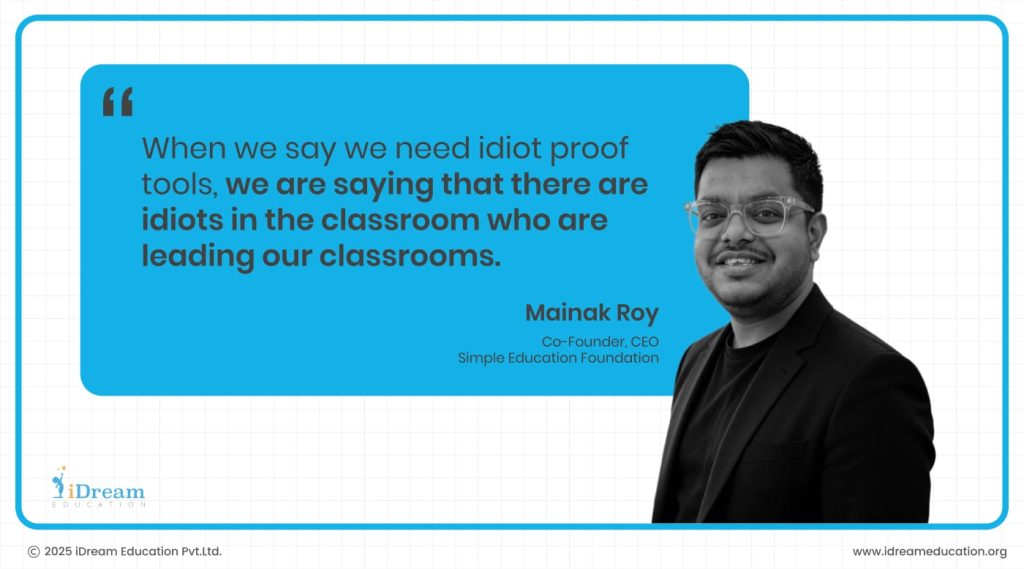
“When we say we need idiot proof tools, we are saying that there are idiots in the classroom who are leading our classrooms. We need to change the language to: how do we build tools that recognise the challenges of teachers? Just by changing the language, we will actually change the tools.”
– Mainak Roy, on how language shapes what gets built for teachers
How teachers are talked about affects whether they engage with what the system provides at all. A teacher who knows the system isn’t on their side has little reason to pick up the tool it’s handing them. It goes unused, and the blame finds the teacher.
Teaching as a profession has also seen a steady decline in social standing. Families that once took pride in having teachers in the household now steer young people away from it. During COVID, teachers in some states were deployed to manage queues outside liquor shops. These things accumulate, and Mainak’s view is that no training programme alone addresses them.
Mainak doesn’t think AI will fully close this gap, a view Rohit shared.
Why Most Teacher Training Programmes Don’t Stick
India mandates 50 hours of teacher training annually: 10 hours centrally through NCERT, 40 hours through each state. In practice, most state programmes are built to fill the 40 hours, not to develop the competencies teachers actually need.
The problem starts before training begins. Most states have no reliable data on where their teachers actually struggle, so programmes default to covering the tool or curriculum being introduced rather than the skills needed to make it work. A STEM programme teaches STEM content. It doesn’t teach a teacher how to draw out scientific curiosity in a child, or how to manage a class where students are at completely different learning levels.
“I have taught someone how to use this mic, but I have not given them an electric connection. No matter how well they know how to use it, it will be useless. That leads to teachers feeling demotivated because the electricity connection is not there.”
– Mainak Roy, on why well-resourced classrooms still underperform
There’s a second problem running alongside this.
“Trainings are often considered as a one-time event. Teachers, I believe, do require continuous handholding and a support mechanism which is available to them as required.”
– Rohit Prakash, on what training models miss
The most effective approach SEF has found is in-classroom coaching. One teacher may understand the device but struggle to choose the right lesson, while another may navigate the content but get stuck on basic operation. A single training session won’t catch either of these. But classroom coaching almost always does.
The ask is specific: if 10 of the 40 mandated state hours go towards direct coaching, the return on the full training investment improves substantially. For any programme that includes a teacher training component, this is worth building in from the start.
What Changes When Teachers Are Actually Supported
SEF has worked in Uttarakhand for 11 years. Two outcomes from that work stand out, and neither fits neatly into a grant report.
More girls in communities SEF works with are completing school, going to college, and getting married later. The Van Gujjar community, traditionally nomadic people who move between regions of Uttarakhand with the seasons, have spent the last three years settled near one of the schools SEF works with.
“They’ve changed some of their professional approaches so that they can stay back in the village. They are seeing that the teaching that is happening, and the way their kids are learning, is something they are finding value in.”
– Mainak Roy, on what changed in Uttarakhand
In Mainak’s experience, that kind of shift doesn’t come from test scores. It comes from a classroom that families found worth staying for.
In a Delhi school where SEF began working in 2017, a Grade 1 teacher resisted any involvement for months. SEF kept showing up, kept working with the children. Gradually, she began to engage. By the end of their five-year term at that school, she had become one of their strongest advocates, picking up tools SEF brought in and refining them for use in other government classrooms. What changed wasn’t the tools or the curriculum. Someone kept showing up and took her expertise seriously.
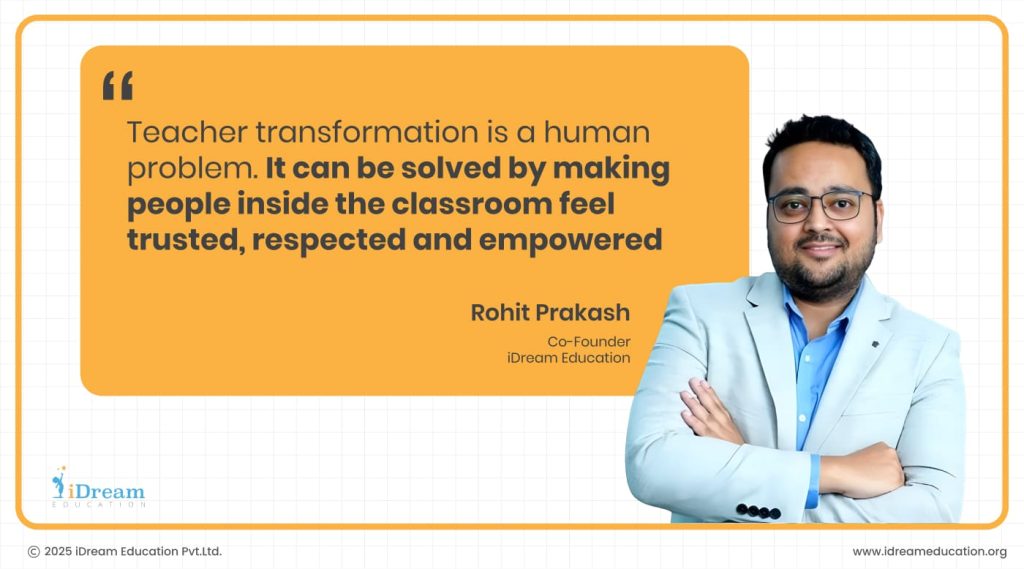
“Teacher transformation is a human problem. It can be solved by making people inside the classroom feel trusted, respected and empowered. Once that foundation is set, student transformation will come in naturally, without being forced.”
– Rohit Prakash, iDream Education
Both stories point to the same thing. The Van Gujjar community didn’t shift because of a device. The Grade 1 teacher didn’t turn around because of a training module. The foundation that made both possible was simpler: someone showed up consistently and treated the teacher as a professional.
Watch the full conversation above.
Categories You may Explore
Related Articles