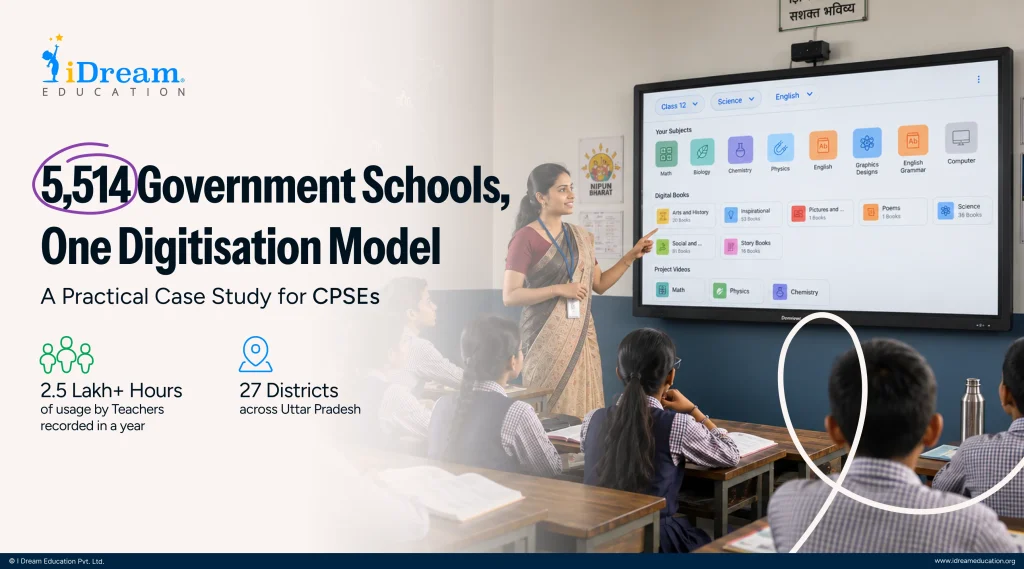
Every year, thousands of crores are spent on digital hardware for government schools across India. Interactive flat panels, smart TVs, laptop labs, tablets; equipment arrives, gets installed, and largely sits unused. The learning outcomes that made the investment look worth it show marginal improvement, if any.
Yet, nobody seems to be asking the obvious question: is any of this hardware actually working? And that silence is part of the problem.
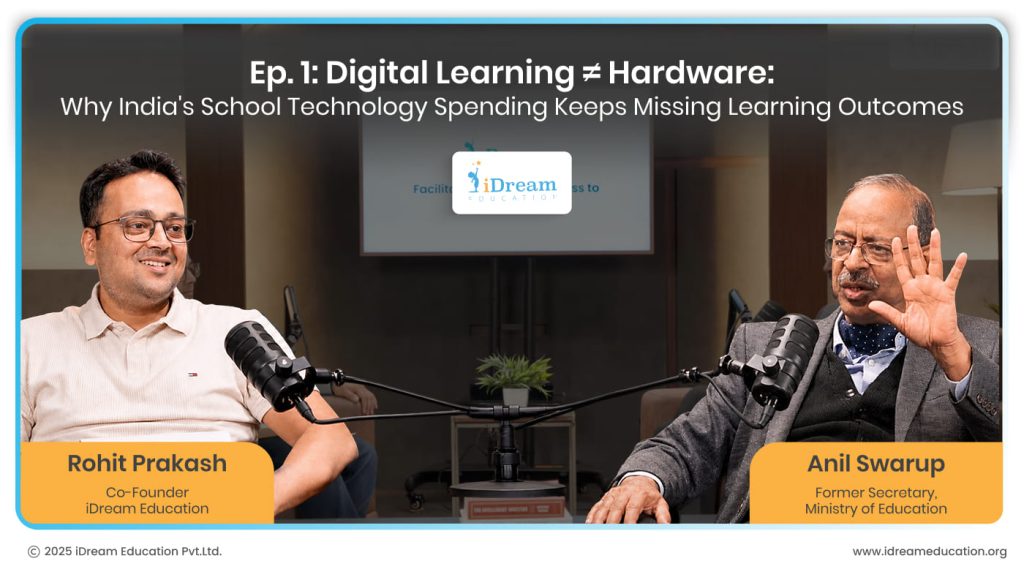
In the first episode of the Digital Learning ≠ Hardware podcast series, Rohit Prakash, co-founder of iDream Education, sat down with Shri Anil Swarup, former Secretary of School Education, Government of India. The conversation produced a clear diagnosis of why this cycle keeps repeating, and what breaking it would actually require.
Prefer to read? The key insights follow.
How The Procurement Cycle Got Inverted

Shri Anil Swarup was at the Ministry of Education when the ICT (Information and Communication Technology) policy for schools was formed. The policy’s goal was clear: put the right technology into classrooms and use it to directly improve learning. However, the implementation went in a different direction.
“We got it [the approach] wrong. We first identified the hardware because that’s the easiest and probably the most lucrative way of going about it. Hardware was identified, hardware was procured, and then we thought in terms of software, and then we thought in terms of how to use that software. It should have been the other way around.“
— Shri Anil Swarup, former Secretary, Ministry of Education
Hardware is visible. A school fitted with new screens and equipment looks good and signals action. But whether the screens are being used purposefully is a question that rarely receives the same urgency.
Part of the reason for this is structural. Most ICT procurement is supply-driven: someone at a policy level decides schools need hardware, the order goes down, and equipment arrives. Schools that figure out what to do with it start using it, but most don’t.
“Training and information dissemination is as important as procurement of goods.”
— Shri Anil Swarup
What Gets Left Out of India’s School Technology Contracts
A Request for Proposal (RFP) for school ICT typically runs to pages of hardware specifications: screen sizes, processor requirements, and warranty terms. However, monitoring and reporting get a single line. Learning outcomes, the whole point of the exercise, aren’t defined anywhere.
The problem is fundamental: you cannot monitor what you haven’t defined. Before any conversation about dashboards and data, someone needs to specify what success looks like. What level should a child reach? Through how many sessions? Assessed against what criteria? Without that clarity, a reporting dashboard is just a document.
States have begun requiring that software-generated reports sync with their Management Information Systems. But those MIS systems carry the same gap: what they’re meant to measure is equally undefined.
There’s also the MDM problem. Mobile Device Management records when a device was switched on and for how long. Some states have started presenting this data in monitoring reports as proof of tracking. But it’s only a hardware metric, not a learning one. Presenting it as monitoring data is not accountability.
Why the Processes Nobody Monitors Are the Ones That Matter

The deeper problem is about incentives, not technical capacity. Defining who should be trained, monitoring trainer selection, tracking whether a child attended sessions at all: none of this generates publicity.
“Everyone will talk big about education. But this requires a lot of granularity, going into the details of it. The tragedy is that the details don’t give you publicity.“
— Shri Anil Swarup, on why process improvement never makes the news
The announcement of hardware procurement for 10,000 schools gets all the attention. But defining trainer standards and monitoring frameworks does not get much visibility, which drives most decisions.
Mr. Swarup calls it putting on makeup: the surface looks attended to while the underlying problem gets worse. Which means the headline number gets discussed because it can be announced. While the process decision that actually determines whether that number moves gets no attention.
The problem compounds further when data becomes public. When monitoring reports reveal that outcomes haven’t improved despite significant spending, that becomes a negative story.
The catch is: you can’t fix a problem you haven’t first accepted. But accepting it attracts bad publicity. So it stays unacknowledged.
The Granularity That’s Actually Required
The solution isn’t technically complicated. It requires sustained, granular work that nobody is currently doing at any consistent scale.
- At the trainer level: who was selected and against what criteria, what training they received, how many sessions they’ve conducted, and whether their performance was assessed.
- For the student: sessions attended, subjects covered, tests taken, results recorded.
Each of these is a yes-or-no data point. Aggregated across a district or state, they tell you whether the process is functioning long before you reach the learning outcome question.
The outcome follows from getting the processes right, not from measuring them more precisely.
iDream’s own implementation experience shows what the absence of this looks like. In one state where both tablet-based digital libraries and smart classrooms had been deployed in government schools, district-level training was organised. Each school sent one teacher: a science teacher from one, a maths teacher from another, an English teacher from a third. Each was expected to go back, train their colleagues, and roll out the technology across their school.
When iDream’s team called those schools months later, the teachers couldn’t remember which training they had attended.
The gap between attending a training and actually changing practice is exactly what no one is tracking.
How Change Actually Spreads
Swarup’s answer is to find where it’s already working, understand what made it work, and present that case to others. The demonstration effect matters more than any programme designed from scratch.
“In India, pilots don’t fly, literally and otherwise… it doesn’t get replicated to scale.”
— Shri Anil Swarup, on why pilots don’t become programmes
What actually scales is a genuine success model: a school or district where outcomes improved and the process can be traced. Policy presentations don’t move people, but a school where it actually worked, and where you can trace exactly how, is what moves people.
Replication comes down to the same question as implementation: whether the person in front of the hardware actually understands what they’re doing with it, or has simply sat through a session.
“He [the trainer] has to internalise what you’re telling him. And once he internalises it, he will not forget it.”
— Shri Anil Swarup, on what training actually needs to achieve
That’s not in any hardware specification. No procurement document tries to measure whether a trainer has understood what they’re supposed to do, or has simply attended. That gap, between sitting through something and genuinely grasping it, is what the teacher who couldn’t remember their training keeps pointing at. Until outcome accountability appears in an RFP, hardware will keep arriving, getting photographed, and sitting unused.
Watch the full conversation above.
Categories You may Explore
Related Articles