

Key Takeaways
- The Ministry of Finance’s Office Memorandum (18 June 2026) directs CPSEs to align CSR expenditure with three national priority themes for FY 2026-27 and 2027-28.
- The three themes are: Nutrition and Anganwadi infrastructure, Development of Sporting Activities, and Innovative Livelihood Enhancement.
- Anganwadi Infrastructure support includes construction of bhawans, functional toilets, drinking water, boundary walls, child-friendly furniture, and smart TVs for early education.
- The Sporting theme covers infrastructure, equipment, professional coaching, and nurturing sportspersons—extending foundational development beyond the classroom.
- The Livelihood theme links education and employability, encouraging CPSEs to invest in digital learning tools, workshops, and smart classrooms, with a specific nudge towards the 100 PMDDKY districts.
- The framework favours a local geography, encouraging CPSEs to work within their own operational geographies for more relevant, sustained local impact.
- Several leading PSUs had already been laying the foundation for digital education transformation through impactful CSR initiatives across the country.
- Overall, the OM reflects a foundational, last-mile vision for inclusive development, connecting early childhood, youth, and livelihood outcomes.
- See how a PSU-supported CSR initiative is leading to measurable impact in conflict-affected districts of Jammu & Kashmir.
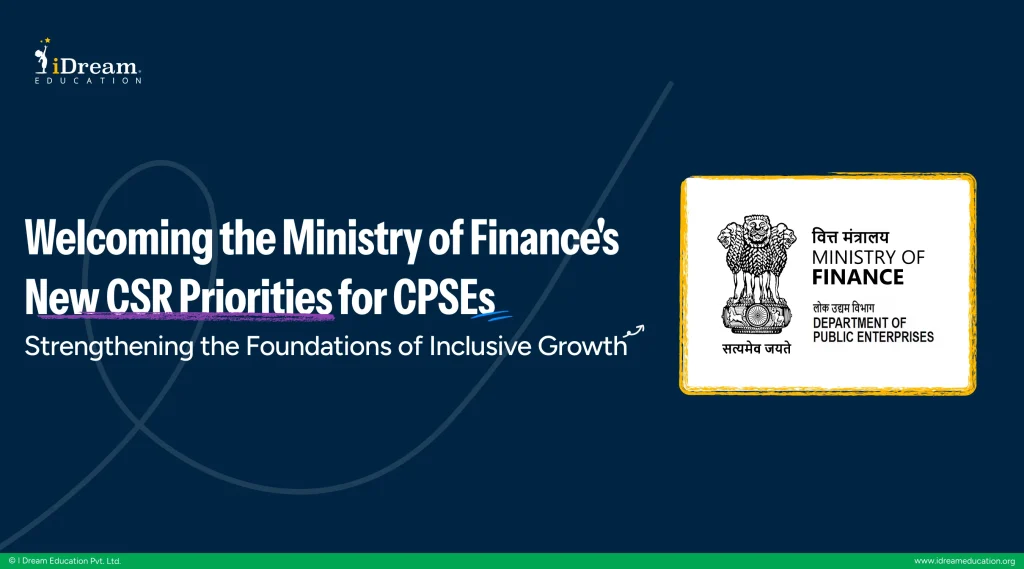
On 18 June 2026, the Department of Public Enterprises, Ministry of Finance, issued an Office Memorandum. It directs Central Public Sector Enterprises (CPSEs) to align their CSR expenditure with three national priority themes for FY 2026-27 and 2027-28: Nutrition and Anganwadi infrastructure, Development of Sporting activities, and Innovative Livelihood Enhancement.
This is a welcome and forward-looking step. It reflects a strong commitment to strengthening the foundational aspects of last-mile development, recognising that sustainable social progress begins not in policy documents, but at the grassroots, in the classroom, the playground, and the workshop where a child, a young athlete, or an aspiring worker takes their first steps forward.
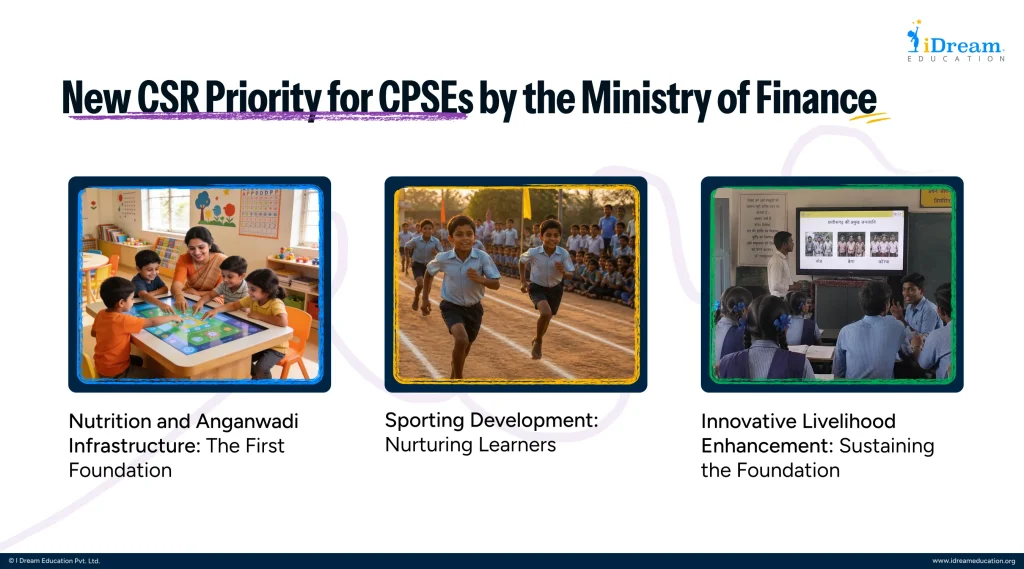
Nutrition and Anganwadi Infrastructure: The First Foundation
The first pillar centres on a fundamental idea. It focuses on giving Anganwadi centres the physical foundations they need to function well. Construction of Anganwadi bhawans, functional toilets, reliable drinking water, boundary walls, child-friendly furniture, and setting up smart TVs for early education and learning—these are not abstract line items. They are the everyday conditions that determine whether a young child arrives at school ready to learn, or arrives having missed the earliest, most formative years of development.
For many children, particularly those in underserved communities, Anganwadis represent their first structured learning experience. A child who is undernourished or learning in an unsafe, poorly equipped space cannot be expected to build strong cognitive and social foundations. By enabling CPSEs to invest directly in this Anganwadi infrastructure, the Ministry is acknowledging a principle that children learn best when they have both supportive learning environments and quality teaching from the very beginning.
Sporting Development: Nurturing Learners
The inclusion of sports as a priority area is equally significant. This second pillar centres around developing sporting infrastructure, providing equipment, enabling access to professional coaching, promoting sport, and nurturing sportspersons—extending this same foundational logic beyond the classroom. Sport builds discipline, resilience, teamwork, and physical wellbeing, all of which support learning outcomes rather than compete with them. For many young people, particularly in under-resourced communities, access to sporting infrastructure and coaching can be the difference between untapped potential and a genuine pathway to opportunity.
Bringing sporting development into the same CSR framework is a thoughtful recognition that a child’s development is not confined to a textbook. It is a call for CPSEs to support young people holistically as they grow.
Innovative Livelihood Enhancement: Sustaining the Foundation
The third pillar looks further along the same continuum. It encourages CPSEs to invest in equipment, infrastructure, digital learning tools, modern workshops and laboratories, smart classrooms, and digital learning infrastructure, while also supporting districts identified under the Prime Minister Dhan-Dhaanya Krishi Yojana (PMDDKY) that align with their operational geography. This recognises that education and livelihoods are closely linked. Access to quality learning, practical skills and digital resources helps young learners prepare for employment, strengthens local economies and creates greater opportunities within their own communities.
Equally important is the emphasis on local action. By encouraging CPSEs to work in the regions where they operate, including PMDDKY districts, the Ministry is promoting a more place-based approach to CSR. This enables enterprises to partner with local communities, understand their needs, and support development that is relevant, sustained, and rooted in the local context.
PSUs Are Already Building the Groundwork
Several CPSEs have, in fact, been running sizable education-linked CSR programmes for years – well before this new framework. A quick look at ten major PSUs shows the range of work already underway:
- Coal India Limited supports digital classrooms, smart schools, scholarships, and school infrastructure in coal-bearing districts through its CSR programmes. Recent initiatives such as Digi Vidya are equipping hundreds of government schools with smart classrooms and ICT labs.
- NTPC Limited, through the NTPC Foundation and its CSR initiatives, has been investing in school digitisation, smart classrooms, computer labs, and skill development centres in communities around its power plants.
- Power Grid Corporation of India (POWERGRID) has established smart classrooms, computer labs, and strengthened educational infrastructure in government schools across its project locations as part of its education-focused CSR programmes.
- ONGC is one of the largest CSR spenders among PSUs, funding scholarships, digital labs and smart-classroom rollouts under its “Ankur” and related education schemes.
- GAIL (India) Limited, through GAIL Ujjwal, is strengthening government schools by establishing smart classrooms, STEM resource centres, Atal Tinkering Labs, and other digital learning infrastructure.
- Indian Oil Corporation supports scholarships, digital learning initiatives, school infrastructure, and skill development through its CSR programmes and the IndianOil Foundation.
- Steel Authority of India (SAIL) is expanding digital education through smart classrooms and educational infrastructure, including its recent Smart Digital Classrooms initiative.
- BHEL promotes education through digital classrooms, school infrastructure development, and Kaushal Vikas (skill development) centres in communities around its manufacturing units.
- NHPC Limited supports digital classrooms, computer labs, educational infrastructure, scholarships, and community education initiatives through its CSR programmes.
- Bharat Petroleum (BPCL) invests in e-classrooms, scholarships, school infrastructure, and digital learning initiatives in communities surrounding its refineries and marketing locations.
While major PSUs such as Coal India, NTPC, Power Grid, ONGC, GAIL, and several others have already been investing in digital education initiatives through their CSR programmes – from smart classrooms and computer labs to scholarships and skill development centres in the communities they operate in; this new, focused vision from the Ministry gives them a clear mandate to go further.
With a sharpened focus on uplifting educational, skill, and growth infrastructure for learning, PSUs now have the opportunity to take these efforts to the next level, moving beyond one-time infrastructure grants towards driving a genuine 360-degree digital education transformation. One infra built on data-driven outcomes, sustained monitoring, and measurable long-term impact for the communities they serve.
The Department of Public Enterprises, Ministry of Finance, Has Laid a Framework for More Meaningful CSR
For CPSEs, these three themes provide more than a list of eligible interventions. They offer an opportunity to align CSR investments with national priorities while responding to the specific needs of communities they serve. Many CPSEs already work closely with districts and local administrations. A shared thematic direction can encourage greater collaboration, reduce fragmented interventions, and support programmes that create lasting value for last-mile learners and communities alike.
This integrated approach will help drive more inclusive and lasting development. It recognises that meaningful outcomes depend not only on programmes, but also on the environment in which they are delivered. Safe learning spaces, digital access and functional infrastructure provide the foundation for quality education to thrive.
A Collaborative Path Forward
What stands out most in this Office Memorandum is its underlying spirit of partnership and collaboration. It encourages administrative ministries and departments to share these priorities with the CPSEs under their purview, while giving CPSEs the flexibility to align their CSR initiatives with the communities and regions where they already operate. Rather than prescribing a one-size-fits-all approach, it provides a shared framework for creating meaningful local impact.
For organisations working closely with schools, teachers and communities, this is a welcome step. It reinforces what experience has consistently shown: that lasting social development begins with strong foundations. By strengthening early learning, supporting young people and enabling livelihoods, CPSEs have an opportunity to make a meaningful contribution to India’s journey towards more inclusive and equitable development.
This vision resonates strongly with our experience in the education ecosystem.
Over the years, we have worked across the continuum of learning – from foundational education and digital classrooms to teacher capacity building, learning outcomes, and future-ready skills. Our work has consistently shown that the greatest impact comes when infrastructure, quality digital content, teacher support, and continuous monitoring come together as a connected intervention rather than isolated initiatives.
One example of this is our classroom digitisation initiative implemented with the Indian Army and supported by one of leading PSU.
Across 10 schools in conflict-affected districts of Jammu & Kashmir, the initiative reached over 4,000 students through tablet-based digital libraries, smart classrooms, and continued access to the iPrep learning mobile learning app during COVID induced lockdown. Between 2022 and 2025, the programme delivered measurable improvements:
- 36% increase in school enrolment
- Attendance improved from 71% to 91%
- Average academic scores increased from 73% to 88%
- More than 130 teachers developed digital teaching competencies
The CSR programme demonstrated how thoughtfully designed CSR investments can create lasting educational outcomes even in some of India’s most challenging geographies, while strengthening both school systems and community confidence in education.
As CPSEs continue to align their CSR investments with national priorities such as quality education, digital inclusion, skill development, and equitable access, we look forward to contributing to this shared mission alongside CPSEs, governments, and local partners. Together, we can build scalable, evidence-driven education programmes that create meaningful and lasting impact for India’s last-mile learners.
If you would like to learn more about our work with CPSEs and other public sector organisations, our implementation models, measurable outcomes, scalable education solutions, or our capabilities to support the CSR priorities outlined in the Ministry of Finance Office Memorandum, we’d be happy to connect. Reach out to us at +91 7678265039 or share your details here. You can also write to us [email protected]. We would be happy to explore how we can partner to create lasting educational impact in the lives of last mile learners.
Frequently Asked Questions -
1. What is the Ministry of Finance's new CSR priority for CPSEs?
On 18 June 2026, the Department of Public Enterprises, Ministry of Finance, issued an Office Memorandum directing CPSEs to align their CSR expenditure with three common national priority themes for FY 2026-27 and 2027-28: Nutrition and Anganwadi infrastructure, Sporting activities, and Innovative Livelihood Enhancement.
2. What does the Anganwadi infrastructure theme for CPSE include?
It covers the construction of Anganwadi bhawans, functional toilets, drinking water provision, boundary walls, child-friendly furniture, and smart TVs for early education and learning.
3. How does this CSR priority for CPSE support sporting development?
It enables CPSEs to invest in sporting infrastructure, equipment, professional coaching access, sports promotion, and nurturing of sportspersons.
4. What is the Prime Minister Dhan-Dhaanya Krishi Yojana (PMDDKY) connection in this CPSE’s OM?
CPSEs are encouraged to adopt one or more of the 100 PMDDKY districts that align with their own operational geography, as part of the livelihood enhancement theme.
5. Why is this CSR priority for CPSE described as "foundational"?
Because it anchors CSR investment in early childhood nutrition and learning, youth development through sport, and sustainable livelihoods—three connected stages that, together, support long-term, inclusive social development.
Categories You may Explore
Related Articles