

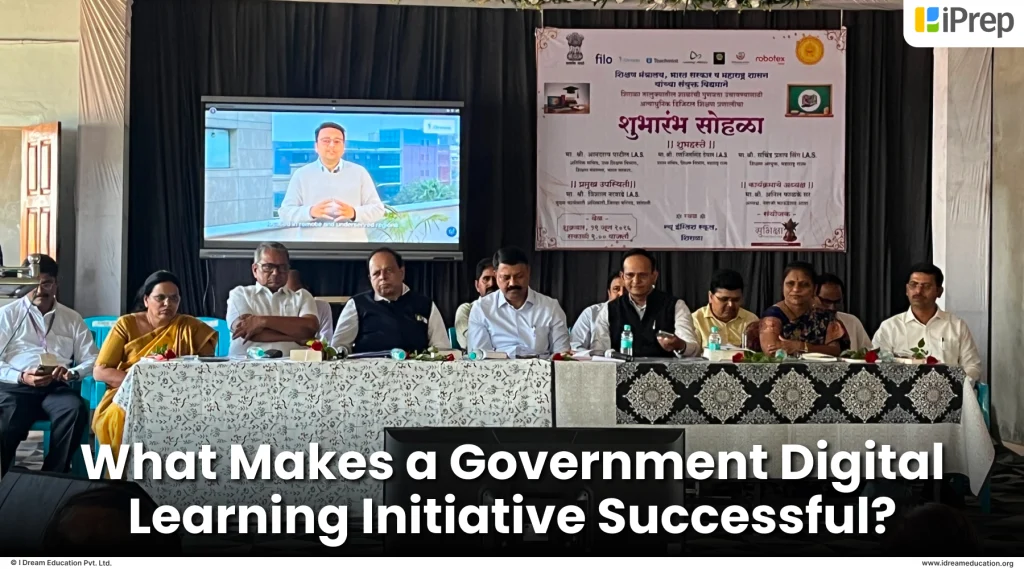
On 19 June 2026, the Digital Learning Initiative Launch Event was held at New English School, Shirala, under the joint initiative of the Ministry of Education, Government of India and the Government of Maharashtra. The event brought together senior IAS officers from the education department, district administration officials, school leaders, teachers, and students to witness the launch of digital learning in government schools.
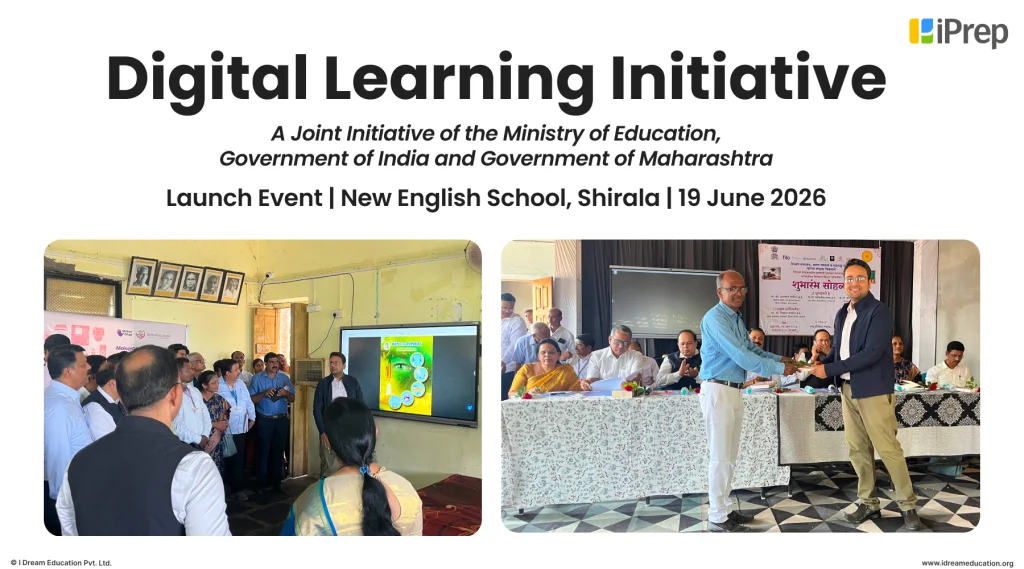
As part of the event, our team showcased how teachers are using iPrep LMS and digital content on the smart classroom infrastructure installed in their schools to make classroom teaching more engaging and effective. Live classroom demonstrations highlighted how digital content can seamlessly support teaching while keeping students actively involved in the lesson.
While the demonstrations were well received, the most memorable moment of the day happened away from the stage.
As we walked through the school campus along with senior government officials, we happened to pass a Class XI Science classroom. There was no scheduled demonstration, no members of our team inside the classroom, and the teacher had no idea that visitors would walk in. She was simply teaching her students.
What immediately caught our attention was how effortlessly she was using iPrep. She navigated through the subjects, selected the exact topic she wanted, opened the relevant digital content, and continued teaching without interruption. There was no hesitation or dependence on anyone for support. The smart classroom wasn’t the highlight of the lesson, it had quietly become part of her everyday teaching process.
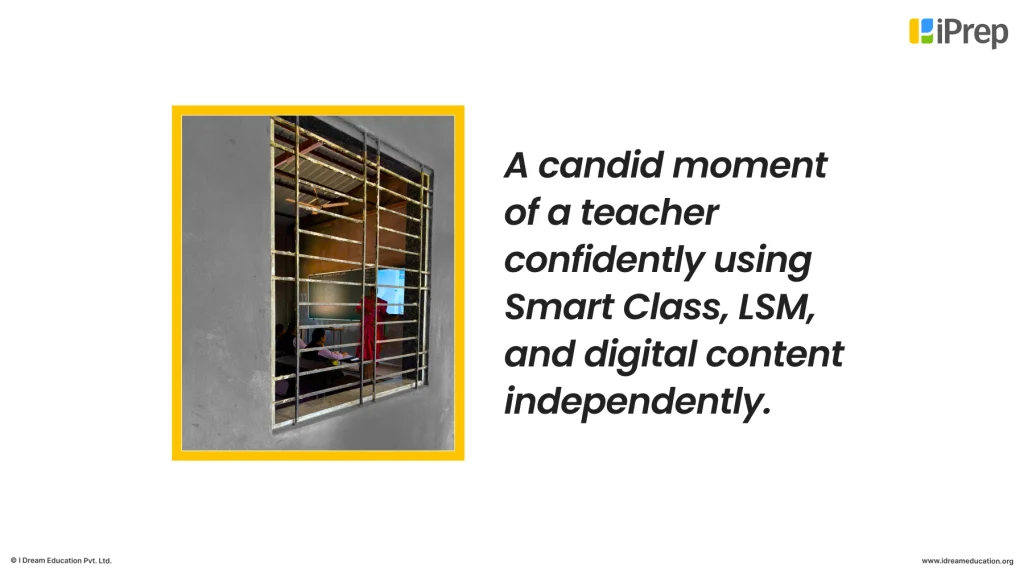
As we looked around, we noticed the same sense of satisfaction on the faces of the government officials accompanying us. They weren’t watching a prepared showcase; they were witnessing genuine classroom adoption. For us, that moment became the true measure of successful smart classroom implementation in Maharashtra schools.
Too often, digital classroom projects are judged by the number of smart classrooms installed, devices distributed, or teachers trained. While these are important milestones, they don’t define success. The real success begins after the launch event is over, when teachers independently choose to use digital resources because they genuinely make teaching easier and improve student learning.
Over the years, we’ve realised that teachers don’t resist technology. They resist complexity.
This is the line that should reframe how the sector thinks about adoption, and it’s worth taking seriously rather than nodding past. Every stalled EdTech rollout we’ve seen shares a common root cause: it asked teachers to add cognitive load to an already demanding job. A device that needs internet access mid-lesson. Content that doesn’t map to what’s actually being taught that week. An interface that requires training just to navigate. None of these are failures of teacher motivation, they’re failures of design.
The inverse is what we saw in Shirala. Complexity had been engineered out of the experience: content that works offline, navigation simple enough to use without a support call, material aligned closely enough to the curriculum that a teacher doesn’t have to hunt for what she needs.
This is a large part of why we started our podcast series, Digital Learning Is Not Hardware Procurement
Through our podcast series, we have been engaging with education leaders to understand the gaps, challenge existing notions, and explore what it takes to make digital classroom initiatives sustainable. It is encouraging to see this narrative gaining momentum, with government-led smart classroom initiatives increasingly looking beyond hardware and placing greater emphasis on Learning Management Systems (LMS), high-quality digital content, teacher enablement, and classroom adoption.
Let us look at a different way to evaluate success of digital learning initiatives
If you’re a policymaker, CSR/NGO, government official, school leader, or implementer evaluating a digital learning initiative, the honest test isn’t “how many classrooms have the equipment.” It’s closer to: walk into an unannounced digital classroom, mid-lesson, and see what the teacher does without a script. If the answer comes confidently, without hesitation or interruption, that’s success. If there’s uncertainty, pauses, or time spent searching through content, then installation numbers were never the real measure of impact.
That’s the standard we hold our own work to. It’s much harder to showcase in a press release, but it’s the only metric that truly tells us whether a digital learning initiative changed anything inside the classroom.
Our visit to government schools in Maharashtra as part of the state’s digital learning initiative reaffirmed this belief.
The true success of a digital learning initiative is not measured by the number of smart classrooms installed or launch events conducted. It is measured when a teacher confidently uses digital resources without anyone prompting her, when technology quietly becomes an integral part of classroom teaching, and when students experience richer, more engaging learning every single day. That is the kind of implementation that creates lasting impact, and the future we are committed to building together.
If you’re looking to strengthen your digital learning initiative, we’d be happy to help.
Our end-to-end solution combines digital/smart classroom hardware, a robust Learning Management System (LMS), curriculum-aligned digital content with comprehensive usage analytics to ensure technology is not just installed, but meaningfully used. We’d be happy to share our experience, successful implementation case studies, and practical insights from large-scale government and CSR projects. Together, we can help design a digital learning initiative that is classroom-ready from day one and delivers measurable learning outcomes. You may contact us at us at +91 7678265039 or write to us at [email protected]
Categories You may Explore
Related Articles