Genesis of PAL, How it Works, Benefits, Implementation & Progress

Explore the journey of Personalized Adaptive Learning in India – from genesis of PAL to its impact & progress.
Cover image for blog on the genesis of PAL, featuring iPrep PAL solution interface and elements representing personalized adaptive learning

The genesis of Personalized Adaptive Learning (PAL) was born out of a simple yet powerful realization –  every learner is unique. In most traditional classrooms, however, students are taught the same lessons, in the same way, and at the same pace. This one-size-fits-all approach does not consider individual differences in learning speed, prior knowledge, strengths, or challenges. As a result, many students either struggle to keep up or lose interest altogether. They skip over topics they don’t fully understand, gradually falling behind in their conceptual understanding. This creates a gap that often widens as they move to higher grades.

The learning gap in India, in particular, is complex and deeply rooted concern 

  • One key reason is that students are often promoted to the next grade based on cumulative scores rather than true mastery of each subject. This means their grasp of foundational skills may remain unclear, creating gaps that make future learning increasingly difficult.
  • Secondly, absenteeism in classrooms whether due to family responsibilities, illness, or lack of motivation — further disrupts continuity in education. 
  • Third, overcrowded classrooms, limited teaching resources, and insufficient infrastructure, especially in rural areas, make effective teaching difficult. 
  • Fourth, the overemphasis on rote memorization aimed mainly at passing exams does little to build deeper understanding or critical thinking skills. As a result, students often struggle to apply what they learn to real-life situations.

The COVID-19 pandemic made this situation worse. 

School closures and online learning highlighted the digital divide, with many students unable to access remote classes. Two years of disrupted learning widened existing gaps and created a pressing need for focused, personalized learning solutions. To truly address these challenges, we needed to first understand each student’s learning needs and then provide targeted support. This might involve one-on-one tutoring, extra practice, technology-enabled interventions, or adaptive learning platforms.

At the same time, the revised NEP curriculum framework, structured as 5+3+3+4, emphasizes covering skill gaps and life competencies across all educational levels. 

Thus, it also emphasizes helping students bridge historical learning gaps, achieve grade-appropriate proficiency, and support holistic development – making Personalized Learning a vital component of the Indian education system.

It was in response to these challenges that the genesis of PAL first took shape

Personalised Adaptive Learning (PAL) is an approach designed to meet each learner where they are and help them grow from that point onward. Edtech innovators began creating PAL solutions that adapt to individual learning needs, track student progress, personalize the learning journey and help them reach grade level learning. This marked the beginning of a new era in education – one that promises “One Size does not Fits All

Now, Let’s First Understand: What is Personalized Adaptive Learning, how it works & Key Benefits of PAL?

Personalized Adaptive Learning (PAL) is a technology-driven approach that recognizes that every student’s learning journey is unique. Students often start at different levels of understanding, progress at different paces, and have distinct learning needs. PAL adapts to these individual differences to ensure every student can achieve mastery.

Here’s how PAL works:

  • Diagnosis of Learning Levels: PAL software identifies what a student already knows, what concepts they are struggling with, and any misconceptions that may be hindering their progress.
  • Personalized Learning Path: Based on this diagnostic, the software designs a tailored learning path for each student. This path includes adaptive practice exercises, remedial content, and targeted resources such as books and activities to address gaps.
  • Concept Mastery: Students move forward only after mastering a topic or concept. Once they achieve proficiency at one level, then the next level gets unlocked, ensuring a strong foundation before progression.
  • One to One Tutoring: PAL works like a one-on-one tutoring approach. With PAL software each learner gets their own personalized learning path, free from the fear of being judged or compared to others. As a result, students progress confidently, mastering concepts without needing multiple attempts or repeated assessments.
  • Targeted Remediation: Unlike traditional methods, which may treat all errors the same, PAL pinpoints specific misconceptions. For example, if a student struggles with decimal multiplication, instead of simply marking the answer wrong, PAL identifies the exact issue like whether the student is unclear on decimals, double-digit multiplication, or the structure of the problem and provides step-by-step guidance to correct it.

Therefore, when industry stakeholders say PAL works, they mean its genesis is not just about practice; it’s about precisely understanding each student’s challenges and guiding them through a personalized, mastery-based learning journey.

Let Us Now Look at Key Benefits of PAL
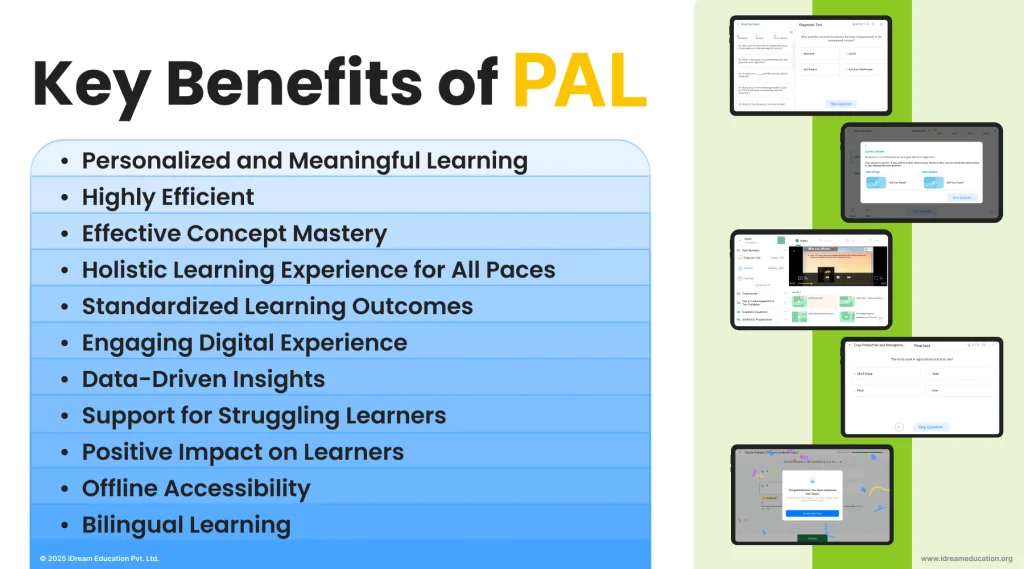
Illustration showing the benefits of PAL for school education

Personalized and Meaningful Learning

PAL makes the learning experience personal. By suggesting learning paths that resonate with each student’s current understanding, it ensures that every concept and activity feels relevant and meaningful.

Highly Efficient

Adaptive learning focuses only on what a student doesn’t know. It avoids repeating concepts already mastered, saving time and making the learning process far more efficient.

Effective Concept Mastery

PAL starts with areas where a student struggles and reinforces them throughout the learning journey until mastery is achieved. This repeated, targeted approach ensures strong conceptual understanding.

Holistic Learning Experience for All Paces

The PAL solution embraces different learning speeds. Faster learners move ahead confidently, while slower learners can spend as much time they need to grasp through remedial lessons, and concept recaps. Students move to higher levels only when they have fully mastered the fundamental concepts, making learning truly holistic

Standardized Learning Outcomes

Even though learners have diverse styles and strengths, the PAL learning system ensures everyone achieves the same learning outcomes. By offering distinct pathways tailored to each student, it harmonizes results without compromising personalization.

Engaging Digital Experience

The digital, interactive nature of PAL solution appeals to younger learners, making lessons more engaging and enjoyable. This interactivity helps sustain attention and motivates students to stay committed to learning.

Data-Driven Insights

PAL uses analytics to gather and examine data from diagnostic scores. Based on this, adaptive learning technology identifies patterns, detects learning gaps, and delivers content in real-time based on individual needs, far faster and more accurately than traditional methods.

Support for Struggling Learners

Students who face challenges with conventional teaching methods benefit greatly from the PAL solution. Personalized practice and remedial learning content ensure that every learner reaches expected outcomes, bridging gaps that traditional methods often leave unaddressed.

Positive Impact on Learners

PAL enhances learner confidence and perseverance. With a tailored pace and clear guidance, students feel less stressed, more motivated, and more honest in their work, leading to a healthier, more productive learning experience.

Offline Accessibility

One of the significant benefits of the PAL solution is that the PAL can be used even without internet connectivity. This makes PAL an ideal remedial learning solution for schools and communities located in low bandwidth areas. This ensures that all students can engage with adaptive learning app and content without being constrained by connectivity barriers.

Bilingual Learning

PAL supports bilingual instruction, including regional languages, enabling students to learn in the language they are most comfortable with. A PAL solution having the potential to deliver local language learning is critical because research shows that children grasp foundational concepts more effectively when taught in their mother tongue, building stronger comprehension, confidence, and long-term retention.

How PAL is Being Implemented and Progressing: Insights from State Initiatives, Research, and the Social Sector

Having seen the key benefits of PAL, it’s important to understand how this adaptive learning approach is being implemented across India – by states, through research-backed initiatives, and via social sector programs.

  • PAL in Haryana: Haryana became the first state to adopt a tablet-based Personalized Adaptive Learning program. The state implemented this initiative across all 5 lakh government school students in classes 10 to 12, bringing adaptive, personalized learning directly into classrooms at scale. Know more about Haryana’s e-Adhgam initiative
  • PAL in Rajasthan: Rajasthan launched one of the largest PAL programs in India to address learning loss caused by the Covid-19 pandemic. The program seeks to support 3 million students, with a special focus on adolescent girls, by offering personalized digital content and real-time feedback through a PAL platform accessible via school labs or smartphones.
  • PAL in Andhra Pradesh: Andhra Pradesh introduced personalized adaptive learning systems in 51 high schools, with plans to expand further. Launched in 2018, the program has expanded significantly and was recently praised by Nobel laureate Michael Kremer

Several other states are also exploring/ adopting PAL solutions for schools and NGOs, often in partnership with companies that provide PAL software or complete PAL setups such as PAL Lab, digital library with PAL or PAL on tablets.

Research Insights on PAL 

An independent study conducted by Nobel Prize-winning economist Michael Kremer on Andhra Pradesh’s Personalised Adaptive Learning (PAL) model revealed inspiring learning outcomes. Students who used PAL showed improvements equivalent to 1.9 years of schooling compared to their peers who did not use the programme. Those in Grades 7 to 9 who participated in the PAL programme over two academic years (about 17 months) and spent an average of 35.3 hours using the software to learn math concepts achieved learning gains at nearly twice the rate of students who did not use the software. Highlighting the potential of this approach, Kremer remarked, “If I were a policymaker in India, I’d go ahead with personalized adaptive learning.” This research underscores the transformative potential of PAL in improving learning outcomes at scale. Read in detail

Our Implementation Experience  from Govt. and Social sector PAL Programs: Progress from the Ground

Being part of the education ecosystem for over nine years, we have worked extensively with government schools, social sector partners, and NGOs to deploy digital learning solutions that truly make a difference. For the past three years, we have been actively working to accelerate PAL implementation. From setting up PAL labs to enabling PAL software on personalized student devices across states such as Haryana, Punjab, and others, our implementation experience has consistently shown that PAL improves student learning outcomes.

Insights from Haryana’s e-Adhigam Initiative

One of the most impactful examples comes from Haryana, where we enabled our PAL software, iPrep PAL, on student tablets under the government’s e-Adhigam program. In the academic year from July 2023 to June 2024, students using the PAL software showed inspiring progress:

  • Initial Performance: Average diagnostic test score – 35.6%
  • Post-PAL Performance: Average final test score – 73.6%

This represents an impressive 38% improvement, clearly indicating how PAL’s personalized, mastery-based approach accelerates learning outcomes when implemented at scale.

Insights from PAL Lab Implementation in Punjab

Similar improvements have been observed in our PAL lab implementations in government schools across Punjab:

  • Overall Improvement: Students demonstrated an average 30–35% improvement across subjects from diagnostic to final assessments.
  • Closing Foundational Gaps: A significant proportion of students who started at beginner or intermediate levels progressed to higher proficiency levels, successfully bridging critical learning gaps.
  • Achieving Grade-Level Competency: Hundreds of students who were initially below grade level reached grade-level expectations. For instance, in Science, the number of grade-level students increased from just 8 at baseline to 464 by the final assessment.
The research by Michael Kremer and our on-ground insights from Haryana, and Punjab on PAL usage and outcomes clearly show that PAL works  – But only with structured programmatic support. Its success relies on creating a safe environment for students to learn without judgment, providing experiential training for both teachers and students, conducting regular school visits to ensure smooth adoption, and continuously monitoring usage and learning outcomes to guide timely interventions.

Different Ways to Implement PAL in Schools & for At Home Learning
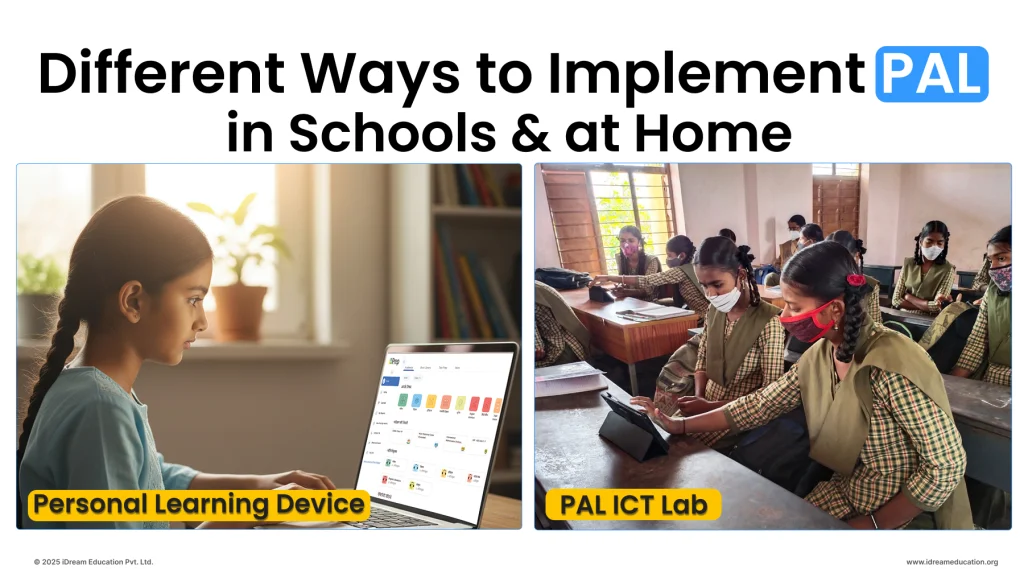
Image showing two ways of implementing PAL for students: PAL ICT lab and students using PAL learning on tablets

Personal Learning Device:

  • In this approach, each student receives a personal learning device that can be used both at school and at home. For schools, tablets are typically provided, preinstalled with the PAL app and preloaded remedial learning content, enabling students to learn completely offline. For home learning, PAL can be accessed on tablets, Chromebooks, laptops, or even mobile phones. On tablets, Chromebooks, or laptops, the app comes pre-installed with content aligned to the curriculum. For mobile devices, the PAL app and content can be accessed online by downloading it from the Play Store or App Store. In both cases, the PAL app is available in preferred languages, and offers a fully personalized learning path for each student. This ensures continuity of learning and allows students to progress at their own pace, whether in school or at home.
  • This approach can be implemented for individual students or scaled up to small- or large-scale remedial learning programs, ensuring that every learner receives targeted support and continuity of learning, whether in school or at home.

PAL ICT Lab

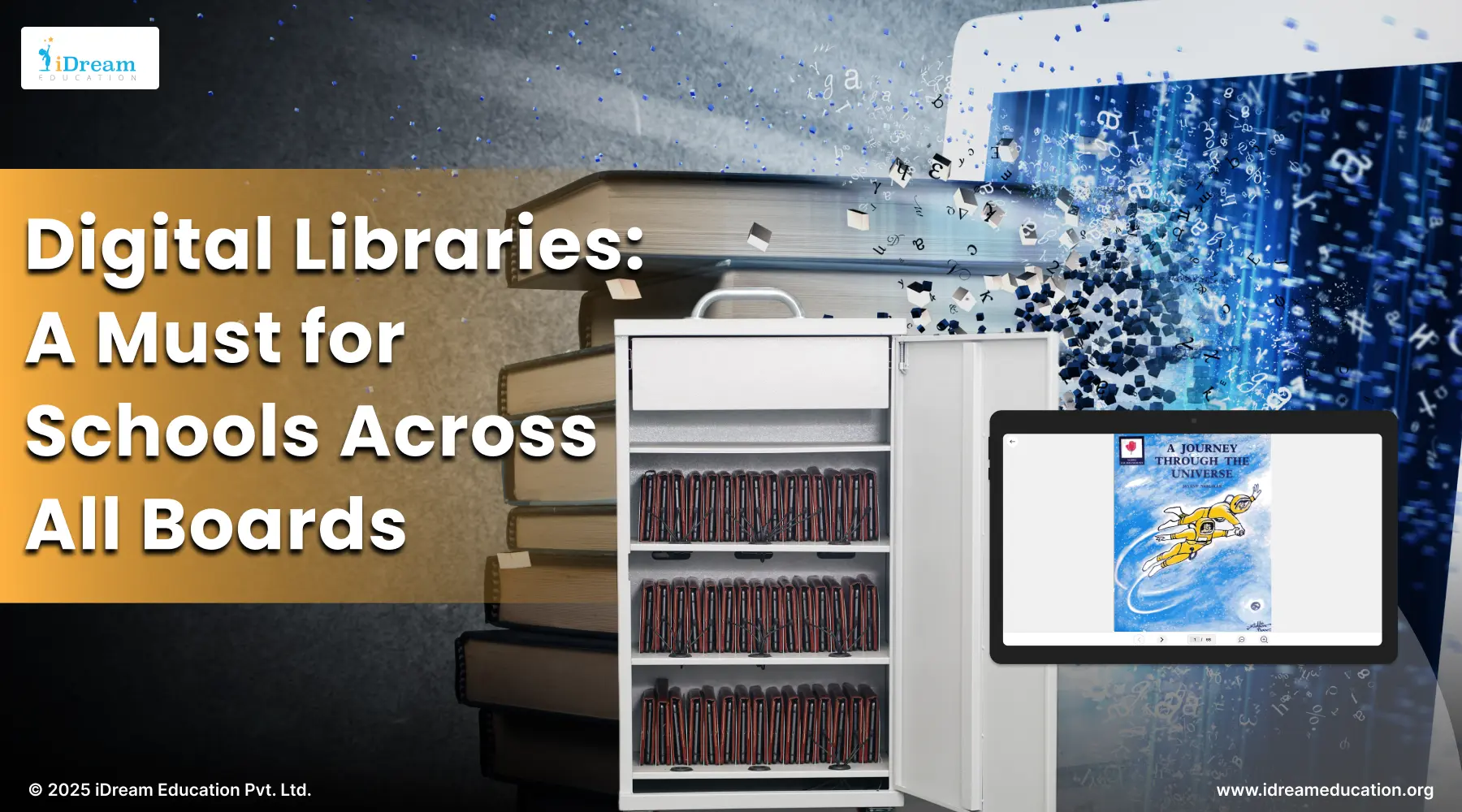
  • In this approach, a dedicated PAL Lab is set up in the school with a storage and charging rack containing tablets, Chromebooks, or laptops – each pre-installed with the PAL app and preloaded with adaptive learning content. The PAL software also includes a built-in usage reporting mechanism for tracking engagement and ensuring accountability. PAL Labs can be customized to suit the school’s needs and typically accommodate anywhere from 5 to 60 devices, which students across different grades can use on a rotational basis.
  • This PAL ICT Lab model is highly scalable and cost-efficient, making it ideal for large-scale or statewide PAL implementations. By enabling multi-grade access through a single setup, schools can deliver personalized adaptive learning to all students without needing individual devices for each one. The PAL Lab can also be designed as a digital library, offering not only adaptive learning content but also e-books and curriculum-aligned resources, or it can be integrated into an existing digital library space with just the devices added.

All these PAL implementation models, whether through personal learning devices, PAL ICT labs, or digital libraries with PAL are most effective when complemented with continuous training, hand-holding, and technical support. Ongoing capacity building for teachers, regular program monitoring, and timely assistance are essential to ensure the successful adoption and long-term impact of any PAL initiative.

Since the genesis of PAL, its progress has gone beyond merely transforming learning paths. It is helping thousands of students build strong foundational skills, bridge learning gaps, and achieve grade-level mastery.

If you are looking for a PAL solution and wish to experience our PAL software –  including how it can be implemented in your programs through our full-scale programmatic interventions, you may contact us at +91 7678265039. You can also write to us share@idreameducation.org or share your details here

You May Explore More About Personalized Adaptive Learning (PAL)

Develop a deeper understanding of Personalized Adaptive Learning (PAL), through our other created blogs. Our articles cover a wide range of topics — from PAL setup, implementation insights and research findings to state initiatives and social sector programs, helping policymakers, and stakeholders stay informed about the latest developments in adaptive learning.

  • Read Here to Know How to Make the PAL Learning System Fun and Engaging for the Students to Use Regularly
  • Insights from PAL Works: Here What you Should Know
  • Walk through Muskaan’s learning journey with iPrep PAL and see how she bridged her learning gap
  • Read About Increasing Adoption of PAL in 2025
  • Discover what Michael Kremer’s study reveals about personalized learning in India
  • Explore how the end of No Detention Policy could boost PAL adoption in government schools.
  • Read Why is PAL for Government School Students Important?
  • Discover how to bring personalized adaptive learning to your school with a PAL Lab.
  • Can adaptive learning be the key to closing educational gaps? Find out.
  • See the impact of learning gaps and how we can bridge them
  • Find out why Personalized Adaptive Learning is essential for NEP success.
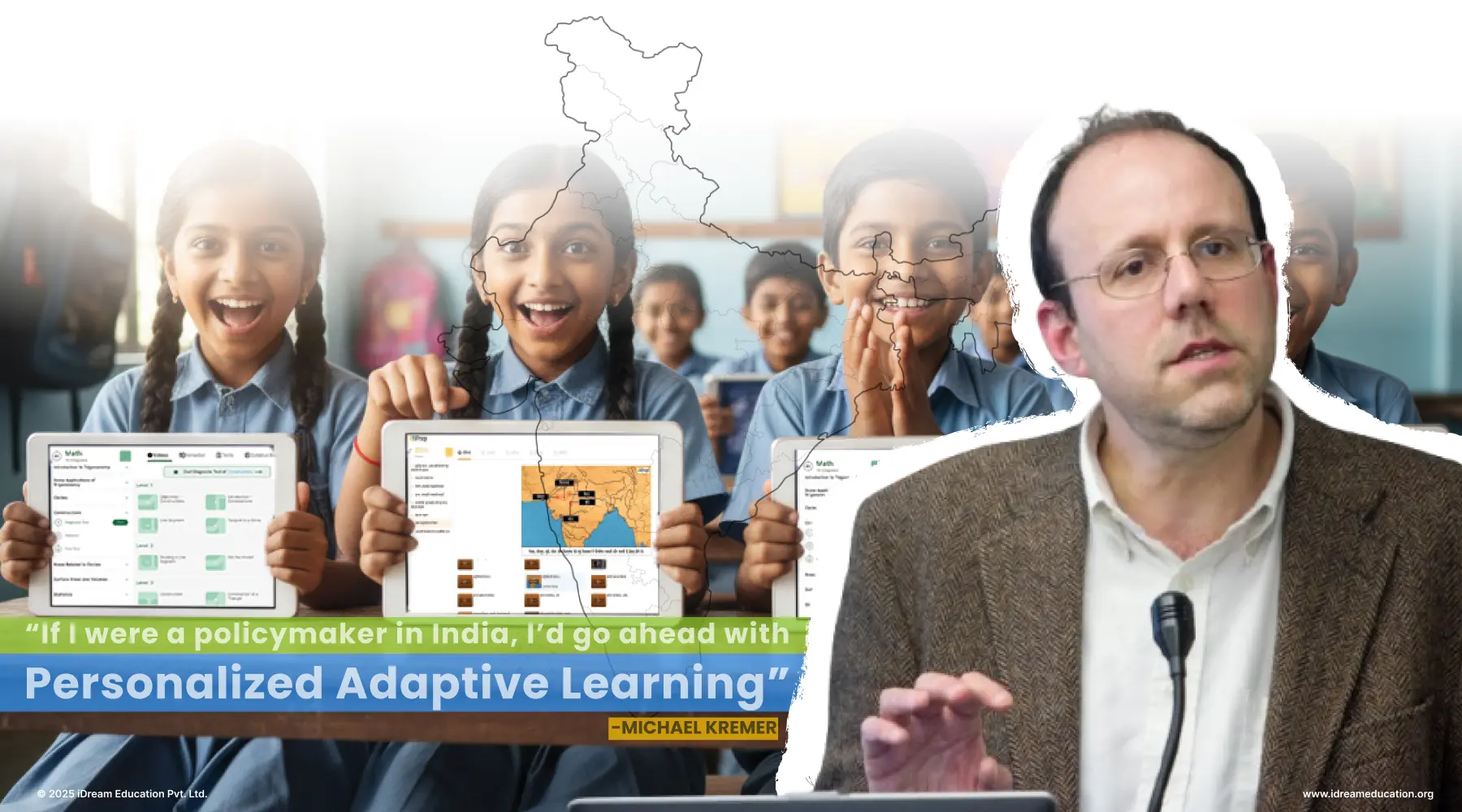
Michael Kremer on Personalized Adaptive Learning in India – Evidence from the Andhra Pradesh PAL Study

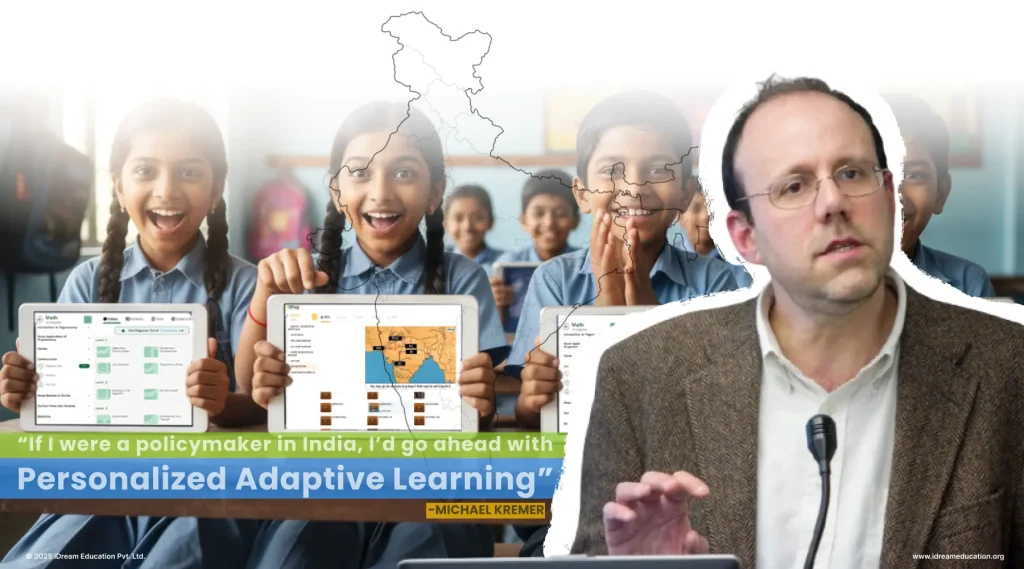
What Nobel Laureate Michael Kremer says about education in India is hard to ignore: “If I were a policymaker in India, I’d go ahead with personalized adaptive learning.” And we couldn’t agree more. 

Cover image featuring Michael Kremer’s statement on education in India, emphasizing PAL adoption in India based on the Andhra Pradesh PAL study

In a country where millions of students struggle to reach even grade-level learning, lose interest without understanding the root of their difficulties, attend classes irregularly, or disengage from certain subjects, Personalized Adaptive Learning (PAL) is essential. 

PAL solutions have the power to transform classrooms from a rigid, one-size-fits-all system into a model which understands that one size does not fit all. PAL enhances learning outcomes by helping students understand their actual learning gaps, guiding them along personalized paths, and allowing them to improve at their own pace. Instead of treating all students the same, it meets each learner where they are, making education both more effective and more equitable.

Evidence from the Andhra Pradesh PAL Study is compelling. 

Kremer’s team at the Development Innovation Lab, University of Chicago, evaluated PAL in 1,224 government schools in Andhra Pradesh. Their findings PAL study are insightful: His PAL research, along with a PAL study conducted in Andhra Pradesh, showed that PAL significantly accelerated learning. Students achieved the equivalent of 1.9 years of schooling in just 17 months—nearly double the progress made through traditional methods. Most strikingly, students at the bottom of the class recorded the greatest gains. In a system where the weakest students often fall further behind, PAL’s ability to lift the lowest performers is nothing short of transformative. 

As Kremer explains

PAL works by adapting lessons to each student’s level. If a child struggles with subtraction, the program reinforces it before moving to division. If another is ready for advanced problems, it challenges them appropriately. It automatically adjusts to meet the student where the student is…Our results suggest this helped students wherever they were because it went to meet them.

This is exactly what effective education should achieve for every student. It should ensure that when students miss foundational concepts, the next lessons don’t feel overwhelming. Education must be adaptive, meeting learners where they are and guiding them toward their full potential.

Kremer further emphasized:

But PAL’s success is not just about technology, it’s about teachers too. He said, “teacher involvement and real-time engagement checks are critical”. And that is exactly what PAL software achieves: it enhances the role of teachers rather than replacing them, enabling teachers to focus on mentoring, monitoring, and ensuring that every student truly benefits from a personalized learning experience.

Although the Andhra Pradesh study focused on Classes 6 to 9 across 1,224 government schools, Kremer emphasizes that PAL is worth implementing in younger grades as well. For a country such as India, where classroom diversity is vast and educational inequities are widespread, PAL is not just an innovation – it is a necessity for an education system long plagued by learning gaps and missed opportunities. 

Kremer’s message is clear and urgent: India cannot afford to ignore personalized adaptive learning.

The PAL study clearly shows that PAL works, but the focus must now shift to how urgently it should be heard, understood, and implemented so that every student, in every classroom, can benefit from learning tailored to their needs.

But to Truly Deliver Results, PAL Must Be Implemented Thoughtfully

To make Personalized Adaptive Learning truly effective – whether at the school level or for statewide PAL integration, it is not enough to adopt the technology. Understanding how PAL is implemented in classrooms is critical to achieving the meaningful improvements in learning outcomes highlighted by Michael Kremer. Evidence from Andhra Pradesh and Rajasthan shows that while the PAL software itself drives learning, its success hinges on structured, programmatic intervention such as: 

Enable PAL Solution That Promotes Student Learning Without Judgment

The PAL solution chosen for implementation must go beyond creating personalized learning paths, it should actively motivate students to stay engaged in remedial learning. The design should allow learners to progress seamlessly, without realizing they are being taken back to previous grade levels. Remedial content should be integrated naturally into their journey, accessible as part of their learning path rather than as a separate or stigmatized activity.

Such an approach is crucial for schoolwide/statewide PAL adoption. When students know they can revisit concepts without fear of judgment or comparison, they are more likely to embrace the system, reflect on their gaps, and work to close them. The solution should also ensure that all content is synced with the curriculum so that learners remain aligned with grade-level expectations, regardless of how much remedial material they access. Finally, the system must give students the time and flexibility to cover historical learning gaps at their own pace, without pressure, so progress feels natural, continuous, and empowering.

Experiential Training for Teachers and Students

Experiential training is a critical intervention to ensure PAL adoption and to drive meaningful outcomes from school- or state-level PAL implementation. It must go far beyond handing over devices preloaded with software. Instead, training should be designed as a hands-on, student- and teacher-centric experience that builds confidence, clarity, and ownership.

  • For students, this means being guided through every step of their learning journey: how to take diagnostic tests, how remedial learning is embedded in their path, how to engage with content meaningfully, when and how practice tests or final assessments will appear, how to make use of hints and attempt multiple practice sessions without fear of judgment. The focus should be on mastery, progress tracking, and building self-awareness of their own learning journey.
  • For teachers, experiential training must empower them to use PAL as a tool for guidance rather than as a replacement. Teachers should be taught how to track student data, interpret progress reports, and identify which students may need personalized, in-person support. With these insights, teachers can adapt classroom instruction, mentor individual learners, and ensure that PAL complements rather than competes with their role.

By investing in structured experiential training on PAL, schools and states can ensure that both students and teachers understand not just what PAL is, but how to use it effectively, helping them improve learning outcomes.

Regular School Visits to Ensure Smooth Implementation

A PAL program should not be just about deploying devices and software, it should be about ensuring consistent and meaningful use. For students to progress steadily, they must be able to access PAL without long interruptions caused by technical glitches, device issues, or lack of support. If such barriers remain unresolved for weeks, students lose momentum, teachers lose trust, and the program’s long-term impact is compromised.

That is why regular visits to schools are critical. Implementing partners must stay closely connected with teachers and students. This ensures continuous track of how well the software is being used. These visits should provide immediate troubleshooting support, address usage challenges, and ensure that both teachers and learners remain engaged. By maintaining this on-ground presence, schools can avoid delays, sustain consistent usage, and ultimately translate PAL into real and timely progress for every student.

Usage Reporting and Monitoring Outcomes

  • For PAL to create measurable impact at scale, every school/ every statewide PAL ecosystem must have transparent visibility into both usage and outcomes. Impact is not enough by installing the PAL software; stakeholders must know how often it is being used, by whom, and with what results.
  • The PAL solution should therefore include real-time usage tracking, with offline capability and automatic syncing to a centralized reporting dashboard. This enables project authorities and education officials to clearly monitor adoption trends, learning progress, and gaps across schools. With such insights, decision-makers can plan targeted teacher training or retraining, identify where additional support is needed, design appreciation programs to motivate adoption, and make data-driven choices for project expansion.
  • By embedding robust monitoring and reporting mechanisms, PAL becomes more than just a technology, it evolves into a transparent, accountable ecosystem where usage drives outcomes and outcomes guide future action.

These programmatic interventions are critical when enabling Personalized Adaptive Learning. To truly deliver results, PAL must be implemented thoughtfully and systematically. 

With our PAL solution already being used by more than 5 lakh students across India through PAL lab setups and personalized tablets, we are consistently seeing year-on-year improvements of 30–40% across subjects and grades. Our first official PAL report on 12 months of usage trends and outcomes from schools in Punjab will be released soon. Stay Tuned


If you would like to know more about the progress our students have been making, and about the programmatic interventions we integrate into our end-to-end PAL implementations for achieving learning outcomes, you may contact us at +91 7678265039. You can also write to us at share@idreameducation.org or share your details here.

Find the Right Multi-Format Digital Content for Class 10 – Aligned with NCERT & State Boards

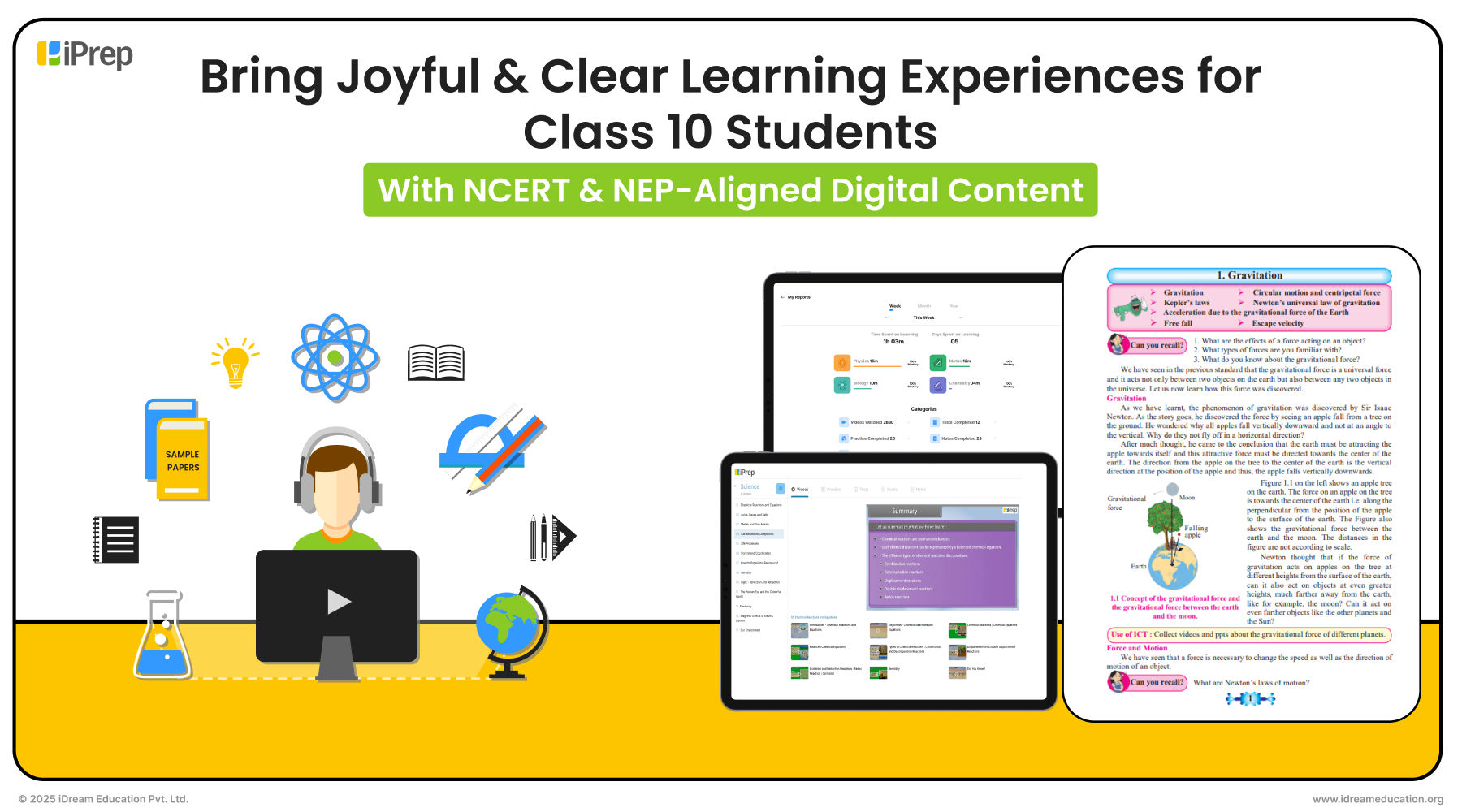
Cover image of blog showing Class 10 digital content by iDream Education on iPrep LMS for students and teachers

Class 10 is one of the most crucial stages in a student’s academic journey. It is not just about completing the syllabus, instead it is the year that sets the foundation for future choices, whether in science, commerce, or humanities. The way students learn and perform in Class 10 often shapes their confidence and interest in particular subjects, which directly influences their stream selection and career direction. That is why, more than any other stage, Class 10 learning demands a careful balance of conceptual understanding, consistent practice, and exam-oriented preparation.

This is Why Textbooks Alone Are Not Enough

Board exams in Class 10 cover an extensive curriculum, and to master it, students need much more than just textbooks. They need access to curriculum-aligned content that not only explains concepts in a clear and simple way but also offers step-by-step solutions, easy-to-use revision notes, reference books, and opportunities for adaptive practice or comprehensive assessments. Study material in a diverse format not only simplifies complex topics but also helps students identify weak areas, revise effectively, and build confidence for the exam.

Therefore, Comprehensive Curriculum-Aligned Content is A Must for Every Class 10 Student

Well-structured content ensures that students not only cover the entire syllabus but also learn in a way that improves conceptual clarity. From comprehensive content including multimodal content to personalized learning paths, Students can identify their  weak areas, address historical learning gaps, and make exam preparation much smoother.

NCERT: The Core of Class 10 Curriculum

For Class 10 students, NCERT books are often considered the best starting point. In fact, most State Board curriculums are also designed around NCERT because these books are created by subject experts after extensive research. That makes the information not only accurate but also easy to understand. Let’s look at why:

  • One of the biggest advantages of NCERT books is their focus on concept building. In subjects such as Science and Mathematics, understanding the basics is more important than rote learning. NCERT books explain topics in a simple, clear language while ensuring in-depth coverage. This helps students strengthen their fundamentals and prepare for both board exams and higher studies.
  • When it comes to exam preparation, NCERT books also stay in close alignment with the CBSE curriculum. In fact, many questions in board exams, especially in Science, are picked directly from NCERT chapters and examples. Chemistry equations, definitions, and diagrams often come straight from the textbook, while NCERT exemplar problems provide additional practice for Maths and Physics.

That’s why teachers and toppers always recommend NCERT and its solutions as the first step to mastering Class 10. Once students build a strong foundation with NCERT, they are prepared to progress to advanced resources, practice tests, and digital content that support deeper learning and exam readiness.

What are the major CBSE updates for Class 10 in 2025–26?

From 2025–26 onwards, the Class 10 curriculum has been revised with a focus on flexibility, reduced exam stress, and competency-based learning. Here are the major highlights:

Two Board Exams from 2026

Starting 2026, CBSE will introduce a two-exam policy for Class 10. Instead of one final exam, students will now appear for two board exams in a year. This step is designed to lower pressure, distribute the syllabus more evenly, and make assessments more student-friendly.

Choice Between Standard and Advanced Levels

The new syllabus gives students flexibility in Science and Social Science exams. Both subjects will now have two versions: Standard Level – concise paper with a shorter duration. Advanced Level – longer paper with additional questions for those aiming for higher depth. Both exams will be conducted on the same day, giving students the option to choose the difficulty level that matches their preparation.

Focus on Competency-Based Learning

The updated curriculum for Class 10 strongly emphasizes critical thinking, problem-solving, and creativity rather than rote memorization. With this shift, students will need to focus more on application of concepts. The official Class 10 syllabus PDF thus becomes a must-have guide for enabling, planning and preparing subject-wise strategies.

CBSE Class 10 Exam Pattern for the academic year 2025-26

  • Competency-Based Questions: 50% of the theory paper
  • Short & Long Answer Questions: 30% of the theory paper
  • Multiple Choice Questions (MCQs): 20% of the theory paper
  • Practical Exams: Subject Specific
  • Theory Exams: 3 hours per subject
  • Formative and Summative Assessments: Continuous evaluation
  • Internal Assessments: Throughout the Year

These changes have also influenced the Class 10 curriculum in many State Boards. Considering all these updates, it is important to introduce students to multimodal digital content that goes beyond textbooks. 

For this, you need a trusted digital content provider that offers up-to-date resources aligned with both NCERT and State Board syllabus. The right provider would ensure that content is structured as per the latest exam pattern, so that when students learn from digital resources, they are not only covering the syllabus but also preparing effectively for board exams. Hence, you should look for the content provider that works on bridging learning gaps, strengthening conceptual understanding, and achieving grade-level proficiency with confidence.

Let us share what you should look for when selecting the right multi-format digital content for Class 10 aligned with NCERT & State Boards

When selecting the right multi-format digital content for Class 10 aligned with NCERT and State Boards, the first priority should always be on diversification of content. This is because every student learns differently, some grasp concepts through visuals, some by practice, and some through stories or discussions. With the constant stress of exam preparation, students often feel overwhelmed – wondering what to pick, whether to revise first, or which source is the best. This leaves them scattered across multiple resources. With this thought, sharing few categories you should look for in digital content for Class 10, and the very categories we offer in digital resources for Class 10:

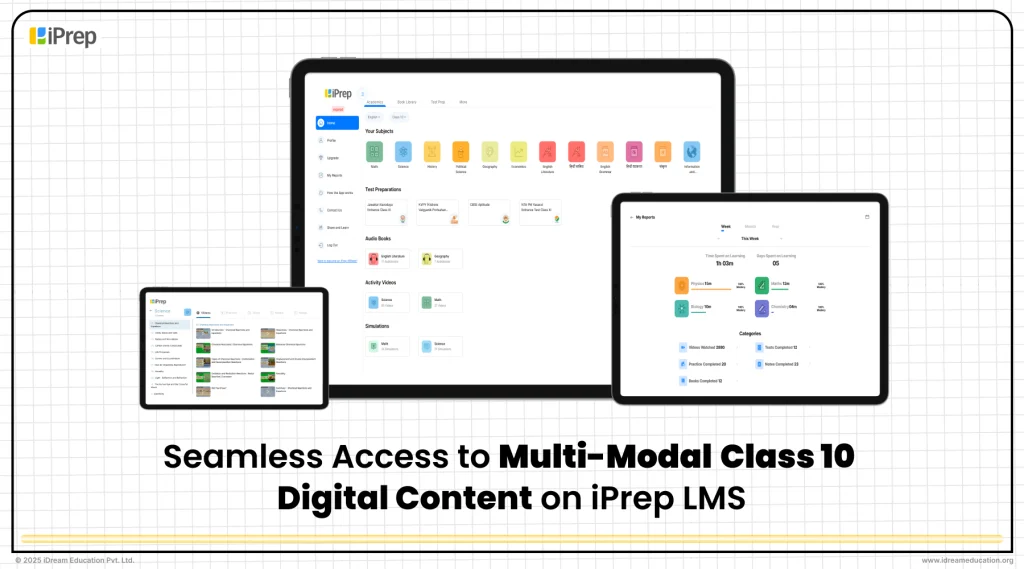
Multi-category, Subject-wise digital content for Class 10 displayed on a structured LMS by iDream Education, designed to enable organized learning

Sample Papers for Class 10

  • Sample papers are an integral part of digital content for Class 10. It helps students clearly understand the exam pattern, the types of questions asked, and the major focus areas to prepare for. They not only allow students to practice but also train them to pick the right approach, perspective, and thought process needed to attempt answers effectively. 
  • What we offer: Considering this importance, we have integrated sample papers from the last 10 years as a core part of our Class 10 digital content. While the formats of board exams have evolved over the years, these papers still serve as an excellent question bank that students can use to strengthen their exam strategies and boost confidence during practice.

Animated Video Lessons

  • Over the past decade, video content has completely transformed the way students learn and retain concepts. Therefore, Class 10, animated video lessons are also one of the most impactful learning categories. Textbook concepts, when explained through engaging animations, help simplify complex topics and make them easier to grasp. 
  • What we offer: We have created and curated animated video lessons across all subjects and chapters. Each lesson is carefully created and curated in alignment with NCERT and State Board curriculum, ensuring that students not only understand but also revise concepts effectively. The explanations are delivered in bite-sized video formats, keeping students’ interest alive while enabling quick understanding of what they might have missed in textbooks. For many learners, these animated videos also become their go-to resource for fast revision and concept clarity.

Assessments and Practice Exercises

  • For Class 10 students, practice is the key to mastery. This is the stage where they must not only understand concepts but also demonstrate their ability to apply, analyze, and present answers as per board expectations. Regular assessments and practice exercises help them strengthen retention, identify weak areas, and build exam confidence. 
  • What we offer: Our Class 10 assessments are designed to give students exposure to the complete variety of question types now asked in CBSE/NCERT board exams. Our assessment ranges from assertion-reasoning, statement-based questions, and case studies to “pick the odd one out,” “match the following,” and beyond. Each practice set is structured as per Bloom’s Taxonomy, ensuring inclusion of knowledge-based, application-driven, analytical, and competency-based questions. This makes every assessment align with the learning outcomes of the chapter, helping students not just prepare for exams but also develop deeper conceptual understanding.

Simulations for Experiential Learning

  • One of the most powerful ways to learn is by doing, and that’s where simulations in digital content for Class 10 become a true blessing. They allow students to perform virtual experiments, observe outcomes, and connect concepts with real-life applications. This kind of experiential learning not only deepens understanding but also significantly improves retention. Students tend to remember concepts for life because they have seen and done them themselves. It also builds confidence, as learners can test, explore, and repeat without the fear of going wrong.
  • What we offer: In our Class 10 digital content, simulations are specially integrated for Math and Science, where practical understanding is critical. Simulations for concepts such as Ohm’s Law, motion, friction, and many more bring learning alive through interactive, gesture-based simulations. This allows students to virtually experiment and discover. We continue to enhance this category so that learners can experience science and mathematics in action, making learning not just effective, but also engaging and joyful.

Chapter-wise Notes for Quick Revision

  • When exams approach, revision becomes the top priority for Class 10 students. In the rush to revise everything, many often feel confused, stressed, or helpless, especially if they cannot recall concepts or if their own notes are incomplete or scattered. This makes revision disconnected and leaves gaps in preparation. What students truly need at this stage is well-structured, chapter-wise notes that cover every important concept in a clear and concise way.
  • What we offer: We provide comprehensive digital notes across all Class 10 subjects, designed as quick summaries of each chapter. These notes not only help during exams for fast revision of the entire subject but also act as a handy reference throughout the year whenever students feel learning gaps. With chapter-wise notes readily available, learners can confidently revise, recall, and reinforce their understanding without the fear of missing anything important.

Along with the above categories, our digital content for Class 10 also includes a range of supplementary resources to ensure students have everything they need for complete preparation and joyful learning:

  • Climate Leadership Content: To inspire awareness and responsibility among students towards climate change, sustainability, and leadership for a better future.
  • NCERT Solutions (PDF format): Easy-to-access, step-by-step solutions for every NCERT question, helping students clarify doubts instantly and strengthen their practice.
  • NCERT PPT Videos: A powerful practice tool where NCERT content is explained in an engaging presentation format, aiding both understanding and recall.
  • Chapter-wise PPTs: Ready-to-use presentations for each chapter across subjects, useful for both teachers in classrooms and students for structured teaching and revision.

Together, these additional resources make our Class 10 digital content not just exam-oriented but also holistic – supporting conceptual clarity, practice, awareness, and revision in one place.

Another Key Aspect: How Digital Content is Enabled for Class 10 Students?

Structured Access Through an Easy-to-Use LMS

  • For Class 10 students to truly benefit from digital learning material, it is essential that the content is enabled through a structured Learning Management System (LMS). An effective LMS ensures that all categories, whether videos, notes, simulations, assessments, or sample papers are available in one unified platform that is simple to use and easy to navigate. This way, students can find exactly what they are looking for in one go, without wasting time switching between multiple sources.
  • What we offer: Our iPrep LMS offers structured access to Class 10 digital learning material. It allows students to explore subject-wise content, switch between languages, and seamlessly use different content formats. Designed with students’ ease of usage in mind, iPrep LMS supports both school-based learning and home learning, ensuring adoption is smooth, engaging, and truly effective.

Offline Access to Digital Content

  • Relying only on online platforms for Class 10 digital content often means students spend more time searching for the right material than actually learning. It also brings distractions and connectivity issues that can waste their valuable study hours. To avoid this, it is important that digital content is also enabled completely offline, ensuring uninterrupted learning anytime, anywhere.
  • What we offer: Our LMS and content are designed with this in mind – students can access the entire range of learning resources without needing the internet. This makes it easier for schools to implement and for students to stay focused on meaningful learning, whether in the classroom or at home.

Usage Analytics and Monitoring

  • Simply enabling digital content is not enough. Without tracking and monitoring usage, its true impact remains unclear. Students may not know how much time they are spending on learning or which areas they need to focus on more. Likewise, project officials who enable digital content for Class 10 would not be able to measure adoption, and outcomes.
  • What we offer: Our K12 learning platform comes with a robust usage reporting feature. It tracks every category and subject-wise usage of students. The usage can be viewed by both students and teachers on their devices. Additionally, this data is analysed and shared with project partners by us. This enable data-driven decisions on impact measurement, retraining needs, and future expansion. This ensures that digital content not only reaches students but also delivers meaningful, measurable learning progress.
At iDream Education, we have designed our Digital Content for Class 10 with a deep understanding of both teaching needs of teachers and learning needs of students. 

If you are looking to enable digital content for Class 10 students in schools, we would be glad to connect & share more details. You may contact us at +91 7678265039 or share your details here. You can also write to us at share@idreameducation.org.

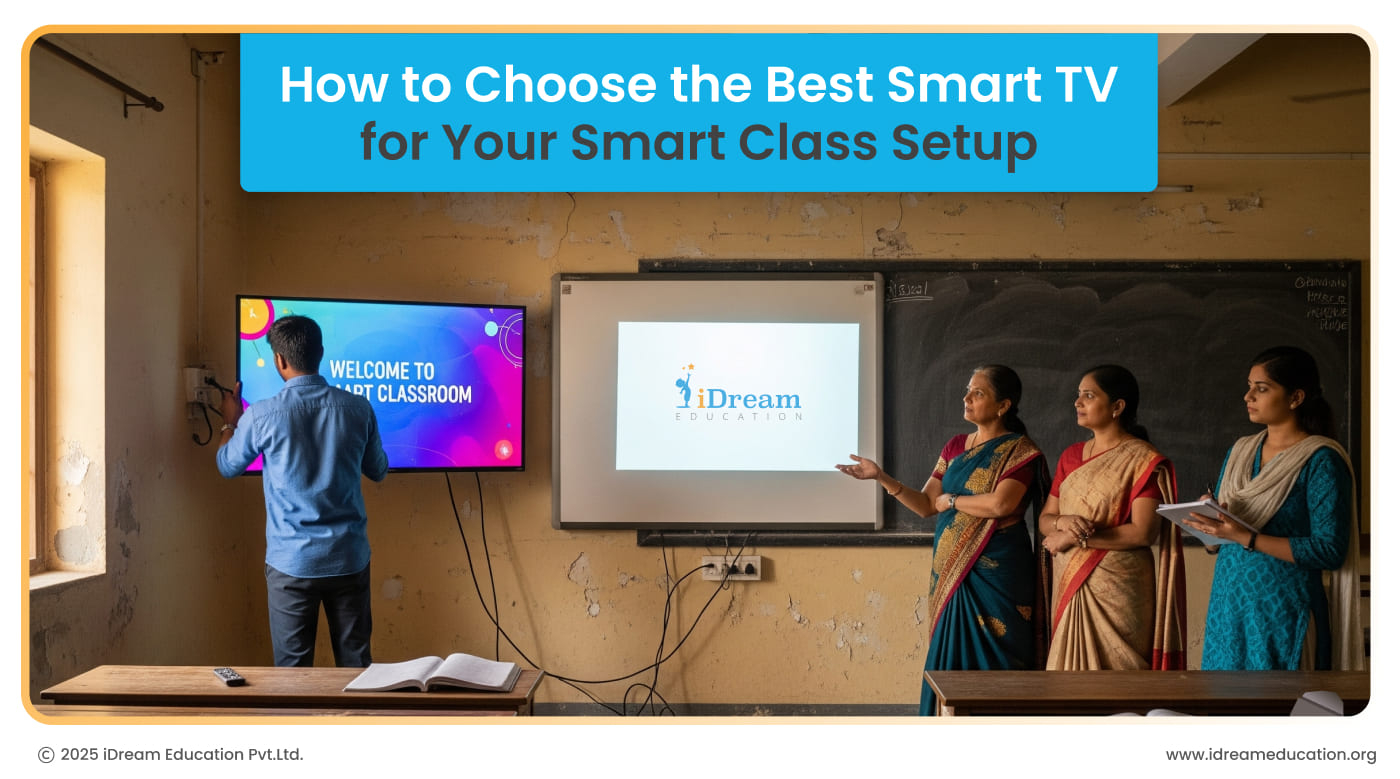
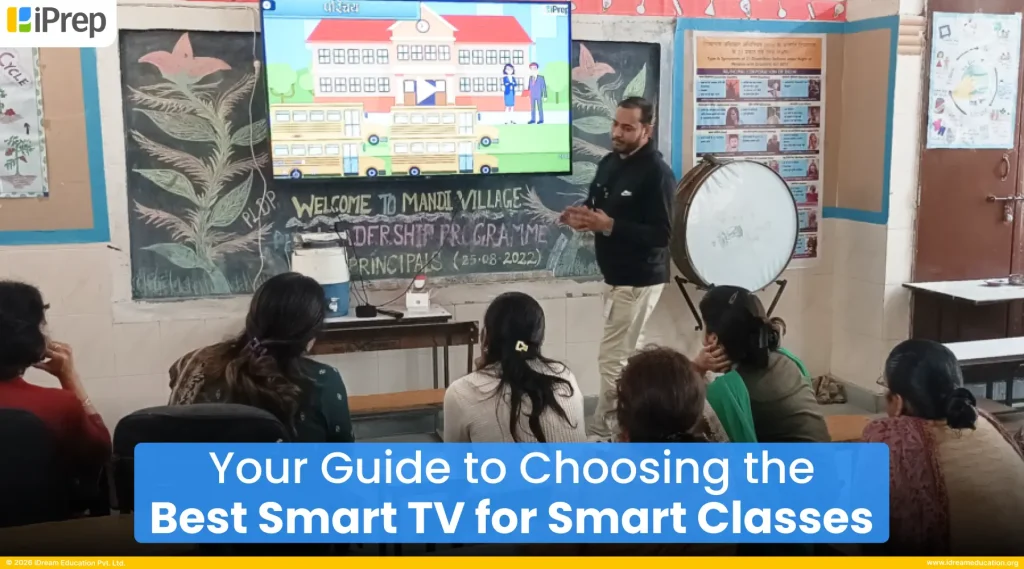
How to Choose the Best Smart TV for Your Smart Class Setup?

Find best smart TVs for smart classrooms in India

The idea of a “smart classroom” is often imagined as a space filled with screens, devices, and high-speed internet. But at its core, a smart classroom is not about technology – it is about how learning happens when the right tools support the right intent. Technology is only powerful when it quietly enables better teaching, deeper understanding, and more meaningful student engagement.

In many schools today, Smart TVs are becoming the new blackboard. They replace chalk and dust with visuals, videos, simulations, and interactive content. Yet, choosing a Smart TV is not as simple as picking the biggest screen or the cheapest option. Every classroom has its own reality – different class sizes, lighting conditions, budgets, power supply challenges, internet reliability, and teacher readiness. A screen that works beautifully in one school may fail completely in another.

This is why selecting the right Smart TV for a smart class setup is not a technical decision alone – it is an educational one. It shapes how teachers explain concepts, how students stay curious, and how smoothly a lesson flows from idea to understanding. A well-chosen screen fades into the background and lets learning take center stage; a poorly chosen one becomes a daily obstacle.

Before looking at specifications, brands, or price tags when looking for the best Smart TV for your Smart Class in school, it is worth pausing to ask a simple question: What kind of learning experience do we want to create in this classroom? The answer to that question should guide every choice that follows.

What Are Smart Class TVs & Why Are Schools Choosing Them?

Before going deeper into features and comparisons, it helps to clearly understand what a “Smart Class TV” actually is.

A Smart Class TV is essentially a large-screen television with a built-in operating system, most commonly Android or Google TV, while some brands use systems such as Samsung’s Tizen or LG’s WebOS. This built-in system allows the TV to connect to the internet, run apps, play videos, open digital books, mirror mobile or laptop screens, and support basic interactive teaching tools, without needing extra devices.

Across India, many schools are choosing Smart TVs as their first step into digital classrooms because they offer a practical balance between cost, simplicity, and functionality. They are far easier to set up than traditional projector-based systems, and they require much less daily handling.

Smart TVs simplify all of this into one wall-mounted device. Teachers can:

  • Play videos and animations directly
  • Open digital textbooks and PDFs
  • Present slides and notes
  • Show educational apps and websites
  • Conduct activities

All of this happens using a single device, often controlled by a remote, mouse, or wireless screen sharing from a phone or laptop.

While Smart TVs are not meant to replace high-end interactive panels in every situation, they work extremely well for most classroom needs, especially where budgets, maintenance, and ease of use matter. For many schools, Smart Class TVs for smart class are the most practical way to start teaching digitally without making the system complicated or fragile.

Discover: Smart Boards for Schools

What Should You Look for in the Best Smart TV for Smart Class?

When you look for the best smart TV for smart class, consider a product that works right away, doesn’t need a tech expert, and handles all your digital learning needs. Here’s what you should look for:

Classroom-Ready Hardware That Works Every Day

The physical and technical build of the Smart TV is the foundation of a reliable smart class setup. Here’s what to prioritize:

  • Screen Size & Viewing Distance: Bigger isn’t always better. Choose a Smart Tvs size that ensures all students, even those at the back, can clearly see the content without straining. Class length and seating arrangement should guide your choice.
  • Brightness & Anti-Glare: Classrooms often have strong natural light. A screen with good brightness (measured in nits) and anti-glare performance helps maintain visibility throughout the day.
  • Durability & Build Quality: School environments are active places. Look for solid build quality, reliable mounting options, and good heat management to reduce breakdowns.
  • Audio Clarity: Built-in speakers need to be loud and clear so students hear videos, voice content, and explanations without external speakers.
  • Connectivity Options: Multiple HDMI/USB ports and wireless casting support make it easy to connect laptops, tablets, and mobile devices.
  • Energy Efficiency: Lower power consumption helps keep running costs manageable, especially where electricity use must be optimized.

Good hardware means teachers can use the Smart TV for smart classes confidently, without daily technical interruptions that disrupt learning.

Pre-Installed Smart Class LMS

A Smart TV becomes truly useful when it supports educational content delivery through a compatible smart class Learning Management System (LMS) or classroom apps. 

  • Compatibility with Your LMS Platform: Look for Smart TVs that work smoothly with the LMS platform you are choosing for your schools. Whether through Android apps, web access, or dedicated smart class software. If the TV and LMS don’t work well together, teachers will always need extra devices, which defeats the purpose of a smart class setup.
  • Easy to Navigate & Bilingual: The smart class LMS should be simple to use, with clear menus and minimal steps to reach lessons/subjects. It should also support bilingual or multilingual use, so your smart TV for smart class can work in schools across different states and language backgrounds in India.
  • Aligned with School Education: The LMS should match how teachers already teach aligned to school boards, subjects, classes, and lesson flow. It should not feel like an “external system” that teachers have to adjust to. Instead, it should feel like a complete teaching resource package, with all resources such as videos, practice, syllabus books, worksheets, assessments, and teacher guides, available in one place and easy to navigate.
  • Offers Usage Reporting: The best Smart TVs for smart class are those that work with an LMS that provides clear usage reports. These reports help you understand how often the system is being used, how teachers and students are engaging with it, and where support is needed – so you can make informed decisions about adoption, improvement, and scaling the program further.

When the Smart TV and LMS work together smoothly, technology fades into the background—and teaching takes the lead.

Quality Educational Content That Supports Learning

Hardware and LMS are important, but smart class content is what truly fuels meaningful engagement in the classroom.

  • Access to Digital Curriculum: Ensure the Smart TV with educational content provides seamless access to all types of NCERT/Stateboard learning resources your school uses. This includes video lessons, practice content, digital books, lesson modules, and curriculum material in formats such as PDFs, and videos. Teachers should be able to open and use these easily during class without technical hurdles.
  • Local & Offline Content Storage: The best Smart TVs for smart class are those that allow connection to external storage such as pen drives or hard disks. This makes it possible to run offline content on Smart TVs, which is critical in areas with weak or unreliable internet. Offline access turns the Smart TV into a complete smart class solution, not one that depends on connectivity every day.
  • Language & Curriculum Alignment: Smart class content should be aligned with NCERT/Stateboard boards, and languages of instruction. When students see content in their own language and according to their syllabus, learning feels familiar and relevant.

Teacher Training & On-Ground Support

When choosing the best Smart TVs for smart class, one of the most important factors to consider is teacher training. Even the best technology fails if teachers are not confident using it.

  • Look for a provider who offers experiential, hands-on training on how to use the Smart TV, LMS, and smart class content in real classroom situations. Training should not be just a one-time demo, it should help teachers actually practice, plan lessons, and use the system in their daily teaching.
  • Equally important is on-ground support. The provider should be available when schools need help – during installation, early usage, and whenever issues arise. If teachers get stuck and there is no quick support, the Smart TV will slowly stop being used.

If you would like to explore and learn more about the best Smart TVs with educational content for a smart class setup, and are planning to implement them in schools, you may contact us at +91 7678265039. You can also share your details here or write to us at share@idreameducation.org.

All You Need to Know About NCERT Changes Post-NEP: A Detailed Overview

Did you know? Post NEP 2020, NCERT has rolled out a massive 1,334 changes across 182 textbooks? Here’s a quick dive into what’s new, what’s the focus and why it matters for students and teachers.

Cover image guiding you to the details of  NCERT changes after NEP 2020

NCERT has long been the backbone of the Indian school curriculum. It is not just a guiding framework for CBSE schools but also as the base for almost all state boards across the country with most SCERTs following NCERT for several Grades. Post-NEP, the education ecosystem has witnessed major shifts in how learning is delivered, enabled, and made more relevant for students, with the curriculum at its very core. 

Naturally, this began with a comprehensive revision of NCERT textbooks

The changes are being implemented based on the new education structure which is 5+3+3+4 and evolving learning needs of students.

When Did NCERT Revisions Actually Start Happening?

The National Council of Educational Research and Training (NCERT) has been revising and updating school textbooks at regular intervals to keep them aligned with the evolving needs of education in India. In line with the vision of the National Education Policy (NEP) 2020, this process has gained renewed momentum in recent years. In fact, since 2014, NCERT has already carried out four rounds of textbook revisions and updates, each aiming to ensure that the curriculum remains relevant, contemporary, and meaningful for learners.

According to NCERT Director Dinesh Prasad Saklani Ji, 

  • The revision of textbooks is not a one-time reform but a global and annual exercise undertaken in almost all education systems across the world. He highlighted that the changes are guided by subject experts and pedagogy specialists, with a focus on addressing redundancy, including updated knowledge, and reducing the learning burden on students. 
  • Explaining the nature of these revisions, he pointed out that some changes were made because certain subjects or themes had become outdated or irrelevant. While others were introduced to integrate the latest knowledge and perspectives. A significant round of changes also came during the COVID-19 pandemic, when several topics were temporarily removed to lighten the load on students and to eliminate duplication of content across grades.

With the NEP 2020 now serving as a guiding framework, the ongoing NCERT news on changes outlines that the curriculum is far more comprehensive and future-focused. Now the aim is not only to restructure the content but also to reimagine how students engage with knowledge. This is to make the learning process more holistic, flexible, and responsive to the demands of the 21st century.

Let’s Look at the Major NCERT Changes Happening

Updates in the Social Science Curriculum

  • A high-level panel reviewing the Social Science curriculum recommended several significant changes to make the content more relevant and culturally rooted. One key suggestion was to replace ‘India’ with ‘Bharat’ in school textbooks across all classes. NCERT Director Dinesh Prasad Saklani Ji clarified that both ‘Bharat’ and ‘India’ would be used interchangeably, reflecting the terminology used in the Indian Constitution.
  • Additionally, the panel, chaired by C I Isaac, proposed replacing the term ‘Ancient History’ with ‘Classical History’ to better capture India’s rich historical legacy. 
  • Another important recommendation was to integrate the Indian Knowledge System (IKS) across all subjects, emphasizing indigenous knowledge, philosophies, and scientific contributions. 

These NCERT changes are aimed at fostering a more holistic understanding of India’s history, culture, and intellectual heritage among students, while aligning the curriculum with the broader goals of NEP 2020.

Revisions in Political Science Textbooks

  • The Class 12 Political Science textbooks have undergone notable revisions aimed at restructuring sensitive historical and political content. For instance, the Babri Masjid is no longer directly mentioned; instead, it is referred to as a “three-domed structure.” Several sections dealing with political events and communal tensions have also been removed. 

These changes reflect a shift in focus towards a neutral and fact-based presentation of political events, while attempting to streamline content for students and reduce contentious or highly polarized narratives in the curriculum.

Revisions have also extended to history-related political themes 

  • Recent ancient DNA studies from the Rakhigarhi site in Haryana, which challenge the Aryan migration theory and call for deeper research into links between the Harappan and Vedic people, have influenced textbook content, with certain topics being either dropped or restructured.
  • Similarly, a two-page table highlighting the achievements of Mughal emperors including Humayun, Akbar, Jahangir, Shah Jahan, and Aurangzeb has been removed from updated editions.
  • Further, the Class 11 Political Science textbook has been revised to include a line suggesting that political parties often prioritize the interests of minority groups with an eye on “vote bank politics,” which, according to the text, leads to “minority appeasement.”

Overall, these changes reflect an attempt to reframe the political narrative in NCERT books, sometimes by simplifying or omitting content, and at other times by presenting issues from a different lens.

Introduction of New Textbooks for Specific Classes

A major step in the NCERT revamp came with the introduction of new textbooks for Classes 3 and 6 in April and May 2024. This marked a crucial milestone in the implementation of NEP-2020, particularly in supporting the smooth transition from the foundational stage to the middle stage of schooling.

  • For Class 3, the updated textbooks are designed to promote experiential and activity-based learning, especially in subjects such as Mathematics and Environmental Studies. The focus here is on encouraging curiosity and problem-solving through interactive content, rather than rote memorization.
  • In Class 6, the revisions are more wide-ranging and forward-looking. The new curriculum introduces basic coding concepts in Computer Science, ensuring students develop early exposure to computational thinking and digital literacy. Alongside this, Social Science now carries an enhanced focus on Indian heritage, helping learners connect with the country’s cultural and historical depth in an engaging way.

Together, these updates showcase how NCERT is embedding the vision of NEP into practical classroom resources. The aim is to bridge the gap between knowledge and application, and preparing students with both 21st-century skills and a strong sense of cultural grounding. Find more details about NCERT curriculum changes for class 3 and 6 here.

Curriculum Rationalisation and Science Content Updates

Another key aspect of the NCERT revisions has been the curriculum rationalisation process, which began in 2021–2022. This initiative was primarily introduced to reduce the academic burden on students, particularly in the aftermath of the COVID-19 pandemic, when concerns around student well-being and mental health were at their peak. The goal was to streamline textbooks, eliminate repetitive material, and ensure a more manageable and balanced learning load.

  • Within this broader exercise, some of the most debated updates have emerged in the Science curriculum. One notable example is the removal of the periodic table from the Class 9 syllabus. While critics argue that this compromises foundational scientific education and may leave gaps in students’ early understanding of chemistry, NCERT has clarified that the topic has not been discarded altogether but has instead been shifted to Class 11. This changed approach aligns better with advanced concepts taught at the senior secondary level.

This reflects NCERT’s broader intent to restructure the sequencing of topics so that learning is age-appropriate, less overwhelming, and logically progressive across grade levels. While the debate continues among teachers, these rationalisation efforts highlight the balancing act NCERT faces between reducing content load for students and maintaining academic rigor in critical subjects such as Science and Mathematics.

Implementation Timeline and Support for Teachers

  • The rollout of revised NCERT textbooks is being carried out in phases to ensure smooth adoption across schools. The first milestone came in April 2024, with the release of the updated Class 3 materials. This was followed by the release of Class 6 textbooks in May 2024. Updates for other grades 4, 5,7, 8 are planned to be released in 2025-26. All aligning with the broader NEP 2020 roadmap of gradually restructuring the school curriculum across all stages of learning.
  • Recognising that curriculum changes require teacher preparedness. This is why NCERT has also introduced “Bridge Programmes” for teachers. These programmes are being implemented across CBSE schools, Kendriya Vidyalaya Sangathan (KVS), and Navodaya Vidyalaya Samiti (NVS) institutions. The focus is on equipping teachers with the new pedagogical approaches required to deliver experiential, competency-based, and multidisciplinary learning effectively.

By combining phased textbook rollout with professional development initiatives for teachers, NCERT is ensuring that the curriculum revamp is more than new books. It is about a holistic transformation in how education is delivered in classrooms. This dual approach aims to help both students and teachers adjust to the new system with confidence and clarity.

How NEP 2020 Priorities Are Being Integrated into NCERT Curriculum Changes?

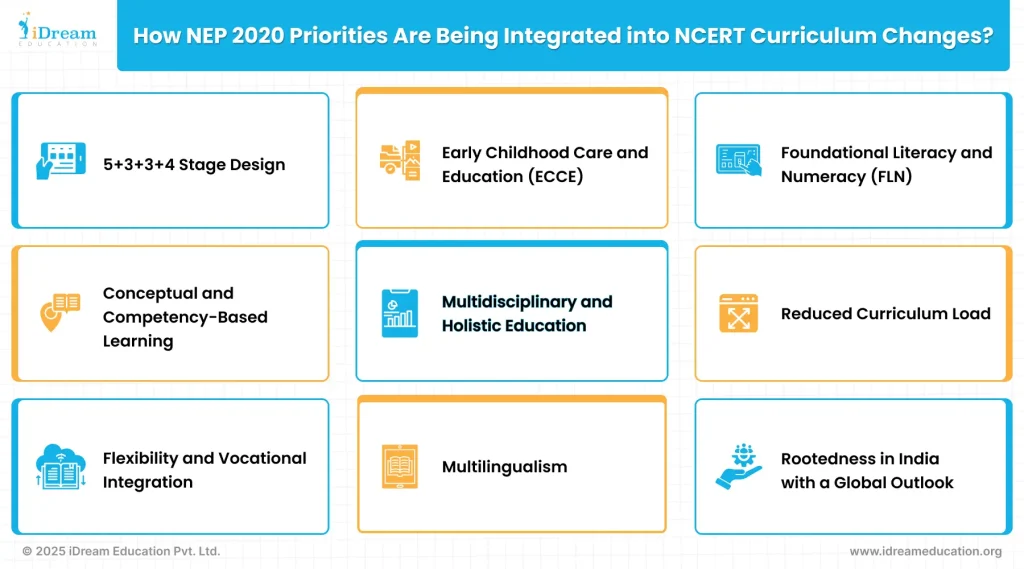
The NCERT revisions post-NEP are not happening in isolation, they are deeply rooted in the key priorities of the National Education Policy 2020. This reimagines school education to be more holistic, flexible, and future-oriented. Some of the major focus areas from NEP that are now being reflected in the updated NCERT curriculum include:

Illustration showing a list of points explaining how NEP 2020 suggestions are integrated into NCERT curriculum changes

5+3+3+4 Stage Design

The traditional 10+2 structure has been replaced by the 5+3+3+4 model, which recognises the developmental needs of different age groups. NCERT textbooks are now being restructured to align with this framework, ensuring that content, pedagogy, and assessment are age-appropriate and suited to each stage from foundational learning to secondary education.

Early Childhood Care and Education (ECCE)

Recognising the critical importance of early years, NCERT has begun designing materials that integrate play-based, activity-driven learning for the Foundational Stage (ages 3–8). This supports holistic child development and covers cognitive, linguistic, socio-emotional, and motor skills, alongside nutrition and well-being.

Foundational Literacy and Numeracy (FLN)

One of the highest priorities of NEP is ensuring that every child achieves basic literacy and numeracy by Grade 3. NCERT’s new Class 3 textbooks reflect this shift, with more focus on reading, comprehension, and number sense through interactive and activity-based learning and integrating separate module for revision “vidya pravesh”.

Conceptual and Competency-Based Learning

Instead of rote memorisation, the revised curriculum encourages conceptual understanding, critical thinking, creativity, and ethical reasoning. Textbooks now integrate activities, reflective exercises, and real-life applications to build skills and values alongside knowledge.

Multidisciplinary and Holistic Education

Textbooks across subjects are being revised to promote cross-disciplinary connections, for example, linking heritage studies with science, or mathematics with daily life problem-solving. This aligns with NEP’s emphasis on the unity of knowledge and preparing students for a multidisciplinary world.

Reduced Curriculum Load

In line with the NEP’s recommendation, NCERT has streamlined content by removing redundancies and focusing on core essentials. This makes space for deeper exploration, projects, and critical discussions, while also reducing pressure on students.

Flexibility and Vocational Integration

At the secondary stage, the curriculum is gradually shifting to allow greater choice of subjects, including vocational skills, arts, and physical education. NCERT has started introducing these elements in middle school to familiarise students with skill-based and career-oriented learning pathways.

Multilingualism

The new textbooks strongly encourage multilingual learning, reflecting India’s linguistic diversity. The policy promotes proficiency in mother tongue/regional language, while also supporting students to learn multiple Indian and global languages for cognitive and cultural growth.

Rootedness in India with a Global Outlook

NCERT revisions also integrate themes from the Indian Knowledge System (IKS), cultural heritage, and traditional wisdom, while balancing them with modern scientific and global perspectives. This ensures students develop a deep pride in being Indian, while also preparing to be responsible global citizens.

What Do These NCERT Changes Mean for Students and Teachers?

The ongoing NCERT changes, inspired by the vision of NEP 2020, are not just structural or academic updates. They directly impact how students learn and how teachers teach in classrooms. Here are some of the most visible implications:

Inclusion of Modern Schemes and Programs

Textbooks now include references to current national initiatives such as Digital India, Make in India, and Swachh Bharat Abhiyan. This keeps learning relevant and connected to real-world developments, ensuring students grow as more informed and socially aware citizens. For teachers, it provides relatable examples to explain complex socio-economic themes.

Greater Emphasis on Ancient Indian Knowledge

The syllabus integrates Indian Knowledge Systems (IKS) such as Yoga, Ayurveda, and Vedic Mathematics. This not only fosters cultural pride among students but also exposes them to traditional practices that still have practical value today. Teachers now have the opportunity to blend indigenous wisdom with modern pedagogy, creating a more holistic learning experience.

Focus on Nationalist Figures

Freedom fighters and leaders like Veer Savarkar, Subhash Chandra Bose, and Sardar Patel now find greater representation in history and political science lessons. Students gain a wider perspective of India’s independence movement, while teachers can facilitate balanced discussions on contributions that may have been underrepresented earlier.

Reduced Content Load

The rationalisation exercise has trimmed nearly 30% of content across subjects. For students, this means less rote pressure and more time to engage deeply with core concepts. For teachers, it offers the scope to focus on experiential learning, discussions, and projects rather than rushing through the syllabus.

Updated and Future-Ready Content

Revisions also bring in the latest developments from science, technology, and social issues, preparing students for a rapidly changing world. Teachers benefit from having up-to-date material that makes lessons more engaging and ensures alignment with contemporary realities.

Together, these shifts show how NCERT’s curriculum changes are making learning lighter, more relevant, and more connected to both India’s heritage and its future aspirations. 

Looking Back: Previous NCERT Syllabus

The current wave of NCERT revisions builds on a series of earlier rationalisation efforts. In 2022, nearly 30% of the NCERT syllabus was removed as part of a major restructuring initiative. This reduction was aimed at easing the academic load on students while keeping the curriculum more focused and streamlined.

As part of this exercise, several sections were either shortened or completely dropped. Notable among these were chapters on the Gujarat riots, Mughal courts, the Emergency, the Cold War, and the Naxalite movement. The intention behind these removals was to avoid content duplication across grades and reduce stress during the post-pandemic years.

Beyond just textbooks, the NCERT also took a significant step by revising the National Curriculum Framework (NCF) in line with the National Education Policy 2020. This process happened after a gap of 14 years. Prior to this, the NCF had been revised only on four occasions: in 1975, 1988, 2000, and 2005. The latest revision seeks to align learning outcomes, pedagogy, and assessments with NEP’s transformative vision for school education.

Embracing NCERT changes in Digital Content

The NCERT curriculum changes post-NEP 2020 represent a bold and future-focused step toward making school education in India more relevant, holistic, and student-centric. From integrating modern government schemes and updated global knowledge to reintroducing ancient Indian wisdom and reducing unnecessary academic load, the NCERT changes have made learning more engaging and meaningful learning experience. They also reflect the evolving priorities of India’s education system, balancing cultural rootedness with global readiness.

At iDream Education, we wholeheartedly applaud these transformative NCERT changes and have been actively working to integrate the revised NCERT curriculum into our digital content.

Our goal is to ensure that schools, teachers, and students across India get seamless access to updated, curriculum-aligned resources. By aligning our content with the latest NCERT revisions, we aim to empower schools with smooth curriculum transitions, provide teachers with ready-to-use, updated material, and enable students to learn from the most relevant and engaging digital resources.

As the education ecosystem continues to evolve under the vision of NEP, we remain committed to supporting this journey. Also, bridging policy with practice and ensuring that learners everywhere can benefit from the richness of India’s updated curriculum.If you’d like to see a demo of our updated digital content aligned with the latest NCERT changes, or learn more about the specific updates we’ve integrated, you may reach out to us at +91 7678265039. You can also share your details here or write to us at share@idreameducation.org

What UDISE+ 2024-25 by MoE Really Tells Us About the Future of Our Schools in India?

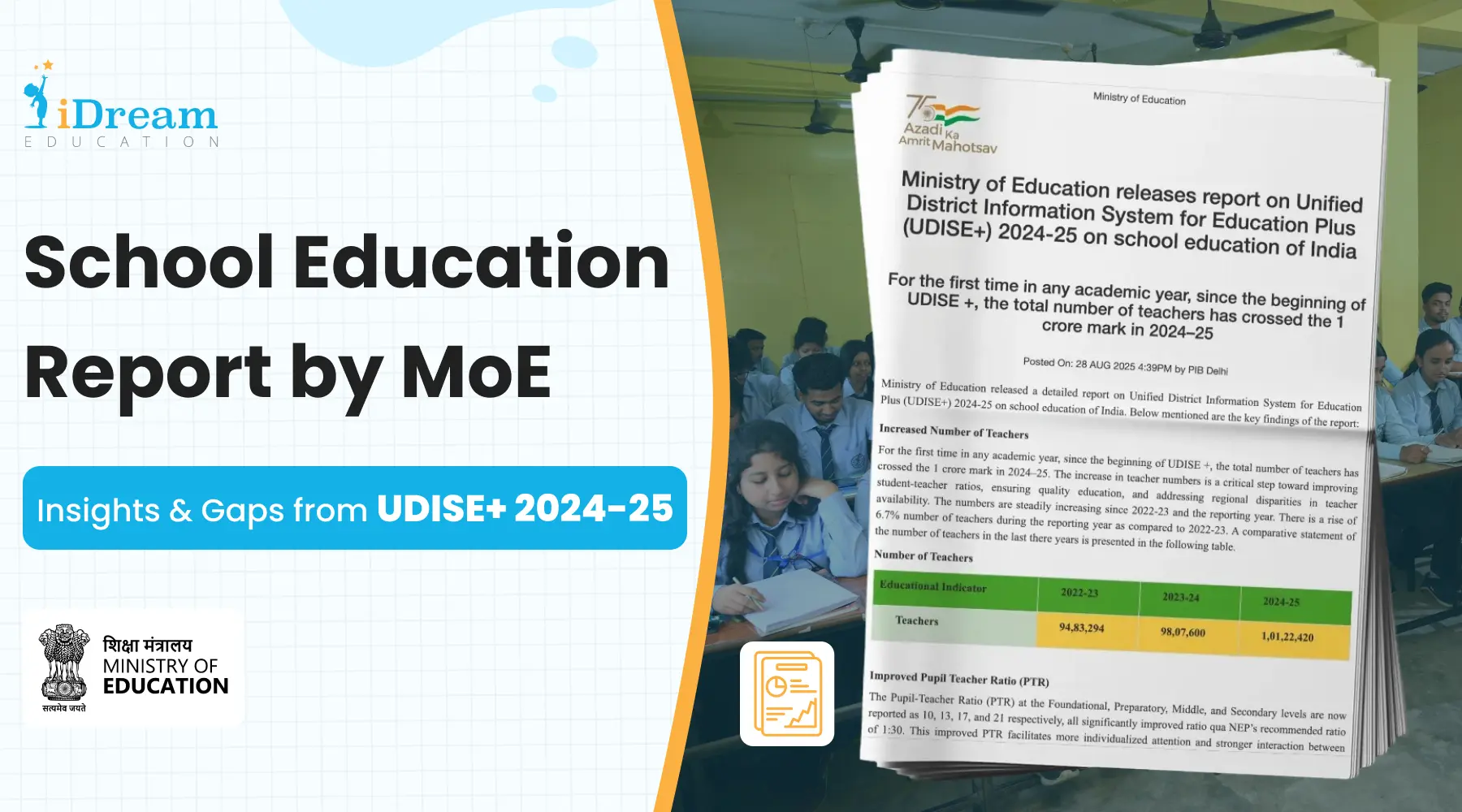
Cover image showing a glimpse of UDISE+ 2024-25 report released by the Ministry of Education, India

The future of India’s schools is often best understood through data, and the Unified District Information System for Education Plus (UDISE+) is one of the most credible sources we have. Managed by the Department of School Education & Literacy under the Ministry of Education, this educational management information system offers an annual snapshot of how our schools are performing. It not only highlights numbers, but shows real indicators of access, equity, and quality.

On 28th August 2025, the Ministry of Education released the UDISE+ 2024-25 report on school education in India. 

The findings are both encouraging and insightful, reflecting how far the system has progressed in terms of teacher strength, student retention, digital access, and school infrastructure. From crossing the 1 crore teacher milestone to witnessing a steady decline in dropout rates and an increase in internet-enabled schools, the report captures a story of resilience and transformation.

Let’s look at key highlights of the UDISE+ 2024-25 report by MoE

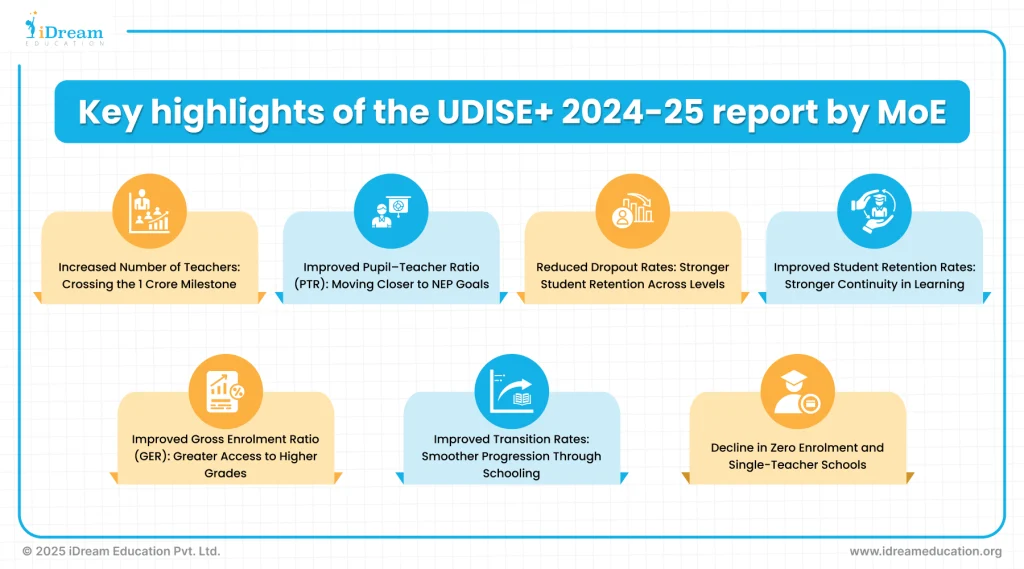
Infographic showing key findings from the UDISE+ 2024-25 report by the Ministry of Education

Increased Number of Teachers

  • One of the most remarkable highlights of the UDISE+ 2024-25 report is the significant rise in the number of teachers across India. For the first time since the inception of UDISE+, the total count of teachers in schools has crossed the 1 crore mark, reaching 1,01,22,420 in 2024-25. This marks a 6.7% increase compared to 2022-23, when the figure stood at 94,83,294, and a notable jump from 98,07,600 teachers in 2023-24. 
  • This steady growth represents a vital step toward strengthening the student–teacher ratio. This shows that now classrooms are not overcrowded and every child is receiving the attention they deserve.

Improved Pupil–Teacher Ratio (PTR)

  • Another encouraging outcome highlighted in the UDISE+ 2024-25 report is the steady improvement in the Pupil–Teacher Ratio (PTR) across all school levels. The PTR in no. for the year 2024-25 stands at: Foundational: 10, Preparatory: 13, Middle: 17, Secondary: 21. This marks a clear progress when compared to previous years. In 2023-24, the PTR was 10 (Foundational), 13 (Preparatory), 18 (Middle), and 21 (Secondary). Going further back, in 2022-23, it stood at 11, 14, 18, and 23 respectively.
  • What makes this development significant is that the ratio aligns with  NEP 2020 recommended benchmark of 1:30, which means Indian classrooms are becoming less crowded and more conducive to personalized attention. A better PTR allows teachers to engage more effectively with students, understand their unique learning needs, and support them in achieving stronger academic outcomes.
  • This shift indicates not just an increase in teacher numbers but also a tangible improvement in the quality of classroom interactions. This improvement is making the way for a more inclusive and learner-centric education system.

Reduced Dropout Rates

A particularly heartening trend in the UDISE+ 2024-25 report is the decline in dropout rates across the Preparatory, Middle, and Secondary stages. Compared to the previous years, the improvement is significant:

  • Preparatory stage: dropped from 3.7% (2022-23) to 3.1% (2023-24) and further down to 2.3% (2024-25)
  • Middle stage: reduced from 5.2% (2022-23) to 4.3% (2023-24) and then to 3.5% (2024-25)
  • Secondary stage: declined from 10.9% (2022-23) to 9.6% (2023-24) and further to 8.2% (2024-25)

This consistent downward trend is a strong indicator of improved student retention However, while the progress is significant, it remains gradual. The major challenge lies in incremental learning. Many students continue to struggle with historical learning gaps that limit their ability to keep pace with grade-level expectations. Unless these gaps are addressed, dropout rates may continue to decline only marginally rather than drastically. To tackle this, Personalized Adaptive Learning (PAL) solutions are being designed and deployed on student devices, enabling learners to bridge gaps and achieve grade-level proficiency. Such innovations, combined with social sector and government initiatives, show promise, but their reach needs to be multiplied and scaled if we are to ensure that every child not only stays in school but thrives in their learning journey.

Improved Student Retention Rates

The UDISE+ 2024-25 report showcases a significant rise in student retention rates across all stages of school education, signaling that more learners are not only enrolling but also continuing their studies. The latest figures reveal encouraging growth compared to the previous year:

  • Foundational level: increased from 98.0% (2023-24) to 98.9% (2024-25)
  • Preparatory level: from 85.4% to 92.4%
  • Middle level: from 78.0% to 82.8%
  • Secondary level: from 45.6% to 47.2%

While this upward trend is encouraging, the growth is incremental and slower than what is truly needed. A retention rate of 47.2% at the secondary level, for instance, is far from where it should be ideally closer to 90–100%. These figures remind us that ensuring students remain in school is not enough; they must also be learning meaningfully, understanding concepts, and finding joy in the process. 

To further accelerate retention, students need curriculum-aligned, multimodal content that not only supports their textbooks but also sparks curiosity and sustained engagement. When content is designed to match 21st-century learning needs that is interactive, adaptive, and relevant, it builds continuity in learning. At scale, such intervention can drive a substantial jump in retention percentages by 2026 and beyond.

Improved Gross Enrolment Ratio (GER)

The UDISE+ 2024-25 report also records a steady rise in the Gross Enrolment Ratio (GER), particularly at the Middle and Secondary levels, highlighting progress in making education more inclusive and accessible.

  • Middle level GER: increased from 89.5% (2023-24) to 90.3% (2024-25)
  • Secondary level GER: improved from 66.5% to 68.5% in the same period

While this upward trend is encouraging, the pace of improvement is still gradual, and the gaps remain significant. This is especially at the Secondary level, where nearly one in three children are still not enrolled. This highlights the urgent need to go beyond access and address the barriers that keep students out of classrooms such as economic constraints, lack of engaging learning environments, and historical learning gaps.

To bridge this gap, it is critical to focus on holistic interventions: strengthening infrastructure, ensuring equitable digital access, and integrating adaptive learning environment. This has the potential to motivate learners to stay and progress to higher grades. Only then can GER rise substantially and reflect not just enrollment, but meaningful participation and continuity in learning.

Improved Transition Rates

The UDISE+ 2024-25 report shows a positive shift in transition rates, meaning more students are successfully moving from one stage of schooling to the next without dropping out. The latest data highlights steady improvement across all key transition points:

  • Foundational → Preparatory: increased from 98.1% to 98.6%
  • Preparatory → Middle: rose from 88.8% to 92.2%
  • Middle → Secondary: improved from 83.3% to 86.6%

These upward movements demonstrate that the school system is becoming more effective at retaining students as they progress through different stages. However, a closer look reveals persistent gaps. While early transitions are nearing universal levels, the sharp dip is evident as students move into Secondary schooling, where transition rates are still significantly lower than they should be. This indicates that structural barriers, weak foundational learning, and lack of engaging academic support could be potential reasons limiting smoother progression for many learners.

To address this, the focus should be on bridging learning gaps early, in alignment with the spirit of the revocation of No Detention Policy. After the revocation, students are not simply promoted to the next grade, but are critically supported and assessed to ensure they build the confidence and competence to meet grade-level expectations. 

Decline in Zero Enrolment and Single-Teacher Schools

Another notable achievement highlighted in the UDISE+ 2024-25 report is the reduction in zero-enrolment schools and single-teacher schools. Both of these have been long pending challenges in India’s schooling system. 

  • The number of single-teacher schools reduced by about 6% compared to the previous year.
  • The count of zero-enrolment schools witnessed a sharp drop of nearly 38%.

This is a highly encouraging trend. However, a deeper look reveals that while the numbers are falling, the challenge is not yet resolved. A large proportion of single-teacher schools still remain. Similarly, the drop in zero-enrolment schools often comes from closures of schools rather than genuine improvements in enrolment.

To truly address these gaps, the focus must be on: Strengthening teacher availability, improving education accessibility and ensuring quality learning. Beyond enrollment and staffing, investing in teacher capacity building, enhancing the learning environment, and setting up solutions students look for can improve the situation in schools. Only then will the reduction in zero-enrolment and single-teacher schools translate into equitable access and meaningful learning outcomes, rather than just statistical progress.

Now, Let’s Look at Infrastructure Improvements in UDISE+ 2024-25 — Driving the Gains We’ve Seen Above

More Schools with Computer Access

  • The UDISE+ 2024-25 report highlights significant progress in the digital infrastructure of schools, a critical factor in modern education. The number of schools with computer access has increased from 57.2% in 2023–24 to 64.7% in 2024–25.
  • While this growth is encouraging, it still represents limited integration when viewed against today’s context, the aspirations of NEP 2020, the ICT Scheme under Samagra Shiksha, and the Viksit Bharat 2047 vision, all of which emphasize 100% technology integration in schools. The question then arises: what is slowing down adoption? Is it the perception of heavy investment, challenges in usage, or the complexities of setup and maintenance? In reality, the ICT scheme has already simplified integration through single-unit smart classes and tablet/notebook-based ICT labs that are easy to set up, manage, and use. Yet, the pace of evaluation and adoption remains slow, limiting the reach and impact of these solutions. If we are to prepare schools and learners for a digital-first future, accelerating technology integration must become a priority, ensuring that every school has the tools to deliver inclusive, engaging, and future-ready learning.

More Schools with Internet Access

  • The UDISE+ 2024-25 report shows a substantial rise in the number of schools with internet connectivity, increasing from 53.9% in 2023–24 to 63.5% in 2024–25. This improvement reflects a strong focus on strengthening digital infrastructure, allowing schools to provide students and teachers with access to online resources, digital content, and technology-enabled teaching methods. 
  • With better internet access, classrooms are becoming more interactive and resource-rich. However, unfiltered internet exposure in schools also comes with risks of distractions, unsafe content, and the challenge of keeping learners focused on constructive use. To balance these opportunities and challenges, schools should adopt a cautious, structured approach, prioritizing safe and curriculum-aligned offline digital learning solutions that work seamlessly with limited or no internet. 

Improvement Basic Infrastructure of Schools

The UDISE+ 2024-25 report highlights significant progress in basic school infrastructure. Key improvements include:

  • Electricity: 93.6% of schools are now powered
  • Girls’ toilets: 97.3%
  • Boys’ toilets: 96.2%
  • Handwashing facilities: 95.9%
  • Safe drinking water: 99.3%

These upgrades are more than just statistics, they ensure dignity, hygiene, and safety for all students, which is important and led to increased retention, enrolment, and transition rates. Improved facilities also contributed directly to better learning outcomes and overall progress highlighted throughout the UDISE+ 2024-25 findings.

Improved Female Representation in Schools

The UDISE+ 2024-25 report also highlights encouraging progress in female representation within the education system, both among teachers and students.

  • Female teachers: Female teachers in 2024-25 make up 54.2% of the total teaching workforce, up from 53.3% in 2023–24 and 52.3% in 2022–23, reflecting a positive shift toward gender balance in schools.
  • Girls’ enrolment: has risen slightly from 48.1% to 48.3%, showing continued efforts to improve access and participation for girls across all levels of schooling.

This dual improvement, in both female teaching staff and girl student enrolment, signals a broader commitment to gender equity, helping ensure that schools are safe, welcoming, and empowering spaces for all learners.

Being a part of the education ecosystem – working closely with CSR partners, government bodies, NGOs, hardware providers, and other education allies, we feel truly encouraged to see the improvements reflected in the UDISE+ 2024–25 report. But these insights are more than just numbers; they raise an important question: should we celebrate the progress so far, or hold ourselves accountable to ensure it translates into deeper, more meaningful change?

  • While enrolments, retention, and infrastructure are improving, the report still leaves a critical gap – learning outcomes and student proficiency levels remain underrepresented. This must become the central focus if we are to achieve real impact. One example is the growing emphasis on Personalized Adaptive Learning (PAL) on student devices, where every learner’s progress can be tracked dynamically. From diagnostic assessments to final outcomes, while offering remedial support PAL helps students bridge gaps and achieve grade-level proficiency. PAL is highlighted in World Bank’s Best Buys for Education Reports — 2020 and 2023

Another important point to note is that infrastructure improvements are directly proportional to better learning outcomes. 

Stronger facilities in schools naturally lead to reduced dropout rates, improved student retention, higher Gross Enrolment Ratios (GER), and smoother transition rates across levels. The insights from UDISE+ 2024-25 reinforce that strengthening school infrastructure is not just about physical assets but about enabling an environment where learning thrives. However, the real impact comes when these improvements are combined with strategic interventions that holistically target teachers, students, learning gaps, and infrastructure together. 

A similar correlation can be clearly seen in our work in Meghalaya

When we started in 2022, there was limited awareness about the importance of education, no exposure to technology, and the Class 10 pass percentage was just 25%. This not only led to less engagement but also led to higher dropouts and fewer students continuing into higher grades. However, with two years of focused interventions—smart class implementation, technology-enabled assessments, and bridging support for learners, the results have been transformational. The pass percentage has risen to 92% in just two years, enrolments have gone up, and the government is now more invested in long-term educational goals.

These changes reinforce the message of UDISE+ 2024–25: when we collectively invest in better infrastructure and equitable access, schools become places of unlimited learning and growth. The progress we are seeing today is just the beginning of a brighter educational journey for India.

If you are seeking a comprehensive solution provider that can transform schools – from digitizing infrastructure to improving pass percentages, retention, enrolments, transition rates, and teacher capacity. You can connect with us at +91 7678265039 or share your details here. You can also write to us at share@idreameducation.org

Explore Career Path with Career Cards: MoE, NCERT & UNICEF India’s Joint Initiative for School Students

Glimpse of Career Cards from Career Guidance Book for school students by NCERT, MoE and UNICEF

When we talk about career guidance, many people still imagine it as something only private school students get to experience. But in reality, it is equally important for government school students. Why? Because, every student, no matter where they study, deserves to know the range of opportunities they can pursue based on their skills, interests, and aspirations. Without this awareness, students often limit themselves to only a few professions they have heard of or seen around them.

The ASER 2023 findings make this clear. When students were asked about role models and career goals, most mentioned only a few familiar roles such as police officer, teacher, doctor. Very few knew about the hundreds of other possibilities that could align with their abilities and passions. This gap exists not because students lack potential, but nobody told them that their skills, passions, or even hobbies could open doors to careers they never thought possible. 

And what was missing in this? Career Guidance

Over the years, career counselling has evolved. Today, counselors are guiding students based on their scores, skills, and interests. But here’s the challenge –  it still depends on the presence of an external expert. This means many students still slip through the cracks. Some never ask the right questions. Some don’t even know what to ask. Others get guided into something “safe” without truly exploring what fits them. And so, they step into adulthood following a path someone else chose, not one they owned.

But navigating life after school should be an exciting journey. A journey where every student knows their options early on, where they can explore, change directions if needed, and shape their path with confidence. No one should find themselves “stuck” simply because they didn’t know better. 

This is why a nationwide career guidance initiative for students has been launched

On 29th July 2024, the Department of School Education and Literacy, in collaboration with UNICEF India and NCERT, launched the Career Guidance Book (Volume 1 & 2) during the Akhil Bharatiya Shiksha Samagam.

Inside this Career Guidance Book (Volume 1 & 2), there are 1000 Career Cards 

Each career card is a window into a different profession. From job responsibilities to qualifications to growth opportunities, these cards give students a clear, early exposure to possibilities aligned with the National Education Policy (NEP) 2020. 

Career Guidance Book Volume 1 and 2 by NCERT, MoE and UNICEF showing 1000 career options for school students

500 career cards  (Volume 1) are organised into 5 broad domains

Agriculture and Allied Sciences, Arts, Media, Marketing and Entertainment, Business and Finance, Education and Training, and Health and Wellness. They’re designed to be practical, engaging, and easy for teachers, counselors, and students to use.

500 career cards  (Volume 2) are organised into 5 broad domains:

Volume 2, on the other hand, introduces learners to career paths across domains such as Engineering, Government Services, Information Technology, Management, Operations, Logistics, Hospitality, Public Policy, Law and Safety, Research and Development, and Technical and Skill Trades, offering in-depth insights into roles that are shaping the future of work.

Together, both volumes empower students to explore a spectrum, helping them discover their interests and chart meaningful pathways.

What’s Inside the Career Cards

The Career Cards give students a complete and practical understanding of different career options. Each card is designed to answer the most important questions a student might have when exploring a profession. Here’s what they cover:

  • Job Title & Role Overview: A clear description of the profession and what it involves on a daily basis.
  • Essential Personality Traits: The qualities, strengths, and skills that are best suited for success in that career.
  • Scholarships & Financial Support: Information about available scholarships, education loans, and other financial aid to support studies.
  • Expected Income: Insights into typical earning potential in the chosen field.
  • Educational Pathway: The qualifications, courses, and training needed to enter and grow in the profession.
  • Work Environment: Details on where and how professionals in this role typically work.
  • Job Growth & Future Scope: Trends, demand, and opportunities in the sector or industry.
  • Where to Study: A list of institutions or training centres offering relevant courses.
  • Inspiring Examples: Case studies or stories of successful people in the field to motivate students.

By combining career insights, education guidance, financial details, and real-life success stories, these cards give students a 360-degree view of each career option. This helps students not only understand the possibilities and plan the steps to reach their goals, but also ensures that if they get stuck along the way or wish to switch to another field, they have a wide range of options with all the necessary details at their fingertips.

How Teachers, Counsellors, and Students Can Use Career Cards?

Career Cards are more than just information sheets. They’re practical tools for exploration, planning, and decision-making. When used effectively, they can spark curiosity, encourage self-reflection, and guide students toward careers that truly fit their strengths and interests.

Teachers & Counsellors can use it to:

  • Familiarise students with the cards: In this they would share each career card’s details: job descriptions, required skills, education pathways, and potential growth opportunities.
  • Set clear objectives: Through this they can guide students on how they would want to use the cards, whether for career exploration, skill identification, or aligning interests with possible careers.
  • Explain the purpose: Help students see how these cards can guide them in discovering and comparing various career options.
  • Make it interactive: Use the cards in classroom group discussions, role-plays, or career day events.
  • Assign research tasks: Have students pick a card, research the career, and present their findings to the class.
  • Encourage reflection: Ask students to think about how what they’ve learned connects to their own skills and interests.

Teacher and Counsellor can also conduct Activities with Career Cards such as:

  • Career Mapping: Motivating students to create a “map” showing different pathways to achieve a career goal from their current grade onwards.
  • Role Play: Encouraging students to act out “a day in the life” of a chosen profession to understand its challenges and responsibilities.
  • Career Fair: Organising a session where students present researched careers through posters, presentations, or interactive displays.
  • Peer Discussions: Conducting group discussions to compare learnings and explore similarities or differences between careers.
  • Skills & Interests Matching: Asking students to match personal skills and interests with the most relevant careers from the cards.
  • Professional Talks: Inviting professionals featured in the cards to share real-world insights.
  • Extra Resources: Providing students with websites, books, or community programs for deeper exploration.

Students can use career cards to:

  • Set goals: Students can use the career cards to outline short-term and long-term educational and career plans.
  • Participate actively: Basis the career guidance book and its understanding students can be engaged in discussions, activities, and presentations basis their interests and skills.
  • Ask questions: Students can seek clarity on aspects of careers that interest or confuse them from teachers and counsellors
  • Cross-check information: Compare  career card details with other reliable sources for a well-rounded understanding.
  • Connect to their interests: Students can identify which careers align with your passions, skills, and values.
  • Plan skill development: With cards in a career guidance book, students can recognise the abilities needed and find ways to develop them through school or extracurricular activities.
  • Seek guidance: Students can also approach teachers, counselors, or mentors for advice on your chosen paths for more clarity and deeper understanding 

When used well, Career Cards in Career Guidance Book can turn vague career aspirations into informed, actionable plans. This will help students explore possibilities, make confident choices, and adapt whenever they want to try a different path.

Building on this momentum, another significant step has been taken by CBSE in 2025

On 7th August 2025, CBSE launched two flagship initiatives to strengthen the institutional framework for career guidance and to promote holistic psychosocial well-being among students. These are:

  • CBSE Career Guidance Dashboard: This offers students a rich set of tools and resources to explore careers & make informed choices. It serves as a one-stop platform where students can discover different professions. They can also understand required skills, and plan their next steps with clarity. Live Link to CBSE Career Guidance Dashboard
  • CBSE Counselling Hub & Spoke School Model (Session 2025–26): This focuses on mental health and overall well-being. Under this model, CBSE mentor hub schools work closely with spoke schools to create a collaborative network for student wellness. This structure encourages peer learning, builds the capacity of teachers and counselors, and allows best practices in psychosocial support to be shared across schools.

Both initiatives are deeply aligned with the vision of the National Education Policy (NEP) 2020. This makes career guidance and mental health support more accessible, practical, and impactful for every student. By equipping teachers, counselors, and wellness teachers with better tools and training, these programmes aim to ensure that students are not only academically prepared but also emotionally resilient and confident in planning their futures.

At iDream Education, we truly applaud these initiatives and the clarity it brings to career pathways

It is something that students in both government and private schools often struggle with. The way this information has been presented ensures that no student will feel overwhelmed. It’s a one-stop “career bundle” where students can access everything they need to know: from colleges and average pay scales to growth paths, without spending hours scrolling the internet or worrying about the cost of professional counselling.

With the Career Guidance Book in hand, and the support of their teachers and counselors, students will have the confidence and clarity to explore their options and make informed choices.

Another valuable advantage of the Career Cards is their potential to integrate with vocational education content in schools

Delivering vocational learning in alignment with the career domains in the guidance book can create a powerful combined resource. This would allow students to not only identify a career path but also develop and earn from essential skills relevant to that path right from school.

At iDream Education, we are eager to explore this further. If you are looking to enable vocational education content for specific career domains, we would be happy to create and curate it for your students. We already have foundational vocational content for Digital Literacy, Financial Literacy and more domains tailored for school students, and we would be delighted to show you how it can seamlessly complement the newly released Career Guidance Book by the Department of School Education, NCERT, and UNICEF.

For detailed discussion, you may contact us at +91 7678265039. You can also write to us share@idreameductaion.org or share your details here. We would be happy to connect and share more details.

Find the Right Multi-Format Digital Content for Class 1 – Aligned with NCERT & State Boards

Tablets displaying digital content for Class 1, designed as per NCERT and State Board curriculum, to support interactive education in schools

Class 1 is one of the most crucial milestones in every child’s learning journey. It marks the beginning of their formal school life, where they step into a structured classroom environment, meet new teachers, and start exploring subjects in a more systematic way. What happens in this foundation year often shapes their attitude toward learning for years to come. That is why adopting the right practices, building basic competencies, and nurturing positive learning habits at this stage becomes extremely important.

So, how do we make sure our young learners start this journey on the right note?

The answer lies in initiatives such as Nipun Bharat Vidya Pravesh. It is a 3-month school readiness module is being introduced across schools. Before teachers begin the Class 1 syllabus, this module helps in revising and strengthening the foundational literacy and numeracy skills. It gives children a smoother transition from pre-primary to primary classes, while also giving teachers the opportunity to bridge any learning gaps early on. The aim is not only to prepare children academically but also to help them develop the confidence and curiosity needed to enjoy learning.

How NCERT & State Board Curriculum Aligns with Learning Needs of class 1?

The curriculum prescribed by NCERT and various State Boards is designed keeping the learning needs of each grade student in mind. For Class 1, it is aligned with the natural development stages of children at this age, striking a balance between academics and joyful learning. The lessons are not just about covering subjects such as Mathematics, Language, and Environmental Studies; they are about nurturing creativity, problem-solving, and communication skills. This way, children do not just study concepts instead they begin to experience learning as something fun, engaging, and meaningful.

One of the reasons NCERT curriculum is considered a benchmark in school education is the depth of research and expertise behind it. NCERT textbooks and resources for Class 1 are not only used by CBSE schools but also serve as a base for several state board curriculums across India. They provide well-structured, age-appropriate study material that ensures every child can learn at their own pace and level. For schools and teachers, this makes NCERT and state board content a reliable foundation to build classroom learning experiences.

Additionally, Class 1 curriculum is becoming more structured under the purview of NEP NCF

The National Education Policy (NEP) 2020 has emphasized the importance of rethinking what and how we teach and what kind of learning environment we create for children. With its new 5+3+3+4 design covering ages 3–18, NEP is encouraging a shift from rote memorization and exam-oriented teaching toward holistic, conceptual, and skill-based education. For Class 1 students, this means greater focus on building curiosity, critical thinking, and creativity right from the beginning. 

To truly bring the vision of NEP 2020 NCF to life and enrich the learning environment suggested by NCERT and State Boards, relying on textbooks alone is not enough. Today’s young learners need experiences that spark curiosity and hold their attention. That’s where multi-format NCERT/State Board Aligned digital content comes in.

However, with so many options available today, you may often find yourself asking: Where can we find the right multi-format digital content for Class 1 that is aligned with NCERT and State Boards? The content that not only matches the prescribed curriculum but also be structured, easy to use, and designed in a way that teachers can seamlessly integrate it into their classrooms.

That is where trusted K-12 digital content providers in India play a crucial role. 

Schools should have solutions that offer well-curated, multimodal content that ensures alignment with NCERT and state boards. At iDream Education, we understand the importance of this foundation year and uniqueness of every class. Our dedicated team of subject matter and curriculum experts and curriculum continuously work on creating and curating high-quality digital content for all classes and subjects. With experience in delivering learning solutions across schools in India, we ensure that our content is not only curriculum-aligned but also joyful, interactive, and teacher-friendly.

Explore more about our NCERT-aligned digital content for all classes and subjects here, and learn about our State Board content here

Let us share what you should look for when selecting the right multi-format digital content for Class 1.

With this you will know what to expect when partnering with content providers to bring engaging, NCERT- and state board-aligned content into classrooms.

Infographic highlighting key features to look for in Class 1 digital content for school students

Ensure Vidya Pravesh Alignment

  • The right Class 1 digital content should include the NIPUN Bharat Vidya Pravesh three-month preparatory module. This helps children revise key concepts and smoothly transition from preschool to formal schooling.
  • What we offer: We have specifically created and curated vidya Pravesh digital content for Class 1. The content includes animated lessons and classroom activities for subjects such as Maths, EVS, Hindi, and English. This structure is designed to help teachers complete the course within a 3-month timeframe while also addressing any foundational gaps students may have before transitioning to full-fledged Class 1 learning.

Look for multimodal content

  • Digital content for Class 1, should go beyond just digital syllabus books. Truly engaging learning comes from a mix of formats. This could be animated videos, syllabus books, worksheets, stories, puzzles, and more. Enabling such diversified content together makes learning joyful, interactive, and purposeful.
  • What we offer: We have diversified digital content  for class 1 across to serve both teachers and students. This includes colourful worksheets, animated video lessons, syllabus books, puzzles (in PDF and video), stories, classroom activities, picture library, teacher instructions, and additional learning resources. All of this is designed to make learning engaging, meaningful, and multipurpose, whether the content is played directly on screen for students or used by teachers as part of their classroom teaching.

Ensure curriculum alignment

  • From Class 1 onward, digital content should strictly follow NCERT books, while also reflecting the NCF (National Curriculum Framework) where required. Avoid providers who piece together random content from multiple sources. What’s needed is carefully curated content that supports Class 1 students’ real curriculum needs.
  • What we offer: We have seamlessly integrated NCF requirements with NCERT curriculum to create a holistic Class 1 package. Along with Maths, EVS, Hindi, and English (including literature), our content also covers Computers, Sanskrit (introductory), Health & Physical Education, and Socio-Emotional Learning. We are delivering not only what NCERT expects, but also the wider NCF-aligned learning outcomes.

Look for structured LMS integration

  • It’s important that digital content for class 1 is not just available but also enabled through a structured and easy-to-navigate LMS. This ensures young learners don’t miss out on key topics, and teachers can easily access the right resources without feeling overwhelmed. As a result, the entire classroom experience stays organized and smooth.
  • What we offer: We enable our Class 1 digital content through a school LMS designed with universal design principles—making it simple, intuitive, and accessible in preferred languages. Whether it’s worksheets, animated videos, stories, or activities, teachers can play any category of content, and students are guided seamlessly to the right learning resource without confusion.

Check for preferred language alignment: 

  • Digital content for class 1 should be available not only in English or Hindi but also in the local languages. This will enable learning in language children and teachers are most comfortable with. This makes learning more relatable, reduces barriers to understanding, and allows teachers to navigate the LMS with ease.
  • What we offer: We have created and curated our digital content for class 1 and LMS in Hindi, English, and multiple local languages, ensuring that both teachers and students can learn, teach, and engage in the language they are most familiar with.

Check for Offline Accessibility

  • Many government schools still lack reliable internet access, which makes offline availability of digital content essential. While choosing a provider, ensure they can deliver fully functional offline digital content for classrooms, so learning is not disrupted.
  • What we offer: At iDream Education, we understand that in many school locations, continuous internet is a luxury. That’s why we enable Class 1 digital content that runs completely offline, ensuring seamless usage and adoption. Content is kept updated with minimal internet connectivity through easy sync options, so teachers and students never face interruptions.

Bringing It All Together for Class 1 Learning

At iDream Education, our approach to create and curate digital content for class 1 goes beyond ticking boxes. For us, it’s about truly empowering both teachers and students. Having worked closely with them, we’ve designed content that aligns with NCERT, NCF, and NIPUN Bharat goals. It also reinforces core learning, enhances comprehension, and nurtures logical thinking and problem-solving skills. Our diversified categories make learning collaborative, simplified, inclusive, and skill-based, while keeping it joyful and engaging for young learners. 

With us, you get comprehensive digital content for Class 1 across all subjects including:

  • Digital Content for English Literature – Class 1
  • Digital Content for Hindi – Class 1
  • Digital Content for Mathematics – Class 1
  • Digital Content for Environmental Studies (EVS) – Class 1
  • Digital Content for English Grammar – Class 1
  • Digital Content for Computer – Class 1
  • Digital Content for Regional Languages – Class 1
  • Stories, Worksheets & Activities – Class 1
  • Animated Video Lessons, Puzzles, Classroom Activities – Class 1
  • Audiobooks, Picture Library, Teacher Instruction – Class 1

If you are exploring digital content for Class 1 for CBSE or state board schools, we’d be glad to connect. You can reach out to us at +91 7678265039, for a quick demo of our content. You can also write to us at share@idreameducation.org or share your details here.

CBSE or State Board  – Why should every school have a Digital Library?

Tablet-based digital library showing e-library content, guiding you to the importance of CBSE digital libraries in schools

When we visit schools, one thing we notice time and again is how the curiosity of students has outgrown the four walls of the classroom. They don’t just stop at what’s written in their textbooks. They want quick answers to their questions, clearer explanations of concepts, and sometimes even more examples than a single chapter can provide. And in today’s world – where almost everything is available instantly at our fingertips, why should learning be any different?

Imagine a student who has just learned about space exploration in class. The curiosity doesn’t end when the bell rings. They might want to watch a short documentary about the Mars Rover, read about the life of Kalpana Chawla, or understand how rocket propulsion works in more detail. But without easy access to reliable learning resources, this curiosity often fades before it can turn into deeper understanding.

This is where a Digital Library Becomes Your Answer 

It brings multi-format, multi-cultural, and multi-level reading and learning resources directly to students. They don’t have to spend hours searching or depending solely on what’s available in a physical library. 

But can a digital library work in both CBSE and state board schools?

Absolutely. Digital libraries can be implemented in any school across India. Importantly, it can be customised and setup with content in preferred languages. You can also align your digital library setup with both state and national education goals.

Since most state board content is mapped to the CBSE curriculum, a CBSE digital library can also be implemented in any state. This offers relevant and engaging diverse e-library resources for school students.

Did you know? CBSE already has its own official digital library known as CBSE’s Digital Library 

CBSE’s digital library emphasizes a wide collection of materials, including books, periodicals, newspapers, manuscripts, prints, documents, CDs, cassettes, videotapes, DVDs, and much more. Beyond that, it connects students to an even larger universe of knowledge through platforms such as the National Digital Library of India, the Universal Digital Library, and the International Children’s Digital Library, opening up a world of authentic and diverse learning.

The vision behind CBSE’s digital library is deeply connected to CBSE’s broader mission: to create a robust, vibrant, and holistic school education system that fosters excellence in every sphere of human endeavour. It’s about developing learners who are not just academically competent, but also confident, compassionate, and equipped to contribute to harmony and peace in society. The emphasis is on holistic development and nurturing not just the mind, but also values, creativity, and critical thinking skills.

To achieve this, everyone involved in education – schools, teachers, parents, and the larger community must work together to make diverse resources of CBSE Digital Library accessible to all School students across India

  • With a CBSE Digital Library, every student in every corner of the country can have equal access to multi-cultural, and multi-level e-books, journals, sample papers, biographies, interactive learning modules, and CBSE-aligned study materials, right at the touch of a finger.
  • For teachers, CBSE Digital Library is an equally powerful tool. Instead of spending hours searching for quality teaching materials, they can instantly find ready-to-use lesson plans, worksheets, reference materials, and multimedia content. This not only saves time but also helps make lessons more engaging and effective. A well-implemented CBSE digital library in any school means a teacher can complement their lesson planning and bring the concept to life.

CBSE/State Digital Library implementation in schools aligns with CBSE’s mission of creating a safe, inclusive, and stress-free learning environment, while also preparing students to be competent and confident citizens in a rapidly changing world.

In a time when knowledge is expanding faster than ever before, 

The question is no longer “Should schools adopt digital libraries?” The real question is “Can we afford not to?” Every moment we delay is a moment where a student’s curiosity might go unanswered. 

So, Let Us Look at Some Important Factors: Why Should Every School Have a CBSE/ State Board Digital Library?

Visual list highlighting why every school should adopt a CBSE or state board aligned Digital library by iDream education

Affordable and Scalable Setup

Setting up a digital library doesn’t require large-scale construction or expensive furniture. All you need is a simple, cost-effective library solution such as a charging trolley or a mini computer server paired with a few devices for students. This makes the setup highly affordable and easy to replicate across multiple schools. All it requires is prioritising the right devices and digital library resources aligned with CBSE or state boards. With digital library content available in the preferred language, you can get started without any major hassle.

Offline Access to Curated, Age-Appropriate Content

With the right digital library vendor, schools can offer students a rich collection of age-appropriate, well-curated e-library resources, all accessible offline. This includes CBSE or state board-aligned reading and learning materials, available in the preferred language, without any internet dependency. Students get to learn and read in a safe library environment without the struggle of searching endlessly for relevant resources. Everything is preloaded, well-organised, and available in abundance to match students’ interests, curriculum needs, and reading levels. This ultimately saves time and ensures focused, meaningful learning.

Multi-Format Learning

Through a right implementing agency partner for digital libraries  you can e-library content in multiple formats. Thai includes e-books, audiobooks, and journals to sample papers, poems, stories, PDFs, reference videos, and more. This variety caters to different learning styles, whether a student prefers reading, listening, or visual learning. It empowers students to choose how they want to explore knowledge, making learning more engaging, personalised, and easily accessible.

Equitable Access for All Students

Digital libraries help bridge the gap for rural and under-resourced schools where physical libraries may be limited or outdated. With the easy setup of CBSE or state board-aligned digital libraries, schools can provide every student, equal access to quality reading and learning materials regardless of location.  This ensures that all learners, whether in a metro city or a remote village, can benefit from the same rich, well-organised e-library content and reading opportunities.

Supports Independent Reading Habits

A digital library in every school encourages students to explore and learn beyond their prescribed syllabus. This is big add on to schools to build a genuine love for reading. With a wide variety of engaging and well-curated library resources, students can follow their curiosity, discover new topics, & read at their own pace. This nurtures self-learning skills, strengthens comprehension, expands vocabulary, and builds critical thinking. Over time, it helps create confident, independent learners who see reading not as a school task, but as an enjoyable lifelong habit.

Digital library Content in Preferred Languages

Another key reason why every school should have a digital library is its ability to provide resources in multiple languages. These include English, Hindi, and various regional languages. Digital libraries empower schools to offer e-library content in the medium of instruction they follow. They also adapt to students’ comfort levels, ensuring learning feels natural and accessible. Unlike many physical libraries, which may have limited language diversity, a digital library can offer an extensive collection across multiple languages without space or stocking limitations. This ensures that students learn and read in the language they understand best. This makes the content more relatable, improving comprehension, and fostering inclusion for learners from different linguistic backgrounds. 

Space and Maintenance Friendly

Digital libraries are remarkably easy for schools to maintain, requiring no large storage areas, shelving, or physical upkeep. There’s no recurring cost of repairing torn pages, replacing lost or damaged books, or organising stacks of physical materials. Once set up, the content remains intact, updated, and easily accessible without the wear and tear that physical books face. This not only saves schools valuable space and operational effort but also ensures that the library’s collection remains fresh, organised, and ready for students at all times.

Keeps Content Updated

One of the biggest reasons why every school should have a digital library is how effortlessly it can stay current. With digital libraries, schools can get updated and expand the collection with new books, reference materials, and multimedia resources. This ensures students and teachers always have access to the most relevant, accurate, and up-to-date information without waiting for new physical copies to arrive. Updates can also include supplementary resources such as practice papers, exam guides, or topic-specific videos, keeping the library dynamic and in sync with evolving learning needs.

Digital Library with PAL for Learning Transformation

With the right implementing agency for digital library setup, schools can set up Digital Library with PAL. This aligns with the School Transformation Framework of the PM SHRI Yojana. This powerful combination provides access to a rich digital library. It also empowers students to assess their own learning, identify historical gaps, and work on them at their own pace. By addressing these gaps systematically, students are better equipped to achieve grade-level learning outcomes.

With a digital library, CBSE/ State board schools can create a culture of reading and exploration without the barriers of space, cost, or accessibility. Digital library is a future-ready solution for both CBSE and state board schools.

If you are looking for a CBSE digital library or digital library for state board schools, we would be happy to collaborate. You may contact us at +91 7678265039 for a demo of our e-library content. We will help you explore multiple easy and affordable setup options for schools. We can also share examples of our successfully implemented digital library setups for schools, along with the process schools follow to ensure equitable access and a safe, engaging reading environment. You can write to us at share@idreameducation.org or share your details here

Top Benefits of Hosting E-Learning Content in a Digital Library for Schools

Cover image guiding you to the blog explaining the benefits of e-learning content in a digital library

In today’s digital age, information is everywhere, but that doesn’t mean it’s accessible or meaningful, especially for school students. The internet is overflowing with educational resources, from e-books and PDFs to YouTube tutorials and online courses. But ironically, this abundance often creates more confusion than clarity. When students look up a topic online, they’re met with a flood of links, ads, pop-ups, and content of varying quality. They have to guess the right keywords, sift through multiple sources, and rely on their own limited judgment to figure out what is relevant, credible, and age-appropriate.

For school students, accessing the internet for learning is not just overwhelming, instead it’s deeply inefficient and potentially risky. Let’s look at why?

Without clear guidance, students can easily end up accessing outdated information, unreliable sources, or content that’s simply too advanced or irrelevant for their grade level. Moreover, open internet platforms are full of distractions. From autoplay videos to targeted ads and non-educational suggestions, students are constantly pulled away from focused learning. In government schools, where digital literacy is still growing, these challenges multiply.

Thus, there is an increasing recognition that simply providing hardware devices and internet access is not enough. What is truly required is a curated, distraction-free, and grade-appropriate digital library environment – one that ensures safe, structured access to digital library & e-learning content.

That’s where the need arises for a well-organized E-Learning Content in a Digital Library. Lets Look at what it Offers?

  • Digital Library & E-Learning Content is hosted or preloaded at a single, accessible location. Such a library brings all e-learning content together in one structured format. Digital libraries for schools makes it easier for schools to create focused and streamlined digital learning environments.
  • Digital Library enables content in structured approach. Students can access it basis grade, and language, helping them browse only what’s relevant to their level. This ensures not only clarity but also inclusion, especially for learners in rural or multilingual settings.
  • Importantly, digital library content hosted at one place doesn’t need internet connectivity. It can be hosted on a local server within the school premises or be preloaded onto devices such as tablets, chromebooks. Through an intuitive and student-friendly LMS interface, students can explore e-books, journals, comics, stories, poems, biographies, exam prep and more with just a few taps. The simplicity of navigation makes it accessible even for first-time digital learners. You can also explore setting up a digital library with PAL to empower students with library resources on adaptive LMS that helps them cover their historical learning gaps.
  • The E-Learning content in a digital library setup is also remarkably flexible. Whether on cloud,  or via storage and charging racks, the library can be made available for rotational access among students. Shared devices can be used efficiently without needing a one-device-per-child ratio. This makes it cost-effective and scalable across government and even private schools.
  • Additionally, you also get tracking and reporting features built into the e-library LMS. This allows teachers and project administrators to monitor what content is being accessed, how often, and by whom. This helps identify learning patterns, content preferences, and areas where further support is needed. All the tracking is done at backend, while ensuring that learners remain focused and safe within a distraction-free digital environment.
In essence, hosted/preloaded E-Learning Content can help you bring structured, accessible, and safe digital learning to your schools. This is exactly what we need to enable safe digital learning inside schools and also align with the PM SHRI framework of school transformation. 

Watch this video to see how Digital Library & e-learning content works seamlessly without the internet

Let’s now explore the top benefits of hosting e-learning content within a digital library – not just for convenience, but for what is truly beneficial and aligned with grassroots challenges

Infographic showing 5 key benefits of e-learning content in a digital library by iDream Education

Completely Offline Access

Hosting or preloading e-learning content in a digital library allows students and teachers to access the full e-library resources without any internet connection. This is critical in many Indian government schools where internet connectivity is poor, unreliable, or unavailable altogether. Offline access ensures uninterrupted learning, regardless of geography.

Distraction-Free Learning Environment

Unlike the open internet, hosting or preloading e-learning content in a digital library setup offers a focused and safe space. No ads, no pop-ups, no unrelated video suggestions. Students just get clean, age/grade appropriate content. This shields students from inappropriate or irrelevant material and allows them to focus fully on their reading/learning.

Time-Saving and Simplified Access

Instead of spending time searching for relevant reading materials online, often using incorrect keywords and accessing scattered, mismatched resources. With hosted e-learning content in a digital library students can find everything they need with just a few clicks, organized by grade, subject, and language.

Supports Teachers with Ready-to-Use Resources

Another benefit of hosting or preloading e-learning content in a digital library is teachers no longer need to worry about students navigating unsafe or misleading digital content. With pre-curated library resources, they can confidently direct learners to age-appropriate, curriculum-mapped materials that support in-class and self-paced learning.

Promotes Consistent and Inclusive Learning Experiences

Whether in a private/ government school, with hosted digital library & e-learning content, every student receives the same quality of digital library content. This consistency helps reduce learning disparities and ensures inclusive education regardless of geography or background.

Together, these benefits make hosted or preloaded e-learning content in a digital library a scalable, inclusive and safe solution to set up.

If you are looking for a digital library vendor, offering hosted or preloaded e-learning content in a digital library setup, you may contact us at +91 7678265039. You can also write to us at share@idreameducation.org or share your details here.