

The Comprehensive Guide to the National Education Policy 2023 envisioning the transformation of the Indian education system, emphasizing critical thinking, fostering holistic development, and embracing global perspectives.
The National Education Policy (NEP) 2020 was approved by the Union Cabinet on 29 July 2020. Since then, it has reshaped several areas of India’s school system: curriculum design, medium of instruction, technology use in classrooms, and vocational education. What most people search for as “NEP 2023” is not a separate policy. It refers to the rollout of NEP 2020 gaining visible momentum during the 2023-24 academic session, guided by the National Curriculum Framework (NCF) 2023.
Key Takeaways
- The National Education Policy (NEP) 2020, approved by the Union Cabinet on 29 July 2020, is commonly referred to as “NEP 2023” because its reforms gained momentum through the 2023-24 academic session.
- The policy replaces India’s 10+2 schooling structure with a 5+3+3+4 model spanning Foundational, Preparatory, Middle, and Secondary stages.
- The Foundational Stage covers three years of pre-primary learning plus Classes 1 and 2, with the final two years focused on Foundational Literacy and Numeracy (FLN).
- NEP 2020 sets a goal for 50% of learners to be enrolled in vocational education by 2025.
- The policy emphasises regional language instruction in schools up to Grade 5, aiming to make early learning more accessible and familiar in students’ own home languages.
- NEP 2020 calls for a shift from summative, exam-only assessment to a more continuous and holistic evaluation system, supported by sustained, ongoing teacher training programmes.
How NEP 2020’s Reforms Gained Momentum in 2023
NEP 2020 was approved by the Union Cabinet on 29 July 2020. Several of its reforms moved from policy documents into classrooms during the 2023-24 academic session, once the Ministry of Education (renamed from the Ministry of Human Resource Development) rolled out the National Curriculum Framework 2023. That period of visible implementation is what most searches for “NEP 2023” are actually referring to.
In response to the evolving demands of the contemporary era, this policy underscores the importance of comprehensive education focusing on digital literacy, skill development, and holistic learning.
The stated purpose of NEP 2020 is:
“To universalize education and make India a global knowledge superpower”
Key Reforms Under NEP 2020
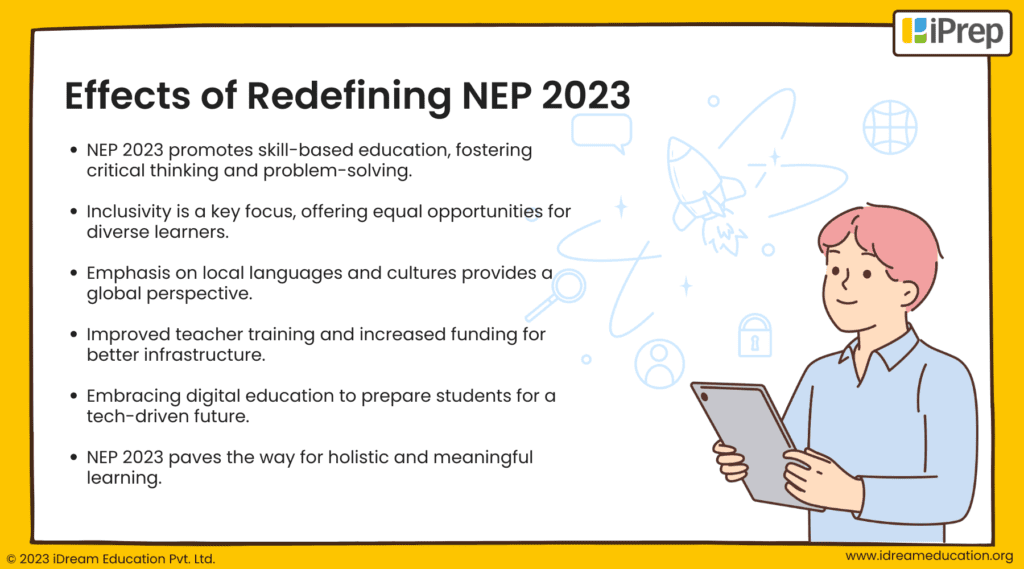
- NEP 2023 promotes skill-based education, fostering critical thinking and problem-solving.
- Inclusivity is a key focus, offering equal opportunities for diverse learners.
- Emphasis on local languages and cultures provides a global perspective.
- Improved teacher training and increased funding for better infrastructure.
- Embracing digital education to prepare students for a tech-driven future.
- NEP 2023 paves the way for holistic and meaningful learning.
A significant change in NEP 2023 from the past involves:
The transition from the conventional 10+2 model to the ever-growing 5+3+3+4 structure. This framework places a strong emphasis on fundamental skills and life competencies at every educational level.
What does 5+3+3+4 Structure mean?
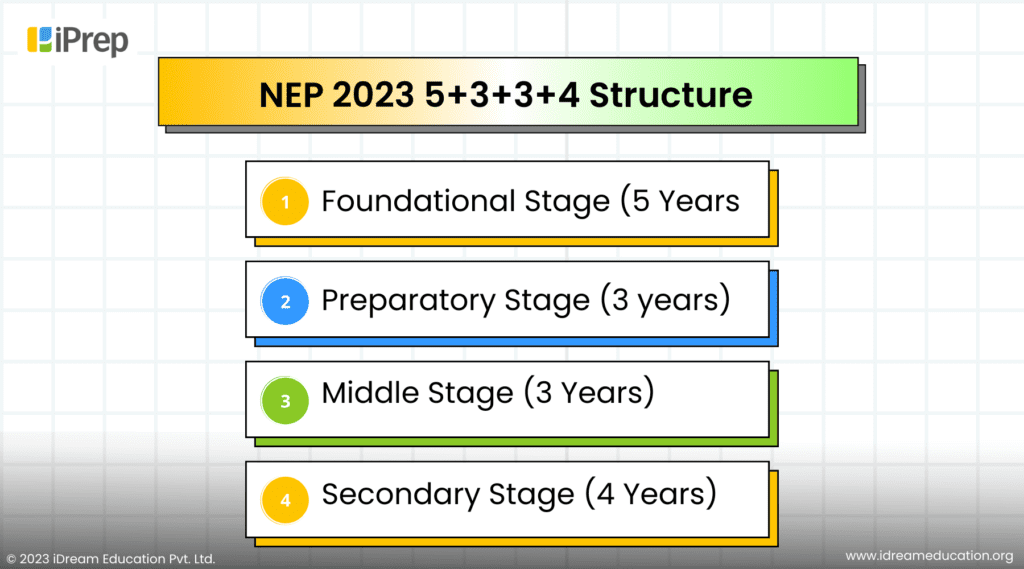
NEP 2023 redefined the educational framework to a 5+3+3+4 structure to enhance and align the traditional learning system with the evolving needs of students.
To create a holistic pedagogical environment, National Education Policy 2023 emphasizes on:
Foundational Stage (5 Years)
During the first three years of pre-primary education, children will primarily engage in playful and interactive learning activities, while the following two years in classes 1st and 2nd the focus will be on the development of Foundational Literacy and Numeracy (FLN) skills.
Preparatory Stage (3 years)
During this three-year phase, the primary emphasis is on students of classes 3rd, 4th, and 5th grades where a multifaceted teaching approach will be integrated as it seamlessly integrates various subjects, providing a well-rounded and holistic learning experience. The focus of preparatory stage centers on fostering a sense of discovery and exploration, aiming to steer away from rote learning of complex concepts. It is important because at this stage when the curriculum gets deep it becomes necessary to encourage a deeper understanding and the practical application of knowledge.
Middle Stage (3 Years)
During this three-year phase, the emphasis is on delving deeper into the subject matter for students in 6th, 7th, and 8th grades. The Middle Stage will focus on helping students explore subjects in greater detail, thereby enabling critical thinking. Furthermore, the Middle Stage is dedicated to introducing project-based learning to help students gain hands-on experience.
Secondary Stage (4 Years)
In the final four years of school, from grades 9 to 12, students get ready for their future. Some for higher education or vocational paths. Therefore, during this stage, when students can choose what they want to study, the focus will be on holistic development. This will help them gain real-world skills and competencies.
Guidelines of NEP 2023
- Holistic Development Focus: NEP 2023 fosters cognitive, emotional, and societal growth for students.
- Early Foundational Learning: Prioritizes Early Childhood Education and Care for strong foundations.
- New Curriculum Structure: Introduces a 5+3+3+4 structure for experiential and skill-based learning.
- Vocational Education Goal: Aim for 50% of learners in vocational education by 2025 is to contribute to the Nation’s human capital.
- Regional Language Learning: Emphasizes regional language learning up to Grade 5, to enable a familiar learning environment.
- Tech-Driven Education: NEP 2023 emphasizes using e learning platforms like DIKSHA or K 12 learning management system to enable access to quality education.
- Adaptive evaluation system: The policy emphasizes rethinking assessments to shift from summative to a more comprehensive evaluation system.
- Teacher Training: Continuous training and professional development of teachers to align with evolving teaching approaches.
- Inclusivity and Equity: NEP 2023 commits to ensuring education for all, regardless of socioeconomic or physical barriers to learning.
It’s truly inspiring to witness the proactive approach of the Government of India in revamping the National Education Policy (NEP).
In line with NEP 2023, iDream Education is happy to underscore its alignment with the policy’s vision, as it centers on fostering the holistic development of students through its comprehensive, one-stop learning platform, iPrep. This platform places equal emphasis on both academic and non-academic growth.
iPrep’s alignment with 5+3+3+4 Structure
In harmony with the new Curriculum 5+3+3+4 framework, iPrep, through its K12 LMS offers a diverse range of curriculum-aligned multi-category content for students in grades K-12, available in Hindi, English, and seven other regional languages. iPrep Learning Management system for schools can be incorporated as a Digital Class through a Smart board or a Digital Board, or as a learning tablet with rich digital NCERT content and content for and aligned with other state boards. Beyond academics, iPrep delves into areas such as life skills, value education, vocational content, climate change awareness, activity and project-based learning, and more for the holistic growth of students. Furthermore, iPrep prioritizes experiential and skill-based learning for different grades. It’s meticulously designed to draw content from Open Educational Resources (OER) sources/platforms such as DIKSHA and Khan Academy, thereby ensuring access to quality education.
iPrep PAL, a personalized adaptive learning solution by iDream Education enables an adaptive evaluation system
iPrep PAL is a structured app featuring an adaptive evaluation system that shifts the focus from summative assessments to a more comprehensive evaluation approach. This personalized adaptive learning solution tailors individual learning paths for each student, recognizing their unique learning needs and abilities.
What else is in line with the NEP 2023?
We not just focus on developing and delivering our solution but our commitment lies in the successful implementation of the solution, with comprehensive and ongoing teacher training programs, ensuring teachers can effectively digital in their daily classroom sessions.
Lastly, with a focus on local language medium, a multi-category curriculum alignment, ICT labs, and offline digital learning content, iPrep stands as an inclusive and equitable solution that caters to all learners. With its adaptability to various devices and operating systems, it eliminates socioeconomic and physical barriers to learning.
To Conclude
This revamping of NEP at this juncture has the potential to transform the Indian education system into a more inclusive, flexible, and learner-centric one. iDream Education looks forward to working with System Integrators, Government entities, corporations, foundations, NGOs, and other ecosystem partners to facilitate a holistic and integrated education approach.
Frequently Asked Questions -
1. What is NEP 2020?
NEP 2020, the National Education Policy, is India's framework for transforming school and higher education, approved by the Union Cabinet on 29 July 2020. It replaced the National Policy on Education of 1986 and focuses on holistic development, foundational literacy and numeracy, and skill-based learning.
2. What does "NEP 2023" refer to?
"NEP 2023" is not a separate government policy. It is a term commonly used for the ongoing rollout of NEP 2020, which gained visible momentum in the 2023-24 academic year, guided by the National Curriculum Framework for School Education (NCF-SE) 2023.
3. What is the 5+3+3+4 structure under NEP 2020?
The 5+3+3+4 structure replaces India's earlier 10+2 schooling model with four stages: Foundational (5 years), Preparatory (3 years), Middle (3 years), and Secondary (4 years). Each stage is designed around students' developmental needs rather than a uniform teaching approach across all grades.
4. What happens during the Foundational Stage under NEP 2020?
The Foundational Stage covers three years of pre-primary education followed by Classes 1 and 2. The first three years focus on playful, interactive learning, while Classes 1 and 2 build Foundational Literacy and Numeracy (FLN) skills.
5. What is NEP 2020's target for vocational education?
NEP 2020 set a goal for 50% of learners to be exposed to vocational education by 2025. This is part of the policy's broader push to move away from purely academic learning toward practical, skill-based education from an early stage.
6. How does NEP 2020 change classroom assessment?
NEP 2020 calls for a shift away from summative, exam-only assessment toward a more continuous and holistic evaluation system. This approach tracks a student's overall development rather than relying on a single test score at the end of a term.
Categories You may Explore
Related Articles