A Guide on How to Set Up a PAL Lab for Schools

Learn how to set up a PAL Lab for schools to make adaptive learning accessible for last-mile learners.
Cover image for a guide on how to set up a PAL Lab in schools, featuring students learning on personalized resources a single space

The concept of “one-size-fits-all” learning is becoming obsolete. This became clear during the post-COVID era, with the abrupt shift to digital learning. Millions of students during the COVID-19-induced lockdown did not have access to digital learning. This resulted in noticeable learning gaps among students when they returned to school after 2 years.

With the social sector prioritizing adaptive learning solutions in schools, the Haryana Government became one of the first states to adopt PAL software. For over 500,000 students in government schools of Haryana under the e-Adhigam initiative. The vision was to empower students to address the two-year learning gap while continuing in the same grade. Under the initiative, the government provided individual tablets with internet access and preinstalled PAL software.

Considering the growing need for adaptive learning to reach even the most remote learners, we are now enabling our PAL solution both online and offline. Further, our PAL solution can be accessed on tablets, Chromebooks, and other devices.

This is now a part of our ICT Lab solution, known as PAL Lab. The model is designed for schools, simplifying the process for the social sector and government to implement adaptive learning systems. 

From our extensive work with government schools, we came to an understanding that the major reason for stagnant learning outcomes is unaddressed historical learning gaps. Some reasons for these learning gaps are irregular attendance, absenteeism, and lack of interest. Therefore, schools need a solution that helps students bridge both the learning gaps caused by COVID-19 and long-standing educational deficiencies. The need is also emphasized in the NEP 2020.

Why PAL Labs Matter for Schools?

Access to Individualized Learning Devices

By setting up PAL labs, we can equip each student with their personalized tablet or device. Having access to personalised learning fosters a sense of ownership and allows for truly individualized learning experiences in school. This centralized approach reduces the need to equip every student with a personal device while ensuring equitable access for all. Schools can integrate PAL Labs into their timetable, allowing students to use the devices on a rotational basis. This approach optimizes resource utilization. Additionally, it creates a non-judgmental environment where every student has an equal opportunity to address their individual learning needs and cover historical learning gaps.

Flexible Implementation of digital learning solution

PAL labs can be set up in any existing classroom or lab space, eliminating the need for costly infrastructure changes. With just a power plug, we can turn any room of the school into a personalized adaptive learning setup.

Adaptive Content

The guided mechanism of PAL is developed both online/offline. Therefore digital content on PAL Software adjusts in real-time based on a student’s performance in the diagnostic tests. If a student struggles with a concept/topic, the system provides additional support through remedial video lessons or practice. Based on their scores and learning levels, students advance to grade-level proficiency.

Cost-Effective Solution

PAL labs are a budget-friendly way to bring personalized adaptive learning to every student. By setting up a charging and storage rack that can centrally manage and charge all tablets or chromebooks, you can avoid costly infrastructural upgrades in schools. 

By addressing the challenges of individualized learning, accessibility, and cost, PAL labs offer an adaptive learning solution for schools. This is designed to empower social sector education and government to enable equitable learning opportunities for all with minimal setup. 

Let’s take a closer look at how to set up a PAL Lab For Schools

While the infrastructure of schools may vary, the need for quality education is universal. As recommended in ICT@Samagra Shiksha, upgrading ICT Labs has created opportunities for EdTech providers and the social sector to develop and set up user-friendly digital learning solutions for schools. ICT Lab-like solutions such as PAL Lab are easy to implement and manage and require no additional infrastructure. Let us know how can you set up a PAL Lab For Schools:

Infrastructure
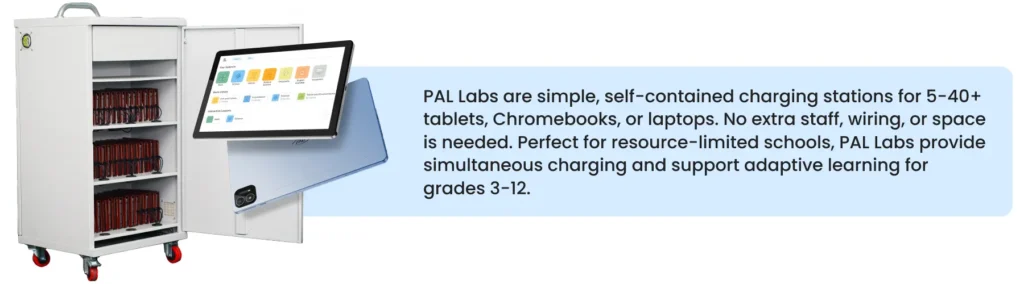
Image of PAL LAB, an ICT lab setup as highlighted in Samagra Shiksha, designed to be implemented with minimal infrastructure in schools

PAL Labs, unlike traditional computer labs, are designed for easy setup and management, requiring no dedicated staff. This ICT lab model functions as a charging and storage rack that can accommodate 5 to 40+ tablets, Chromebooks, or notebooks. It’s ideal for schools with limited resources or in remote areas as it does not require any extra wiring, furniture, or space to keep. Devices in PAL Labs get charged simultaneously on a single power plug for 3-4 hours, lasting the school day. PAL Labs are suitable for schools with grades 3-12 and social sector education programs focusing on enabling adaptive learning to help students cover the historical learning gaps. 

Personalized and Adaptive Learning (PAL) Software
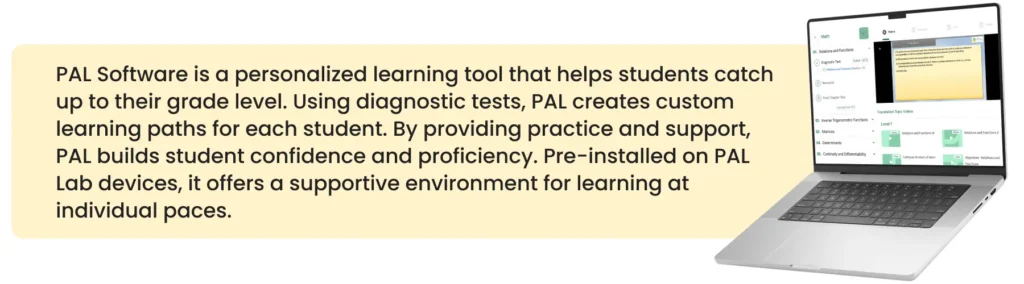
Illustration depicting a personalized adaptive learning solution (PAL) designed for a remedial learning program by a social sector organization

PAL Software is an essential part of the PAL Lab setup. It is designed to ensure a smooth transition to grade-level proficiency by addressing learning gaps without letting students feel bad about moving to grades below. With a guided mechanism, PAL creates personalized learning paths tailored to each student’s current grade and learning level. Students begin by taking diagnostic tests within the PAL software, which assess their understanding of subjects and chapters. Based on their responses, PAL guides them through foundational learning content and practice exercises, gradually building their proficiency until they reach grade-level expectations. Further, PAL App is pre-installed on all devices in PAL Lab, which can be accessed by students through their unique login details. This fosters a non-judgmental learning environment where students can address their learning gaps at their own pace.

Learning Management System with PAL
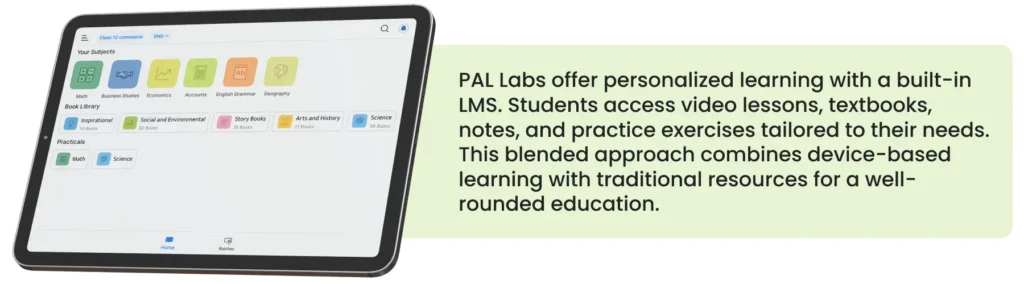
Image showing Learning Management System with PAL software by iDream Education

PAL lab setup in schools enhances learning through a Learning Management System (LMS) installed on student devices, offering a rich array of curriculum-aligned resources such as video lessons, syllabus books, notes, and practice materials. The PAL software enhances the personalized learning experience by creating personalized learning paths for each student, which is a combination of practice sessions and remedial video lessons tailored to their needs. Beyond adaptive learning on devices, students have the freedom to explore a wider range of learning resources, including books, notes, and practicals, fostering a holistic and self-directed approach to learning.

Content for Life Skills and Value Education
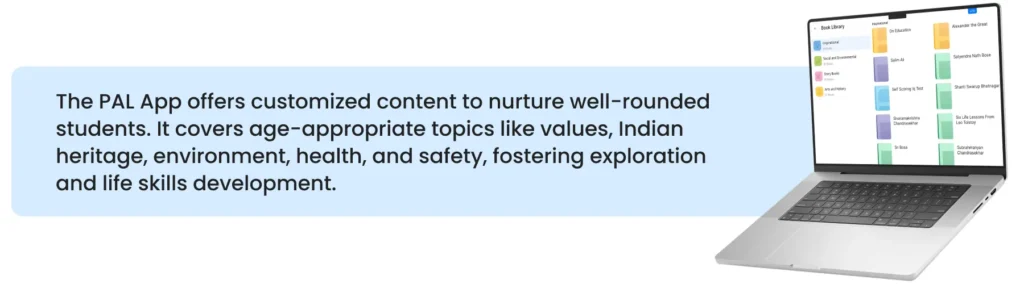
Life Skill and Value Education content in PAL Lab set up by iDream Education for holistic development for students

You can customize the content on the LMS with PAL to meet the unique needs and holistic growth of students in your education program. The customization ensures age-appropriate extracurricular content that keeps young learners aware of their surroundings from the start. The content covers a diverse range of topics, from moral values and Indian festivals to stories of Indian leaders, climate action, health, safety, and sanitation. By offering such comprehensive and engaging content, the learning platform empowers students to explore their interests, learn essential life skills, and develop into well-rounded individuals.

Ongoing Reporting
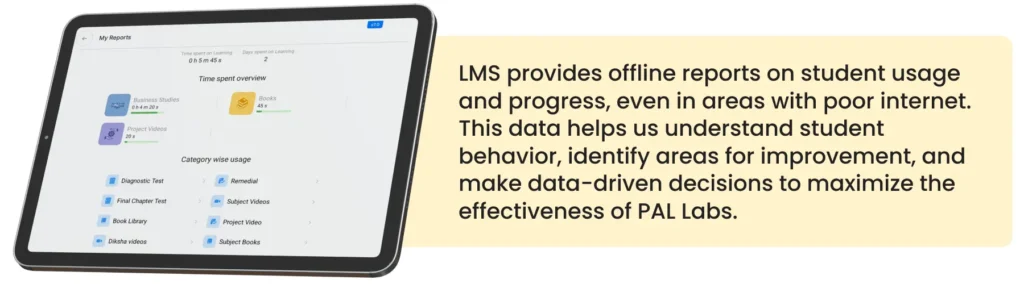
K-12 LMS with offline reporting capabilities in a Personalized Adaptive Learning (PAL) Lab setup by iDream Education

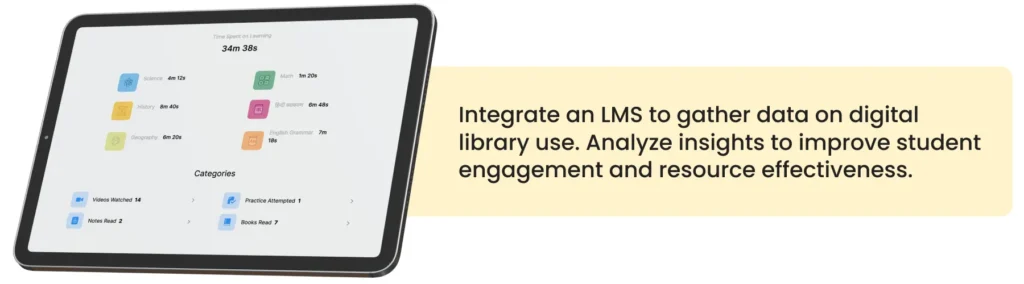
Establishing an effective adaptive learning solution such as PAL Lab necessitates more than just implementation. PAL LMS with reporting is vital to ensure its usage and keep track of improvement in learning outcomes. Therefore, our focus has always been on integrating a learning management system (LMS) equipped with offline reporting on the PAL App. This enables us to collate comprehensive usage data offline, making it suitable for schools located in areas with limited internet connectivity. This PAL app records usage data based on categories, practice, and subjects, and seamlessly syncs to project dashboards and command centers. This offers valuable insights into daily usage patterns on students’ interests, learning patterns, and scores. This is designed and developed to empower project officials to get data-driven insights to achieve measurable outcomes.

A compelling example of how to set up a PAL Lab for schools is the implementation of PAL Lab at iMpower clubs of Aide et Action. 

Facilitators and coordinators at iMpower centers work to provide educational, health, and nutritional support to children of construction workers. Their children often accompany their parents to work due to frequent changes in their place of employment. The children’s transient lifestyle often leads to discontinuity in learning, limiting them from enrolling in school and ultimately leading to significant learning gaps.

To address this, facilitators at the iMpower Clubs, try to involve students in continuous learning through textbooks, playful learning resources, and so much more but there is no specific solution to address learning gaps. Learning gaps persisted, but this year, a collaborating social sector organization, dedicated to supporting these centers, established PAL Labs with 10 tablets in partnership with us. Previously, teachers could only estimate a child’s learning level based on their age, limiting their ability to address individual needs effectively. However, with PAL software, students can now log in with their personal and grade details, allowing the system to identify their current learning level and provide personalized learning paths. “When students learn and practice simultaneously, they get involved in learning more”, -said one of the facilitators of iMpower Club. Read More

The PAL Lab setup at the iMpower clubs includes a charging and storage rack, 10 tablets pre-installed with PAL software, a K-12 Learning Management System for formal learning, and an LMS with PAL for grades 3 to 12. Both LMS versions feature offline reporting capabilities to track usage and drive measurable learning outcomes.

If you found this relevant for your remedial learning school education program or looking for information on how to set up a PAL Lab for schools, please contact us at +91 7678265039. You can also email us at share@idreameducation.org, or share you details here.
A Step-by-Step Guide on How to Set up a Digital Library for Schools?

Learn how to set up a digital library for schools to enhance access to digital library resources through a bilingual digital library platform.

Cover image depicting a step-by-step guide on how to set up a digital library for schools

Imagine a library where reading and digital library resources, digital learning content, and every piece of educational content including K-12 books and beyond academics are just a click away. A place where students aren’t limited by the confines of physical shelves, but instead have a universe of information that combines their academic and non-academic learning resources. That’s the power of a digital library for schools, and it’s easy to set up, manage, and even use. 

Before we guide you through setting up a digital library for schools, let’s explore a few inspiring examples that have paved the way for digital libraries in India. 

  • The National Digital Library of India (NDLI), developed by the Indian Institute of Technology Kharagpur with the support of the Ministry of Education, provides a vast collection of educational resources for students of all levels, from primary to postgraduate. With millions of books, articles, videos, and more, NDLI has become a cornerstone of digital education in India. 
  • Digital Library of India (DLI), is an ambitious government initiative to digitize and preserve India’s vast cultural and intellectual heritage. This monumental project aims to make literary, artistic, and scientific works freely accessible to everyone, everywhere, for educational, research, and cultural purposes. The DLI began with the mission to convert all copyright-free books and manuscripts in India into digital format, ensuring their preservation for future generations and fostering a wider appreciation of India’s rich knowledge traditions.

Inspired by these successful models, we immersed deep into understanding the core principles of digital library concepts to meet the unique needs of school education.

Let us first know why schools need a digital library set up when the internet already offers a wealth of information

While it’s undeniable that the internet is a vast repository of knowledge, it’s not always the most conducive environment for focused learning, especially for school education. Today’s students are increasingly visual learners, and a well-created and curated digital library platform can offer a wealth of engaging multimedia content like curriculum-aligned educational videos, interactive simulations, audiobooks and so much more that cater to diverse learning styles.

  • Additionally, the sheer volume of information available online can be overwhelming and time-consuming to navigate. A affordable digital library for schools acts as a trusted guide, curating resources that align with the curriculum and extracurricular interests, ensuring that students can easily find relevant and reliable information without getting lost in the digital maze.  
  • Beyond that, not every student has equal access to technology or a reliable internet connection, particularly in government schools located in remote areas. A school-based digital library setup levels up the availability of digital learning resources offline, ensuring that every student, regardless of their socioeconomic background, has access to the same high-quality educational resources and personalized learning.

This gives the need for a digital library solution for school education which requires minimal infrastructure to set up and provide well-curated, easily accessible learning resources on a single platform. Crucially, it should be capable of updating information even with limited internet connectivity. This inclusive approach ensures that all students and teachers, regardless of location, internet access, or school infrastructure, have equal opportunity to benefit from the wealth of available knowledge as per state/national educational goals

Let’s take a closer look at how you can set up a Digital Library For Schools

School infrastructure across regions may differ, but the need for quality education remains universal. A digital library solution can bridge this gap, providing equitable access to a curated repository of offline and online learning resources. The solution should align with the broader vision of your education initiative, fostering a love for learning in last-mile learners regardless of location or socioeconomic background. By setting up a digital library for schools, you can enhance teaching and learning experiences, without making any infrastructural changes.

Find out the essential components required to set up a digital library for schools

Infrastructure

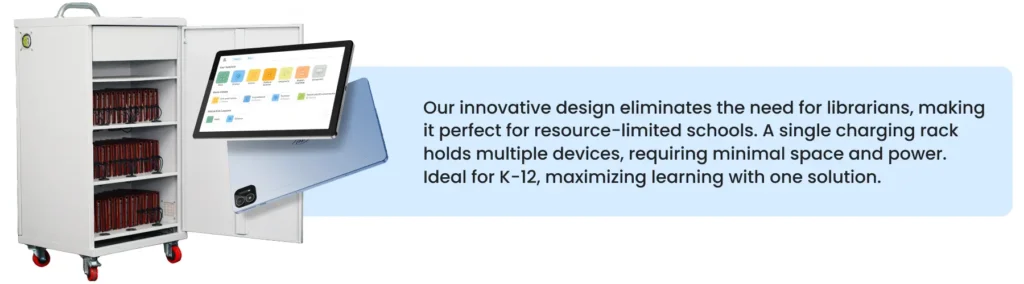
Image showing Digital library for schools by iDream Education which is easy to set up, manage, and use. It can be set up with devices such as tablets, Chromebooks, and notebooks, as suggested in ICT Lab Initiative and Samagra Shiksha

Unlike traditional libraries, digital libraries are simple to set up and manage. Our innovative design, modeled after an ICT lab, eliminates the need for dedicated personnel/librarians to manage it.  A charging and storage rack can accommodate 5, 10, 20, 30, 40, or more devices like tablets, desktops, Chromebooks, or notebooks. This solution is designed keeping in mind the schools with limited resources or those in remote areas, providing convenient access to digital learning resources to students and teachers. It does not require any additional wiring, furniture, or dedicated space. In this, multiple devices can be charged simultaneously using a single power plug for 3-4 hours and can be used by students during the entire school day.  This adaptability makes the digital library an ideal solution for K-12 educational institutions where you can plan to maximize resources and enhance learning opportunities with a single solution.

All-Inclusive Digital Library Platform

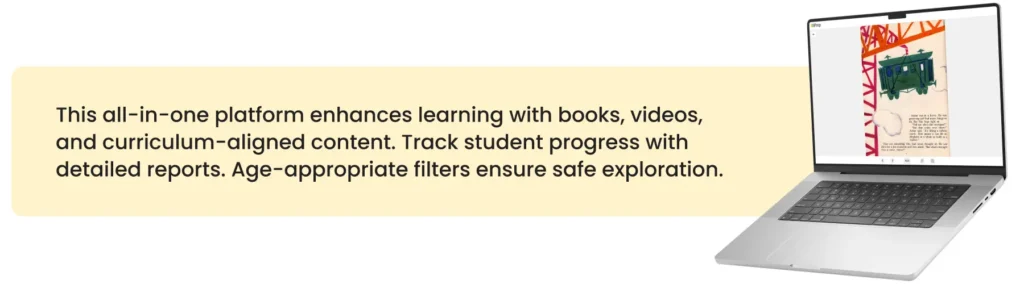
A digital library setup for schools featuring an all-inclusive learning platform. It includes digital learning resources such as books, videos, activities, inspirational biographies, stories, life skills, and more

The digital library should be one that enhances the learning experience of students through an all-inclusive digital library platform. iPrep is one such platform that seamlessly integrates diverse digital library resources with a reporting dashboard. This empowers teachers, project managers/administrators to track individual student usage, fostering data-driven insights for measurable outcomes. Our Digital library platform provides access to diverse digital library resources including a rich collection of books, engaging video resources, and comprehensive learning materials. It comprises a wide array of categories, including inspirational biographies, life skills, health, safety, sanitation, moral education, and Indian festivals, ensuring a holistic learning experience. Furthermore, the iPrep Digital Library Platform enables access to age-appropriate content, ensuring that students interact with materials tailored to their developmental stage. The digital library resources also include K-12 curriculum-aligned content in various forms such as videos, notes, practice exercises, and syllabus books, to further enhance the educational value of the digital library setup. Teachers in rural and urban areas are looking for ways to balance tech with access. Choosing the best digital library for schools often starts with understanding what works for both learners and classrooms.

Easy User Interface of Digital Library Platform

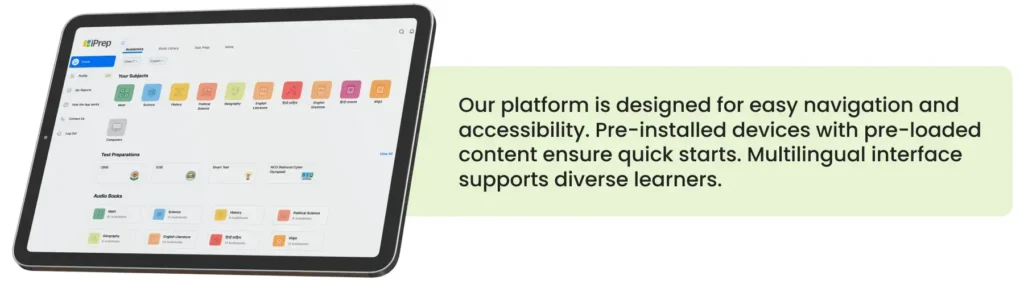
Image featuring a bilingual and intuitive learning platform on tablets a promoting an interactive and inclusive educational environment

A seamless user experience is crucial for the successful implementation of a digital library in schools. Our digital library platform iPrep prioritizes intuitive design, adhering to universal design principles to ensure easy navigation and accessibility for all users. To further simplify the setup process, our library platform comes pre-installed on devices with pre-loaded digital library resources, allowing users to dive right in. Recognizing the importance of linguistic diversity, iPrep offers a bilingual interface that adapts to the language chosen for content, supporting languages like English, Hindi, Marathi, Kannada, Odia, and more. This feature not only promotes inclusivity but also makes the digital library platform by the best digital library provider more approachable for users with varying language preferences, encouraging wider adoption and usage.

Digital Library Resources for School Education

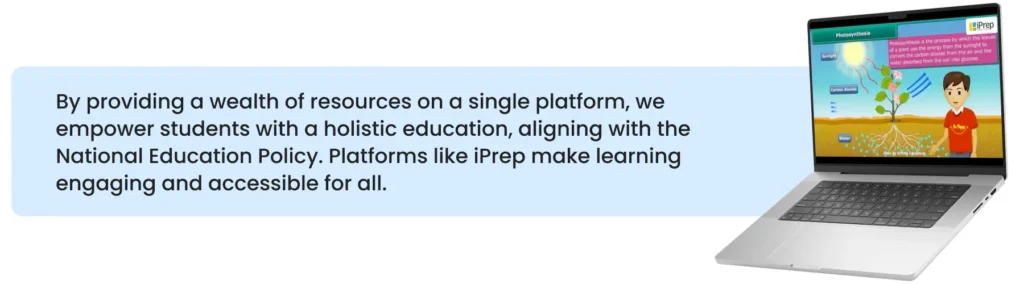
 A digital library setup with K-12 content for school education by iDream Education

Setting up a digital library in every school is essential to bridge the educational divide and democratize access to quality learning resources. By offering books, videos, and curriculum-based learning materials in one place, our digital library platform gives K–12 students a well-rounded and engaging way to learn. As envisioned in the National Education Policy 2020, this approach fosters not only academic excellence but also holistic development. Digital library platforms such as iPrep, designed with this vision in mind, offer a comprehensive repository of academic and non-academic digital library resources, ensuring that learning remains engaging, interactive, and joyful for every student, regardless of their location or background.

Ongoing Reporting

Image showing a comprehensive learning management system (LMS) featuring advanced reporting capabilities that can be enabled by setting up a digital library for schools

Setting up a digital library or any other digital learning solution requires more than just implementation. To ensure its usage and improvement in learning outcomes, ongoing tracking is crucial. Integrating a digital library platform with offline reporting capabilities on devices allows for comprehensive usage data collection, even in areas with limited connectivity. This data, automatically synced to project dashboards and command centers, provides valuable insights into daily usage patterns and student interests. With this information, teachers, and project officials can make informed decisions, conduct targeted repeat training, and address low usage issues effectively. By prioritizing usage tracking and data-driven strategies, schools can maximize the impact of their digital libraries, fostering better engagement in vast learning resources. 

Explore how iDream Education’s multilingual offline digital libraries are enabling anytime, anywhere learning. 

Final Thoughts: Choose a Partner, Not Just a Product

Setting up a digital library in schools goes far beyond installing hardware or loading content. It’s about creating a unified, seamless experience for students, teachers, and administrators. That’s why it’s essential to choose a digital library technical partner who is an all-inclusive digital library setup including hardware, digital library platform with rich digital library resources, analytics, and ongoing support.

By partnering with a single, capable technical partner for digital library setup  such as iDream Education, you can ensure a hassle-free implementation—right from procurement and setup to training, usage tracking, and long-term maintenance. Our digital library platform is designed to work effortlessly across diverse school environments, be it rural or urban, government or private, with or without internet.

For government bodies, NGOs, and institutions working towards educational equity, the right digital library platform must be easy to use, scalable, and impactful. It should offer engaging, curriculum-aligned content along with offline reporting tools that help track student learning and measure the real-world outcomes of your digital library initiatives.

Make a smart, future-ready choice

Opt for a digital library implementing agency that simplifies management, maximizes impact, and supports you at every step. With iDream Education, you’re not just adopting technology; you’re enabling a lifelong culture of learning. If you are looking for a technical partner for a digital library implementation, contact us at  +91 7678265039. You can also write to us at share@idreameducation.org or fill out the query form. We look forward to collaborating with ecosystem partners and setting up a digital library for schools across the nation so that every last-mile learner has access to digital library resources. 

Quick Insight on How to SetUp a Digital Library for Schools

  • Setting up a digital library for schools is easier than ever with preloaded devices, bilingual content, and minimal infrastructure requirements.
  • A well-designed digital library setup includes charging racks, tablets or notebooks, and an all-inclusive platform with curriculum-aligned and library content including books, stories, poems, biographies, exam prep, journals and lot more
  • Digital Library platforms such as iPrep Digital Library simplify how to set up a digital library by offering offline access, e-learning content in hindi, english and local language with student usage tracking.
  • A school-based digital library is far more effective than open internet browsing, offering focused, safe, and inclusive learning for every student.
  • Whether you’re an educator, NGO, foundation, policymaker, or anyone working to improve education, understanding how to set up a digital library can help bring joyful and equitable learning to last-mile learners

How to Solve a Long-Pending Problem of Low Usage and Improve Learning Outcomes with a Smart Classroom?

Cover image highlighting graphs of smart classroom LMS with reporting developed and designed by iDream Education, to improve  learning outcomes in  government and social sector education initiatives

With the noble goal of enhancing education for every student, especially those in remote or underserved areas, we’ve seen a nationwide wave of ICT and smart classroom implementations. Despite substantial national investment in ICT and smart classroom initiatives under Samagra Shiksha Abhiyan, a persistent gap remains between implementation and measurable improvements in teaching/learning outcomes. The low usage and accountability, in terms of reporting, remain alarmingly low, whether the implementation is through government initiatives or the social sector. This low usage is a long-standing problem that hinders our progress toward achieving the desired learning outcomes with smart classrooms.

Although governments have established Vidya Samiksha Kendra, the implementation of smart classrooms is such that the crucial learning usage data and learning outcomes cannot be effectively presented to these centers. This is primarily because the government lacks a comprehensive platform that ensures ongoing monitoring and reporting of smart classroom usage.

Therefore, it’s time for a frank assessment. Have we truly prioritized understanding why these classrooms haven’t been fully embraced? More importantly, have we invested in the solution that empowers us to continuously report and monitor?

The promise of educational equity, accountability, and inclusivity lies not merely in providing technology, but in ensuring its effective and consistent use to truly uplift every last-mile learner. 

How can you chart a path toward data-driven solutions that bridge the gap between investment and impact?

In the quest to bridge the gap between investment and impact in educational technology, the ability to track and analyze data is paramount. Therefore the government as well as social sector organizations must adopt a multi-faceted approach.

Smart Classroom LMS Should Have Offline Reporting 

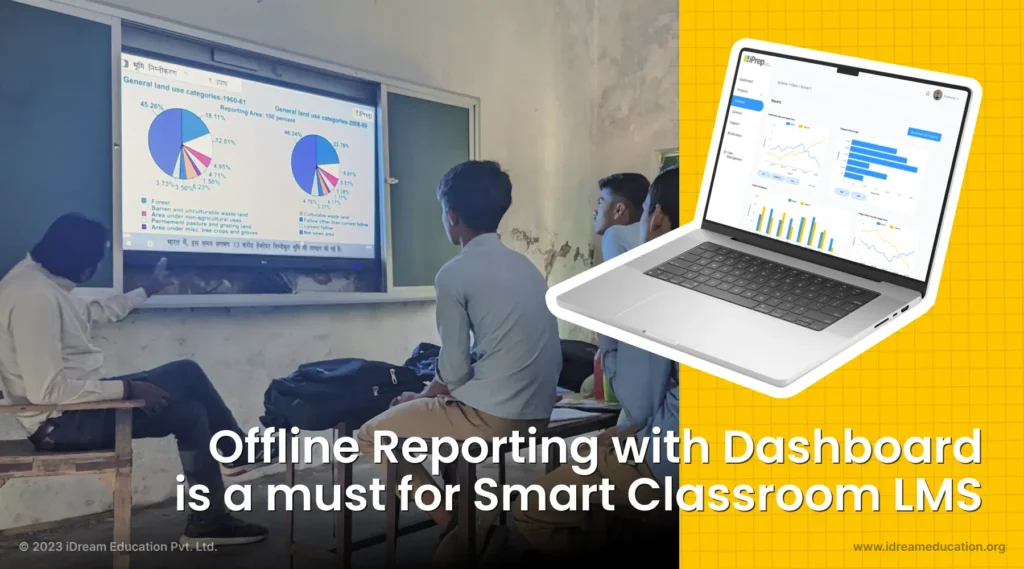
The first and most crucial step to bridging the gap between investment and impact is ensuring your Smart Classroom Learning Management System (LMS) has offline reporting capabilities. The LMS should be able to save usage data offline and automatically sync it to your project-level dashboards. Further, the data should be integrated into your command control center. With this setup, you can track daily usage, make data-driven decisions, and conduct repeat training. This way, improved usage can become a key focus in smart classroom implementation, empowering you to drive better usage and accountability.

Digital Content Should be Easy to Navigate and Use 

Secondly, digital learning content should be user-friendly and easy to navigate. While there’s an abundance of information online, it can be challenging for teachers to find curriculum-aligned, relevant content to complement their lessons. As a result, many prefer sticking to traditional teaching methods. To address this, the focus should be on enabling smart classroom LMS that is aligned with state educational goals and language. This ensures smart classrooms are accessible and practical for teachers and students to use in their daily routines.

Smart Classroom Hardware Should Be Intuitive and Familiar

Hardware should be very easy to use. Many instances of smart classroom implementation involve unnecessarily interconnected, complex computing hardware, creating an unneeded setup. This complexity often leads to resistance to using technology. Therefore, the focus in smart classroom implementation should be on enabling smart class hardware that is very simple to use. Hardware with which teachers and students are already familiar such as Android-based devices. For example, a smart TV or an interactive flat panel/digital board/smart board, which is similar to the TVs teachers use in their homes, leading to a seamless and user-friendly experience. By prioritizing intuitive and recognizable interfaces, you can empower teachers and students to embrace technology as a natural extension of their learning environment.

Image shows teachers tracking usage on Smart classroom LMS with reporting: A comprehensive edtech solution by iDream Education to improve learning outcomes.

By integrating these three key elements—offline reporting on Smart Classroom LMS, user-friendly content, and intuitive hardware—government and social sector organizations can create a comprehensive, data-driven approach to educational technology. 

This strategy not only maximizes the impact of investments but also empowers teachers and students to embrace technology as a tool for learning and growth. Ultimately, this holistic approach paves the way for a more accountable, inclusive, and data-driven education system.

Project Alankar under Gorakhpur UP  is one initiative signifying the shift in approach. The project envisions solving the long-pending problem of low usage and improving learning outcomes with smart classrooms. iDream Education is happy to be part of Project Alankar, providing curriculum-aligned UP Board content and Smart Classroom LMS for offline use with integrated and continuous reporting. 

If you are also looking for a solution to solve this long-pending problem of low usage and improving learning outcomes with smart classrooms contact us at +91 7678265039. You can also write to us at share@idreameducation.org or fill out the query form.

All about ICT Tools Used in Classroom Teaching as per the Samagra Shiksha Scheme

Cover image of iDream Education showcasing Samagra Shiksha-aligned ICT tools Used in Classroom Teaching.

While ICT tools have been present in classrooms for a decade, their usage has been a significant concern. Computer-based ICT labs, once considered essential, have often been underutilized due to complex hardware, internet dependency, and unreliable electricity. This is particularly a situation of government schools located in rural areas. In these schools, teachers struggle to integrate computer based ICT labs into regular teaching because interconnected hardware failures, such as a faulty keyboard or mouse. This lead to underutilization of entire ICT Lab setup.  Further, getting or enabling regular technical support to remote locations to resolve these issue is again a concern. Consequently, these labs were primarily used for dedicated computer classes, limiting the integration of ICT tools in classroom teaching and learning across the curriculum.

Considering these challenges, the Ministry of Human Resources and Development organized a Think Tank on ICT Policy in 2017

This marked the beginning of a new chapter in ICT integration in education. We are happy to share that the Ministry of Human Resources and Development recognized our efforts and invited us to participate in a Think Tank on ICT Policy. We were honored to present our findings to the Honorable Education Minister, Shri Prakash Javadekar Ji.

You can listen to Puneet, Co-Founder of iDream Education. In the video below, he shares his thoughts and recommendations for creating a roadmap for Digital Learning for Students in Government Schools.

What were the revisions laid in ICT Scheme Under Samagra Shiksha to streamline the ICT Lab setup?

In 2019, the Ministry of Education introduced a new form of technology for classrooms, including

  • ICT equipment with devices like tablets, laptops, notebooks, and PCs, Integrated Teaching Learning Devices, Digital Boards with Content Management Systems/solutions (CMS)/Learning Management Systems (LMS), Free and Open Source Software, etc. 
  • The revised ICT@Samagra Shiksha scheme also emphasized enabling digital resources, e-content, internet access, and financial assistance for ICT instructors. 
  • Tablets to  the Teachers of Primary Schools

We were happy to see the provision for government schools to consider buying tablets, notebooks, and laptops for ICT labs”, said Rohit Prakash – Co-Founder of iDream Education.

With this background in mind, let’s explore how schools can leverage the ICT tools outlined in the Samagra Shiksha Scheme.

ICT Tools Used in Classroom Teaching have started to enhance learning outcomes and strengthen the digital infrastructure of schools. All this is possible because of its easy-to-set-up, manage, and use nature. Know More:

ICT Lab

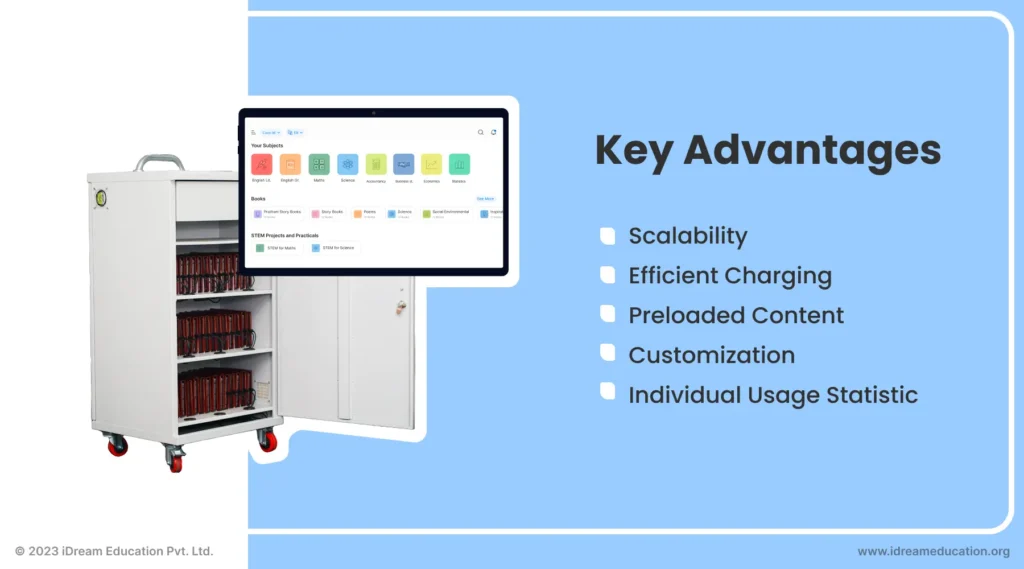
ICT Labs also known as digital library solutions. These Labs are designed to strengthen the digital infrastructure of any school without requiring extra furniture, wiring, or space. As outlined in SSA guidelines, this flexible ICT setup utilizes devices like notebooks, tablets, or Chromebooks, paired with a charging and storage rack. 

 Image of a Samagra Shiksha Aligned ICT lab setup, also known as a Digital Library for schools

Key Advantages:

  • Scalability: Accommodate 10 to 40+ devices, customized to your needs.
  • Efficient Charging: All devices charge simultaneously with a single power plug, providing 7-8 hours of use after 2-3 hours of charging. This reduces electricity dependence, making it suitable for schools in areas that face frequent electricity outages. 
  • Preloaded Content: Devices are given with preinstalled educational software and digital content in Hindi, English, and local languages, catering to K-12 school education.
  • Customization: Tailored to state-level government projects and social sector education initiatives.
  • Beyond infrastructure: We emphasize the effective use of ICT tools in classrooms through experiential teacher training and ongoing support. We monitor usage through a dashboard that tracks individual students’ involvement in learning. The usage reports can also be accessed on centralized project dashboards of government officials and project partners to help achieve data-driven learning outcomes.

We have been actively implementing ICT Labs through government and social sector partnerships in diverse configurations. We have used hardware such as tablets, Primebooks, and Chromebooks equipped with our comprehensive K-12 learning platform, iPrep. Teachers and students have embraced ICT Labs with enthusiasm, creating timetables to ensure equitable access to devices. Through this, they are able to facilitate personalized learning experiences for each student. This strategic implementation of technology not only enhances the learning environment but also empowers teachers to tailor instruction to individual needs, fostering a more engaging and effective educational journey for all students.

  • Smart Classrooms

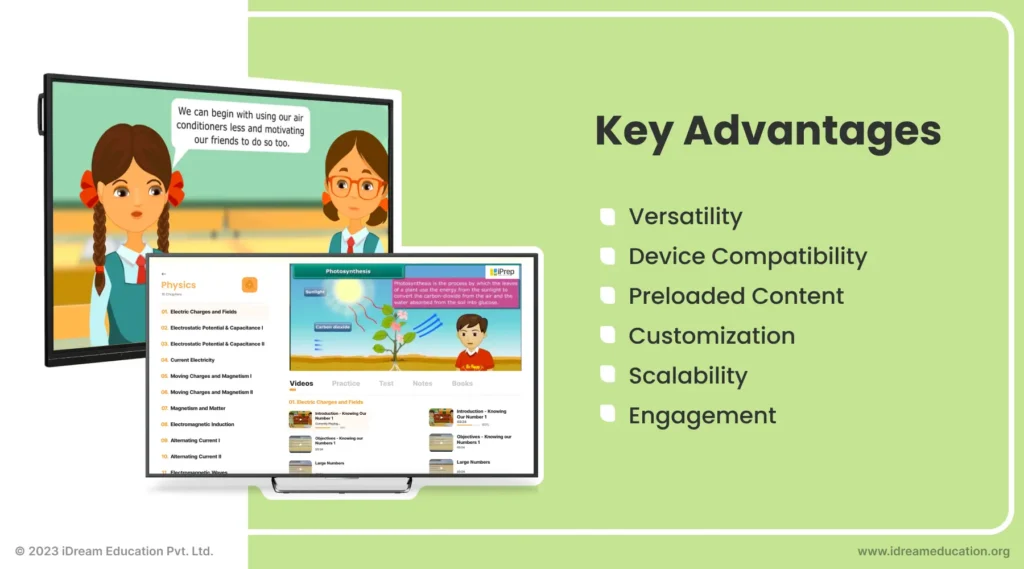
Smart Classrooms also known as digital classroom solutions. It is one of the ICT Tools Used in Classroom Teaching, enhancing the digital infrastructure without the need for additional furniture, wiring, or space. This flexible ICT setup utilizes interactive flat panels, digital boards, interactive boards, or smart TVs, and can be set up on any wall of the classroom.

 Infographic by iDream Education showcasing the advantages of ICT-aligned smart classrooms

Key Advantages:

  • Versatility: Multiple hardware options to choose from based on budget and educational requirements (interactive flat panels, digital boards, smart TVs).
  • Device Compatibility: Runs on widely-used operating systems like Android, Windows, and Linux for easy integration with existing school infrastructure.
  • Preloaded Content: Devices come pre-installed with educational software and digital content in Hindi, English, and local languages, specifically designed for K-12 school education.
  • Customization: We can customize our smart classroom solutions as per the specifications of any government-led education projects and CSR initiatives. For example, we can give comomplete solution including Hardware+ smart classroom LMS or just smart classroom LMS.
  • Scalability: The number of smart classrooms in a school can be adjusted on the basis of education project specifications.
  • Beyond infrastructure: We emphasize the effective use of smart classroom LMS through experiential teacher training, ongoing support, and reporting which gives insights into their usage. Further, smart classroom centralized dashboards empower government officials and social sector people to take data-driven decisions on an ongoing basis on how actively teachers are using it to teach and drive improvement in learning outcomes.

We have been actively implementing smart Classrooms through government and social sector CSR and hardware partnerships in diverse configurations. We have set up hardware such as a smart TV, projector, and interactive panel preinstalled with our comprehensive K-12 learning platform, iPrep. Teachers have adopted smart classrooms very naturally as it aligns with their natural psychology of using TV/smartphones. Some schools have defined smart class timetables to ensure every teacher has access to digital teaching resources. This strategic implementation of technology not only enhances the learning environment but also empowers teachers to make classrooms interactive spaces for learning.

Tablet to Teachers

While providing teachers with tablets is a step towards integrating ICT Tools for classroom teaching, we must equip them with the tools and resources to maximize their potential. iPrep Coach, a comprehensive platform, transforms tablets into powerful teaching solutions and addresses the gap between hardware and effective utilization.

An infographic showcasing the benefits of enabling comprehensive teacher app in ICT aligned tablets for teachers.

Key Advantages:

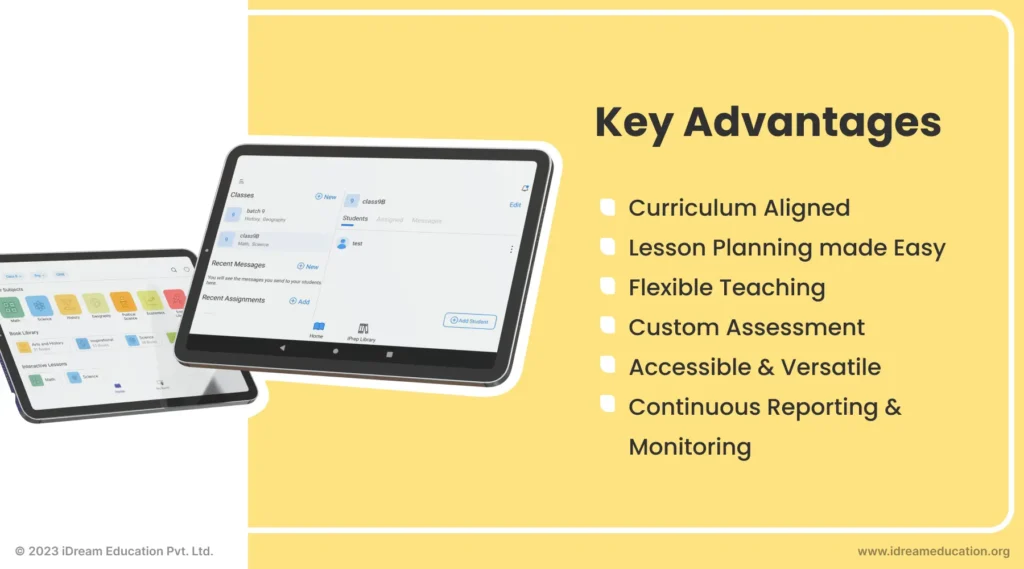
  • Curriculum-Aligned Digital Content: iPrep Coach comes preinstalled on teacher tablets and pre-loaded with a vast library of digital content that aligns with the curriculum. This give access to multi-category teaching resources at the fingertips of teachers.
  • Lesson Planning Made Easy: The platform enables teachers to seamlessly combine personalized notes, videos, images, and other resources into comprehensive lesson plans.
  • Personalized and Flexible Teaching: Teachers can record live lectures and screencasts on smart screens, providing personalized instruction even when absent. Students can also use these recordings for revision/recap.
  • Custom Assessments: iPrep Coach on teacher tablets empowers teachers to create tailored assessments for their classes, facilitating personalized learning experiences.
  • Versatility and Accessibility: The app can be easily integrated on tablet of any brand. This makes it suitable for specification of various government education projects and CSR initiatives.
  • Continuous reporting and monitoring: Principals, school administrators, project managers, and government officials can monitor and approve teacher-created content, ensuring high-quality content is being created and used for improving learning experiences.  

iPrep Coach is more than just an app. It is a holistic approach to empowering teachers with technology. iPrep Coach combines hardware with user-friendly software and a wealth of resources to be a comprehensive teacher companion. It inspires and empower teachers to create personalized digital content. They can further use it to teach in many ways, and make a lasting impact on education.

The integration of ICT tools in classroom teaching, as envisioned by the Samagra Shiksha Scheme, is not merely a technological upgrade. It is a step to improve adoption of digital learning in government schools 

The three tools highlighted in this article, all seamlessly integrated with an LMS for Schools, exemplify this paradigm shift. Their scalability, versatility, accountability, inclusivity, and data-driven monitoring capabilities pave the way for personalized learning experiences. 

The benefits of SSA-aligned ICT solutions designed and developed by iDream Education extend beyond the classroom. This is because it empowers stakeholders in government and social sectors with efficient setup, management, and ongoing usage monitoring. All this is designed and developed to help them achieve learning outcomes. 

We look forward to collaborating with ecosystem partners to accelerate the implementation and adoption of digital in government schools with accountability through usage reporting and data-driven monitoring of learning outcomes. For more information, you can contact us at  +91 7678265039 or write to us at share@idreameducation.org. You can also share your details here.
Smart Classrooms under Project Alankar at Gorakhpur, UP – Bringing focus on tracking usage in classrooms with data-driven monitoring

Project Alankar under Gorakhpur UP exemplifies a shift by strengthening smart classrooms with not just multimedia to teach, but also with accountability through usage reporting and data-driven monitoring of learning outcomes. 

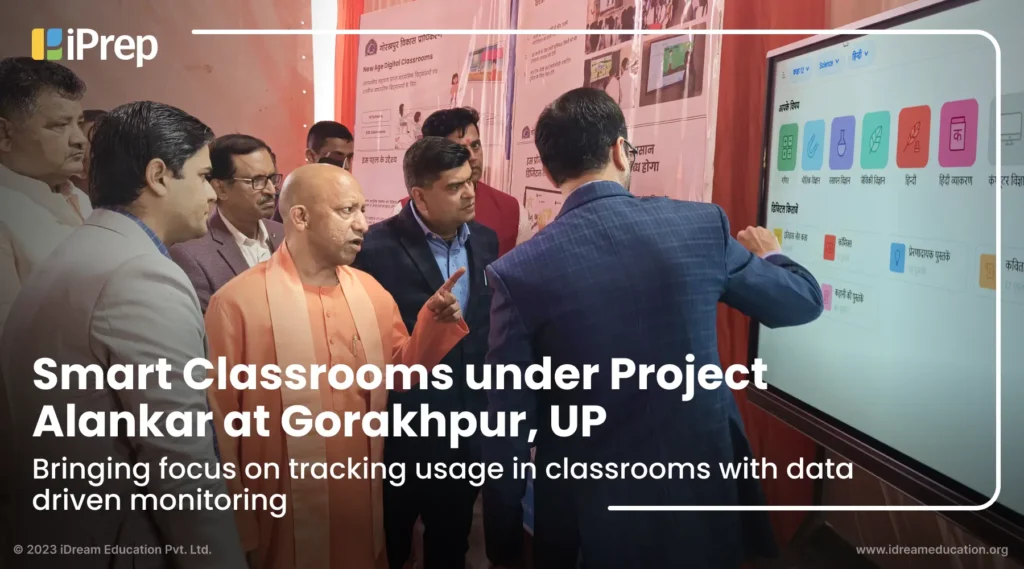
Image of Smart classrooms under Project Alankar in Gorakhpur, Uttar Pradesh, set up by iDream Education, featuring digital content and a smart classroom LMS, with ongoing reporting

With the vision to enhance education for last-mile learners, countless smart classrooms have been implemented across the nation. Yet, a crucial piece has been missing: the power of continuous reporting and data to drive real, measurable improvement. 

With a lot of money being invested in Information and Communication Technology (ICT) initiatives, a notable shift is underway. 

The Gorakhpur Development Authority, Govt of UP, through its Project Alankar, has focused on a comprehensive approach to smart classroom implementation at its Government Schools. The government has prioritized the integration of digital content and a smart classroom LMS with ongoing reporting on digital teaching devices and centralized reporting dashboards for ongoing monitoring of the learning outcomes. With this, teachers, school administrators, and project officials are empowered to monitor the usage, and strategically incorporate improvements and enhancements to ensure that the desired outcomes are achieved. The smart classroom dashboards also empower government officials to take data-driven decisions on an ongoing basis. This comprehensive approach streamlines the use of digital content while ensuring that it is actively contributing to improvement in learning outcomes. 

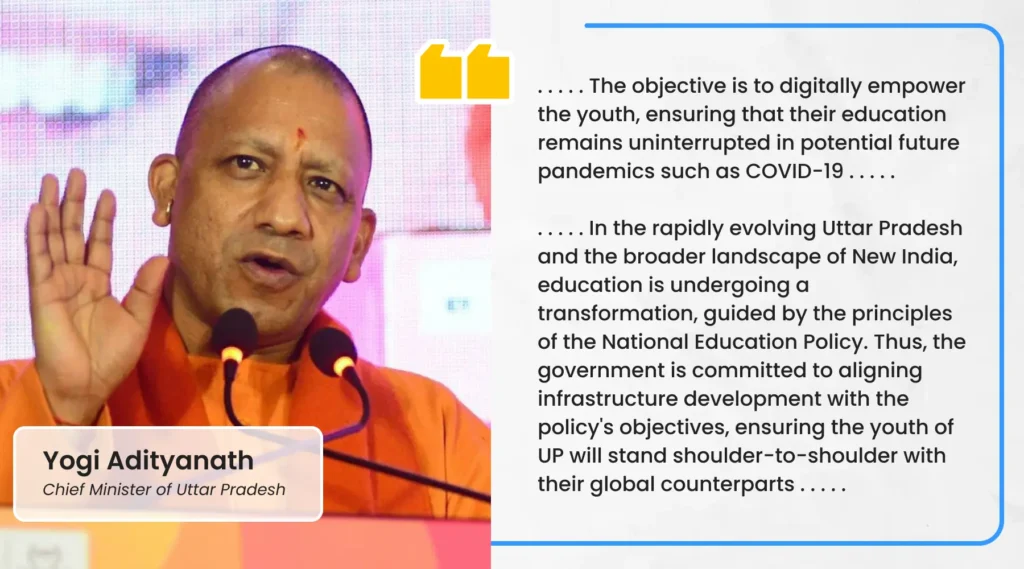
During the inauguration of Project Alankar in March 2024, CM Yogi Ji said, 

The objective is to digitally empower the youth, ensuring that their education remains uninterrupted in potential future pandemics such as COVID-19.” He further emphasized, “When physical education came to a halt during COVID-19, Prime Minister Narendra Modi Ji envisioned fostering connections through technology.”

Image capturing views of Chief Minister Yogi on Project Alankar
  • In Project Alankar, 1,500 students were provided with tablets, and 3,000 students received smartphones. The chief minister personally handed tablets to 15 students and smartphones to 10 students.
  • He also laid the foundation stone of Project Alankar worth Rs 17.35 crore, aiming to renovate 26 secondary schools. Additionally, 330 premium smart classrooms are set to be built at Rs 7.58 crore across 141 secondary schools.
  • Project Alankar has been initiated to strengthen the infrastructure of secondary schools that are old and in poor condition.
  • Recognizing the global prevalence of smart class technology, the project emphasizes the critical need for consistent usage and reporting. This will be achieved by enabling smart class devices with continuous reporting, allowing usage to be monitored regularly. Underscoring this commitment, even the Chief Minister has urged both teachers and students, “To actively use these resources in their daily education to improve learning outcomes”.

He added, “In the rapidly evolving Uttar Pradesh and the broader landscape of New India, education is undergoing a transformation, guided by the principles of the National Education Policy. Thus, the government is committed to aligning infrastructure development with the policy’s objectives, ensuring the youth of UP will stand shoulder-to-shoulder with their global counterparts”. 

iDream Education is happy to be part of Project Alankar, providing curriculum-aligned UP Board content and Smart Classroom LMS for offline use with integrated and continuous reporting. 

Now that Project Alankar is in action, it will be interesting to see the incremental value and usage of smart classrooms under this visionary project in Gorakhpur, UP.

If you are looking to implement smart classrooms with a deep focus on regular usage and continuous reporting to achieve the desired learning outcomes from your education program, contact us at +91 7678265039 or write to us at share@idreameducation.org. You can also share your details with us here

Bridging the Language Gap: iPrep, A K-12 Learning Platform with Digital NCERT Books in Hindi

Cover image of a blog post highlighting digital NCERT books in Hindi available on the K-12 learning platform iPrep by iDream Education

In India, where languages dance and dialects sing, Hindi stands as a unifying force. It is a language spoken and understood by millions across the nation. Yet, for countless students, especially those in rural areas and Hindi-medium schools, accessing quality educational resources in their native tongue remains a challenge. This linguistic barrier can impact learning, limit opportunities, and perpetuate educational inequities. 

Imagine a girl in a government school, eager to learn and absorb knowledge. But the textbooks she has are in English, a language foreign to her, filled with unfamiliar words and complex concepts. The joy of learning will dim, replaced by frustration and a sense of exclusion. This is the reality faced by many students in India, where the language of instruction often differs from the language of the home.

Bridging this language gap is not just a matter of convenience! It is a fundamental step towards inclusive and equitable education

  • When students learn in a language they understand and are comfortable with, they can fully engage with the learning material. This way they grasp complex ideas, and develop a lifelong love of learning.
  • When students learn in Hindi or their native language they are more likely to participate in class discussions. This way, they ask questions, and express their opinions. 
  • Learning in Hindi or a language students are familiar with, they connect new information with their existing knowledge and experiences. This makes their learning more meaningful and engaging.
  • When students are not struggling with language comprehension, they have more cognitive resources available to analyze, evaluate, and synthesize information. This fosters critical thinking skills and a deeper understanding of the subject matter.
  • Enabling learning in a preferred language creates a more inclusive learning environment. This ensures that all students have equal access to educational opportunities.

NCERT Books in Hindi Bridging the Language Gap 

When learning at home or school, books remain an integral part of student learning. Access to educational materials in a student’s preferred language is crucial for effective comprehension and knowledge retention. Recognizing this, the National Council of Educational Research and Training (NCERT) offers a wide array of textbooks in Hindi. This is to cater to the diverse linguistic landscape of India.

NCERT textbooks have long been known as the gold standard for students across the country. It serves as the foundation for success in CBSE board exams, class tests, and competitive entrance exams like NEET, UPSC, and JEE. These books are meticulously crafted to build a strong conceptual understanding of each subject, covering everything from English and Social Science to the core sciences like Physics, Chemistry, Biology, and Mathematics. By making these resources available in Hindi, NCERT ensures that language is not a barrier to learning.

iPrep Enabling Digital NCERT Books in Hindi

In the digital age of education, ensuring equitable access to learning resources is paramount.  As more schools and students embrace digital learning, the need for NCERT textbooks in Hindi has become increasingly clear. This shift not only streamlines the transition to digital classrooms but also empowers students to learn in their preferred language. Recognizing the prevalence of Hindi and local languages in many schools, particularly those served by government and social sector initiatives, it’s essential that educational platforms support bilingualism in classrooms. This fosters inclusivity and enhances comprehension for students across diverse backgrounds.

We have been consistently enabling bilingualism through iPrep’s K-12 digital content in Hindi, English, and local languages.  By providing NCERT digital books in Hindi for each class, iPrep aligns seamlessly with the existing school curriculum. This is to ensure continuity and familiarity for teachers and students when learning through digital.  

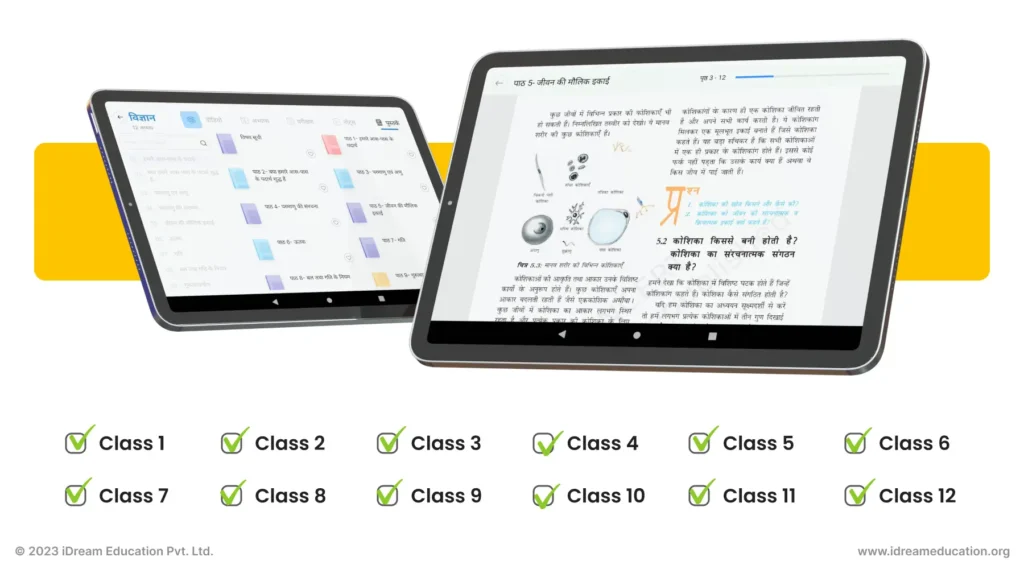
A closer look at how these digital textbooks are offered on the iPrep platform

From intuitive navigation to interactive features, iPrep’s interface enhances the overall learning experience. This makes digital NCERT books in Hindi both accessible and engaging.

Tablet displaying digital NCERT books in Hindi for all classes on the learning platform iPrep by iDream Education

Here are the digital NCERT books available in Hindi on iPrep:

Nursery to UKG 

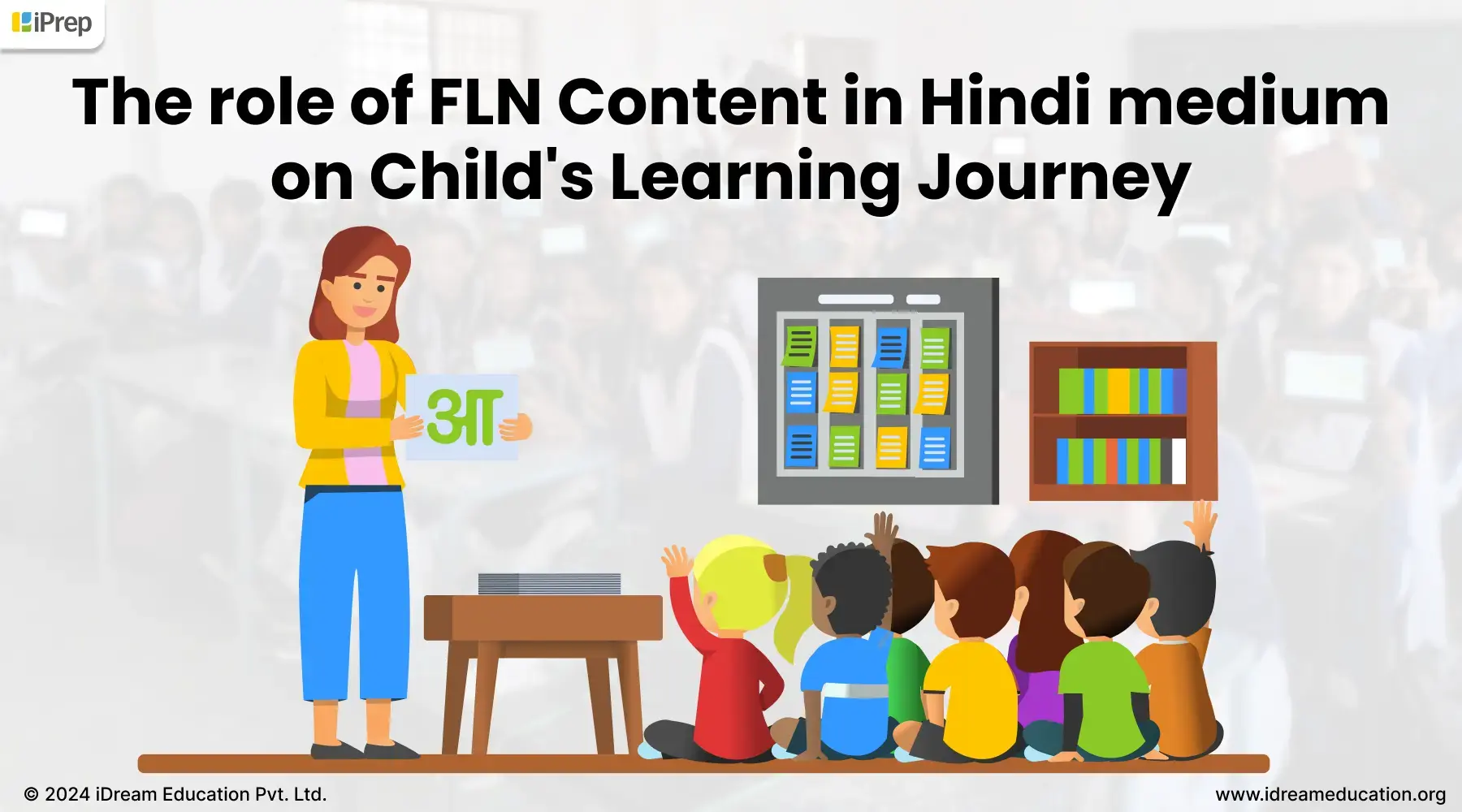
  • iPrep’s Hindi-medium Foundation Literacy and Numeracy (FLN) content grows with the child from Nursery to UKG.  Starting with core subjects like Math (गणित), EVS (पर्यावरण अध्ययन), and Hindi Grammar (हिंदी व्याकरण) in Nursery, each stage builds in complexity, aligning with the National Curriculum Framework’s developmental goals. By UKG, children explore NCERT digital books in Hindi for subjects such as Hindi Literature (हिन्दी साहित्य),  Poetry (कविताएं) and more. Whether a child’s strength is Hindi or English, iPrep’s dual-language presentation ensures a comfortable, inclusive environment for every learner.

For Class 1 

  • iPrep offers a comprehensive learning experience for Class 1 students with digital NCERT textbooks in Hindi across all subjects, including Math (गणित), English Literature, Hindi Literature (हिन्दी साहित्य). Popular titles like “संख्याओं के साथ खेल,” “हम कितना खर्च कर सकते हैं?,” and “कितने” are just a few examples of the engaging content available in Hindi.

Class 2

  • iPrep brings NCERT digital books in Hindi for class 2 with other digital content for all subjects. You can find fun lessons like “संख्याओं का आनंद”, “समूह एवं बँटवारा”, “नीमा की दादी”, and “तीन दोस्त”, all in Hindi! No more turning pages or searching for chapters – just scroll and find what you need. These PDF syllabus books can be easily accessed on any device such as mobile, tablet, smart TV, or IFP, making learning easier than ever!

For Class 3

  • As students move to higher grades, the complexity of their studies increases. Recognizing this, iPrep offers digital NCERT Books in Hindi, covering subjects like Maths (गणित), EVS (पर्यावरण अध्ययन), English Literature, Hindi Literature (हिन्दी साहित्य), and Computers. These digital books feature all chapters and topics in Hindi, including engaging titles such as ‘संख्याओं की उछल कूद’, ‘हमारा पहला स्कूल’, ‘हमारे साथी जानवर’, ‘बीरबल की खिचड़ी’, and ‘हम अनेक किंतु एक’. iPrep focus on providing all NCERT books in Hindi ensures that students can access educational materials in their preferred language, breaking down language and resource barriers to learning.

Class 4

  • In this grade, subjects such as Maths (गणित), EVS (पर्यावरण अध्ययन), English Literature, Hindi Literature (हिन्दी साहित्य), and Computers remain similar to Class 3, but the level of learning deepens. Now, digital NCERT introduces engaging topics like ईंटों से बनी इमारत, आधा और चौथाई”, दुनिया कुछ ऐसी दिखती है, ओमना का सफ़र, चूँ-चूँ करती आई चिड़िया, फ़ौजी वहीद, स्वतंत्रता की ओर and more all in Hindi. These stories and poems connect students with real-life people and experiences. Learning these topics in Hindi enhances their understanding and encourages critical thinking about their surroundings.

Grade 5

  • In this Grade, students revisit familiar subjects like Maths (गणित), EVS (पर्यावरण अध्ययन), English Literature, Hindi Literature (हिन्दी साहित्य), and Computers, but the learning journey takes a deeper dive. Digital NCERT topics in hindi now include आकृतियाँ और कोण, कितने वर्ग?,पानी के प्रयोग, जब धरती काँपी, कहानी सँपेरों की, and more. As students explore stories like कहानी सँपेरों की and events like जब धरती काँपी, they develop a deeper understanding of the world around them. Learning these topics in Hindi not only strengthens their language skills but also fosters a connection to their cultural roots, encouraging them to analyze and question the world through a uniquely Indian lens.

For Grade 6

  • As the level increases, Digital NCERT books in Hindi also cover a wider range of subjects. The curriculum gets vast on iPrep as well, which includes subjects such as Maths (गणित), Science (विज्ञान), History (इतिहास), Civics (नागरिक शास्त्र), Geography (भूगोल), English Literature, Hindi Literature (हिन्दी साहित्य), Sanskrit (संस्कृत) and Computers. As the subjects increase, students learn topics that outline the basics of these subjects, which includes भोजन के घटक, वस्तुओं के समूह बनाना, आखेट–खाद्य संग्रह से भोजन उत्पादन तक, राज्य, राजा और एक प्राचीन गणराज्य, सौरमंडल में पृथ्वी, विविधता की समझ and more. All this in Hindi helps students gain a deeper understanding of complex concepts in their mother tongue, fostering a love for learning and building a strong academic foundation.

Class 7

  • In grade 7, subjects such as subjects such as Maths (गणित), Science (विज्ञान), History (इतिहास), Civics (नागरिक शास्त्र), Geography (भूगोल), English Literature, Hindi Literature (हिन्दी साहित्य), Sanskrit (संस्कृत) and Computers remain same, but the level of learning deepens. Now, digital NCERT introduces engaging topics like गति एवं समय,  दिल्ली बारवीं से पन्द्रहवि शताब्दी, अठारहवीं शताब्दी में नए राजनितिक गठन, स्वास्थ्य में सरकार की भूमिका, and more. Hindi digital content on these topics makes learning more accessible and fosters a deeper understanding by allowing students to engage with complex concepts in the language they are comfortable with.

For Class 8

  • In 8th grade, students revisit familiar subjects such as Maths (गणित), Science (विज्ञान), History (इतिहास), Civics (नागरिक शास्त्र), Geography (भूगोल), English Literature, Hindi Literature (हिन्दी साहित्य), Sanskrit (संस्कृत), but the learning journey takes a deeper dive. Digital NCERT topics in hindi now include, चतुर्भुजों को समझना, आँकड़ो का प्रबंधन, दहन और ज्वाला, जंतुओं में जनन, देशी जनता को सभ्य बनाना राष्ट्र को शिक्षित करना, भारतीय संविधान, संसाधन and more. As students learn topics like this in Hindi, they develop a deeper understanding of the subject matter and sharpen their analytical skills. By learning through NCERT digital content in Hindi, students not only become more interested in the subjects but also connect them to their daily lives. This makes their learning process more effective and enjoyable.

Grade 9

  • As the level increases, Digital NCERT books in Hindi provide a wider range of subjects including some that were in previous grades. The NCERT curriculum of class 9 includes, Maths (गणित), Science (विज्ञान), Political science (राजनीति विज्ञान), Geography (भूगोल), Economics (अर्थशास्त्र) History (इतिहास), English Literature, Hindi Literature (हिन्दी साहित्य), Sanskrit (संस्कृत) and Computers. The topics and level of information on all of these subjects increase significantly, where students learn about जनसंख्या (Population), भारत में खाद्य सुरक्षा (Food Security in India), प्राकृतिक वनस्पति तथा वन्य प्राणी (Natural Vegetation and Wildlife), लोकतंत्र क्या ? लोकतंत्र क्यों ? (What is Democracy? Why Democracy?), फ़्रांसीसी क्रांति (French Revolution), दो चरों वाला रैखिक समीकरण (Linear Equations in Two Variables) and more. This digital content in Hindi, aligned with NCERT guidelines, empowers Class 9 students to grasp complex concepts easily and make learning comprehensible.

Class 10

  • NCERT Digital Books in Hindi for class 10 students include subjects similar to class 9th that is Maths (गणित), Science (विज्ञान), Political science (राजनीति विज्ञान), Geography (भूगोल), Economics (अर्थशास्त्र), History (इतिहास), English Literature, Hindi Literature (हिन्दी साहित्य), Sanskrit (संस्कृत) and Computers. However, the level of learning deepens. Now, because it is time to reflect on previous learning, here the topics become critical which includes भारत में राष्ट्रवाद, सत्ता की साझेदारी, लोकतंत्र के परिणाम, मुद्रा और साख, उपभोक्ता अधिकार and more. By this stage, students tend to develop a good understanding of India’s development, economy, political status, and more. Therefore, digital learning in Hindi or any preferred language helps students connect with concepts better if they have grown up learning in Hindi. Introducing learning in a new language at this stage can impact the ability to grasp concepts and retain more.

Class 11 and 12 (All Streams)

  • For higher classes, iPrep offers NCERT Digital Books in Hindi for all streams, including Arts, Commerce, and Science. These resources cover subjects such as Math (गणित), Physics (भौतिक विज्ञान), Biology (जीवविज्ञान), Chemistry (रसायन विज्ञान), History (इतिहास), Political Science (राजनीति विज्ञान), Psychology (मनोविज्ञान), Sociology (समाजशास्त्र), and more. iPrep enables students to learn various topics in digital form in Hindi, including सांस्कृतिक परिवर्तन, सामाजिक प्रभाव एवं समूह प्रक्रम, मानव स्मृति, भारत के विदेश संबंध, चुनाव और प्रतिनिधित्व, कोशिका: जीवन की इकाई, रसायन विज्ञान की कुछ मूल अवधारणाएँ, and more. These topics are critical and require students to develop a clear and conceptual understanding. Therefore, NCERT books in digital form in Hindi act as a support system for learners who prefer studying in Hindi, providing an additional and engaging source of learning, regardless of whether they have the physical NCERT books in Hindi.

Apart from digital NCERT books in Hindi, iPrep also offers

NCERT-aligned Hindi medium animated lessons, practice exercises, and detailed notes to support complete concept clarity and revision. This integrated and immersive learning approach helps both students and teachers study, practice, and teach comfortably in their preferred language, leading to stronger understanding, better retention, and greater engagement with every subject.

iPrep, a comprehensive learning companion for students looking for NCERT-aligned Hindi medium content

By providing digital NCERT books in Hindi and a vast array of curriculum-aligned content, iPrep empowers students to learn at their own pace, reinforcing their understanding of crucial concepts. Whether you’re a student looking to complement your classroom learning or from the social sector seeking NCERT Digital content in Hindi, iPrep’s bilingual interface and engaging content make it the ideal choice for your learning and your education program. 


Looking to enable NCERT-aligned digital Learning content in Hindi, contact us at +91 7678265039 or write to us at share@idreameducation.org to enable learning in Hindi. You can also share your details with us here.

EdTech’s Expectations from Union Budget 2024: What the Sector Hopes For?

Cover Image guiding through the blog on EdTech's Expectations from Union Budget 2024, analyzed through the perspective of iDream Education

As the nation holds its breath in the hope of the Union Budget 2024, the EdTech sector, a vibrant force in India’s educational ecosystem, stands ready with its wishlist. Having enhanced the way we learn and teach, the sector now looks to the government for a boost that will help it further its mission of democratizing quality education. With a focus on infrastructure, innovation, incentives, and resources, EdTech’s wish list reflects the sector’s aspirations for a future where technology and education work hand in hand to create an inclusive learning environment in India.

But what exactly does the EdTech sector hope for? 

EdTech industry players have high expectations for Union Budget 2024, but we hope for measures that will enhance education access and quality for last-mile learners through:

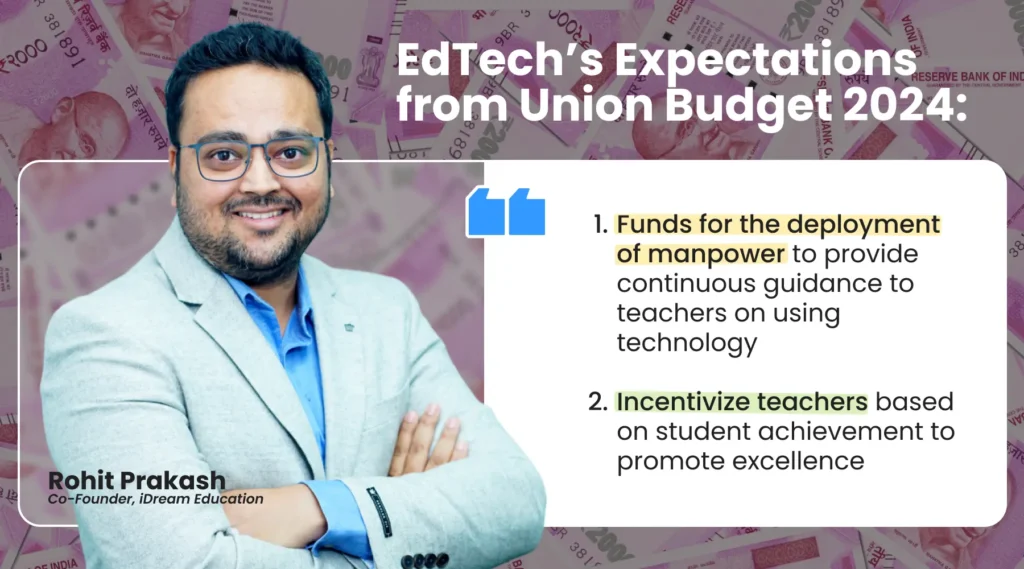
  • We hope the Union Budget 2024 allocates funds and resources for the deployment of manpower to provide continuous guidance to teachers and students on using technology effectively in schools, said Rohit Prakash, Co-Founder of iDream Education. He also emphasized the need for ongoing data support for teachers, enabling them to better understand students and offer personalized guidance, which will enhance the overall learning experience in classrooms.
  • Rohit Prakash further added that in the Union Budget 2024, we also hope for the inclusion of provisions to incentivize teachers based on the achievement of academic goals. Through this, we can motivate teachers by recognizing and rewarding their efforts in improving student outcomes. By linking incentives to academic achievements, we can foster a culture of excellence in teaching, encouraging teachers to go beyond teaching to improve learning outcomes. Such a measure is likely to boost morale within the teaching community and attract talented individuals to the profession, ultimately benefiting the entire education ecosystem.
Image featuring the co-founder of iDream Education highlighting EdTech's Expectations from Union Budget 2024

He then concluded by saying, “Eight years of comprehensive work in government schools have revealed a critical gap: a lack of accountability in implementing and utilizing educational solutions. State governments often prioritize hardware distribution without digital content and reporting, leaving teachers uncertain about the use of  technology for teaching.” To address this, we hope for a provision/system that incentivizes and adds manpower to ensure the effective use of education technology. By aligning these efforts, we can achieve National and State Education Outcomes.

Now, Let’s look at some of the key expectations of EdTech Players highlighted by Abhinav Ji, senior correspondent in The Week Magazine

  • The reduction of GST on upskilling and reskilling programs to make them more affordable for students. This change could significantly enhance access to these vital programs, equipping students with the skills necessary for the evolving job market.
  • Additionally, there is a growing call to bring skilling and reskilling programs under the purview of education loans. This move would attract more students to these programs by making them financially accessible, thus broadening their scope and impact.
  • The sector also looks forward to increased support for digital infrastructure in schools and more funding for innovative educational technologies. This support is crucial for modernizing the education system and ensuring that students have access to the best learning resources.
  • Moreover, there is a push for GST to be applicable to both print and digital solutions to create efficiencies in the educational ecosystem. This step is seen as essential for making education accessible, affordable, and effective for millions of students across the country.
  • Further, additional budget allocations for technology-driven learning and blended learning environments can help bring the vision of the National Education Policy (NEP) 2020 to life. By embracing these initiatives, the education sector can create a more dynamic, inclusive, and effective learning environment for all students.

EdTech companies are optimistic about the potential for a substantial boost to the education budget, exceeding the current 13% to create a sustained funding stream for vital educational programs, enabling the modernization of infrastructure and the seamless integration of technology in schools and universities. This increased investment could bolster the entire educational framework, providing students and teachers with the resources they need to thrive in the digital age.

The Indian EdTech sector is on the cusp of a transformative period, and the Union Budget 2024 could be a defining moment. 

The collective aspirations of industry leaders emphasize the need for comprehensive policies and investments to unleash the full potential of technology in enhancing education and achieving National and State Education Outcomes.

We hope these insights have shed light on the key expectations of the EdTech sector in the upcoming budget. 

If you found this blog insightful, please share it to spread the word. If you’re looking to enable comprehensive digital learning in schools, you can contact us at +919521133770 or learn more about our solutions here.

A Comprehensive Guide to MP Board Content on iPrep

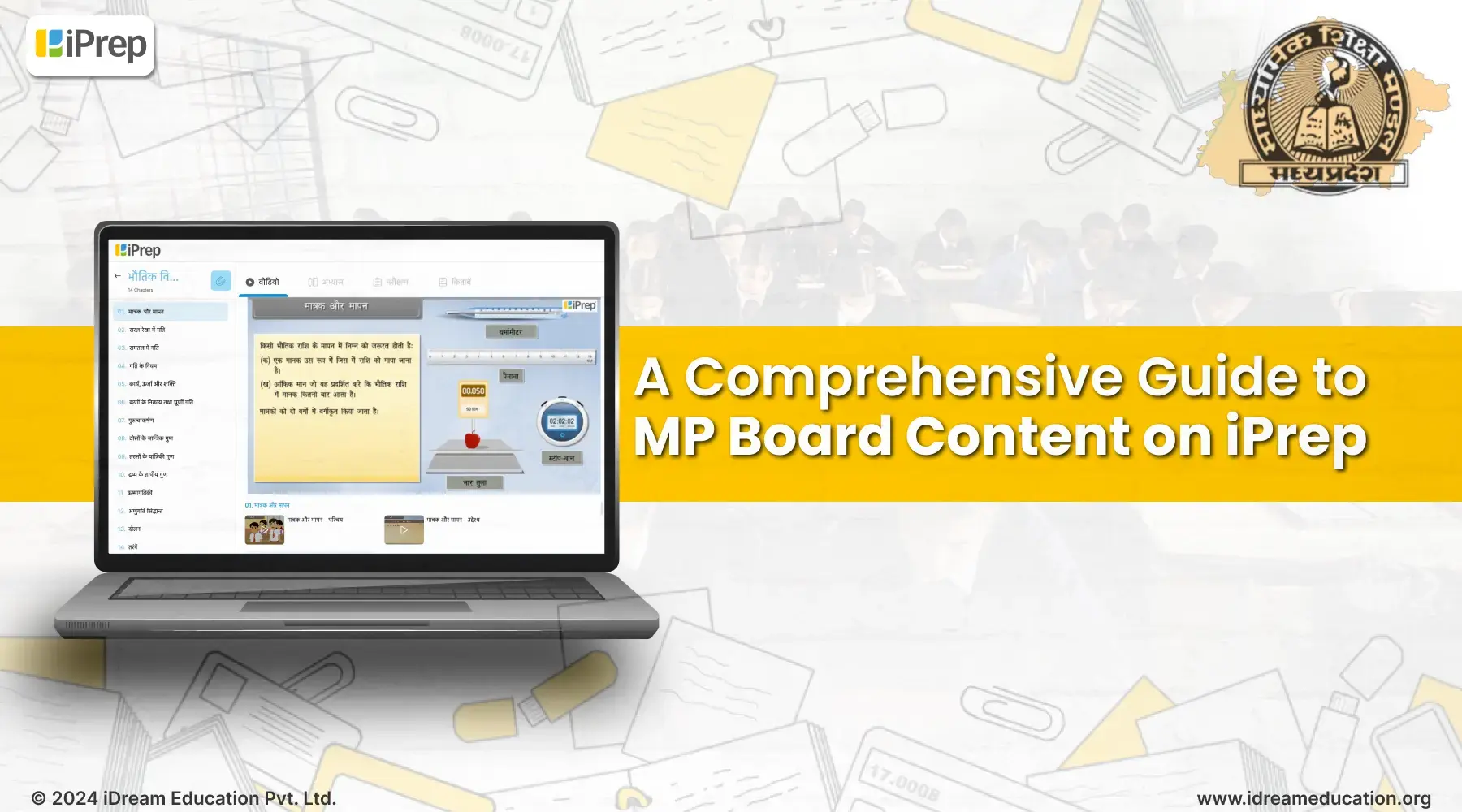
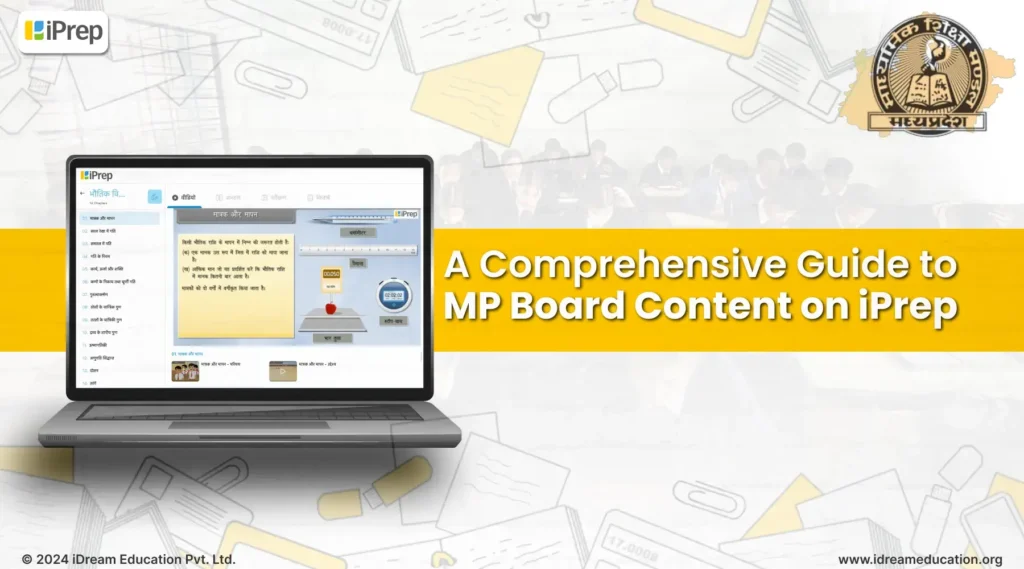
Welcome to our comprehensive guide to MP Board Content on iPrep! If you’re someone from the government, social sector,  or a teacher/student, you’re at the right place. Navigate to the range of educational resources in the MP Board Curriculum.

A laptop displaying the iPrep learning platform, featuring MP Board content

State board curriculums play a significant role in shaping well-rounded learners. By integrating regional history, culture, and contemporary issues, these curriculums foster a deep connection to one’s roots and community.  The Madhya Pradesh Board of Secondary Education (MPBSE) stands as an example of this approach. Not only does it equip students with the knowledge and skills needed for academic success, but it also instills a strong sense of local identity and pride. 

MP Board Curriculum: Nurturing Rooted Learners

Madhya Pradesh, with its predominantly Hindi-speaking population. While Hindi remains the heart of cultural and linguistic identity, there’s a notable emphasis on bilingual learning. This is the situation with both private and government schools, promoting fluency in both Hindi and English language. This further recognizes the importance of connecting students to their roots while equipping them with a language that opens doors to global opportunities.

Our observations from social sector digital education projects underscore this trend 

Government schools, often associated with Hindi as a medium of instruction, are increasingly adopting a dual-language approach. The focus on bilingualism in Madhya Pradesh exemplifies a commitment to an inclusive and comprehensive education that values both tradition and progress.

Recent Updates in MP Board Content

  • The Madhya Pradesh Board of Secondary Education (MPBSE) has implemented significant changes to its curriculum for the 2024 academic year.  In a move aimed at streamlining education and easing the burden on students, the board has reduced the Class 12 syllabus by 30%. This reduction applies across all subjects, including core subjects like English, Physics, Chemistry, History, and Economics.
  • Not just for Class 12, the board has also taken similar steps for Class 10, releasing an updated and reduced syllabus for 2024. This decision to reduce the syllabus for the second consecutive year demonstrates the board’s commitment to adapting to the evolving educational needs and ensure a balanced learning experience for students.

These updates are expected to significantly impact how students prepare for their board exams. With a more focused syllabus, students can dedicate more time to understanding core concepts and developing critical thinking skills. It will be interesting to see how this streamlined curriculum influences learning outcomes and overall academic performance in the coming year.

The uniqueness of MP Board Content: Blending the Best of Both Worlds

While, the MP Board content is rooted in the NCERT framework, especially for science subjects in higher grades. However, it distinguishes itself with unique content additions with a focus on regional perspectives, particularly for students in classes 6-8.

Image showcasing the uniqueness of MP Board content with the distinctive educational syllabus for SST, English, and Hindi literature specific to the Madhya Pradesh region

Strong Foundation in Core Science Subjects

The MP Board 12th syllabus 2024 provides a comprehensive foundation in core science subjects. Physics, chemistry, mathematics, biology, and computer science form the backbone of the curriculum. This ensures students are well-prepared for higher education and future careers. Additionally, the board offers a diverse range of language courses as electives, allowing students to expand their linguistic horizons while fulfilling the mandatory requirement of English proficiency.

Progressive Changes in English and Hindi Literature

A significant distinction between the NCERT and MP Board content lies in grades 6-8, particularly in the English and Hindi literature subjects. The MPBSE traditionally focused on a “General Series” for English and a “Special Series” for Hindi. However, in a progressive move, the Madhya Pradesh education department has merged both series for both languages. This means students now learn both General and Special series content in English, while in Hindi, they engage with “Bhasha Bharti” (भाषा भारती) and “Sugam Bharti” (सुगम भारती). Thus, enabling students to experience a comprehensive blend of literary styles and themes.

Unique Focus on Social Sciences

The Madhya Pradesh Board of Secondary Education (MPBSE) social science curriculum for classes 6th-8th is distinct, incorporating a local perspective. While the core content across History, Civics, and Geography largely mirrors the NCERT syllabus, the MPBSE modifies the naming of topics and chapters to align with regional relevance. Additionally, it introduces unique chapters and topics such as “Interdependence (पारस्परिक निर्भरता)” in Civics, “India’s relations with Asian countries (एशियाई देशों के साथ भारत के सम्बन्ध)” in History, and “African continent: economic profile (अफ्रीका महाद्वीप : आर्थिक स्वरूप)” in Geography, and lot more. This is an enriching part of MP Board content combining diverse perspectives for learners.

Considering this uniqueness, 

Our team is committed to crafting unique content to ensure a rich learning experience that caters to the specific needs of Madhya Pradesh students. By leveraging their subject matter expertise, we create MP Board content that is both informative and engaging. 

Guide to MP Board curriculum on iPrep

iPrep, a comprehensive e-learning platform, is designed to align with India’s National Education Policy (NEP) and cater to the diverse needs of both national and state curricula. Our content team prioritizes staying aligned with curriculum updates and curating top-tier resources to ensure an engaging and thorough learning experience for all students. Recognizing the importance of state-specific curriculum adjustments, we strive to empower students with meaningful learning opportunities that meet the highest state and national standards.

In line with this commitment, we have meticulously created and curated content for the MP Board (MPBSE), and are actively implementing progressive changes based on insights from educational initiatives led by the social sector and government partners. 

Explore the latest updates in K-12 content on iPrep as per MP Board

Bilingual Education through iPrep: 

To align with the Madhya Pradesh education department’s focus on bilingualism, we create and curate content on the iPrep platform that is accessible in both English and Hindi. This initiative aims to foster inclusive learning environments across classrooms in Madhya Pradesh by catering to students’ diverse linguistic needs and preferences. By providing MP Board Content in both languages, we strive to enhance students’ comprehension, engagement, and overall academic performance while promoting cultural appreciation and linguistic diversity among K-12 Learners.

Curriculum Alignment with NCERT for Class 6th to 10th on iPrep

Focusing on the MP Board content, iPrep delivers Maths and Science content for classes 6-10 that align with NCERT textbooks. This ensures students receive content that mirrors their textbooks, enhancing their learning experience with digital resources. iPrep maintains this alignment unless specific needs are requested by stakeholders.

iPrep Aligns Social Studies Content with Revised MP Board Curriculum for Classes 6-8

In response to the Madhya Pradesh Board’s recent content updates, iPrep’s subject matter experts have meticulously revised the Social Studies learning materials for classes 6-8. A significant focus of this revision was aligning chapter titles with the MP Board textbooks, which, while similar in content to NCERT, feature more descriptive and comprehensive names tailored to Madhya Pradesh students. For example, the NCERT chapter “Hunter Gatherers” becomes the more evocative “मानव में परिवर्तन” (Change in Humans) in the MP Board version. Numerous such changes have been made to better address the specific learning needs of students in Madhya Pradesh.

These revisions are continuously implemented and delivered on iPrep, ensuring alignment with the state board curriculum. Additionally, iPrep has updated several chapters that were completely changed or newly added to the MP Board Social Studies content for classes 6-8, ensuring that students and teachers alike are engaging with the most current and relevant material.

Building a Strong Foundation on iPrep with NCERT-Aligned Curriculum for MP Board

For classes 9-10, the Social Science, Hindi, and English Literature content on iPrep is aligned with the NCERT curriculum as mentioned in the MP Board curriculum. This ensures that students receive a comprehensive and standardized education that prepares them for their board examinations and fosters a deeper understanding of the subjects.

iPrep Enhances English Literature with General and Special Series for Classes 6th-8th

We have added the General and Special series for English Literature on iPrep for classes 6th through 8th in alignment with MP Board content. This comprehensive program seamlessly blends literature in both Hindi and English, providing students with a rich and diverse learning experience entirely in the English language. By bridging linguistic and literary traditions, iPrep empowers learners to develop strong language skills, cultural understanding, and critical thinking abilities.

iPrep Enhances Hindi Literature with General and Special Series for Classes 6th-8th

iPrep leaps forward in Hindi Literature as well for classes 6th to 8th by incorporating “Bhasha Bharti” (भाषा भारती) and “Sugam Bharti” (सुगम भारती). This unique blend of Hindi and English literature presented in the Hindi language creates a comprehensive platform where students can delve into literary works while enhancing their language skills. With this addition, iPrep aims to provide a holistic approach to Hindi education, fostering a deeper appreciation for literature and language among learners.

iPrep Empowers MP Board Content with downloadable classroom resources 

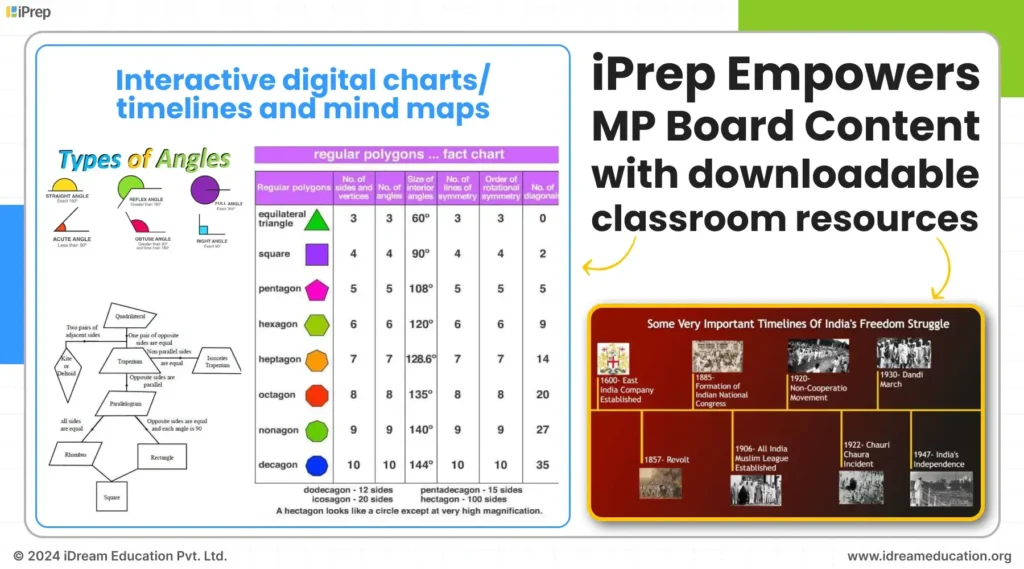
iPrep goes beyond textbooks, offering MP Board schools an enriching learning experience with supplementary content in the form of interactive digital charts/timelines and mind maps covering fundamental concepts like numbers, geometry, and shapes, enhancing classrooms into engaging learning spaces. Additionally, timelines added on iPrep offer a concise overview of historical events, enabling students to quickly grasp complex topics such as From Kingdom to an Empire, The Making of The National Movement 1870s – 1947s, The French Revolution, and more. This comprehensive approach empowers both teachers and students with accessible and versatile resources for effective learning and revision.

An image showing digital charts, timelines, and mind maps, all aligned with the MP Board curriculum, on the iPrep

Further, iPrep’s ensures personalized learning through its multi-category content approach 

Recognizing that students have diverse learning styles and needs, iPrep offers animated lessons for visual learners, practice exercises for hands-on reinforcement, syllabus books for quick reference, concise notes for efficient revision, and practicals for real-world application. This comprehensive suite of resources caters to a wide range of preferences, ensuring that every student can find the state board-aligned content that best suits their individual learning journey.

iPrep focuses on the Holistic Growth of students with its Beyond Academics Content

iPrep goes beyond MP Board curriculum to foster well-rounded students. In both Hindi and English, we offer a treasure trove of learning resources for holistic growth. This includes learning material on life skills, inspirational biographies, health, safety, hygiene, climate action, stories, moral values, and poems that nurture their character and imagination. iPrep is committed to developing not just scholars, but compassionate, informed, and responsible citizens of tomorrow.

The MP Board curriculum’s dynamic nature, with its revisions, updates, and unique features, underscores the importance of providing relevant and accessible digital content. 

At iPrep, we are committed to mirroring these revisions and updates in our platform, ensuring that teachers and students across Madhya Pradesh have access to up-to-date digital educational resources. We eagerly anticipate collaborating with social sector organizations dedicated to enhancing education in MP schools, and we are hopeful that together, we can make a meaningful impact by enabling state-specific learning content in schools.

If you are looking for MP Board Content, you can contact us at +91 9501110665 at or write to us at share@idreameducation.org

The Role of FLN Content in Hindi Medium on Child’s Learning Journey

Illustration of primary school teachers teaching foundational literacy and numeracy FLN content in Hindi to children

In India, Hindi serves as a common thread, weaving together diverse communities and households across the country. Therefore, children naturally develop a strong linguistic connection with the language from an early age. This is particularly true for those living in rural areas and attending government schools, where Hindi often dominates daily interactions. As these children transition from the playful environment of home to the formal setting of school, maintaining a sense of familiarity is crucial for their smooth adaptation. Introducing a foreign language suddenly can create unnecessary barriers to learning and hinder their progress. 

Therefore, it is imperative to strengthen the existing educational ecosystem.

This can be done by providing learning content in Hindi, particularly during the formative years of kindergarten. This approach ensures a seamless continuity of language and fosters a comfortable learning environment for children in their growing years. 

Let’s understand the Role of FLN Content in Hindi Medium in a Child’s Learning Journey through examples

Imagine a child’s eyes lighting up as they read a story about their favorite animal in Hindi, or excitedly explaining the steps of their school science experiment to their grandparents/parents in Hindi. This isn’t just language practice; it’s a foundation for a richer, more meaningful learning experience.

An infographic highlighting the role of FLN content in Hindi medium on a child's learning journey

1. The Cognitive Role of FLN Content in Hindi is to Build a Strong Mental Framework

Learning the basics in Hindi or their mother tongue helps children build a strong foundation for their brains. This is especially true when they learn concepts like colors (रंग) or shapes (आकार). This helps them learn other things more easily, even in different subjects or languages.

Why does it matter?

  • FLN content in Hindi helps children at primary schools and Anganwadi centers understand concepts within a familiar cultural context. This means they are not just memorizing information, but truly grasping the meaning and relevance of what they are learning.
  • Learning in their mother tongue significantly benefits children’s cognitive development. They develop better thinking skills, become better problem solvers, and can understand complex ideas more easily.
  • FLN content in Hindi is like building a mental map with clear, well-defined roads for learning.

2. The Social and Emotional Development Role of FLN Content in Hindi is to Facilitate a Sense of Belonging

Imagine a child proudly singing a Hindi song at a family gathering. They feel connected to their family, culture, and community. This makes them feel good about themselves and who they are.

Why does it matter?

  • Learning Hindi in early years helps children develop a strong sense of identity and self-esteem. It allows children to express their thoughts and feelings more authentically, leading to stronger relationships with family, friends, teachers, and even community.
  • When children are taught using FLN content in Hindi, they tend to develop a lifelong love for the language and learning.

3. The Academic Role of FLN Content in Hindi is to Springboard Learning

When a child learns math (गणित) or EVS (पर्यावरण अध्ययन) in Hindi, they understand the ideas more deeply. This makes it easier for them to learn those subjects in English or any other language.

Why does it matter?

  • FLN instruction acts as a bridge to learning other subjects. When children understand the fundamentals in a language they’re comfortable with, they’re better equipped to tackle complex topics across the curriculum.
  • Teaching in Hindi during the early years of learning is like a springboard that helps them jump higher in their studies.

4. The Beyond the Classroom Role of FLN Content in Hindi is it offers a Lifelong love for the language

Imagine, a child who listens to a story from their grandparents in Hindi language. He/she not only enjoys the story but also feels closer to their family and learns about their heritage.

Why does it matter?

  • The ability to communicate effectively in the Hindi language opens doors to diverse cultural experiences and opportunities. It’s a gift that enriches a child’s life for years to come.
  • It helps children stay connected with their roots, and culture, explore new traditions, and communicate with a wider range of people.

Thus, we believe integrating FLN content in Hindi medium into a child’s learning journey is not just about language acquisition. It’s about nurturing a love for learning, fostering a strong sense of identity, and building a solid foundation for academic and personal growth.

Looking for NCF and NCERT Aligned FLN Content in Hindi?

Considering the needs of students and teachers in primary schools and at Anganwadi centers, we have simplified FLN Content in both Hindi and English. All content is aligned with the 3 developmental goals of the National Curriculum Framework and is designed to make teaching engaging and learning playful. 

Explore iPrep’s FLN Content in Hindi for Nursery, LKG, and UKG:

For class Nursery

iPrep offers a comprehensive library of FLN content in Hindi medium, covering subjects such as Math (गणित), EVS (पर्यावरण अध्ययन), Hindi Grammar (हिंदी व्याकरण), social and emotional (सामाजिक और भावनात्मक), Health and physical (स्वास्थ्य और शारीरिक). Additionally, it provides audiobooks, puzzles, and activities related to Math (गणित), EVS (पर्यावरण अध्ययन), Hindi Grammar (हिंदी व्याकरण), all in Hindi. This extensive collection of Hindi resources ensures that teachers can effectively engage students in meaningful learning experiences, fostering a joyful learning environment for the students whose mother tongue is Hindi.

For Class LKG

In LKG, the subjects mirror those of a Nursery, yet the level of content is a little high, aligning with the competencies defined as per the 3 development goals of the National Curriculum Framework. This progression ensures a gradual and appropriate increase in complexity for young learners. Mirroring the approach in Nursery, all subjects and categories are presented in both Hindi and English, empowering students to engage with learning content in their preferred language, thus fostering a comfortable and inclusive learning environment.

For class UKG

In UKG, the subjects mirror those of a Nursery and LKG, yet the level of content is now a little more high, aligning with the competencies defined as per the 3 development goals of the National Curriculum Framework. Additionally, new audiobooks in the categories of Poetry (कविताएं) and Hindi Literature (हिन्दी साहित्य) have been added to the stage. This progression ensures a gradual and appropriate increase in complexity for young learners. Mirroring the approach in Nursery and LKG, all subjects and categories of UKG are also presented in both Hindi and English. This empowers children/teachers to learn/teach in their preferred language. 

Not just this, 

iPrep recognizes the importance of school readiness for a child’s successful transition to Grade 1. To bridge the gap in early years’ development, iPrep offers “Vidya Pravesh,” a comprehensive three-month play-based school preparation module designed in alignment with NCF and NCERT guidelines. Vidya Pravesh on iPrep delivers engaging subject-wise animated lessons, interactive classroom activities, and assessments. All this content is available in both Hindi and English, nurturing a love for learning through play-based methods. This approach ensures that children entering Grade 1 possess the foundational learning, skills, and knowledge necessary for a smooth and enjoyable educational journey.

Thus, the integration of FLN content in Hindi, as offered by platforms such as iPrep, presents a potential opportunity to improve early childhood education. 

By aligning with NCF guidelines and providing resources in both Hindi and English, your education initiative can empower teachers in primary schools and Anganwadi centers to create inclusive learning environments. This approach not only fosters playful language acquisition but also bridges the gap between home and school, ensuring a smoother transition for children. Embracing FLN content in Hindi is not just a pedagogical shift; it’s a significant step towards equitable and effective education.

If you are looking for FLN Content in Hindi, you can contact us at  +91 7678265039 or write to us at share@idreameducation.org. You can also share your details here.
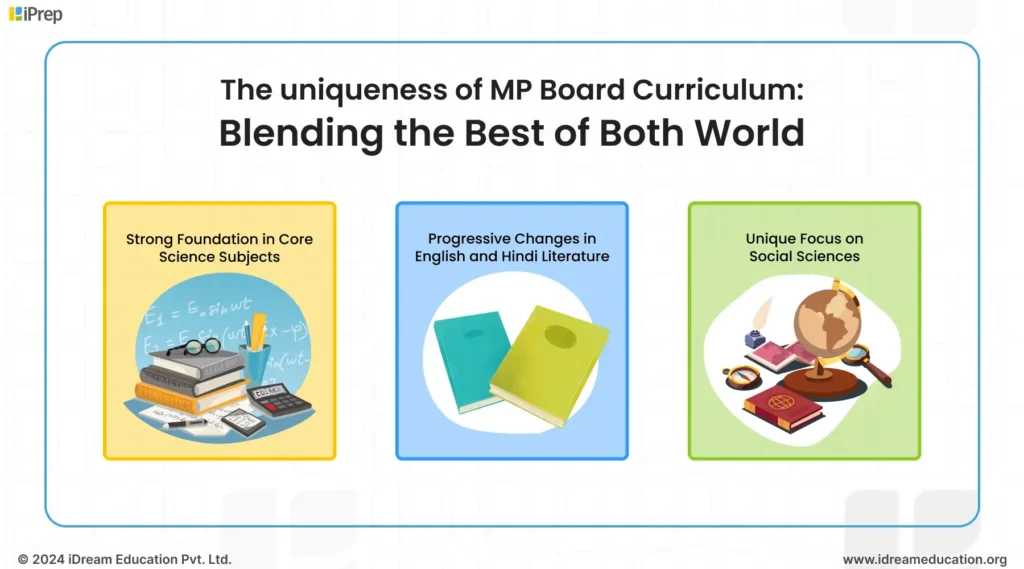
A Comprehensive Guide to Haryana Board Content on iPrep

Welcome to our comprehensive guide to Haryana Board Content on iPrep! If you’re someone from the social sector, government, or a student/teacher, you’re in the right place. Navigate to the vast landscape of educational resources in the Haryana Board Curriculum.

Illustration showing Haryana Board Content on iPrep by iDream Education

State boards play a crucial role in shaping a student’s academic journey. The Haryana Board of School Education (HBSE) is no exception! These curricula act as roadmaps, outlining the knowledge and skills students need to acquire at each stage of their education. They provide a structured framework for teachers, ensuring a consistent and standardized learning experience for all students within the state.

The Haryana board offers a comprehensive curriculum designed for various stages of education. Like other educational boards, it periodically revises this curriculum to ensure alignment with updates in educational policy and NCERT guidelines. This practice is essential for maintaining the relevance and effectiveness of the curriculum in a constantly evolving educational ecosystem. Moreover, these revisions also consider the evolving learning needs and demands of students. This ensures that the curriculum remains engaging and beneficial for all learners.

To delve deep, let us first know the objectives of the Haryana Curriculum and TextBook Department as highlighted in the State Council of Educational Research & Training

The objectives outline the department’s initiatives to create and provide comprehensive teaching and learning material. This substantially enhances the learning experiences of both students and teachers. 

  • Objective 1:  Develop high-quality, relevant textbooks and workbooks for core subjects. This includes Mathematics, Science, English, Hindi, Social Science in Grades 1-8 to provide a strong educational foundation.
  • Objective 2: To deliver high-quality educational resources for optional subjects, enriching the curriculum and empowering student choice.
  • Objective 3: Enhance the educational experience by developing State-Specific Supplementary Materials for NCERT Textbooks in classes 6th to 8th. This is to reflect the state’s distinct political, historical significance, and geographical features.
  • Objective 4: To develop and evaluate comprehensive remedial teaching (learning enhancement) materials and strategies. The motive is to effectively support students facing academic challenges and ensure no student is left behind.
  • Objective 5: Develop a comprehensive, month-by-month, competency-based curriculum plan for all subjects in grades 1-8, aligned with student learning outcomes.

Revision in Haryana Board of School Education in alignment with objective 3 highlighted in SCERT

The Haryana Board of School Education (HBSE) has always been committed to providing students with comprehensive and relevant education, aligning its content with the guidelines of the National Council of Educational Research and Training (NCERT). However, a significant revision recently took place in the HBSE social science curriculum for classes 6th to 8th, placing a greater emphasis on Haryana-specific content in History, Political Science, and Geography.

In History, Haryana Board Content envisions uncovering Haryana’s Rich Heritage

In the revised History curriculum, students will learn about unique historical narratives of Haryana. They explore the region’s ancient civilizations, its contributions to various empires, and its role in India’s freedom struggle. By learning about the achievements and struggles of their ancestors, students develop a stronger sense of identity and pride in their heritage.

In Political Science, Haryana Board Content envisions developing an Understanding of Haryana’s Governance

The Political Science HBSE curriculum now focuses on the political landscape of Haryana. Students gain insights into the state’s administrative structure, its political parties, and the electoral processes. They learn about the rights and responsibilities of citizens, the functioning of the state legislature, and the role of the judiciary. This knowledge equips them to become informed and active participants in the democratic process of the state.

In Geography, Haryana Board Content envisions uncovering Haryana’s Diverse Landscapes

The Geography HBSE curriculum takes students on a journey through Haryana’s diverse geographical features. They study the state’s climate, topography, rivers, and natural resources. They also learn about the different regions of Haryana, their agricultural practices, and their economic activities. This understanding of their environment fosters a sense of responsibility toward its conservation and sustainable development.

Let us now understand why this revision is done 

The state-specific revisions in state boards such as the Haryana board content are done to impart the importance of local knowledge. The inclusion of Haryana-specific content in the social science curriculum is of importance for several reasons:

  • Relevance: Students find the subject matter more engaging and relevant when it connects to their immediate surroundings and experiences.
  • Identity: Learning about their local history, politics, and geography. This helps students develop a strong sense of identity and belonging to their state.
  • Empowerment: Understanding the state-specific context equips students with the knowledge and skills they need to address the challenges and opportunities facing their community.
  • Active Citizenship: By learning about the political and social structures of their state, students are more likely to become active and responsible citizens.

Therefore, the Haryana board content in the social science curriculum is a step in the right direction. It empowers students with local knowledge and fosters a deeper connection to their state. By learning about the history, politics, and geography of Haryana, students are better prepared to contribute to its progress and development.

The Uniqueness of Haryana Board Curriculum

From our extensive work within the Haryana education ecosystem, through our social sector partners and government,  we at iDream Education have developed a deep appreciation for the distinctive aspects of the Haryana Board content.  Several key features stand out:

  • Early Years Focus: In grades 1 and 2, the curriculum builds a strong foundation with 10 core chapters. What’s unique is the inclusion of supplementary content that goes beyond rote learning. Activities like comparison, differentiation, and problem-solving are woven in, fostering critical thinking skills from a young age. This innovative approach prepares children for deeper engagement with their studies as they progress.
  • Seamless Alignment with National Standards: For higher secondary students (grades 9-12), the Haryana Board curriculum is closely aligned with NCERT guidelines. This ensures that Haryana students are well-prepared for national-level competencies. This alignment opens doors for higher education and diverse career opportunities.
  • Bilingual Learning Environment:  The curriculum is available in both Hindi and English, accommodating the linguistic diversity of the state and fostering inclusive learning. This dual-language approach empowers students to become proficient in both their mother tongue and a widely used global language.

This unique blend of foundational learning,  alignment with the National Board, and bilingual education sets the Haryana Board content apart. 

Guide to Haryana Curriculum on iPrep

Content on iPrep is created and curated with a deep understanding of the significance of state board and state-specific curricula. Recognizing the distinct educational goals set forth by each state’s education department, iPrep aims to enhance and empower local education ecosystems. By aligning with these specific curricula, we ensure that students receive targeted, relevant content that directly addresses their unique educational needs and prepares them for success within their respective state’s academic framework.

In light of this, our subject matter experts meticulously monitor and revise the Haryana Board content on iPrep, ensuring students in Haryana have access to materials that precisely mirror their textbooks. All content categories on iPrep aligns with the Haryana Board of School Education (HBSE) curriculum. 

Newly Added Haryana Board-Aligned Content on iPrep: Deeper Learning, Broader Horizons

Staying true to our commitment to providing the most relevant learning experience, we focus on ongoing updates to iPrep’s content library. In line with the recent curriculum revisions, we’ve added a wealth of new material specifically aligned with the Haryana Board content. This means students get access to the same concepts and topics they see in their textbooks, ensuring they’re learning exactly what they need to succeed.

What’s New:

  • Social Science: The Department revitalized the social science curriculum for grades 6th through 9th by adding captivating new chapters that delve into the rich tapestry of Haryana and India’s past.
  • The students will now learn about the enigmatic Saraswati Indus Civilization, the wisdom of the Vedic period, the epic tales of the Ramayana and Mahabharata, and the vibrant reign of Emperor Harshvardhan, southern Kingdoms of Chalukya, Pallava, and Chola, the rise of the Mughal Empire and the resilience of the Sikh Guru tradition and lot more. These additions promise to foster a passion for history and culture and inculcate a deeper understanding of Haryana and India’s diverse heritage.
  • For Class 1st and 2nd: To enrich the early years learning experience, we’ve integrated supplementary content that complements each chapter, while also granting students access to an extensive content library. Moreover, we have added expanded its resource pool to foster critical thinking, problem-solving skills, and diverse learning pathways. By delving into a wider range of materials, young learners can broaden their knowledge base, explore various perspectives, and develop a deeper understanding of the world around them.
  • Bilingual Platform: Recognizing the importance of both mother tongue and global language proficiency, iPrep’s content in Haryana is predominantly available in both Hindi and English.

About iPrep’s State Board-Aligned Content

iPrep goes far beyond syllabus books in the form of PDFs. Our content is delivered in a variety of engaging formats:

  • Animated Video Lessons: Bring concepts to life and make learning fun
  • Notes: Concise summaries for quick revision
  • Chapter-Aligned Practice: Questions that reinforce understanding of specific topics.
  • Practicals: Hands-on activities for experiential learning

And More: We’re always adding new ways to make learning interactive and effective. This multi-format approach simplifies the comprehension of the state-specific curriculum, making learning more engaging and enjoyable for all students. We’re excited to see how these updates empower Haryana’s students on their educational journey!

Further, 

iPrep goes beyond academic learning by embracing the holistic development of students, aligning with the National Education Policy 2020. Recognizing that education extends beyond textbooks, iPrep offers a wealth of content fostering life skills, inspirational biographies, stories, poems, activity-based videos, and climate action initiatives.  This diverse range of resources empowers students with an awareness of health, safety, hygiene, a sense of belonging, citizenship, the people around them, and the environment. By nurturing well-rounded individuals, iPrep prepares students for a fulfilling life beyond the classroom.

To Conclude

As we walk through the evolving landscape of education, it’s crucial to uphold the value of state board content such as Haryana board content and their revisions. These updates prepare students for modern times while also fostering an awareness of Haryana’s rich civilization.

If you are looking for Haryana Board Content, you can contact us +91 9501110665 at or write to us at share@idreameducation.org